REPORT ON SUMMER TRAINING AT
DLW, VARANASI
By: RAKESH KUMAR
ME 7th semester
Dr. K N MODI UNIVERCITY
,NEWAI,RAJ.
To : Pradeep Sir
Ass. Proff. Of ME
(DKNMU)
CONTENTS:-
 Introduction
 Production Unit
 DLW, Varanasi
 Types of product
 Diesel Traction Assembly
 Specification Of WDM& Performance
 Specification of WDG & Performance
 Welding Shop
 Machine Shop
 Heat Treatment Shop
 Engine Erection Shop
 Sub Assembely Shop
 Conclusion
INDIAN RAILWAYS: AT A GLANCE
 Indian Railways (Hindi: भारतीय रेल Bhāratīya Rail),
abbreviated as IR (Hindi: भा.रे.), is a departmental
undertaking of Government of India, which owns and
operates most of India's rail transport. It is overseen by
the Ministry of Railways of the Government of India.
 Indian Railways has 113,617 kilometres (70,598 mi). of
total track over a route of 63,974 kilometres (39,752
mi) and 7,083 stations. It has the world's fourth largest
railway network after those of the USA ,
Russia and China. The railways traverse the length and
breadth of the country and carry over 30 million
passengers and 2.8 million tons of freight daily . It is the
world's second largest commercial or utility employer,
with more than 1.36 million employees As for rolling
stock, IR owns over 219,931 (freight) wagons, 51,030
coaches and 8,889 locomotives.
PRODUCTION UNITS
 Indian Railways manufactures much of its rolling
stock and heavy engineering components at its six
manufacturing plants, called Production Units, which are
managed directly by the Ministry. Popular rolling stock
builders such as CLW and DLW for electric and diesel
locomotives; ICF and RCF for passenger coaches are
Production Units of Indian Railways. Over the years,
Indian Railways has not only achieved self-sufficiency in
production of rolling stock in the country but also
exported rolling stock to other countries. Each of these
six production units is headed by a General Manager,
who also reports directly to the Railway Board. The six
Production Units are:-
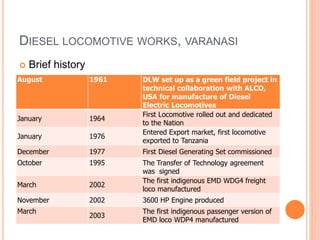
DIESEL LOCOMOTIVE WORKS, VARANASI
 Brief history
August 1961 DLW set up as a green field project in
technical collaboration with ALCO,
USA for manufacture of Diesel
Electric Locomotives
January 1964
First Locomotive rolled out and dedicated
to the Nation
January 1976
Entered Export market, first locomotive
exported to Tanzania
December 1977 First Diesel Generating Set commissioned
October 1995 The Transfer of Technology agreement
was signed
March 2002
The first indigenous EMD WDG4 freight
loco manufactured
November 2002 3600 HP Engine produced
March
2003
The first indigenous passenger version of
EMD loco WDP4 manufactured
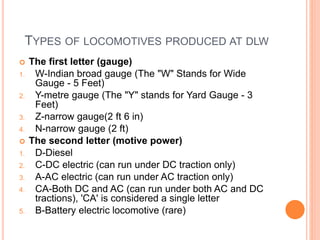
TYPES OF LOCOMOTIVES PRODUCED AT DLW
 The first letter (gauge)
1. W-Indian broad gauge (The "W" Stands for Wide
Gauge - 5 Feet)
2. Y-metre gauge (The "Y" stands for Yard Gauge - 3
Feet)
3. Z-narrow gauge(2 ft 6 in)
4. N-narrow gauge (2 ft)
 The second letter (motive power)
1. D-Diesel
2. C-DC electric (can run under DC traction only)
3. A-AC electric (can run under AC traction only)
4. CA-Both DC and AC (can run under both AC and DC
tractions), 'CA' is considered a single letter
5. B-Battery electric locomotive (rare)
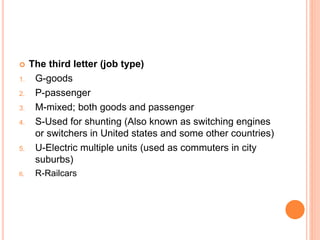
 The third letter (job type)
1. G-goods
2. P-passenger
3. M-mixed; both goods and passenger
4. S-Used for shunting (Also known as switching engines
or switchers in United states and some other countries)
5. U-Electric multiple units (used as commuters in city
suburbs)
6. R-Railcars
 For example, in "WDM 3A":
1. "W" means broad gauge
2. "D" means diesel motive power
3. "M" means suitable for mixed(for both goods
and passenger)service
4. "3A" means the locomotive's power is 3,100 hp ('3'
stands for 3000 hp, 'A' denotes 100 hp more)
 Or, in "WAP 5":
1. "W" means broad gauge
2. "A" mean AC electric traction motive power
3. "P" means suitable for Passenger service
4. "5" denotes that this locomotive is chronologically the
fifth electric locomotive model used by the railways for
passenger service
DIESEL TRACTION
ASSEMBLY AT DLW
 Following types of diesel loco are being produced in
the DLW:
1. WDM - Wide Diesel Mixed
2. WDP - Wide Diesel Passenger
3. WDG - Wide Diesel Goods
4. WDS - Wide Diesel Shunter
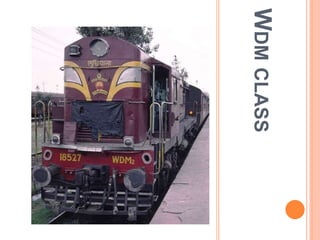
WDMCLASS
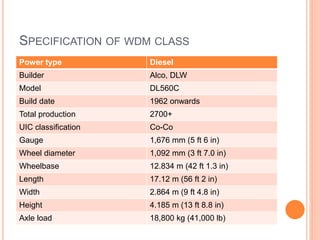
SPECIFICATION OF WDM CLASS
Power type Diesel
Builder Alco, DLW
Model DL560C
Build date 1962 onwards
Total production 2700+
UIC classification Co-Co
Gauge 1,676 mm (5 ft 6 in)
Wheel diameter 1,092 mm (3 ft 7.0 in)
Wheelbase 12.834 m (42 ft 1.3 in)
Length 17.12 m (56 ft 2 in)
Width 2.864 m (9 ft 4.8 in)
Height 4.185 m (13 ft 8.8 in)
Axle load 18,800 kg (41,000 lb)
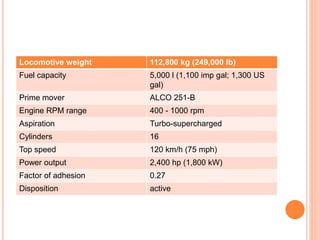
Locomotive weight 112,800 kg (249,000 lb)
Fuel capacity 5,000 l (1,100 imp gal; 1,300 US
gal)
Prime mover ALCO 251-B
Engine RPM range 400 - 1000 rpm
Aspiration Turbo-supercharged
Cylinders 16
Top speed 120 km/h (75 mph)
Power output 2,400 hp (1,800 kW)
Factor of adhesion 0.27
Disposition active
PERFORMANCE
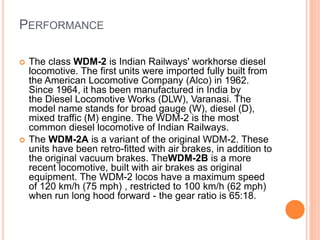
 The class WDM-2 is Indian Railways' workhorse diesel
locomotive. The first units were imported fully built from
the American Locomotive Company (Alco) in 1962.
Since 1964, it has been manufactured in India by
the Diesel Locomotive Works (DLW), Varanasi. The
model name stands for broad gauge (W), diesel (D),
mixed traffic (M) engine. The WDM-2 is the most
common diesel locomotive of Indian Railways.
 The WDM-2A is a variant of the original WDM-2. These
units have been retro-fitted with air brakes, in addition to
the original vacuum brakes. TheWDM-2B is a more
recent locomotive, built with air brakes as original
equipment. The WDM-2 locos have a maximum speed
of 120 km/h (75 mph) , restricted to 100 km/h (62 mph)
when run long hood forward - the gear ratio is 65:18.
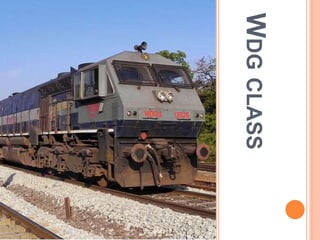
WDGCLASS
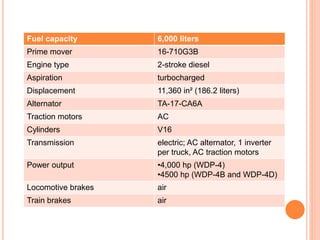
SPECIFICATION OF WDG CLASS
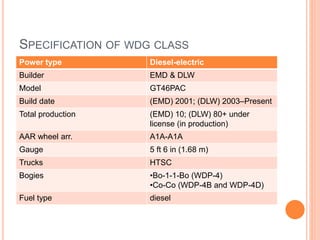
Power type Diesel-electric
Builder EMD & DLW
Model GT46PAC
Build date (EMD) 2001; (DLW) 2003–Present
Total production (EMD) 10; (DLW) 80+ under
license (in production)
AAR wheel arr. A1A-A1A
Gauge 5 ft 6 in (1.68 m)
Trucks HTSC
Bogies •Bo-1-1-Bo (WDP-4)
•Co-Co (WDP-4B and WDP-4D)
Fuel type diesel
Fuel capacity 6,000 liters
Prime mover 16-710G3B
Engine type 2-stroke diesel
Aspiration turbocharged
Displacement 11,360 in² (186.2 liters)
Alternator TA-17-CA6A
Traction motors AC
Cylinders V16
Transmission electric; AC alternator, 1 inverter
per truck, AC traction motors
Power output •4,000 hp (WDP-4)
•4500 hp (WDP-4B and WDP-4D)
Locomotive brakes air
Train brakes air
PERFORMANCE
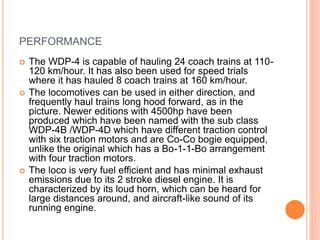
 The WDP-4 is capable of hauling 24 coach trains at 110-
120 km/hour. It has also been used for speed trials
where it has hauled 8 coach trains at 160 km/hour.
 The locomotives can be used in either direction, and
frequently haul trains long hood forward, as in the
picture. Newer editions with 4500hp have been
produced which have been named with the sub class
WDP-4B /WDP-4D which have different traction control
with six traction motors and are Co-Co bogie equipped,
unlike the original which has a Bo-1-1-Bo arrangement
with four traction motors.
 The loco is very fuel efficient and has minimal exhaust
emissions due to its 2 stroke diesel engine. It is
characterized by its loud horn, which can be heard for
large distances around, and aircraft-like sound of its
running engine.
TRAINING PERIOD
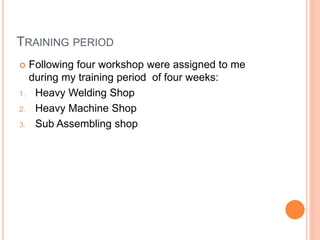
 Following four workshop were assigned to me
during my training period of four weeks:
1. Heavy Welding Shop
2. Heavy Machine Shop
3. Sub Assembling shop
HEAVY WELDING SHOP
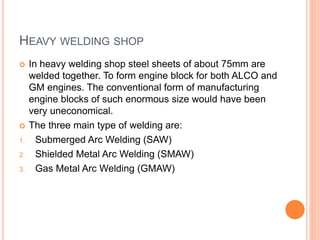
 In heavy welding shop steel sheets of about 75mm are
welded together. To form engine block for both ALCO and
GM engines. The conventional form of manufacturing
engine blocks of such enormous size would have been
very uneconomical.
 The three main type of welding are:
1. Submerged Arc Welding (SAW)
2. Shielded Metal Arc Welding (SMAW)
3. Gas Metal Arc Welding (GMAW)
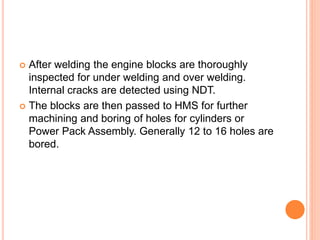
 After welding the engine blocks are thoroughly
inspected for under welding and over welding.
Internal cracks are detected using NDT.
 The blocks are then passed to HMS for further
machining and boring of holes for cylinders or
Power Pack Assembly. Generally 12 to 16 holes are
bored.
HEAVY MACHINE SHOP
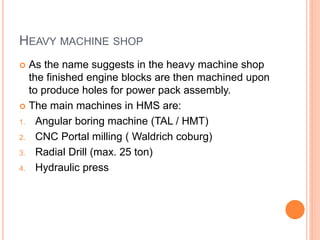
 As the name suggests in the heavy machine shop
the finished engine blocks are then machined upon
to produce holes for power pack assembly.
 The main machines in HMS are:
1. Angular boring machine (TAL / HMT)
2. CNC Portal milling ( Waldrich coburg)
3. Radial Drill (max. 25 ton)
4. Hydraulic press
HEAT TREATMENT SHOP
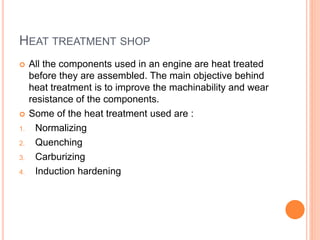
 All the components used in an engine are heat treated
before they are assembled. The main objective behind
heat treatment is to improve the machinability and wear
resistance of the components.
 Some of the heat treatment used are :
1. Normalizing
2. Quenching
3. Carburizing
4. Induction hardening
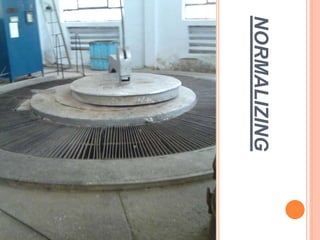
NORMALIZING
NORMALIZING
 In this heat treatment process the material is kept at
a temperature 40° to 50℃ above critical
temperature. This done due to following reasons:
1. To remove coarse grain structure
2. To remove internal stresses
3. To improve mechanical properties
QUENCHING
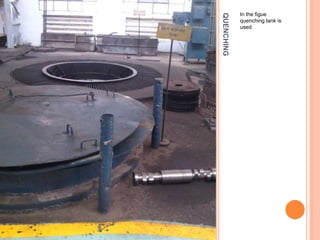
In the figue
quenching tank is
used.
QUENCHING
 In quenching the material is heated to a
temperature of about 815° to 900°C and then it is
rapidly cooled by a mixture of water and
polystyrene glycol.
 The main advantage of quenching is to improve
machinability, hardness and development of
martensite structure. Generally all the components
used in the locomotive are quenched before any
other heat treatment process.
CARBURIZING
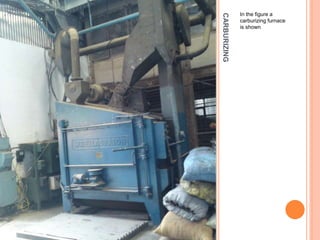
In the figure a
carburizing furnace
is shown
CARBURIZING OR CASE HARDENING
 In this process a hard surface is produced on a low
carbon steel of 0.15 percent carbon. In course of
process the outer layer is converted into a high
carbon steel with a carbon content ranging from 0.9
to 1.2 per cent of a carbon.
 The components in the carburizing process are
kept in contact with carbonaceous compounds and
energizer (BaCO3). Then they are kept together in
a furnace for a given period of time.
 The hardness depends upon the penetration of
carbon, temperature and time up to which its is
kept in furnace. An hour of heating produces 4000
to 5000 hardness.
 The main components which are carburized in the
HTS are main piston pin, rocker arm assembly,
crab bolts etc.
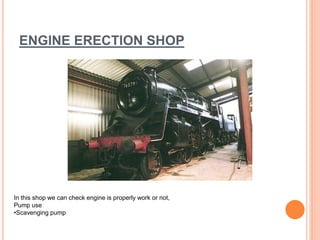
ENGINE ERECTION SHOP
In this shop we can check engine is properly work or not,
Pump use
•Scavenging pump
SUB ASSEMBLY SHOP
 This shop deals with following section:--
 Turbo machining section
 Cylinder head & shot blast section
 Fuel pump, Support, Cam shaft ate section
 Cylinder head
 Turbo
 Governor, Water Pump, Fan drive, Lube oil
Pump, After cooler assembly section.
INDUCTION HARDENING
 Induction hardening process is the heat treatment
process in which components of high carbon percentage
are hardened using high frequency ac current. Generally
a p.d. of 200kv to 130kv is used.
 In induction hardening process there is no change in
chemical composition. The work piece is kept at a
distance of 3-4 mm from the coils. The current produces
a magnetic flux which produces eddy current resulting in
heating.
 I.H. is generally done on crankshafts who have a high
percentage of carbon say about .45 to .48 percent.
CONCLUSION
During the Tenure I have Studied the Followings:-
Types of product
Diesel Traction Assembly
Specification Of WDM& Performance
Specification of WDG & Performance
Welding Shop
Machine Shop
Heat Treatment Shop
Engine Erection Shop
Sub Assembely Shop
THANK YOU!!!

introuduction DLW varanaesi

  • 1.
    REPORT ON SUMMERTRAINING AT DLW, VARANASI By: RAKESH KUMAR ME 7th semester Dr. K N MODI UNIVERCITY ,NEWAI,RAJ. To : Pradeep Sir Ass. Proff. Of ME (DKNMU)
  • 2.
    CONTENTS:-  Introduction  ProductionUnit  DLW, Varanasi  Types of product  Diesel Traction Assembly  Specification Of WDM& Performance  Specification of WDG & Performance  Welding Shop  Machine Shop  Heat Treatment Shop  Engine Erection Shop  Sub Assembely Shop  Conclusion
  • 3.
    INDIAN RAILWAYS: ATA GLANCE  Indian Railways (Hindi: भारतीय रेल Bhāratīya Rail), abbreviated as IR (Hindi: भा.रे.), is a departmental undertaking of Government of India, which owns and operates most of India's rail transport. It is overseen by the Ministry of Railways of the Government of India.
  • 4.
     Indian Railwayshas 113,617 kilometres (70,598 mi). of total track over a route of 63,974 kilometres (39,752 mi) and 7,083 stations. It has the world's fourth largest railway network after those of the USA , Russia and China. The railways traverse the length and breadth of the country and carry over 30 million passengers and 2.8 million tons of freight daily . It is the world's second largest commercial or utility employer, with more than 1.36 million employees As for rolling stock, IR owns over 219,931 (freight) wagons, 51,030 coaches and 8,889 locomotives.
  • 5.
    PRODUCTION UNITS  IndianRailways manufactures much of its rolling stock and heavy engineering components at its six manufacturing plants, called Production Units, which are managed directly by the Ministry. Popular rolling stock builders such as CLW and DLW for electric and diesel locomotives; ICF and RCF for passenger coaches are Production Units of Indian Railways. Over the years, Indian Railways has not only achieved self-sufficiency in production of rolling stock in the country but also exported rolling stock to other countries. Each of these six production units is headed by a General Manager, who also reports directly to the Railway Board. The six Production Units are:-
  • 6.
    DIESEL LOCOMOTIVE WORKS,VARANASI  Brief history August 1961 DLW set up as a green field project in technical collaboration with ALCO, USA for manufacture of Diesel Electric Locomotives January 1964 First Locomotive rolled out and dedicated to the Nation January 1976 Entered Export market, first locomotive exported to Tanzania December 1977 First Diesel Generating Set commissioned October 1995 The Transfer of Technology agreement was signed March 2002 The first indigenous EMD WDG4 freight loco manufactured November 2002 3600 HP Engine produced March 2003 The first indigenous passenger version of EMD loco WDP4 manufactured
  • 7.
    TYPES OF LOCOMOTIVESPRODUCED AT DLW  The first letter (gauge) 1. W-Indian broad gauge (The "W" Stands for Wide Gauge - 5 Feet) 2. Y-metre gauge (The "Y" stands for Yard Gauge - 3 Feet) 3. Z-narrow gauge(2 ft 6 in) 4. N-narrow gauge (2 ft)  The second letter (motive power) 1. D-Diesel 2. C-DC electric (can run under DC traction only) 3. A-AC electric (can run under AC traction only) 4. CA-Both DC and AC (can run under both AC and DC tractions), 'CA' is considered a single letter 5. B-Battery electric locomotive (rare)
  • 8.
     The thirdletter (job type) 1. G-goods 2. P-passenger 3. M-mixed; both goods and passenger 4. S-Used for shunting (Also known as switching engines or switchers in United states and some other countries) 5. U-Electric multiple units (used as commuters in city suburbs) 6. R-Railcars
  • 9.
     For example,in "WDM 3A": 1. "W" means broad gauge 2. "D" means diesel motive power 3. "M" means suitable for mixed(for both goods and passenger)service 4. "3A" means the locomotive's power is 3,100 hp ('3' stands for 3000 hp, 'A' denotes 100 hp more)  Or, in "WAP 5": 1. "W" means broad gauge 2. "A" mean AC electric traction motive power 3. "P" means suitable for Passenger service 4. "5" denotes that this locomotive is chronologically the fifth electric locomotive model used by the railways for passenger service
  • 10.
    DIESEL TRACTION ASSEMBLY ATDLW  Following types of diesel loco are being produced in the DLW: 1. WDM - Wide Diesel Mixed 2. WDP - Wide Diesel Passenger 3. WDG - Wide Diesel Goods 4. WDS - Wide Diesel Shunter
  • 11.
  • 12.
    SPECIFICATION OF WDMCLASS Power type Diesel Builder Alco, DLW Model DL560C Build date 1962 onwards Total production 2700+ UIC classification Co-Co Gauge 1,676 mm (5 ft 6 in) Wheel diameter 1,092 mm (3 ft 7.0 in) Wheelbase 12.834 m (42 ft 1.3 in) Length 17.12 m (56 ft 2 in) Width 2.864 m (9 ft 4.8 in) Height 4.185 m (13 ft 8.8 in) Axle load 18,800 kg (41,000 lb)
  • 13.
    Locomotive weight 112,800kg (249,000 lb) Fuel capacity 5,000 l (1,100 imp gal; 1,300 US gal) Prime mover ALCO 251-B Engine RPM range 400 - 1000 rpm Aspiration Turbo-supercharged Cylinders 16 Top speed 120 km/h (75 mph) Power output 2,400 hp (1,800 kW) Factor of adhesion 0.27 Disposition active
  • 14.
    PERFORMANCE  The classWDM-2 is Indian Railways' workhorse diesel locomotive. The first units were imported fully built from the American Locomotive Company (Alco) in 1962. Since 1964, it has been manufactured in India by the Diesel Locomotive Works (DLW), Varanasi. The model name stands for broad gauge (W), diesel (D), mixed traffic (M) engine. The WDM-2 is the most common diesel locomotive of Indian Railways.  The WDM-2A is a variant of the original WDM-2. These units have been retro-fitted with air brakes, in addition to the original vacuum brakes. TheWDM-2B is a more recent locomotive, built with air brakes as original equipment. The WDM-2 locos have a maximum speed of 120 km/h (75 mph) , restricted to 100 km/h (62 mph) when run long hood forward - the gear ratio is 65:18.
  • 15.
  • 16.
    SPECIFICATION OF WDGCLASS Power type Diesel-electric Builder EMD & DLW Model GT46PAC Build date (EMD) 2001; (DLW) 2003–Present Total production (EMD) 10; (DLW) 80+ under license (in production) AAR wheel arr. A1A-A1A Gauge 5 ft 6 in (1.68 m) Trucks HTSC Bogies •Bo-1-1-Bo (WDP-4) •Co-Co (WDP-4B and WDP-4D) Fuel type diesel
  • 17.
    Fuel capacity 6,000liters Prime mover 16-710G3B Engine type 2-stroke diesel Aspiration turbocharged Displacement 11,360 in² (186.2 liters) Alternator TA-17-CA6A Traction motors AC Cylinders V16 Transmission electric; AC alternator, 1 inverter per truck, AC traction motors Power output •4,000 hp (WDP-4) •4500 hp (WDP-4B and WDP-4D) Locomotive brakes air Train brakes air
  • 18.
    PERFORMANCE  The WDP-4is capable of hauling 24 coach trains at 110- 120 km/hour. It has also been used for speed trials where it has hauled 8 coach trains at 160 km/hour.  The locomotives can be used in either direction, and frequently haul trains long hood forward, as in the picture. Newer editions with 4500hp have been produced which have been named with the sub class WDP-4B /WDP-4D which have different traction control with six traction motors and are Co-Co bogie equipped, unlike the original which has a Bo-1-1-Bo arrangement with four traction motors.  The loco is very fuel efficient and has minimal exhaust emissions due to its 2 stroke diesel engine. It is characterized by its loud horn, which can be heard for large distances around, and aircraft-like sound of its running engine.
  • 19.
    TRAINING PERIOD  Followingfour workshop were assigned to me during my training period of four weeks: 1. Heavy Welding Shop 2. Heavy Machine Shop 3. Sub Assembling shop
  • 20.
    HEAVY WELDING SHOP In heavy welding shop steel sheets of about 75mm are welded together. To form engine block for both ALCO and GM engines. The conventional form of manufacturing engine blocks of such enormous size would have been very uneconomical.  The three main type of welding are: 1. Submerged Arc Welding (SAW) 2. Shielded Metal Arc Welding (SMAW) 3. Gas Metal Arc Welding (GMAW)
  • 21.
     After weldingthe engine blocks are thoroughly inspected for under welding and over welding. Internal cracks are detected using NDT.  The blocks are then passed to HMS for further machining and boring of holes for cylinders or Power Pack Assembly. Generally 12 to 16 holes are bored.
  • 22.
    HEAVY MACHINE SHOP As the name suggests in the heavy machine shop the finished engine blocks are then machined upon to produce holes for power pack assembly.  The main machines in HMS are: 1. Angular boring machine (TAL / HMT) 2. CNC Portal milling ( Waldrich coburg) 3. Radial Drill (max. 25 ton) 4. Hydraulic press
  • 23.
    HEAT TREATMENT SHOP All the components used in an engine are heat treated before they are assembled. The main objective behind heat treatment is to improve the machinability and wear resistance of the components.  Some of the heat treatment used are : 1. Normalizing 2. Quenching 3. Carburizing 4. Induction hardening
  • 24.
  • 25.
    NORMALIZING  In thisheat treatment process the material is kept at a temperature 40° to 50℃ above critical temperature. This done due to following reasons: 1. To remove coarse grain structure 2. To remove internal stresses 3. To improve mechanical properties
  • 26.
  • 27.
    QUENCHING  In quenchingthe material is heated to a temperature of about 815° to 900°C and then it is rapidly cooled by a mixture of water and polystyrene glycol.  The main advantage of quenching is to improve machinability, hardness and development of martensite structure. Generally all the components used in the locomotive are quenched before any other heat treatment process.
  • 28.
    CARBURIZING In the figurea carburizing furnace is shown
  • 29.
    CARBURIZING OR CASEHARDENING  In this process a hard surface is produced on a low carbon steel of 0.15 percent carbon. In course of process the outer layer is converted into a high carbon steel with a carbon content ranging from 0.9 to 1.2 per cent of a carbon.  The components in the carburizing process are kept in contact with carbonaceous compounds and energizer (BaCO3). Then they are kept together in a furnace for a given period of time.
  • 30.
     The hardnessdepends upon the penetration of carbon, temperature and time up to which its is kept in furnace. An hour of heating produces 4000 to 5000 hardness.  The main components which are carburized in the HTS are main piston pin, rocker arm assembly, crab bolts etc.
  • 31.
    ENGINE ERECTION SHOP Inthis shop we can check engine is properly work or not, Pump use •Scavenging pump
  • 32.
    SUB ASSEMBLY SHOP This shop deals with following section:--  Turbo machining section  Cylinder head & shot blast section  Fuel pump, Support, Cam shaft ate section  Cylinder head  Turbo  Governor, Water Pump, Fan drive, Lube oil Pump, After cooler assembly section.
  • 33.
    INDUCTION HARDENING  Inductionhardening process is the heat treatment process in which components of high carbon percentage are hardened using high frequency ac current. Generally a p.d. of 200kv to 130kv is used.  In induction hardening process there is no change in chemical composition. The work piece is kept at a distance of 3-4 mm from the coils. The current produces a magnetic flux which produces eddy current resulting in heating.  I.H. is generally done on crankshafts who have a high percentage of carbon say about .45 to .48 percent.
  • 34.
    CONCLUSION During the TenureI have Studied the Followings:- Types of product Diesel Traction Assembly Specification Of WDM& Performance Specification of WDG & Performance Welding Shop Machine Shop Heat Treatment Shop Engine Erection Shop Sub Assembely Shop THANK YOU!!!