PRESENTED BY
Prince Gupta
Mechanical Engineering (1)
4th year
Roll. No. -1316240076
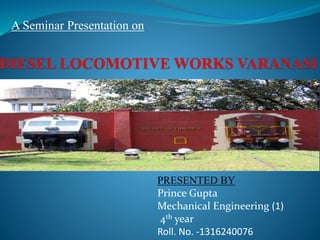
A Seminar Presentation on
Content
 Introduction
 Production shops
 Heavy welding shop
 Maintenance area-1
 Light machine shop
 Rotor shop
 Reference
2
Introduction
 DLW, was founded by Late Railway Minister Mr. Lal Bahadur Shastri on
23 April 1956. It is spread in 300 acres area at Varanasi.
 It is a production unit owned by Indian railways , for which it manufactures
diesel–electric locomotives and its spares parts.
 To meet the increased transportation needs of the Indian railways it was
established in collaboration with ALCO( American Locomotive Company),
USA in 1961.
 DLW rolled out its first locomotive three years later, on January 3, 1964. It
manufactures locomotives.
3
• With technology transfer agreement from manufacturers such as GM-EMD,
DLW today produces advance locomotives having output range from 2600
to 4000 hp.
• At present the latest locomotive produced by DLW; i.e. WDG 5 has
capacity upto 5000 HP & trying to make it 5500 HP.
• It has supplied locomotives to other countries such as Sri Lanka,
Bangladesh, Malaysia, Tanzania and Vietnam etc.
• DLW is supplying locos to PSU’s & Industries Like NTPC, COAL,
INDOGULF etc.
4
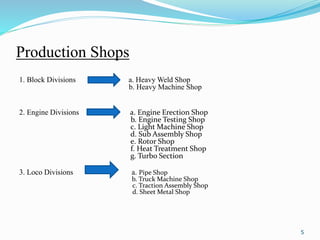
Production Shops
1. Block Divisions a. Heavy Weld Shop
b. Heavy Machine Shop
2. Engine Divisions a. Engine Erection Shop
b. Engine Testing Shop
c. Light Machine Shop
d. Sub Assembly Shop
e. Rotor Shop
f. Heat Treatment Shop
g. Turbo Section
3. Loco Divisions a. Pipe Shop
b. Truck Machine Shop
c. Traction Assembly Shop
d. Sheet Metal Shop
5
Heavy Welding shop
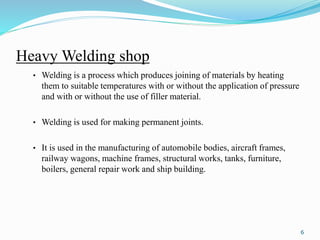
• Welding is a process which produces joining of materials by heating
them to suitable temperatures with or without the application of pressure
and with or without the use of filler material.
• Welding is used for making permanent joints.
• It is used in the manufacturing of automobile bodies, aircraft frames,
railway wagons, machine frames, structural works, tanks, furniture,
boilers, general repair work and ship building.
6
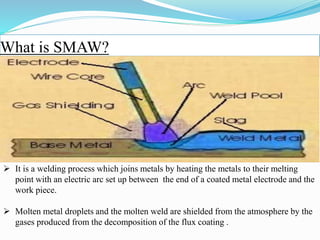
What is SMAW?
 It is a welding process which joins metals by heating the metals to their melting
point with an electric arc set up between the end of a coated metal electrode and the
work piece.
 Molten metal droplets and the molten weld are shielded from the atmosphere by the
gases produced from the decomposition of the flux coating .
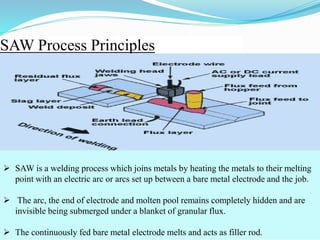
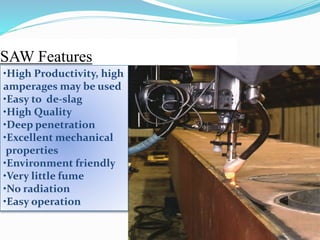
SAW Process Principles
 SAW is a welding process which joins metals by heating the metals to their melting
point with an electric arc or arcs set up between a bare metal electrode and the job.
 The arc, the end of electrode and molten pool remains completely hidden and are
invisible being submerged under a blanket of granular flux.
 The continuously fed bare metal electrode melts and acts as filler rod.
SAW Features
•High Productivity, high
amperages may be used
•Easy to de-slag
•High Quality
•Deep penetration
•Excellent mechanical
properties
•Environment friendly
•Very little fume
•No radiation
•Easy operation
Breakdown maintenance
• Break down of machine can occur due to the following two reasons:
•
• Due to unpredictable failure of component which cannot be prevented.
• Due to gradual wear and tear of the parts of the machine which can be prevented by
regular inspection known as preventive maintenance.
Preventive maintenance
• Also termed as “planned maintenance” or “systematic maintenance” .
• An extremely important function for the reduction of the maintenance cost and to
keep the good operational condition of equipment.
MAINTAINANCE AREA-1
Objective of preventive maintenance
• To obtain maximum availability of the plant by avoiding break down and by
reducing shut down period to a maximum.
• To keep the machine in proper condition so as to maintain the quality of the
product.
• To ensure the safety of the workers.
• To keep the plant at the maximum production efficiency.
• To achieve the above objectives with most economical combination.
Light machine shop
 This shop deals with the matching of various small components required for
the power pack unit such as, cam shaft, connecting rod, liners, gears levers,
F.P. Support, Piston pin, nuts and bolts bushes, various shafts etc.
 The light machine shop divided into the following section:-
1. Grinding section
2. Gear section
3. Cam shaft section
4. Connecting rod section
5. Lathe section
6. Drilling section
7. Milling section.
12
13
1. Camshaft section :–
This section making cam shaft (both B.G. & M.G.) with completed machining
operation by various special type of machine.
2. Connecting rod section:-
In this section the connecting rod is made. All the machining operations
of the connecting rod. Completed here with the help of various types of
machine. The connecting rod has two parts, one is cap and other is rod.
The material of the connecting rod is steep forging.
3. Grinding Section: -
In this section the various small components are grinding as per required
finishing after machining operation and each components having grinding
allowance and main piston pin, impeller and fuller and follower gear, pin valve
guide, various studs. Cam roller, seat various bushes etc.
PIPE SHOP
 This shop deals with the various pipe fitted into trains. Different types of
pipe used in trains for different purpose. In this shop these different types of
pipe are used in trains for passing a fuel in engine, compressing the air to
apply the breaks etc.
 This is specially use for following reasons:
 Passing fuel in engine.
 Compress the air to apply break.
 Throw out of dirty water.
 Maintain air supply.
 Connect from one coach to another coach.
14
Reference
1.www.indianrailway .com
2. www.indianrailways.gov.in
3. https://en.wikipedia.org
4. https://www.youtube.com
15
Prince ppt

Prince ppt

  • 1.
    PRESENTED BY Prince Gupta MechanicalEngineering (1) 4th year Roll. No. -1316240076 A Seminar Presentation on
  • 2.
    Content  Introduction  Productionshops  Heavy welding shop  Maintenance area-1  Light machine shop  Rotor shop  Reference 2
  • 3.
    Introduction  DLW, wasfounded by Late Railway Minister Mr. Lal Bahadur Shastri on 23 April 1956. It is spread in 300 acres area at Varanasi.  It is a production unit owned by Indian railways , for which it manufactures diesel–electric locomotives and its spares parts.  To meet the increased transportation needs of the Indian railways it was established in collaboration with ALCO( American Locomotive Company), USA in 1961.  DLW rolled out its first locomotive three years later, on January 3, 1964. It manufactures locomotives. 3
  • 4.
    • With technologytransfer agreement from manufacturers such as GM-EMD, DLW today produces advance locomotives having output range from 2600 to 4000 hp. • At present the latest locomotive produced by DLW; i.e. WDG 5 has capacity upto 5000 HP & trying to make it 5500 HP. • It has supplied locomotives to other countries such as Sri Lanka, Bangladesh, Malaysia, Tanzania and Vietnam etc. • DLW is supplying locos to PSU’s & Industries Like NTPC, COAL, INDOGULF etc. 4
  • 5.
    Production Shops 1. BlockDivisions a. Heavy Weld Shop b. Heavy Machine Shop 2. Engine Divisions a. Engine Erection Shop b. Engine Testing Shop c. Light Machine Shop d. Sub Assembly Shop e. Rotor Shop f. Heat Treatment Shop g. Turbo Section 3. Loco Divisions a. Pipe Shop b. Truck Machine Shop c. Traction Assembly Shop d. Sheet Metal Shop 5
  • 6.
    Heavy Welding shop •Welding is a process which produces joining of materials by heating them to suitable temperatures with or without the application of pressure and with or without the use of filler material. • Welding is used for making permanent joints. • It is used in the manufacturing of automobile bodies, aircraft frames, railway wagons, machine frames, structural works, tanks, furniture, boilers, general repair work and ship building. 6
  • 7.
    What is SMAW? It is a welding process which joins metals by heating the metals to their melting point with an electric arc set up between the end of a coated metal electrode and the work piece.  Molten metal droplets and the molten weld are shielded from the atmosphere by the gases produced from the decomposition of the flux coating .
  • 8.
    SAW Process Principles SAW is a welding process which joins metals by heating the metals to their melting point with an electric arc or arcs set up between a bare metal electrode and the job.  The arc, the end of electrode and molten pool remains completely hidden and are invisible being submerged under a blanket of granular flux.  The continuously fed bare metal electrode melts and acts as filler rod.
  • 9.
    SAW Features •High Productivity,high amperages may be used •Easy to de-slag •High Quality •Deep penetration •Excellent mechanical properties •Environment friendly •Very little fume •No radiation •Easy operation
  • 10.
    Breakdown maintenance • Breakdown of machine can occur due to the following two reasons: • • Due to unpredictable failure of component which cannot be prevented. • Due to gradual wear and tear of the parts of the machine which can be prevented by regular inspection known as preventive maintenance. Preventive maintenance • Also termed as “planned maintenance” or “systematic maintenance” . • An extremely important function for the reduction of the maintenance cost and to keep the good operational condition of equipment. MAINTAINANCE AREA-1
  • 11.
    Objective of preventivemaintenance • To obtain maximum availability of the plant by avoiding break down and by reducing shut down period to a maximum. • To keep the machine in proper condition so as to maintain the quality of the product. • To ensure the safety of the workers. • To keep the plant at the maximum production efficiency. • To achieve the above objectives with most economical combination.
  • 12.
    Light machine shop This shop deals with the matching of various small components required for the power pack unit such as, cam shaft, connecting rod, liners, gears levers, F.P. Support, Piston pin, nuts and bolts bushes, various shafts etc.  The light machine shop divided into the following section:- 1. Grinding section 2. Gear section 3. Cam shaft section 4. Connecting rod section 5. Lathe section 6. Drilling section 7. Milling section. 12
  • 13.
    13 1. Camshaft section:– This section making cam shaft (both B.G. & M.G.) with completed machining operation by various special type of machine. 2. Connecting rod section:- In this section the connecting rod is made. All the machining operations of the connecting rod. Completed here with the help of various types of machine. The connecting rod has two parts, one is cap and other is rod. The material of the connecting rod is steep forging. 3. Grinding Section: - In this section the various small components are grinding as per required finishing after machining operation and each components having grinding allowance and main piston pin, impeller and fuller and follower gear, pin valve guide, various studs. Cam roller, seat various bushes etc.
  • 14.
    PIPE SHOP  Thisshop deals with the various pipe fitted into trains. Different types of pipe used in trains for different purpose. In this shop these different types of pipe are used in trains for passing a fuel in engine, compressing the air to apply the breaks etc.  This is specially use for following reasons:  Passing fuel in engine.  Compress the air to apply break.  Throw out of dirty water.  Maintain air supply.  Connect from one coach to another coach. 14
  • 15.
    Reference 1.www.indianrailway .com 2. www.indianrailways.gov.in 3.https://en.wikipedia.org 4. https://www.youtube.com 15

Editor's Notes