Summer training report
on
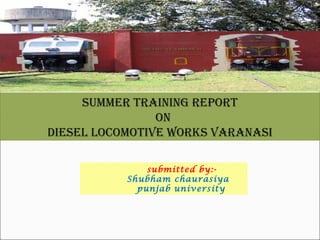
dieSel locomotive workS varanaSi
submitted by:-
Shubham chaurasiya
punjab university
introduction
DLW, was founded by Late Railway Minister Mr. Lal Bahadur Shastri on 23
April 1956. It is spread in 300 acres area at Varanasi.
It is a production unit owned by Indian railways , for which it manufactures
diesel–electric locomotives and its spares parts.
To meet the increased transportation needs of the Indian railways it was
established in collaboration with ALCO( American Locomotive Company),
USA in 1961.
 DLW rolled out its first locomotive three years later, on January 3, 1964. It
manufactures locomotives.
Got its first ISO certification in 1997 and ISO-9001 and ISO-14001 in
December 2002.
At present the latest locomotive produced by DLW; i.e. WDG 5 has capacity
upto 5000 HP & trying to make it 5500 HP.
It has supplied locomotives to other countries such as Sri Lanka, Bangladesh,
Malaysia, Tanzania and Vietnam etc.
DLW is supplying locos to PSU’s & Industries Like NTPC, COAL,
INDOGULF etc.
dieSel electric locomotive
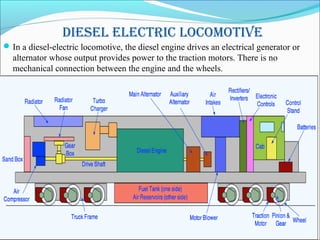
In a diesel-electric locomotive, the diesel engine drives an electrical generator or
alternator whose output provides power to the traction motors. There is no
mechanical connection between the engine and the wheels.
claSSification of locomotiveS
Locos, except the older steam ones, have classification codes that
identify them. This code is of the form
WDG5A “ [ gauge ][ power ][load ][ series ][ sub type ]”
the firSt letter (gauge)
W- Indian broad gauge
Y- meter gauge
Z- narrow gauge(2.5 ft)
N- narrow gauge (2 ft)
the Second letter (motive power)
D- Diesel
C- DC electric (can run under DC traction only)
A- AC electric (can run under AC traction only)
CA- Both DC and AC (can run under both AC and DC tractions)
B- Battery electric locomotive (rare)
the third letter (load type)
G-goods
P-passenger
M-mixed traffic ; both goods and passenger
S-Used for shunting
U-Electric multiple units (E.M.U.)
R-Railcars
the fourth letter (SerieS)
The series digit identifies the horsepower range of the locomotive.
Example for the series letter ‘3’ means that the locomotive has power
over 3000 hp but less than 4000 hp.
the fifth letter (Subtype)
an optional letter or number that indicates some smaller variations in
the basic model.
For ex: ‘A’ for 100 hp,
‘B’ for 200 hp and so on……..
engine diviSion
1. Engine Erection Shop
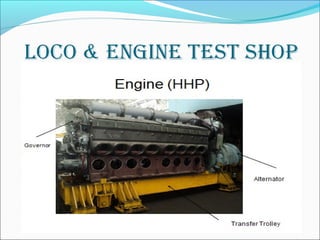
2. Engine Testing Shop
3. Light Machine Shop
4. Sub Assembly Shop
5. Rotor Shop
6. Heat Treatment Shop
7. Turbo Section
loco diviSion
1. Loco Frame Shop
2. Pipe Shop
3. Truck Machine Shop
4. Traction Assembly Shop
5. Sheet Metal Shop
6. Loco Assembly Shop
7. Loco Paint Shop
8. Loco Test Shop
welding Shop
Welding is a process which produces joining of materials
by heating them to suitable temperatures with or
without the application of pressure and with or without
the use of filler material.
Welding is used for making permanent joints.
It is used in the manufacturing of automobile bodies,
aircraft frames, railway wagons, machine frames,
structural works, tanks, furniture, boilers, general repair
work and ship building.
Shielded Metal Arc Welding [SMAW]
Submerged Arc Welding [SAW]
Gas Shielded Metal Arc Welding [MIG]
Flux Cored Arc Welding [FCAW]
Shielded Metal Arc Welding [SMAW]
Submerged Arc Welding [SAW]
Gas Shielded Metal Arc Welding [MIG]
Flux Cored Arc Welding [FCAW]
Types Of Welding Used in dlWTypes Of Welding Used in dlW
WhaT is sMaW?WhaT is sMaW?
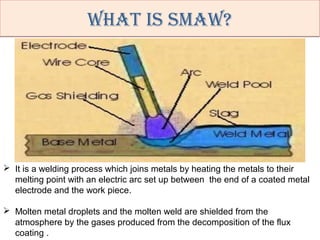
 It is a welding process which joins metals by heating the metals to their
melting point with an electric arc set up between the end of a coated metal
electrode and the work piece.
 Molten metal droplets and the molten weld are shielded from the
atmosphere by the gases produced from the decomposition of the flux
coating .
saW prOcess principles
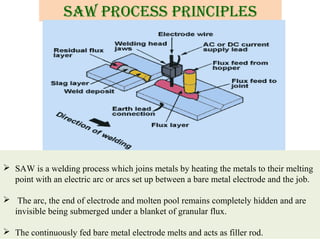
 SAW is a welding process which joins metals by heating the metals to their melting
point with an electric arc or arcs set up between a bare metal electrode and the job.
 The arc, the end of electrode and molten pool remains completely hidden and are
invisible being submerged under a blanket of granular flux.
 The continuously fed bare metal electrode melts and acts as filler rod.
SAW Features
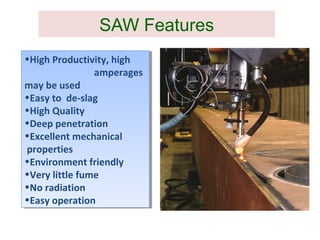
•High Productivity, high
amperages
may be used
•Easy to de-slag
•High Quality
•Deep penetration
•Excellent mechanical
properties
•Environment friendly
•Very little fume
•No radiation
•Easy operation
•High Productivity, high
amperages
may be used
•Easy to de-slag
•High Quality
•Deep penetration
•Excellent mechanical
properties
•Environment friendly
•Very little fume
•No radiation
•Easy operation
Gas Metal Arc ( MIG )
Welding
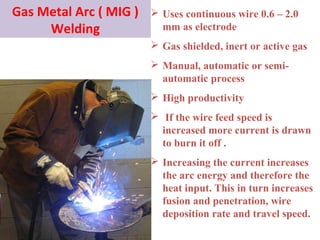
 Uses continuous wire 0.6 – 2.0
mm as electrode
 Gas shielded, inert or active gas
 Manual, automatic or semi-
automatic process
 High productivity
 If the wire feed speed is
increased more current is drawn
to burn it off .
 Increasing the current increases
the arc energy and therefore the
heat input. This in turn increases
fusion and penetration, wire
deposition rate and travel speed.
16
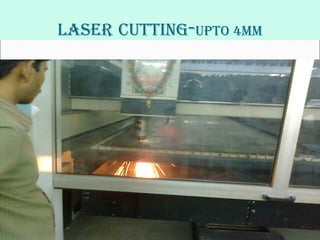
laser cUTTing-UpTO 4MM
17
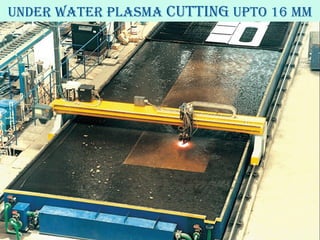
Under WaTer plasMa cUTTing UpTO 16 MM
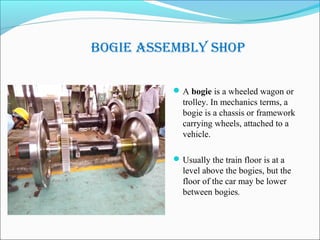
bogie assembly shop
A bogie is a wheeled wagon or
trolley. In mechanics terms, a
bogie is a chassis or framework
carrying wheels, attached to a
vehicle.
Usually the train floor is at a
level above the bogies, but the
floor of the car may be lower
between bogies.
bogie assembly (emD)
 Wheel and Axle assembly.
 Brake rigging assembly.
 Traction motor & gear case assembly.
 Bearing adopter assembly.
 Final assembly.
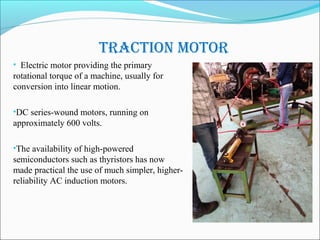
TracTion moTor
• Electric motor providing the primary
rotational torque of a machine, usually for
conversion into linear motion.
•DC series-wound motors, running on
approximately 600 volts.
•The availability of high-powered
semiconductors such as thyristors has now
made practical the use of much simpler, higher-
reliability AC induction motors.
assembly process:
PRESS BULL GEAR ON AXLE.
SHIFT ABOVE ASSEMBLY AT BEARING HOUSING FITTING
STAND.
FIT THE BEARING HOUSING AND BOLTING .
ASSEMBLE SEAL , CAP AND TAPER ROLLER BEARING
BOLTING .
NOW, SHIFT THIS ASSEMBLY ON WHEEL & AXLE PRESS
MACHINE.
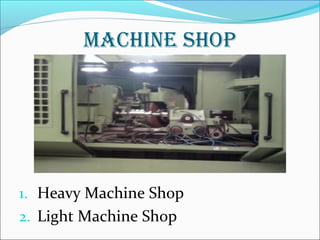
machine shop
1. Heavy Machine Shop
2. Light Machine Shop
1. Conventional machine
2. NC machine
3. CNC machine
1. convenTional machine:
It is a simple machine which is now an old technique.
2. numerical conTrol machine:
Numerical control is defined as a system in which the actions of the machines
are controlled by the insertion of the numerical data. In other words number
controls the action.
Types of machines
compuTerizeD numerically conTrolleD
machine
In CNC the control system further energized with a mini computer or a post
processor.
The control unit stores the programmed information of the work piece, the
travel limits, collisions zones and the diagnostic information etc. it also
gives a feedback to the operator about the current position and distance to
be travelled etc.
 CNC machines have the ability to edit or alter the existing program in no
time.
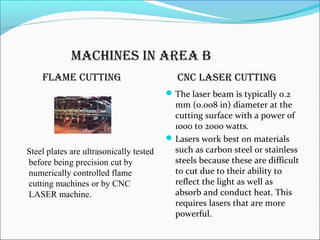
machines in area b
flame cuTTing cnc laser cuTTing
Steel plates are ultrasonically tested
before being precision cut by
numerically controlled flame
cutting machines or by CNC
LASER machine.
The laser beam is typically 0.2
mm (0.008 in) diameter at the
cutting surface with a power of
1000 to 2000 watts.
Lasers work best on materials
such as carbon steel or stainless
steels because these are difficult
to cut due to their ability to
reflect the light as well as
absorb and conduct heat. This
requires lasers that are more
powerful.
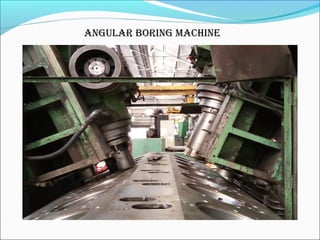
angular boring machine
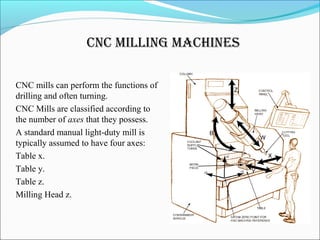
CNC milliNg maChiNes
CNC mills can perform the functions of
drilling and often turning.
CNC Mills are classified according to
the number of axes that they possess.
A standard manual light-duty mill is
typically assumed to have four axes:
Table x.
Table y.
Table z.
Milling Head z.
lubriCatiNg oil testiNg
 Lubrication is done for better performance of the engine parts.
 testing is done by checking the circulation of lubricant oil.
 For rotating parts checking is done by seeing the returning path of the oil
i.e. checking not only the forward path but also the returning path.
 RR40 is used as lubricating oil.
types of testiNg
water testiNg
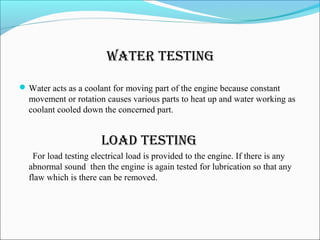
Water acts as a coolant for moving part of the engine because constant
movement or rotation causes various parts to heat up and water working as
coolant cooled down the concerned part.
load testiNg
For load testing electrical load is provided to the engine. If there is any
abnormal sound then the engine is again tested for lubrication so that any
flaw which is there can be removed.
eNgiNe test operatioN sequeNCe
Base inspection under screen and fitting over screen.
Water circulation.
Lube oil filling and check deflection crank shaft.
Lube oil circulation.
Pre run on no load 3 to 5 times of duration 10 to 30
min each 400 rpm.
Intermediate runs 12 runs of 30 min duration each
from 400 to 1000 rpm.
Check over speed trip of recheck 3 times.
Check bake in nozzles and set tapped clearance.
Inspection before fist hour performance.
First hour performance on full load.
Base inspection.
Second hour performance on full load.
Attend defects of first hour performance.
Final base inspection.
Check engine deficiencies.
Engine clearance.
THANKS

DLW varanasi summer training report

  • 1.
    Summer training report on dieSellocomotive workS varanaSi submitted by:- Shubham chaurasiya punjab university
  • 2.
    introduction DLW, was foundedby Late Railway Minister Mr. Lal Bahadur Shastri on 23 April 1956. It is spread in 300 acres area at Varanasi. It is a production unit owned by Indian railways , for which it manufactures diesel–electric locomotives and its spares parts. To meet the increased transportation needs of the Indian railways it was established in collaboration with ALCO( American Locomotive Company), USA in 1961.  DLW rolled out its first locomotive three years later, on January 3, 1964. It manufactures locomotives.
  • 3.
    Got its firstISO certification in 1997 and ISO-9001 and ISO-14001 in December 2002. At present the latest locomotive produced by DLW; i.e. WDG 5 has capacity upto 5000 HP & trying to make it 5500 HP. It has supplied locomotives to other countries such as Sri Lanka, Bangladesh, Malaysia, Tanzania and Vietnam etc. DLW is supplying locos to PSU’s & Industries Like NTPC, COAL, INDOGULF etc.
  • 4.
    dieSel electric locomotive Ina diesel-electric locomotive, the diesel engine drives an electrical generator or alternator whose output provides power to the traction motors. There is no mechanical connection between the engine and the wheels.
  • 5.
    claSSification of locomotiveS Locos,except the older steam ones, have classification codes that identify them. This code is of the form WDG5A “ [ gauge ][ power ][load ][ series ][ sub type ]” the firSt letter (gauge) W- Indian broad gauge Y- meter gauge Z- narrow gauge(2.5 ft) N- narrow gauge (2 ft) the Second letter (motive power) D- Diesel C- DC electric (can run under DC traction only) A- AC electric (can run under AC traction only) CA- Both DC and AC (can run under both AC and DC tractions) B- Battery electric locomotive (rare)
  • 6.
    the third letter(load type) G-goods P-passenger M-mixed traffic ; both goods and passenger S-Used for shunting U-Electric multiple units (E.M.U.) R-Railcars the fourth letter (SerieS) The series digit identifies the horsepower range of the locomotive. Example for the series letter ‘3’ means that the locomotive has power over 3000 hp but less than 4000 hp. the fifth letter (Subtype) an optional letter or number that indicates some smaller variations in the basic model. For ex: ‘A’ for 100 hp, ‘B’ for 200 hp and so on……..
  • 7.
    engine diviSion 1. EngineErection Shop 2. Engine Testing Shop 3. Light Machine Shop 4. Sub Assembly Shop 5. Rotor Shop 6. Heat Treatment Shop 7. Turbo Section
  • 8.
    loco diviSion 1. LocoFrame Shop 2. Pipe Shop 3. Truck Machine Shop 4. Traction Assembly Shop 5. Sheet Metal Shop 6. Loco Assembly Shop 7. Loco Paint Shop 8. Loco Test Shop
  • 9.
    welding Shop Welding isa process which produces joining of materials by heating them to suitable temperatures with or without the application of pressure and with or without the use of filler material. Welding is used for making permanent joints. It is used in the manufacturing of automobile bodies, aircraft frames, railway wagons, machine frames, structural works, tanks, furniture, boilers, general repair work and ship building.
  • 10.
    Shielded Metal ArcWelding [SMAW] Submerged Arc Welding [SAW] Gas Shielded Metal Arc Welding [MIG] Flux Cored Arc Welding [FCAW] Shielded Metal Arc Welding [SMAW] Submerged Arc Welding [SAW] Gas Shielded Metal Arc Welding [MIG] Flux Cored Arc Welding [FCAW] Types Of Welding Used in dlWTypes Of Welding Used in dlW
  • 11.
    WhaT is sMaW?WhaTis sMaW?  It is a welding process which joins metals by heating the metals to their melting point with an electric arc set up between the end of a coated metal electrode and the work piece.  Molten metal droplets and the molten weld are shielded from the atmosphere by the gases produced from the decomposition of the flux coating .
  • 12.
    saW prOcess principles SAW is a welding process which joins metals by heating the metals to their melting point with an electric arc or arcs set up between a bare metal electrode and the job.  The arc, the end of electrode and molten pool remains completely hidden and are invisible being submerged under a blanket of granular flux.  The continuously fed bare metal electrode melts and acts as filler rod.
  • 13.
    SAW Features •High Productivity,high amperages may be used •Easy to de-slag •High Quality •Deep penetration •Excellent mechanical properties •Environment friendly •Very little fume •No radiation •Easy operation •High Productivity, high amperages may be used •Easy to de-slag •High Quality •Deep penetration •Excellent mechanical properties •Environment friendly •Very little fume •No radiation •Easy operation
  • 14.
    Gas Metal Arc( MIG ) Welding  Uses continuous wire 0.6 – 2.0 mm as electrode  Gas shielded, inert or active gas  Manual, automatic or semi- automatic process  High productivity  If the wire feed speed is increased more current is drawn to burn it off .  Increasing the current increases the arc energy and therefore the heat input. This in turn increases fusion and penetration, wire deposition rate and travel speed.
  • 16.
  • 17.
    17 Under WaTer plasMacUTTing UpTO 16 MM
  • 19.
    bogie assembly shop Abogie is a wheeled wagon or trolley. In mechanics terms, a bogie is a chassis or framework carrying wheels, attached to a vehicle. Usually the train floor is at a level above the bogies, but the floor of the car may be lower between bogies.
  • 20.
    bogie assembly (emD) Wheel and Axle assembly.  Brake rigging assembly.  Traction motor & gear case assembly.  Bearing adopter assembly.  Final assembly.
  • 21.
    TracTion moTor • Electricmotor providing the primary rotational torque of a machine, usually for conversion into linear motion. •DC series-wound motors, running on approximately 600 volts. •The availability of high-powered semiconductors such as thyristors has now made practical the use of much simpler, higher- reliability AC induction motors.
  • 22.
    assembly process: PRESS BULLGEAR ON AXLE. SHIFT ABOVE ASSEMBLY AT BEARING HOUSING FITTING STAND. FIT THE BEARING HOUSING AND BOLTING . ASSEMBLE SEAL , CAP AND TAPER ROLLER BEARING BOLTING . NOW, SHIFT THIS ASSEMBLY ON WHEEL & AXLE PRESS MACHINE.
  • 23.
    machine shop 1. HeavyMachine Shop 2. Light Machine Shop
  • 24.
    1. Conventional machine 2.NC machine 3. CNC machine 1. convenTional machine: It is a simple machine which is now an old technique. 2. numerical conTrol machine: Numerical control is defined as a system in which the actions of the machines are controlled by the insertion of the numerical data. In other words number controls the action. Types of machines
  • 25.
    compuTerizeD numerically conTrolleD machine InCNC the control system further energized with a mini computer or a post processor. The control unit stores the programmed information of the work piece, the travel limits, collisions zones and the diagnostic information etc. it also gives a feedback to the operator about the current position and distance to be travelled etc.  CNC machines have the ability to edit or alter the existing program in no time.
  • 26.
    machines in areab flame cuTTing cnc laser cuTTing Steel plates are ultrasonically tested before being precision cut by numerically controlled flame cutting machines or by CNC LASER machine. The laser beam is typically 0.2 mm (0.008 in) diameter at the cutting surface with a power of 1000 to 2000 watts. Lasers work best on materials such as carbon steel or stainless steels because these are difficult to cut due to their ability to reflect the light as well as absorb and conduct heat. This requires lasers that are more powerful.
  • 27.
  • 28.
    CNC milliNg maChiNes CNCmills can perform the functions of drilling and often turning. CNC Mills are classified according to the number of axes that they possess. A standard manual light-duty mill is typically assumed to have four axes: Table x. Table y. Table z. Milling Head z.
  • 30.
    lubriCatiNg oil testiNg Lubrication is done for better performance of the engine parts.  testing is done by checking the circulation of lubricant oil.  For rotating parts checking is done by seeing the returning path of the oil i.e. checking not only the forward path but also the returning path.  RR40 is used as lubricating oil. types of testiNg
  • 31.
    water testiNg Water actsas a coolant for moving part of the engine because constant movement or rotation causes various parts to heat up and water working as coolant cooled down the concerned part. load testiNg For load testing electrical load is provided to the engine. If there is any abnormal sound then the engine is again tested for lubrication so that any flaw which is there can be removed.
  • 32.
    eNgiNe test operatioNsequeNCe Base inspection under screen and fitting over screen. Water circulation. Lube oil filling and check deflection crank shaft. Lube oil circulation. Pre run on no load 3 to 5 times of duration 10 to 30 min each 400 rpm. Intermediate runs 12 runs of 30 min duration each from 400 to 1000 rpm.
  • 33.
    Check over speedtrip of recheck 3 times. Check bake in nozzles and set tapped clearance. Inspection before fist hour performance. First hour performance on full load. Base inspection. Second hour performance on full load. Attend defects of first hour performance. Final base inspection. Check engine deficiencies. Engine clearance.
  • 34.