M S Ramaiah Institute of Technology
Bangalore
(Autonomous, affiliated to Visvesvaraya Technological University)
Seminar on Industrial Training received at
L & T Construction Equipment Ltd.
Submitted in partial fulfillment of the requirements for the award of the degree of
Bachelor in Engineering
in
Mechanical Engineering
Under the guidance of
Mr. Venkateshwara Rao
Senior Manager, L&T Construction Equipment Ltd.
By
Bharat Joshi 1MS12ME041
Year: 2016
Acknowledgement
The satisfaction of completion of any task is incomplete without
the mention of those people whose constant guidance and
encouragement crown all the efforts with success.
My sincere thanks to the Department of Mechanical Engineering,
M S Ramaiah Istitute of Technology, for allowing me to indulge in
this training program, which has greatly educated me on the
realities of engineering.
My respectful gratitude to Mr. Venkateshwara Rao, Senior
Manager, L&T Construction Equipment Ltd., for sharing with me
his vast knowledge base on the functioning of the entire
manufacturing plant.
I am grateful to Mr. Samuel Prashanth Kumar, HR Department, for
guiding me through the internship period.
I thank Mr. Rajiv Kamath for his patience and for helping me
better understand the technical aspects of the manufacturing unit.
About LTCE
• Larsen & Toubro was started by a pair of Danish refugees in
India, in 1938.
• It is an example of opportunistic start-up. It was started as the
founders could not return to Europe due to World War II.
• It is India’s largest engineering and construction company.
• Was awarded the “Company of the Year” at the Economic
Times Awards 2010.
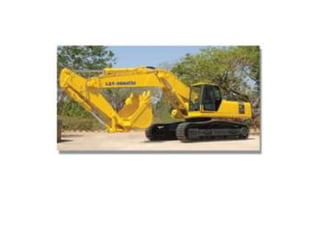
• LTCE is a manufacturer of earth-movers and excavators of
various loads and sizes.
• It was earlier tied up with the Japanese company Komatsu,
but split up in 2008.
Industry
Based on Utility
• Professional, Scientific and Technical services.
• Health care.
• Public administration.
• Telecommunication services
• Agriculture, forestry, fishing and hunting.
• Transportation.
• Finance and insurance.
• Mining, quarrying, oil and gas extraction.
• Construction.
• Manufacturing.
• Wholesale trade.
• Retail trade.
Based on Ownership
• Private sector – Owned by private organisations,
not part of government, citizen sector.
• Public sector – Owned and operated by the
government.
• Joint sector - Owned jointly by private
organisations and govt.. Day-to-day handling is by
private party.
• Co-operative sector – Union of persons working
towards common goal.
• MNC – Operates in various countries.
Productivity
Factors influencing productivity
• Location – Proximity to market and raw materials, rules
and regulations of the region, workforce available.
• Government – Laws and regulations, freedom of
transportation of goods.
• Management – Efficiency of management, speed of
decision making, communication between higher
authorities and workers.
• Personnel – Skill of workers, suitability of the worker
for specific tasks.
• Finance – Model of funding, capitol flow.
• Organization – Should be simple and clear, well laid-
out responsibilities.
• Technology – Automation, process layout,
simultaneous operations.
Quality
Aspects of Quailty
• Producing – providing something.
• Checking – confirming that something has been
done correctly.
• Quality Control – controlling a process to ensure
that the outcomes are predictable.
• Quality Management – directing an organization
so that it optimizes its performance through
analysis and improvement.
• Quality Assurance – obtaining confidence that a
product or service will be satisfactory (normally
performed by a purchaser).
Fabrication Processes at LTCE
Shot Blasting
• Shot blasting is a method used to clean,
strengthen or polish metal
• There are two technologies used: wheel
blasting or air blasting.
• Normally this is done to remove something on
the surface such as scale, but it is also done
sometimes to impart a particular surface
• The shot can be sand, small steel balls of
various diameters, granules of silicon carbide
Gouging
• An oxyfuel gas flame heats up the piece.
• Cutting oxygen jet combusts and carries away
the molten metal.
• In gouging, the oxygen beam is almost parallel
with the surface of the piece to be worked.
• By using ODOROX® (odorized oxygen) you can
minimize the risk of fire and explosion always
associated with fuel gases.
Honing
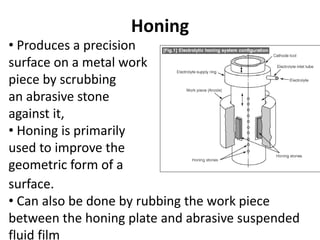
• Produces a precision
surface on a metal work
piece by scrubbing
an abrasive stone
against it,
• Honing is primarily
used to improve the
geometric form of a
surface.
• Can also be done by rubbing the work piece
between the honing plate and abrasive suspended
fluid film
Centreless Grinding
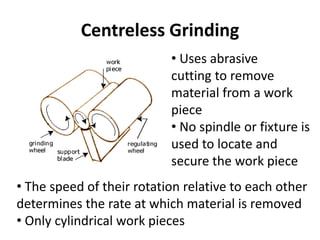
• Uses abrasive
cutting to remove
material from a work
piece
• No spindle or fixture is
used to locate and
secure the work piece
• The speed of their rotation relative to each other
determines the rate at which material is removed
• Only cylindrical work pieces
Induction Hardening
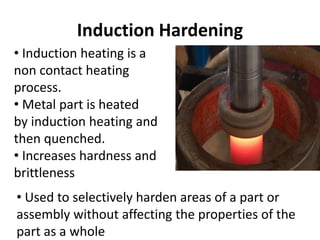
• Induction heating is a
non contact heating
process.
• Metal part is heated
by induction heating and
then quenched.
• Increases hardness and
brittleness
• Used to selectively harden areas of a part or
assembly without affecting the properties of the
part as a whole
Korene Process
• Pre-heating is done at 3500C for half an hour.
• Component is immersed in treatment tank at
4500C for 30 minutes.
• Silicon removal through ion exchange in the
tank. Air cooled to room temperature.
• It is then processed to the phosphating shop.
Phosphating
• Used on steel parts for corrosion resistance, or
as a foundation for subsequent coatings or
paintings.
• Dilute solution of phosphoric acid and
phosphate salts is applied.
• Spraying or immersion is used as the method
of application.
Laser Vision Tracking
• Method provides weld for joint thickness less
than 1 mm.
• Laser sensor is attached 1 inch ahead of
welding torch. Laser diode projects a line onto
the part.
• A camera detects the joint seam based on
distortion line.
• Camera software provides feedback to the
robot
• Clearer signal, less noise.
Compressors
Reciprocating Compressor
• 50A input DC motor drives a shaft.
• Air is sucked in through a suction valve.
• That shaft hence rotates which further causes a to-fro motion of a
connector.
• With connector are 2 oppositely attached pistons themselves move
in to and fro direction
• Rotary motion hence converted to reciprocating action
• One side piston action compresses the air at a low pressure, which
then passes through a heat exchanger and is then compressed to
more high pressure.
• Due to another side piston force action this highly compressed air is
again cooled down and sent to supply lines and storage reserves.
• 1bar water and 1.5 bar oil pressures are required to run the coolant
system and shaft respectively.
Screw Compressor
• A shaft rotates causing screw movement.
•Air is sucked through upper pump and oil
is sucked through the lower green pipe.
Both are mixed and taken to very high
pressure due to the screw movement.
•Complete mix is passed through the green
pipe. It reaches a tank where air (green)
and oil (yellow) are separated.
•Air is passed to cooler through blue line
and sent to storage tank and supply lines.
• Oil passed through cooler, cooled down
and sent back to the upper screw
compressor.
CNC Machines
Based on Movement
• Point-to-point - Machine performs machining
operations at specified position, like drilling.
• Straight line - Machines at a time in one
direction only, like milling
• Continuous path - Interrelated motion of tool
and the work piece along different coordinate
axis to machine contours and curves
continuously.
Based on Feedback
• Open loop - No check of obtained position
with respect to the command position. For
example, giving a command for slide
movement does not ensure it actually moves.
• Closed loop - Encoder as feedback device
keeps check to make sure that obtained
position is the command position and to make
no error.
CNC Coordinate System
• Absolute system
Describes every tool movement in terms of the
coordinates of tool with respect to the reference
point.
Works normally in first quadrant (always +ve).
• Incremental system
Instruction given for the tool movement in terms
of moving –ve or +ve along X & Y directions with
respect to the present tool point.
Robots
Based on Movement
• Limited sequence control - It performs simple
tasks, like pick and place operations. Mechanical
stops are used to set limits
• Point-to-point control - The robot is made to
move from one coordinate to another and each
coordinate is stored in the program.
• Continuous path control - Large number of
closely spaced locations for smooth continuous
motion.
• Intelligent movement - It has sensors that interact
with the environment and make decisions when
an operation goes wrong.
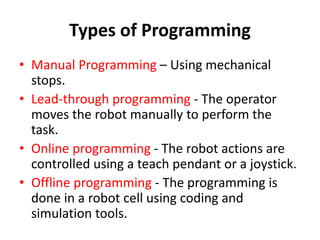
Types of Programming
• Manual Programming – Using mechanical
stops.
• Lead-through programming - The operator
moves the robot manually to perform the
task.
• Online programming - The robot actions are
controlled using a teach pendant or a joystick.
• Offline programming - The programming is
done in a robot cell using coding and
simulation tools.
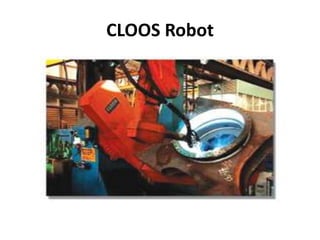
CLOOS Robot
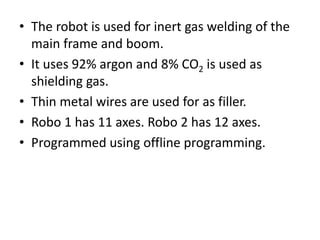
• The robot is used for inert gas welding of the
main frame and boom.
• It uses 92% argon and 8% CO2 is used as
shielding gas.
• Thin metal wires are used for as filler.
• Robo 1 has 11 axes. Robo 2 has 12 axes.
• Programmed using offline programming.
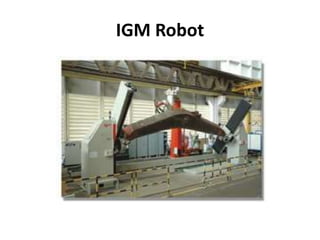
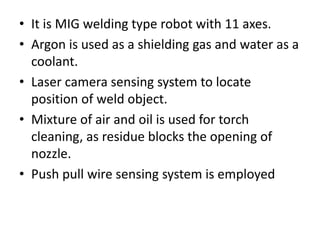
IGM Robot
• It is MIG welding type robot with 11 axes.
• Argon is used as a shielding gas and water as a
coolant.
• Laser camera sensing system to locate
position of weld object.
• Mixture of air and oil is used for torch
cleaning, as residue blocks the opening of
nozzle.
• Push pull wire sensing system is employed
Energy Conservation
• Solar powered street lights are used throughout the
factory.
• Programmable timers are used for fabrication and
assembly shop lights and also to run the air
compressors.
• LED lights for long-running white light is used during
night shifts.
• Factory layout is such that cable length is minimum,
hence, cable losses are minimum.
• Air pressure units are placed to ensure unnecessary
air leakage.
• Solar powered heating units are used to preheat
water up to a certain temperature to reduce LPG
consumption.
• Rain water harvesting is done to reduce water intake.
• Digitally controlled air management system is used to
provide continuous supply of air, hence, reducing
loading period of air compressor.
Safety
• Personal Protective Equipment (PPE) is made
compulsory before entering the shop floor.
• Generators are located in isolated areas, so that
any breakout of fire does not affect
neighbhouring buildings.
• All buildings have ducts on either side such that
are is expelled from one side while more air is
sucked in from the other. This ventilation system
ensures that poisonous gases are not retained in
the building.
• X ray scanners are kept in isolated chambers
below the ground, so that the radiation does not
affect others.

Intership Seminar

  • 1.
    M S RamaiahInstitute of Technology Bangalore (Autonomous, affiliated to Visvesvaraya Technological University) Seminar on Industrial Training received at L & T Construction Equipment Ltd. Submitted in partial fulfillment of the requirements for the award of the degree of Bachelor in Engineering in Mechanical Engineering Under the guidance of Mr. Venkateshwara Rao Senior Manager, L&T Construction Equipment Ltd. By Bharat Joshi 1MS12ME041 Year: 2016
  • 2.
    Acknowledgement The satisfaction ofcompletion of any task is incomplete without the mention of those people whose constant guidance and encouragement crown all the efforts with success. My sincere thanks to the Department of Mechanical Engineering, M S Ramaiah Istitute of Technology, for allowing me to indulge in this training program, which has greatly educated me on the realities of engineering. My respectful gratitude to Mr. Venkateshwara Rao, Senior Manager, L&T Construction Equipment Ltd., for sharing with me his vast knowledge base on the functioning of the entire manufacturing plant. I am grateful to Mr. Samuel Prashanth Kumar, HR Department, for guiding me through the internship period. I thank Mr. Rajiv Kamath for his patience and for helping me better understand the technical aspects of the manufacturing unit.
  • 3.
    About LTCE • Larsen& Toubro was started by a pair of Danish refugees in India, in 1938. • It is an example of opportunistic start-up. It was started as the founders could not return to Europe due to World War II. • It is India’s largest engineering and construction company. • Was awarded the “Company of the Year” at the Economic Times Awards 2010. • LTCE is a manufacturer of earth-movers and excavators of various loads and sizes. • It was earlier tied up with the Japanese company Komatsu, but split up in 2008.
  • 5.
  • 6.
    Based on Utility •Professional, Scientific and Technical services. • Health care. • Public administration. • Telecommunication services • Agriculture, forestry, fishing and hunting. • Transportation. • Finance and insurance. • Mining, quarrying, oil and gas extraction. • Construction. • Manufacturing. • Wholesale trade. • Retail trade.
  • 7.
    Based on Ownership •Private sector – Owned by private organisations, not part of government, citizen sector. • Public sector – Owned and operated by the government. • Joint sector - Owned jointly by private organisations and govt.. Day-to-day handling is by private party. • Co-operative sector – Union of persons working towards common goal. • MNC – Operates in various countries.
  • 8.
  • 9.
    Factors influencing productivity •Location – Proximity to market and raw materials, rules and regulations of the region, workforce available. • Government – Laws and regulations, freedom of transportation of goods. • Management – Efficiency of management, speed of decision making, communication between higher authorities and workers. • Personnel – Skill of workers, suitability of the worker for specific tasks. • Finance – Model of funding, capitol flow. • Organization – Should be simple and clear, well laid- out responsibilities. • Technology – Automation, process layout, simultaneous operations.
  • 10.
  • 11.
    Aspects of Quailty •Producing – providing something. • Checking – confirming that something has been done correctly. • Quality Control – controlling a process to ensure that the outcomes are predictable. • Quality Management – directing an organization so that it optimizes its performance through analysis and improvement. • Quality Assurance – obtaining confidence that a product or service will be satisfactory (normally performed by a purchaser).
  • 12.
  • 13.
    Shot Blasting • Shotblasting is a method used to clean, strengthen or polish metal • There are two technologies used: wheel blasting or air blasting. • Normally this is done to remove something on the surface such as scale, but it is also done sometimes to impart a particular surface • The shot can be sand, small steel balls of various diameters, granules of silicon carbide
  • 14.
    Gouging • An oxyfuelgas flame heats up the piece. • Cutting oxygen jet combusts and carries away the molten metal. • In gouging, the oxygen beam is almost parallel with the surface of the piece to be worked. • By using ODOROX® (odorized oxygen) you can minimize the risk of fire and explosion always associated with fuel gases.
  • 15.
    Honing • Produces aprecision surface on a metal work piece by scrubbing an abrasive stone against it, • Honing is primarily used to improve the geometric form of a surface. • Can also be done by rubbing the work piece between the honing plate and abrasive suspended fluid film
  • 16.
    Centreless Grinding • Usesabrasive cutting to remove material from a work piece • No spindle or fixture is used to locate and secure the work piece • The speed of their rotation relative to each other determines the rate at which material is removed • Only cylindrical work pieces
  • 17.
    Induction Hardening • Inductionheating is a non contact heating process. • Metal part is heated by induction heating and then quenched. • Increases hardness and brittleness • Used to selectively harden areas of a part or assembly without affecting the properties of the part as a whole
  • 18.
    Korene Process • Pre-heatingis done at 3500C for half an hour. • Component is immersed in treatment tank at 4500C for 30 minutes. • Silicon removal through ion exchange in the tank. Air cooled to room temperature. • It is then processed to the phosphating shop.
  • 19.
    Phosphating • Used onsteel parts for corrosion resistance, or as a foundation for subsequent coatings or paintings. • Dilute solution of phosphoric acid and phosphate salts is applied. • Spraying or immersion is used as the method of application.
  • 20.
    Laser Vision Tracking •Method provides weld for joint thickness less than 1 mm. • Laser sensor is attached 1 inch ahead of welding torch. Laser diode projects a line onto the part. • A camera detects the joint seam based on distortion line. • Camera software provides feedback to the robot • Clearer signal, less noise.
  • 21.
  • 22.
    Reciprocating Compressor • 50Ainput DC motor drives a shaft. • Air is sucked in through a suction valve. • That shaft hence rotates which further causes a to-fro motion of a connector. • With connector are 2 oppositely attached pistons themselves move in to and fro direction • Rotary motion hence converted to reciprocating action • One side piston action compresses the air at a low pressure, which then passes through a heat exchanger and is then compressed to more high pressure. • Due to another side piston force action this highly compressed air is again cooled down and sent to supply lines and storage reserves. • 1bar water and 1.5 bar oil pressures are required to run the coolant system and shaft respectively.
  • 23.
    Screw Compressor • Ashaft rotates causing screw movement. •Air is sucked through upper pump and oil is sucked through the lower green pipe. Both are mixed and taken to very high pressure due to the screw movement. •Complete mix is passed through the green pipe. It reaches a tank where air (green) and oil (yellow) are separated. •Air is passed to cooler through blue line and sent to storage tank and supply lines. • Oil passed through cooler, cooled down and sent back to the upper screw compressor.
  • 24.
  • 25.
    Based on Movement •Point-to-point - Machine performs machining operations at specified position, like drilling. • Straight line - Machines at a time in one direction only, like milling • Continuous path - Interrelated motion of tool and the work piece along different coordinate axis to machine contours and curves continuously.
  • 26.
    Based on Feedback •Open loop - No check of obtained position with respect to the command position. For example, giving a command for slide movement does not ensure it actually moves. • Closed loop - Encoder as feedback device keeps check to make sure that obtained position is the command position and to make no error.
  • 27.
    CNC Coordinate System •Absolute system Describes every tool movement in terms of the coordinates of tool with respect to the reference point. Works normally in first quadrant (always +ve). • Incremental system Instruction given for the tool movement in terms of moving –ve or +ve along X & Y directions with respect to the present tool point.
  • 28.
  • 29.
    Based on Movement •Limited sequence control - It performs simple tasks, like pick and place operations. Mechanical stops are used to set limits • Point-to-point control - The robot is made to move from one coordinate to another and each coordinate is stored in the program. • Continuous path control - Large number of closely spaced locations for smooth continuous motion. • Intelligent movement - It has sensors that interact with the environment and make decisions when an operation goes wrong.
  • 30.
    Types of Programming •Manual Programming – Using mechanical stops. • Lead-through programming - The operator moves the robot manually to perform the task. • Online programming - The robot actions are controlled using a teach pendant or a joystick. • Offline programming - The programming is done in a robot cell using coding and simulation tools.
  • 31.
  • 32.
    • The robotis used for inert gas welding of the main frame and boom. • It uses 92% argon and 8% CO2 is used as shielding gas. • Thin metal wires are used for as filler. • Robo 1 has 11 axes. Robo 2 has 12 axes. • Programmed using offline programming.
  • 33.
  • 34.
    • It isMIG welding type robot with 11 axes. • Argon is used as a shielding gas and water as a coolant. • Laser camera sensing system to locate position of weld object. • Mixture of air and oil is used for torch cleaning, as residue blocks the opening of nozzle. • Push pull wire sensing system is employed
  • 35.
  • 36.
    • Solar poweredstreet lights are used throughout the factory. • Programmable timers are used for fabrication and assembly shop lights and also to run the air compressors. • LED lights for long-running white light is used during night shifts. • Factory layout is such that cable length is minimum, hence, cable losses are minimum. • Air pressure units are placed to ensure unnecessary air leakage. • Solar powered heating units are used to preheat water up to a certain temperature to reduce LPG consumption. • Rain water harvesting is done to reduce water intake. • Digitally controlled air management system is used to provide continuous supply of air, hence, reducing loading period of air compressor.
  • 37.
  • 38.
    • Personal ProtectiveEquipment (PPE) is made compulsory before entering the shop floor. • Generators are located in isolated areas, so that any breakout of fire does not affect neighbhouring buildings. • All buildings have ducts on either side such that are is expelled from one side while more air is sucked in from the other. This ventilation system ensures that poisonous gases are not retained in the building. • X ray scanners are kept in isolated chambers below the ground, so that the radiation does not affect others.