A
SUMMER FIELD TRAINING REPORT
AT
DIESEL LOCOMOTIVE WORKS
VARANASI
Submitted To-Department Of Mechanical Engineering
Translam Institute of Technology & Management, Meerut
In partial fulfillment of the requirement for the award of degree of
BACHELOR OF TECHNOLOGY
IN
MECHANICAL ENGINEERING
BY
ISHANT GAUTAM
Roll No.- 1232140025
TRANSLAM INSTITUTE OF TECHNOLOGY &
MANAGEMENT, MEERUT
(Affiliated to AICTE & Uttar Pradesh Technical University, Lucknow)
ACKNOWLEDGEMENT
I would sincerely like to thank the employees and the officers of DLW,
VARANASI for their help and support during the vocational training.
Despite their busy schedules, they took time out for us and explained to us
the various aspects of the working of the plant from the production shops.
I would sincerely like to thank Mr. Sudhir Sinha (CWI /TTC) and Mr.
Ajay Kumar(JE/HWS), Mr. Vipin Srivastava(JE/HWS), Mr. Arvind
Kumar(JE/HMS),Er. Ravi Gupta(SSE/HMS) who was instrumental in
arranging the vocational training at DLW Varanasi, and without whose
help and guidance the training could not have materialize.
I express my deep sense of gratitude to Mr. S.P.Singh(Principal, TTC)
for given me such a great opportunity.
PREFACE
The objectives of the practical training are to learn something about industries
practically and to be familiar with the working style of a technical person to
adjust simply according to the industrial environment.
It is rightly said practical life is far away from theoretical one. We
learn in class room can give the practical exposer real life
experience no doubt they help in improving the personality of the
student, but the practical exposure in the field will help the student in
long run of life and will be able to implement the theoretical knowledge.
As a part of academic syllabus of four year degree course in Mechanical
Engineering, every student is required to undergo a practicaltraining.
I am student of third year mechanical and this report is written on
the basis of practical knowledge acquired by me
during the period of practical training taken at Diesel Locomotive
Works, Varanasi.
CONTENTS
[1].Introduction to DLW……………………………………….
[2]. Heavy Welding Shop……………………………………….
[3]. Light Machine Shop………………………………………...
[4]. Truck Machine Shop………………………………………..
[5]. Machine Shop……………………………………………….
[6]. Conclusion…………………………………………………..
[7]. Bibliography…………………………………………………
INTRODUCTION TO DLW
Diesel Locomotive Works (DLW) is a production unit under the ministry of
railways. This was setup in collaboration with American Locomotive
Company (ALCO), USA in 1961 and the first locomotive was rolled out in
1964. This unit produces diesel electronic locomotives and DG sets for
Indian railways and other customers in India and Abroad.
Subsequently a contract for transfer of technology of 4000 HP
Microprocessor Controlled AC/AC Freight (GT 46 MAC) / passenger (GT
46 PAC) locomotives and family of 710 engines has been signed with electro
motive division of GENERL MOTORS of USA for manufacture in DLW.
The production of these locomotives has now started and thus DLW is the
only manufacturers of Diesel Electric Locomotives with both ALCO and
General Motors technologies in the world.
Brief History:
 Set up in 1961 as a green-field project in technical collaboration with
ALCO/USA to Manufacture Diesel Electric Locomotives.
 First locomotive rolled out and dedicated to nation in January, 1964.
 Transfer-of-Technology agreement signed with General Motors/ USA in
October, 95 to manufacture state-of-the-art high traction AC-AC diesel
locomotives.
 A flagship company of Indian Railways offering complete range of
flanking products in its area of operation.
 State-of-the art Design and Manufacturing facility to manufacture more
than 150 locomotives per annum with wide range of related products viz.
components and sub-assemblies.
 Unbeatable trail-blazing track record in providing cost-effective, eco-
friendly and reliable solutions to ever-increasing transportation needs for
over three decades.
 Fully geared to meet specific transportation needs by putting Price-Value-
Technology equation perfectly right.
 A large base of delighted customers among many countries viz. Sri
Lanka, Malaysia, Vietnam, Bangladesh, Tanzania to name a few, bearing
testimony to product leadership in its category.
SALIENT FEATURES:
Annual production capacity 125 Locomotives
Annual turn-over (Rs) 5000 million
Total number of staff 7223
Workshop land 89 Hectares
Township area 211 Hectares
Covered area in shops 86300 m2
Covered area of other service buildings 73700 m2
Electrical power requirement 3468 KVA
(Average maximum demand)
Electrical energy consumption (units/year) 19.8 million
Standby power generation capacity 3000 KW
PRODUCT OF DLW:
DLW is an integrated plant and its manufacturing facilities are flexible in
nature. These can be utilized for manufacture of different design of locomotives
of various gauges suiting customer requirements and other products. The
product range available is as under:
 WDG4 4000 HP AC/AC Freight Traffic Locomotive
 WDP4 4000 HPAC/AC Broad Gauge High Speed
Locomotive
 WDG3D 3400 HP AC/AC Broad Gauge Mixed Traffic
Micro-ProcessorControlled Locomotive.
 WDM3C 3300 HP AC/DC Broad Gauge Mixed Traffic
Locomotive.
 WDM3A 3100 HP AC/DC Broad Gauge Mixed Traffic
Locomotive.
 WDP3A 3100 HP AC/DC Broad Gauge High Speed
Passenger Locomotive.
 WDG3A 3100 HP AC/DC Broad Gauge Freight Locomotive.
 WDM2 2600 HP AC/DC Broad Gauge Mixed Traffic
Locomotive.
 WDP1 2300 HP AC/DC Broad Gauge Intercity Express
Locomotive.
 WDM7 2150 HP DC/DC Broad Gauge Mixed Traffic
Locomotive.
 WDM6 1350 HP DC/DC Broad Gauge Mixed Traffic
Locomotive.
 YDM4 1350 HP AC/DC & DC/DC Broad Gauge Mixed
traffic Locomotive.
 EXPORT LOCO 2300 HP AC/DC Meter Gauge/Cape gauge Mixed
Traffic Locomotive.
 Diesel Generating Sets 800 KW to 2500 KW
 Spare Parts for engines, locomotives and generating sets.
DESIGN OFFICE:
Prepare diag. of each part and sent to Material Control& inform timely in any
change in any parts to relative department.
3D MODEL OF DIESEL LOCO MOTIVE
MATERIAL CONTROL OFFICE:
Prepared material list (ml) which consists diag. & qty. of each part and sent to
store departments for purchase.
FORK LIFT TRUCK
STORE DEPARTMENT:
After receiving of ML, Store Departments scrutiny the ML, take Funds &
vetting from Accountdepartment & then issue tenders, Open Tenders &
Purchase Order issued. After Receiving of Material inspection has done by
Inspection Department.
INSPECTION DEPARTMENT:
After Receiving of Material inspection has done by Inspection Deptt. Ifmaterial
is OK then Receipt Note issued by Store Deptt and sent to Acct. Department for
payment to firm. If material is not OK Then inform to firm to collect the
rejected material.
ACCOUNT DEPARTMENT:
Check all the purchase, given concurrence for purchase, vett the
ML/Requisition & payment to firms.
PLANNING OFFICE:
Prepare JPO, Monthly Production Program, Scheduling, Processing, Rate
Fixing, Issue Work Orders, Schedule Orders, Issue Job card & other production
Documents. Preparing DLW Budget & Sent to Rly Board.
PROGRESS OFFICE:
After opening of work orders collect the prod. Documents from PCO and hand
over to user shop draw the material from depot& given to shop & hand over the
ready material of shop to user shop/store. After completion of work, close the
work order.
PRODUCTION SHOPS:
Production shops are divided in three divisions-
1. Block Divisions
2. Engine Divisions
3. Loco Divisions
BLOCK DIVISION:
1. Heavy Weld Shop
2. Heavy Machine Shop
ENGINE DIVISION:
1. Engine Erection Shop
2. Engine Testing Shop
3. Light Machine Shop
4. Sub Assembly Shop
5.RotorShop
6. Heat Treatment Shop
LOCO DIVISION:
1. Loco Frame Shop
2. Pipe Shop
3. Truck Machine Shop
4. Traction Assembly Shop
5.Sheet Metal Shop
6. Loco Assembly Shop
7. Loco Paint Shop
8. Loco Test Shop
SERVICE SHOPS:
1. Maintenance Areas#1, 2, 3
2. Tool Room
3. Central Transport Shop
PERSONNAL DEPARTMENT:
Prepare payment of Staff, Leave Record, PersonalRecord of every employee,
Housing allotment, welfare of staff etc.
HEALTH DEPARTMENT:
Having facility of Indoor & Outdoorpatients.
CIVIL DEPARTMENT:
Maintenance of colony quarters, up gradation of facilities in quarters, sanitation
etc.
ELECTRICAL DEPARTMENT:
Maintenance of Lighting in quarters and in workshop, electrical works in
locomotive etc.
TECHNICAL TRANING CENTER:
Provide training to all employees at time to time to refresh update their
knowledge.
RESEARCH &DEVELOPMENT:
1. R & D - a Customer centric Activity Committed to Innovation and
Continuous Improvement;
2. Highly skilled Manpower capable of handling complete R&Dactivities;
3. A sophisticated design center with modern CAD/ CAE workstations
equipped with Unigraphics and Ansys;
4. Back-up supportfrom RDSO, a centralized R&D organization at
corporatelevel;
5. Several milestones in the past - an enviable pedigree viz.
a. original ALCO design made 7% more fuel efficient;
b. many design improvements leading to better performance,
incorporated in the original ALCO design;
c. many new designs for locomotives such as WDP1, WDG2, WDP2
to name a few;
RECENT MILESTONES & FUTURE PLAN:
MILESTONES ACHIEVED:Transfer of technology (TOT) -- An added
feather in the cap:-
 Agreement with General Motors of USA for technology transfer to
manufacture high horse-power GT46MAC 4000HP AC/AC locomotive in
India;
 Only country outside North-America to have this bleeding edge technology
Many export/repeat orders complied successfully in recent past and many
more in the pipeline; Supplied more than 400 locomotives to various non-
railway customers; Emerging as a leading manufacturer of ALCO/ GM
locomotives for developing countries.
FUTURE PLANS:
• Assimilation of GM technology to manufacture their latest 710 series of
diesel electric locomotives;
• To emerge as a globally competitive locomotive manufacturer;
• To develop as an export hub for ALCO/ GM locos for Asian market;
• To follow an export led growth strategy through continuous
improvement;
Costeffectiveness and technology/ productup-gradation as a key to retain
global competitiveness by putting price-value-technology equation right.
WDP4, 4000 HP PASSENGER LOCOMOTIVE
General Characteristic
 Installed Power
 Axle Load
 Gauge
 Wheel arrangement
 Wheel diameter
 Height
 Width
 Overall Length (Over Buffer
Beam)
 Weight
 Max tractive effort
 Maximum speed
 Fuel tank capacity
 Locomotive Control
 4000 HP
 19.5 T
 1676 mm
 A-A-I I-A-A
 1092 mm
 4201mm
 3127 mm
 19964 mm

 117 T
 27 T
 160 Kmph
 4000 lts
 EM 2000 with SIBAS-16 Traction
Control
WDP4-4000 HP GOODS
LOCOMOTIVE
TRACTIVE EFFORT & POWER CHART
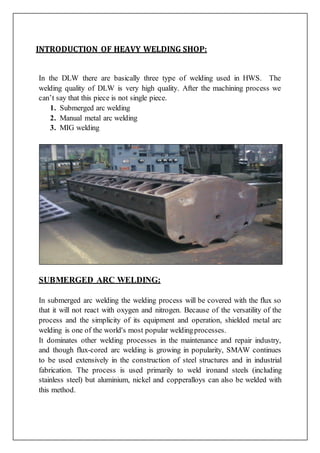
INTRODUCTION OF HEAVY WELDING SHOP:
In the DLW there are basically three type of welding used in HWS. The
welding quality of DLW is very high quality. After the machining process we
can’t say that this piece is not single piece.
1. Submerged arc welding
2. Manual metal arc welding
3. MIG welding
SUBMERGED ARC WELDING:
In submerged arc welding the welding process will be covered with the flux so
that it will not react with oxygen and nitrogen. Because of the versatility of the
process and the simplicity of its equipment and operation, shielded metal arc
welding is one of the world's most popular weldingprocesses.
It dominates other welding processes in the maintenance and repair industry,
and though flux-cored arc welding is growing in popularity, SMAW continues
to be used extensively in the construction of steel structures and in industrial
fabrication. The process is used primarily to weld ironand steels (including
stainless steel) but aluminium, nickel and copperalloys can also be welded with
this method.
GMAW COMPONENTS:
1. DC or Direct Current power supply
2. Electrode or wire feed controller
3. Wire drive roller assembly
4. Shielding gas source(cylinder) & regulator
5. Manually held Gun & ground clamps
6. Wire reel
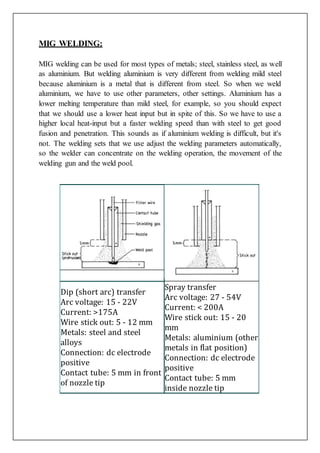
MIG WELDING:
MIG welding can be used for most types of metals; steel, stainless steel, as well
as aluminium. But welding aluminium is very different from welding mild steel
because aluminium is a metal that is different from steel. So when we weld
aluminium, we have to use other parameters, other settings. Aluminium has a
lower melting temperature than mild steel, for example, so you should expect
that we should use a lower heat input but in spite of this. So we have to use a
higher local heat-input but a faster welding speed than with steel to get good
fusion and penetration. This sounds as if aluminium welding is difficult, but it's
not. The welding sets that we use adjust the welding parameters automatically,
so the welder can concentrate on the welding operation, the movement of the
welding gun and the weld pool.
Dip (short arc) transfer
Arc voltage: 15 - 22V
Current: >175A
Wire stick out: 5 - 12 mm
Metals: steel and steel
alloys
Connection: dc electrode
positive
Contact tube: 5 mm in front
of nozzle tip
Spray transfer
Arc voltage: 27 - 54V
Current: < 200A
Wire stick out: 15 - 20
mm
Metals: aluminium (other
metals in flat position)
Connection: dc electrode
positive
Contact tube: 5 mm
inside nozzle tip
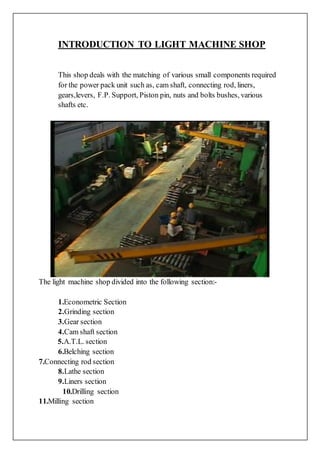
INTRODUCTION TO LIGHT MACHINE SHOP
This shop deals with the matching of various small components required
for the power pack unit such as, cam shaft, connecting rod, liners,
gears,levers, F.P. Support, Piston pin, nuts and bolts bushes, various
shafts etc.
The light machine shop divided into the following section:-
1.Econometric Section
2.Grinding section
3.Gear section
4.Cam shaft section
5.A.T.L. section
6.Belching section
7.Connecting rod section
8.Lathe section
9.Liners section
10.Drilling section
11.Milling section
1. Econometric section:This section manufacturing various sizes etc.
Machine provided: - econometric machine, do-all machine, belt grinding
machine (for control shaft feed)
2. Gear-Section:
This section deals to making various gears impeller such as: cam shaft gear,
crank shaft gear, extension shaft gear, impeller gear (follower & drive) and
broaching Machine Provided:-
(a) gear hobbling machine
(b) gear shaving machine
(c) V.T.L. machine
(d) Radial drilling machine
(e) Broaching machine
(f) Centre mill M/C
3. Grinding Section:
In this section the various small components are grinding as per required
finishing after machining operation and each components having grinding
allowance (G.A.) main piston pin, impeller and fuller and follower gear,
pin valve guide, various studs. Cam roller, seat (V/C Q ‘X’ head) spider
various bushes etc.
Machine provided:
a. cylindrical grinding machine
b. internal grinding machine
c. Centre less grinding machine
d. thread rolling machine
e. universal grinding machine
f. external grinding machine
4. Camshaft section:
This section making cam shaft (both B.G. & M.G.) with completed
machining operation by various special type of machine. In B.G. 08 no’s
per loco and in M.G. 03 per loco.
Machine Provided:
1. Centre mill machine
2. Auto lathe machine
3. Gun drill machine
4. External grinding machine
5. Lathe machine
6. Cam grinding machine
7. Radial drilling machine
8. Cam angle checking machine
9. Magna flux machine
05.Automatic Turret Lathe (A.T.L) Section:
This section manufacturing various types of small components forPower
pack engine such as:
Lock spring seat (V/L & X-Hd) spewing seat. Ball end, cup end ad.
Screw (X-HD & V/L) cop screws L.A.S. retainer, spring lever, F.P. inlet,
Porg Bkt. piston pin liner sleeve, bodyouter ring spicier etc.
Machine Provided:
1. M.T.L. ( Bar type , chuck type)
2. U.T.L.
The A.T.L. section is the vital section of this shop. Maximum small
components are manufacturing in the section.
6. Benching Section:
In this section the benching operation of the entire component which are
manufacturing in the shop are done here. In the benching section, there
hawing hand cutter machining and belt grinding machine, with the half of
these machine bar removing from all the components.
7. Connecting rod section:
In this section the connecting rod is made. All the machining operations
of the connecting rod, completed here with the help of various types of
machine. The connecting rod has two parts, one is cap and other is rod.
The material of the connecting rod is steep forging. In B.G. 16 per loco
and in M.G. 6 per loco.
Main dimensions:
1. crank bore (big bore) =6-411” to 6.421”
2. piston pin bore (small bore)=3.998” to 3.999”
3. Distance Between Two = 20.995” to 21.000” bare Centre
4. Rod Thickness = 3.020” to 3.022”
5. Weight = 32 Kg 950 gram to 32 Kg gram.
6. Pressure Torque = 150 P.S.I.
8. Lathe section:
This section deals various types tropical small components are
manufacturing. Centre lath machines oar provided in this section.
The components are: brass sleeve, wear plate, valve guide, long stud,
shaft etc.
In drum type turret lathe M/C manufacturing pin cam roller, cup end,
bush washer etc.
9. Cylinder Liner Section:
In this section .cycle liner machine operation have done here by the
various type of m/cs. the material of the cylinder Liner is special Cast
iron and the set the per loco is in B.G. 16 and in M.G. 6 cylinder.
Main Dimension:-
1. Length 21 15/16 + 1/64
2. Inside dia. rough honing -9.010”
3. Inside dia. finish honing – 9.015”
4. outside dia. – 10.00”
5. Dia. of groove – 10.749 to 10.750”
Machine provided:-
1. Shot blast machine.
2. Vertical boring machine
3. Auto lathe machine.
4. Honing machine.
5. Cylindrical grinding machine.
10. Drilling Section :
In this section dials with various Types of drilling, reaming, counter
bore spot tracing and counter sinking operation done of various small
components.
The components are, F.P. support, P.R. Lighter, X head, Valve Lever,
Spring Lever, Brg, Bracket, Pin, Ecc Lever, Upper housing etc.
Machine Provided:-
1. Radial drilling Machine,
2. Gang drilling machine of multy spindle drilling machine
3. Drilling Machine
4. Electronic drilling machine.
11. Milling Machine:-
This section manufacturing various types of milling operation of the
components in different types of milling machine-
Machine Provided:-
1. Vertical milling machine
2. Horizontal milling machine
3. Universal milling machine.
INTRODUCTION TO MACHIN SHOP
Machine shop work is generally understood to include all cold-metal work by
which an operator, using either power driven equipment or hand tools, removes
a portion of the metal and shapes it to some specified form or size. It does not
include sheet metal work and coppersmithing. The function of all machine tools
is to produce metal parts by changing the shape, size, or finish of a piece of
material. The shape of a part made with a machine tool is limited by the types of
motion the tool can apply.
Standard machine tools are grouped in six basic classes:
1. LATHES
2. DRILLING MACHINES
3. SHAPERS
4. PLANERS
5. MILLING MACHINES
6. GRINDING MACHINES
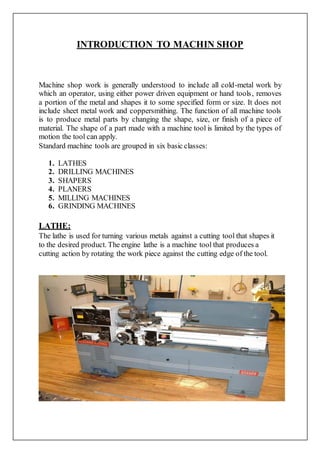
LATHE:
The lathe is used for turning various metals against a cutting tool that shapes it
to the desired product. The engine lathe is a machine tool that produces a
cutting action by rotating the work piece against the cutting edge of the tool.
DRILLING MACHINES:
The drilling machine is a machine tool that produces the necessary cutting
action by the rotation of a multiple edge cutting tool.
SHAPING AND PLANING MACHINES:
Both of these machines can machine flat surfaces with a single point
reciprocating, motion is applied to both the work piece and toolin these
machines.
MILLING MACHINES:
A milling machine provides cutting action to a rotating tool. Thevertical
milling machine is used to cut, shape, and finish metal objects.
GRINDING MACHINES
A grinder differs from other machines in that it uses a tool made of emery,
Carborundum, or similar materials. The wheel, made up of many tiny cutting
points, cuts with the entire surface area that comes in contactwith the material
being ground. Grinders cut with a grinding action, removing material in the
form of tiny particles.
SAFETY RULES FOR MACHINE TOOLS:
The following are general safety rules for any machine tool:
1. Gears, pulleys, belts, couplings, ends of shafts having keyways, and other
revolving or reciprocating parts should be guarded to a height of 6 feet
above the floor. The guards should be removed only for repairing or
adjusting the machine and must be replaced before operating it.
2. Safety setscrews should be used in collars and on all revolving or
reciprocating members of the machine tool or its equipment.
3. Do not operate any machine tool without properlighting.
4. Never attempt to operate any machine tool until you fully understand how
it works and know how to stop it quickly.
5. Never wear loose or torn clothing and secure long hair, since these items
can become caught in revolving machine parts. Ties should be removed
and shirt sleeves should be rolled up above the elbow.
6. Gloves should never be worn when operating machinery except when
absolutely necessary.
7. Always stop the machine before cleaning it or taking measurements of the
work piece.
8. Do not lubricate a machine while it is in motion. Injury to the operator and
damage to the machine may result from this practice.
9. Always wear safety glasses or goggles while operating machine tools.
Also, wear respiratory protection if operation creates hazardous dust. All
persons in the area where power tools are being operated should also wear
safety eye protection and respirators as needed.
10.Know where tire extinguishers are located in the shop area and how to use
them.
11.Never wear jewellery while working around machine tools. Rings,
watches, or bracelets maybe caught in a revolving part which could result
in the hand being pulled into the machine.
12.Avoid horseplay. Tools are very sharp and machines are made of hard
steel. An accidental slip or fall may cause a serious injury.
13.Never use compressed air without a safety nozzle to clean machines or
clothing. It will blow sharp, dangerous metal chips a longdistance.
14.Never place tools or other materials on the machine table. Cluttering up a
machine with tools or materials creates unsafe working conditions. Use a
bench or table near the machine for this purpose.
15.Always use a rag when handling sharp cutters such as milling cutters and
end mills.
INTRODUCTION TO TRUCK MACHINE SHOP:
The shop deals with the matching various small component such as pinion,
Axial wheel, collar, gearing, gear etc.
(1). Truck frame machining section
(2). Center lathe machine section
(3). U.T.L section
(4). Axial wheel machine section
(5). Miscellaneous machine section
(6).Axial wheel and boxassembly section
(7). Truck frame sub assembly section
(8). Truck frame fabrication section
(9).Truck frame assembly section
CONCLUSION
RECENT MILESTONES & FUTURE PLAN:
MILESTONES ACHIEVED:
Transfer of Technology (TOT):
1. Agreement with General Motors of USA for technology transfer to
manufacture high horse-power GT46MAC 4000HP AC/AC locomotive in
India;
2. Only country outside North-America to have this bleeding edgetechnology;
3. Many export/repeat orders complied successfully in recent past and many
more in the pipeline;
4. supplied more than 400 locomotives to various non-railway customers;
5. Emerging as a leading manufacturer of ALCO/ GM locomotives for
developing countries.
FUTURE PLANS:
1. GM technology to manufacture their latest 710 series of diesel electric
locomotives;
2. To emerge as a globally competitive locomotive manufacturer;
3. To develop as an export hub for ALCO/ GM locos for Asian market;
4. To follow an export led growth strategy through continuous improvement
5. Costeffectiveness and technology/ productup-gradation as a key to retain
global competitiveness by putting price-value-technology equation right.
DLW  training report

DLW training report

  • 1.
    A SUMMER FIELD TRAININGREPORT AT DIESEL LOCOMOTIVE WORKS VARANASI Submitted To-Department Of Mechanical Engineering Translam Institute of Technology & Management, Meerut In partial fulfillment of the requirement for the award of degree of BACHELOR OF TECHNOLOGY IN MECHANICAL ENGINEERING BY ISHANT GAUTAM Roll No.- 1232140025 TRANSLAM INSTITUTE OF TECHNOLOGY & MANAGEMENT, MEERUT (Affiliated to AICTE & Uttar Pradesh Technical University, Lucknow)
  • 2.
    ACKNOWLEDGEMENT I would sincerelylike to thank the employees and the officers of DLW, VARANASI for their help and support during the vocational training. Despite their busy schedules, they took time out for us and explained to us the various aspects of the working of the plant from the production shops. I would sincerely like to thank Mr. Sudhir Sinha (CWI /TTC) and Mr. Ajay Kumar(JE/HWS), Mr. Vipin Srivastava(JE/HWS), Mr. Arvind Kumar(JE/HMS),Er. Ravi Gupta(SSE/HMS) who was instrumental in arranging the vocational training at DLW Varanasi, and without whose help and guidance the training could not have materialize. I express my deep sense of gratitude to Mr. S.P.Singh(Principal, TTC) for given me such a great opportunity.
  • 3.
    PREFACE The objectives ofthe practical training are to learn something about industries practically and to be familiar with the working style of a technical person to adjust simply according to the industrial environment. It is rightly said practical life is far away from theoretical one. We learn in class room can give the practical exposer real life experience no doubt they help in improving the personality of the student, but the practical exposure in the field will help the student in long run of life and will be able to implement the theoretical knowledge. As a part of academic syllabus of four year degree course in Mechanical Engineering, every student is required to undergo a practicaltraining. I am student of third year mechanical and this report is written on the basis of practical knowledge acquired by me during the period of practical training taken at Diesel Locomotive Works, Varanasi.
  • 4.
    CONTENTS [1].Introduction to DLW………………………………………. [2].Heavy Welding Shop………………………………………. [3]. Light Machine Shop………………………………………... [4]. Truck Machine Shop……………………………………….. [5]. Machine Shop………………………………………………. [6]. Conclusion………………………………………………….. [7]. Bibliography…………………………………………………
  • 5.
    INTRODUCTION TO DLW DieselLocomotive Works (DLW) is a production unit under the ministry of railways. This was setup in collaboration with American Locomotive Company (ALCO), USA in 1961 and the first locomotive was rolled out in 1964. This unit produces diesel electronic locomotives and DG sets for Indian railways and other customers in India and Abroad. Subsequently a contract for transfer of technology of 4000 HP Microprocessor Controlled AC/AC Freight (GT 46 MAC) / passenger (GT 46 PAC) locomotives and family of 710 engines has been signed with electro motive division of GENERL MOTORS of USA for manufacture in DLW. The production of these locomotives has now started and thus DLW is the only manufacturers of Diesel Electric Locomotives with both ALCO and General Motors technologies in the world.
  • 6.
    Brief History:  Setup in 1961 as a green-field project in technical collaboration with ALCO/USA to Manufacture Diesel Electric Locomotives.  First locomotive rolled out and dedicated to nation in January, 1964.  Transfer-of-Technology agreement signed with General Motors/ USA in October, 95 to manufacture state-of-the-art high traction AC-AC diesel locomotives.  A flagship company of Indian Railways offering complete range of flanking products in its area of operation.  State-of-the art Design and Manufacturing facility to manufacture more than 150 locomotives per annum with wide range of related products viz. components and sub-assemblies.  Unbeatable trail-blazing track record in providing cost-effective, eco- friendly and reliable solutions to ever-increasing transportation needs for over three decades.  Fully geared to meet specific transportation needs by putting Price-Value- Technology equation perfectly right.  A large base of delighted customers among many countries viz. Sri Lanka, Malaysia, Vietnam, Bangladesh, Tanzania to name a few, bearing testimony to product leadership in its category. SALIENT FEATURES: Annual production capacity 125 Locomotives Annual turn-over (Rs) 5000 million Total number of staff 7223
  • 7.
    Workshop land 89Hectares Township area 211 Hectares Covered area in shops 86300 m2 Covered area of other service buildings 73700 m2 Electrical power requirement 3468 KVA (Average maximum demand) Electrical energy consumption (units/year) 19.8 million Standby power generation capacity 3000 KW PRODUCT OF DLW: DLW is an integrated plant and its manufacturing facilities are flexible in nature. These can be utilized for manufacture of different design of locomotives of various gauges suiting customer requirements and other products. The product range available is as under:  WDG4 4000 HP AC/AC Freight Traffic Locomotive  WDP4 4000 HPAC/AC Broad Gauge High Speed Locomotive  WDG3D 3400 HP AC/AC Broad Gauge Mixed Traffic Micro-ProcessorControlled Locomotive.  WDM3C 3300 HP AC/DC Broad Gauge Mixed Traffic Locomotive.  WDM3A 3100 HP AC/DC Broad Gauge Mixed Traffic Locomotive.  WDP3A 3100 HP AC/DC Broad Gauge High Speed Passenger Locomotive.  WDG3A 3100 HP AC/DC Broad Gauge Freight Locomotive.
  • 8.
     WDM2 2600HP AC/DC Broad Gauge Mixed Traffic Locomotive.  WDP1 2300 HP AC/DC Broad Gauge Intercity Express Locomotive.  WDM7 2150 HP DC/DC Broad Gauge Mixed Traffic Locomotive.  WDM6 1350 HP DC/DC Broad Gauge Mixed Traffic Locomotive.  YDM4 1350 HP AC/DC & DC/DC Broad Gauge Mixed traffic Locomotive.  EXPORT LOCO 2300 HP AC/DC Meter Gauge/Cape gauge Mixed Traffic Locomotive.  Diesel Generating Sets 800 KW to 2500 KW  Spare Parts for engines, locomotives and generating sets. DESIGN OFFICE: Prepare diag. of each part and sent to Material Control& inform timely in any change in any parts to relative department. 3D MODEL OF DIESEL LOCO MOTIVE
  • 9.
    MATERIAL CONTROL OFFICE: Preparedmaterial list (ml) which consists diag. & qty. of each part and sent to store departments for purchase. FORK LIFT TRUCK STORE DEPARTMENT: After receiving of ML, Store Departments scrutiny the ML, take Funds & vetting from Accountdepartment & then issue tenders, Open Tenders & Purchase Order issued. After Receiving of Material inspection has done by Inspection Department. INSPECTION DEPARTMENT: After Receiving of Material inspection has done by Inspection Deptt. Ifmaterial is OK then Receipt Note issued by Store Deptt and sent to Acct. Department for payment to firm. If material is not OK Then inform to firm to collect the rejected material. ACCOUNT DEPARTMENT: Check all the purchase, given concurrence for purchase, vett the ML/Requisition & payment to firms.
  • 10.
    PLANNING OFFICE: Prepare JPO,Monthly Production Program, Scheduling, Processing, Rate Fixing, Issue Work Orders, Schedule Orders, Issue Job card & other production Documents. Preparing DLW Budget & Sent to Rly Board. PROGRESS OFFICE: After opening of work orders collect the prod. Documents from PCO and hand over to user shop draw the material from depot& given to shop & hand over the ready material of shop to user shop/store. After completion of work, close the work order. PRODUCTION SHOPS: Production shops are divided in three divisions- 1. Block Divisions 2. Engine Divisions 3. Loco Divisions BLOCK DIVISION: 1. Heavy Weld Shop 2. Heavy Machine Shop ENGINE DIVISION: 1. Engine Erection Shop 2. Engine Testing Shop 3. Light Machine Shop 4. Sub Assembly Shop 5.RotorShop 6. Heat Treatment Shop LOCO DIVISION: 1. Loco Frame Shop 2. Pipe Shop 3. Truck Machine Shop 4. Traction Assembly Shop 5.Sheet Metal Shop 6. Loco Assembly Shop 7. Loco Paint Shop 8. Loco Test Shop
  • 11.
    SERVICE SHOPS: 1. MaintenanceAreas#1, 2, 3 2. Tool Room 3. Central Transport Shop PERSONNAL DEPARTMENT: Prepare payment of Staff, Leave Record, PersonalRecord of every employee, Housing allotment, welfare of staff etc. HEALTH DEPARTMENT: Having facility of Indoor & Outdoorpatients. CIVIL DEPARTMENT: Maintenance of colony quarters, up gradation of facilities in quarters, sanitation etc. ELECTRICAL DEPARTMENT: Maintenance of Lighting in quarters and in workshop, electrical works in locomotive etc. TECHNICAL TRANING CENTER: Provide training to all employees at time to time to refresh update their knowledge. RESEARCH &DEVELOPMENT: 1. R & D - a Customer centric Activity Committed to Innovation and Continuous Improvement; 2. Highly skilled Manpower capable of handling complete R&Dactivities; 3. A sophisticated design center with modern CAD/ CAE workstations equipped with Unigraphics and Ansys; 4. Back-up supportfrom RDSO, a centralized R&D organization at corporatelevel; 5. Several milestones in the past - an enviable pedigree viz. a. original ALCO design made 7% more fuel efficient;
  • 12.
    b. many designimprovements leading to better performance, incorporated in the original ALCO design; c. many new designs for locomotives such as WDP1, WDG2, WDP2 to name a few; RECENT MILESTONES & FUTURE PLAN: MILESTONES ACHIEVED:Transfer of technology (TOT) -- An added feather in the cap:-  Agreement with General Motors of USA for technology transfer to manufacture high horse-power GT46MAC 4000HP AC/AC locomotive in India;  Only country outside North-America to have this bleeding edge technology Many export/repeat orders complied successfully in recent past and many more in the pipeline; Supplied more than 400 locomotives to various non- railway customers; Emerging as a leading manufacturer of ALCO/ GM locomotives for developing countries. FUTURE PLANS: • Assimilation of GM technology to manufacture their latest 710 series of diesel electric locomotives; • To emerge as a globally competitive locomotive manufacturer; • To develop as an export hub for ALCO/ GM locos for Asian market; • To follow an export led growth strategy through continuous improvement; Costeffectiveness and technology/ productup-gradation as a key to retain global competitiveness by putting price-value-technology equation right.
  • 13.
    WDP4, 4000 HPPASSENGER LOCOMOTIVE General Characteristic  Installed Power  Axle Load  Gauge  Wheel arrangement  Wheel diameter  Height  Width  Overall Length (Over Buffer Beam)  Weight  Max tractive effort  Maximum speed  Fuel tank capacity  Locomotive Control  4000 HP  19.5 T  1676 mm  A-A-I I-A-A  1092 mm  4201mm  3127 mm  19964 mm   117 T  27 T  160 Kmph  4000 lts  EM 2000 with SIBAS-16 Traction Control WDP4-4000 HP GOODS LOCOMOTIVE TRACTIVE EFFORT & POWER CHART
  • 14.
    INTRODUCTION OF HEAVYWELDING SHOP: In the DLW there are basically three type of welding used in HWS. The welding quality of DLW is very high quality. After the machining process we can’t say that this piece is not single piece. 1. Submerged arc welding 2. Manual metal arc welding 3. MIG welding SUBMERGED ARC WELDING: In submerged arc welding the welding process will be covered with the flux so that it will not react with oxygen and nitrogen. Because of the versatility of the process and the simplicity of its equipment and operation, shielded metal arc welding is one of the world's most popular weldingprocesses. It dominates other welding processes in the maintenance and repair industry, and though flux-cored arc welding is growing in popularity, SMAW continues to be used extensively in the construction of steel structures and in industrial fabrication. The process is used primarily to weld ironand steels (including stainless steel) but aluminium, nickel and copperalloys can also be welded with this method.
  • 15.
    GMAW COMPONENTS: 1. DCor Direct Current power supply 2. Electrode or wire feed controller 3. Wire drive roller assembly 4. Shielding gas source(cylinder) & regulator 5. Manually held Gun & ground clamps 6. Wire reel
  • 16.
    MIG WELDING: MIG weldingcan be used for most types of metals; steel, stainless steel, as well as aluminium. But welding aluminium is very different from welding mild steel because aluminium is a metal that is different from steel. So when we weld aluminium, we have to use other parameters, other settings. Aluminium has a lower melting temperature than mild steel, for example, so you should expect that we should use a lower heat input but in spite of this. So we have to use a higher local heat-input but a faster welding speed than with steel to get good fusion and penetration. This sounds as if aluminium welding is difficult, but it's not. The welding sets that we use adjust the welding parameters automatically, so the welder can concentrate on the welding operation, the movement of the welding gun and the weld pool. Dip (short arc) transfer Arc voltage: 15 - 22V Current: >175A Wire stick out: 5 - 12 mm Metals: steel and steel alloys Connection: dc electrode positive Contact tube: 5 mm in front of nozzle tip Spray transfer Arc voltage: 27 - 54V Current: < 200A Wire stick out: 15 - 20 mm Metals: aluminium (other metals in flat position) Connection: dc electrode positive Contact tube: 5 mm inside nozzle tip
  • 17.
    INTRODUCTION TO LIGHTMACHINE SHOP This shop deals with the matching of various small components required for the power pack unit such as, cam shaft, connecting rod, liners, gears,levers, F.P. Support, Piston pin, nuts and bolts bushes, various shafts etc. The light machine shop divided into the following section:- 1.Econometric Section 2.Grinding section 3.Gear section 4.Cam shaft section 5.A.T.L. section 6.Belching section 7.Connecting rod section 8.Lathe section 9.Liners section 10.Drilling section 11.Milling section
  • 18.
    1. Econometric section:Thissection manufacturing various sizes etc. Machine provided: - econometric machine, do-all machine, belt grinding machine (for control shaft feed) 2. Gear-Section: This section deals to making various gears impeller such as: cam shaft gear, crank shaft gear, extension shaft gear, impeller gear (follower & drive) and broaching Machine Provided:- (a) gear hobbling machine (b) gear shaving machine (c) V.T.L. machine (d) Radial drilling machine (e) Broaching machine (f) Centre mill M/C
  • 19.
    3. Grinding Section: Inthis section the various small components are grinding as per required finishing after machining operation and each components having grinding allowance (G.A.) main piston pin, impeller and fuller and follower gear, pin valve guide, various studs. Cam roller, seat (V/C Q ‘X’ head) spider various bushes etc. Machine provided: a. cylindrical grinding machine b. internal grinding machine c. Centre less grinding machine d. thread rolling machine e. universal grinding machine f. external grinding machine 4. Camshaft section: This section making cam shaft (both B.G. & M.G.) with completed machining operation by various special type of machine. In B.G. 08 no’s per loco and in M.G. 03 per loco. Machine Provided: 1. Centre mill machine 2. Auto lathe machine 3. Gun drill machine 4. External grinding machine 5. Lathe machine 6. Cam grinding machine 7. Radial drilling machine 8. Cam angle checking machine 9. Magna flux machine 05.Automatic Turret Lathe (A.T.L) Section: This section manufacturing various types of small components forPower pack engine such as:
  • 20.
    Lock spring seat(V/L & X-Hd) spewing seat. Ball end, cup end ad. Screw (X-HD & V/L) cop screws L.A.S. retainer, spring lever, F.P. inlet, Porg Bkt. piston pin liner sleeve, bodyouter ring spicier etc. Machine Provided: 1. M.T.L. ( Bar type , chuck type) 2. U.T.L. The A.T.L. section is the vital section of this shop. Maximum small components are manufacturing in the section. 6. Benching Section: In this section the benching operation of the entire component which are manufacturing in the shop are done here. In the benching section, there hawing hand cutter machining and belt grinding machine, with the half of these machine bar removing from all the components. 7. Connecting rod section: In this section the connecting rod is made. All the machining operations of the connecting rod, completed here with the help of various types of machine. The connecting rod has two parts, one is cap and other is rod. The material of the connecting rod is steep forging. In B.G. 16 per loco and in M.G. 6 per loco. Main dimensions: 1. crank bore (big bore) =6-411” to 6.421” 2. piston pin bore (small bore)=3.998” to 3.999” 3. Distance Between Two = 20.995” to 21.000” bare Centre 4. Rod Thickness = 3.020” to 3.022” 5. Weight = 32 Kg 950 gram to 32 Kg gram. 6. Pressure Torque = 150 P.S.I.
  • 21.
    8. Lathe section: Thissection deals various types tropical small components are manufacturing. Centre lath machines oar provided in this section. The components are: brass sleeve, wear plate, valve guide, long stud, shaft etc. In drum type turret lathe M/C manufacturing pin cam roller, cup end, bush washer etc. 9. Cylinder Liner Section: In this section .cycle liner machine operation have done here by the various type of m/cs. the material of the cylinder Liner is special Cast iron and the set the per loco is in B.G. 16 and in M.G. 6 cylinder. Main Dimension:- 1. Length 21 15/16 + 1/64 2. Inside dia. rough honing -9.010” 3. Inside dia. finish honing – 9.015” 4. outside dia. – 10.00” 5. Dia. of groove – 10.749 to 10.750” Machine provided:- 1. Shot blast machine. 2. Vertical boring machine 3. Auto lathe machine. 4. Honing machine.
  • 22.
    5. Cylindrical grindingmachine. 10. Drilling Section : In this section dials with various Types of drilling, reaming, counter bore spot tracing and counter sinking operation done of various small components. The components are, F.P. support, P.R. Lighter, X head, Valve Lever, Spring Lever, Brg, Bracket, Pin, Ecc Lever, Upper housing etc. Machine Provided:- 1. Radial drilling Machine, 2. Gang drilling machine of multy spindle drilling machine 3. Drilling Machine 4. Electronic drilling machine. 11. Milling Machine:- This section manufacturing various types of milling operation of the components in different types of milling machine- Machine Provided:- 1. Vertical milling machine 2. Horizontal milling machine 3. Universal milling machine.
  • 23.
    INTRODUCTION TO MACHINSHOP Machine shop work is generally understood to include all cold-metal work by which an operator, using either power driven equipment or hand tools, removes a portion of the metal and shapes it to some specified form or size. It does not include sheet metal work and coppersmithing. The function of all machine tools is to produce metal parts by changing the shape, size, or finish of a piece of material. The shape of a part made with a machine tool is limited by the types of motion the tool can apply. Standard machine tools are grouped in six basic classes: 1. LATHES 2. DRILLING MACHINES 3. SHAPERS 4. PLANERS 5. MILLING MACHINES 6. GRINDING MACHINES LATHE: The lathe is used for turning various metals against a cutting tool that shapes it to the desired product. The engine lathe is a machine tool that produces a cutting action by rotating the work piece against the cutting edge of the tool.
  • 24.
    DRILLING MACHINES: The drillingmachine is a machine tool that produces the necessary cutting action by the rotation of a multiple edge cutting tool. SHAPING AND PLANING MACHINES: Both of these machines can machine flat surfaces with a single point reciprocating, motion is applied to both the work piece and toolin these machines. MILLING MACHINES: A milling machine provides cutting action to a rotating tool. Thevertical milling machine is used to cut, shape, and finish metal objects. GRINDING MACHINES A grinder differs from other machines in that it uses a tool made of emery, Carborundum, or similar materials. The wheel, made up of many tiny cutting points, cuts with the entire surface area that comes in contactwith the material being ground. Grinders cut with a grinding action, removing material in the form of tiny particles.
  • 25.
    SAFETY RULES FORMACHINE TOOLS: The following are general safety rules for any machine tool: 1. Gears, pulleys, belts, couplings, ends of shafts having keyways, and other revolving or reciprocating parts should be guarded to a height of 6 feet above the floor. The guards should be removed only for repairing or adjusting the machine and must be replaced before operating it. 2. Safety setscrews should be used in collars and on all revolving or reciprocating members of the machine tool or its equipment. 3. Do not operate any machine tool without properlighting. 4. Never attempt to operate any machine tool until you fully understand how it works and know how to stop it quickly. 5. Never wear loose or torn clothing and secure long hair, since these items can become caught in revolving machine parts. Ties should be removed and shirt sleeves should be rolled up above the elbow. 6. Gloves should never be worn when operating machinery except when absolutely necessary. 7. Always stop the machine before cleaning it or taking measurements of the work piece. 8. Do not lubricate a machine while it is in motion. Injury to the operator and damage to the machine may result from this practice. 9. Always wear safety glasses or goggles while operating machine tools. Also, wear respiratory protection if operation creates hazardous dust. All persons in the area where power tools are being operated should also wear safety eye protection and respirators as needed. 10.Know where tire extinguishers are located in the shop area and how to use them. 11.Never wear jewellery while working around machine tools. Rings, watches, or bracelets maybe caught in a revolving part which could result in the hand being pulled into the machine. 12.Avoid horseplay. Tools are very sharp and machines are made of hard steel. An accidental slip or fall may cause a serious injury. 13.Never use compressed air without a safety nozzle to clean machines or clothing. It will blow sharp, dangerous metal chips a longdistance. 14.Never place tools or other materials on the machine table. Cluttering up a machine with tools or materials creates unsafe working conditions. Use a bench or table near the machine for this purpose. 15.Always use a rag when handling sharp cutters such as milling cutters and end mills.
  • 26.
    INTRODUCTION TO TRUCKMACHINE SHOP: The shop deals with the matching various small component such as pinion, Axial wheel, collar, gearing, gear etc. (1). Truck frame machining section (2). Center lathe machine section (3). U.T.L section (4). Axial wheel machine section (5). Miscellaneous machine section (6).Axial wheel and boxassembly section
  • 27.
    (7). Truck framesub assembly section (8). Truck frame fabrication section (9).Truck frame assembly section
  • 28.
    CONCLUSION RECENT MILESTONES &FUTURE PLAN: MILESTONES ACHIEVED: Transfer of Technology (TOT): 1. Agreement with General Motors of USA for technology transfer to manufacture high horse-power GT46MAC 4000HP AC/AC locomotive in India; 2. Only country outside North-America to have this bleeding edgetechnology; 3. Many export/repeat orders complied successfully in recent past and many more in the pipeline; 4. supplied more than 400 locomotives to various non-railway customers; 5. Emerging as a leading manufacturer of ALCO/ GM locomotives for developing countries. FUTURE PLANS: 1. GM technology to manufacture their latest 710 series of diesel electric locomotives; 2. To emerge as a globally competitive locomotive manufacturer; 3. To develop as an export hub for ALCO/ GM locos for Asian market; 4. To follow an export led growth strategy through continuous improvement 5. Costeffectiveness and technology/ productup-gradation as a key to retain global competitiveness by putting price-value-technology equation right.