
DIESLE LOCOMOTIVE WORK (DLW)
VARANASI, UTTERPRADESH
A TECHNICAL SEMINAR
BACHELOR OF TECHNOLOGY
(Mechanical Engineering)
SUBMITTED TO
AMC ENGINEERING COLLEGE ,
BANGALORE
SUBMITTED BY
University Reg.no
VIPIN KUMAR
RAI 1AM12ME103
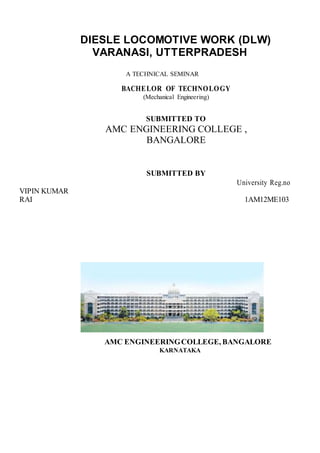
AMC ENGINEERINGCOLLEGE, BANGALORE
KARNATAKA
Diesel Locomotive Works
Varanasi, (Uttar Pradesh)
A TRAINING REPORT
TABLE OF CONTENTS
 Training Certificate
 Acknowledgement
 Preface
 Introduction to D.L.W
 Welding Lab TTC
 Rotor Shop
 Loco Painting Shop
 Machining Lab TTC
 Sub Assembly Shop
 Tool Room
 Demerit
ACKNOWLEDGEMENT
I would like to thank “DLW Technical Training Centre (TTC), Varanasi” for the
solemnly support to the students for their Industrial training program.
I express my sincere gratitude to Mr. _________________________, Principal of
Technical Training Centre for the support and encouragement he provided.
I also wish to extend my thanks to the Respected Engineers, Junior Engineers and the
Workers of different sections and sub-sections of DLW who provided us the knowledge
about the different machining processes, Assembling process and their workings.
I am extremely thankful to prof._________________, HOD, Amc engineering college ,
Bangalore, for his valuable suggestions and encouragement.
I am also thankful to Mr.________________, Training and placement officer, AMC, Bangalore
for providing the opportunity to us by which we can get some industrial knowledge.
Signature of student
Vipin kumar rai (1am12me103)
i
PREFACE
The objectives of the practical training are to learn something
about industries practically and to be familiar with the working
style of a technical person to adjust simply according to the
industrial environment.
It is rightly said practical life is far away from theoretical one.
We learn in class room can give the practical exposer real life
experience no doubt they help in improving the personality of the
student, but the practical exposure in the field will help the student in
long run of life and will be able to implement the theoretical
knowledge.
As a part of academic syllabus of four year degree course in
Mechanical Engineering, every student is required to undergo a
practical training. I am student of third year mechanical and this
report is written on the basis of practical knowledge acquired by
me during the period of practical training taken at Diesel
Locomotive Works, Varanasi.
INTRODUCTION TO D.L.W
DLW, was founded by Late Railway Minister Mr. Lal Bahadur Shastri on 23 April 1956.It is
spread in 300 acres area at Varanasi.It is a production unit owned by Indian railways, for which
it manufactures diesel–electric locomotives and its spares parts.To meet the increased
transportation needs of the Indian railways it was established in collaboration with
ALCO(American Locomotive Company), USA in 1961.DLW rolled out its first locomotive
three years later, on January 3, 1964. It manufactures locomotives.
Got its first ISO certification in 1997 and ISO-9001 and ISO-14001 in December 2002.With
technology transfer agreement from manufacturers such as GM-EMD, DLW today produces
advance locomotives having output range from 2600 to 4000 hp.At present the latest
locomotive produced by DLW; i.e. WDG 5 has capacity up to 5000 HP & trying to make it
5500 HP.It has supplied locomotives to other countries such as Sri Lanka, Bangladesh,
Malaysia, Tanzania and Vietnam etc.DLW is supplying locos to PSU’s & Industries like
NTPC, COAL, and INDOGULF etc.
DLW Varanasi is further divided into sections and sub-sections from where the job get
completed.A flagship production unit of Indian Railways offering complete range of products
in its area of operation with annual turnover of over 2124 Crore. State of the art Design and
Manufacturing facility to manufacture 200 locomotives per annum with wide range of related
products viz. DG Sets, Loco components and sub-assemblies. Supply of spares required to
maintain Diesel Locomotives and DG sets.
DLW VISION:"To be a world class manufacturer of reliable, cost-effective, state of the art
Diesel - electric locomotives."
DLW MISSION:We shall achieve our vision through
♦ Focus on quality for sustained and continuous improvement in reliability & performance on
the product leading to customer satisfaction.
♦ Developing core competence with due emphasis on innovation, human resource development
and team work.
♦ Achieving environmental excellence by prevention of pollution, reduction of emissions,
energy conservation and preservation of natural resources.
1
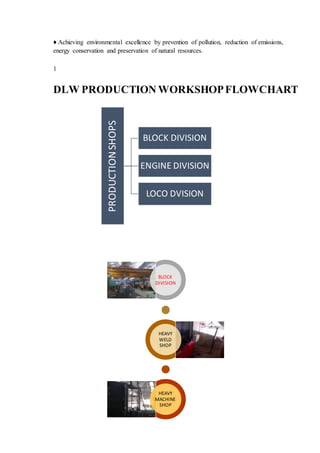
DLW PRODUCTION WORKSHOPFLOWCHART
PRODUCTIONSHOPS
BLOCK DIVISION
ENGINE DIVISION
LOCO DVISION
BLOCK
DIVISION
HEAVY
WELD
SHOP
HEAVY
MACHINE
SHOP
2
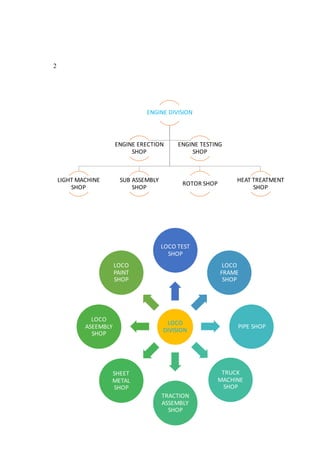
ENGINE DIVISION
LIGHT MACHINE
SHOP
SUB ASSEMBLY
SHOP
ROTOR SHOP
HEAT TREATMENT
SHOP
ENGINE ERECTION
SHOP
ENGINE TESTING
SHOP
LOCO
DIVISION
LOCO TEST
SHOP
LOCO
FRAME
SHOP
PIPE SHOP
TRUCK
MACHINE
SHOP
TRACTION
ASSEMBLY
SHOP
SHEET
METAL
SHOP
LOCO
ASEEMBLY
SHOP
LOCO
PAINT
SHOP
3
SOME BASIC FACT ABOUT DIESEL ELECTRIC
LOCOMOTIVE
 DLW’s annual production - 250
 Cost of one loco - 12 to 14 crore (EMD)
8 crore (Alco)
 Weight of one Loco - 121 Ton
 Fuel Consumption; At Full Load - 540 ltr /hr.
Idle Load - 40 ltr/hr.
 Max. Speed - 160 Km/hr.
 Diameter of Wheel - 1092 mm
 Wheel to Wheel Distance - 1596.5 mm
 Length of Under Frame - 19962 mm
TYPES OF LOCOMOTIVES PRODUCED
 Following types of diesel loco are being produced in the DLW:
1. WDM - Wide Diesel Mixed
2. WDP - Wide Diesel Passenger
3. WDG - Wide Diesel Goods
4. WDS - Wide Diesel Saunter
4
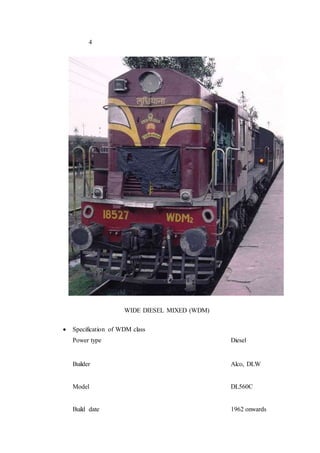
WIDE DIESEL MIXED (WDM)
 Specification of WDM class
Power type Diesel
Builder Alco, DLW
Model DL560C
Build date 1962 onwards
5
Total production 2700+
Gauge 1,676 mm (5 ft 6 in)
Wheel diameter 1,092 mm (3 ft 7.0 in)
Wheelbase 12.834 m (42 ft 1.3 in)
Length 17.12 m (56 ft 2 in)
Width 2.864 m (9 ft 4.8 in)
Height 4.185 m (13 ft 8.8 in)
Axle load 18,800 kg (41,000 lb)
Locomotive weight 112,800 kg (249,000 lb)
Fuel capacity 5,000 ltr (1,100 imp gal;
1,300 US gal)
Prime mover ALCO 251-B
Engine RPM range 400 - 1000 rpm
Aspiration Turbo-supercharged
Cylinders 16
6
Top speed 120 km/hr (75 mph)
Power output 2,400 hp (1,800 kW)
 The class WDM-2 is Indian Railways' workhorse diesel locomotive. The first units were
imported fully built from the American Locomotive Company (Alco) in 1962.
Since 1964, it has been manufactured in India by the Diesel Locomotive Works (DLW),
Varanasi. The model name stands for broad gauge (W), diesel (D), mixed traffic (M)
engine. The WDM-2 is the most common diesel locomotive of Indian Railways.
 The WDM-2A is a variant of the original WDM-2. These units have been retro-fitted
with air brakes, in addition to the original vacuum brakes. TheWDM-2B is a more
recent locomotive, built with air brakes as original equipment. The WDM-2 locos have
a maximum speed of 120 km/h (75 mph), restricted to 100 km/h (62 mph) when run long
hood forward - the gear ratio is 65:18.
7
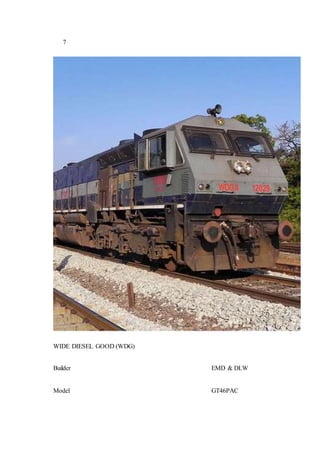
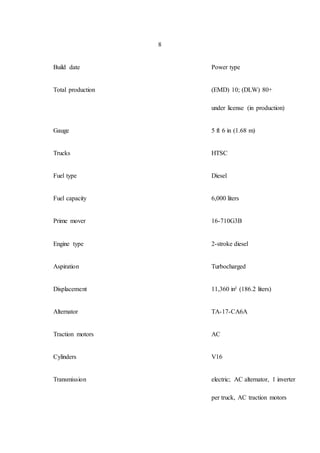
WIDE DIESEL GOOD (WDG)
Builder EMD & DLW
Model GT46PAC
8
Build date Power type
Total production (EMD) 10; (DLW) 80+
under license (in production)
Gauge 5 ft 6 in (1.68 m)
Trucks HTSC
Fuel type Diesel
Fuel capacity 6,000 liters
Prime mover 16-710G3B
Engine type 2-stroke diesel
Aspiration Turbocharged
Displacement 11,360 in² (186.2 liters)
Alternator TA-17-CA6A
Traction motors AC
Cylinders V16
Transmission electric; AC alternator, 1 inverter
per truck, AC traction motors
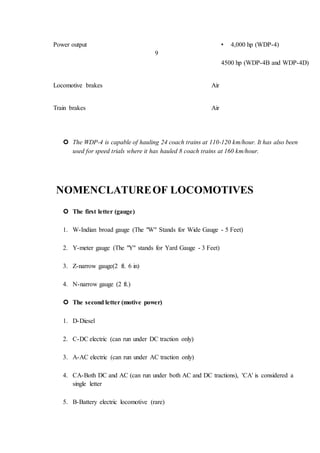
Power output
9
• 4,000 hp (WDP-4)
4500 hp (WDP-4B and WDP-4D)
Locomotive brakes Air
Train brakes Air
 The WDP-4 is capable of hauling 24 coach trains at 110-120 km/hour. It has also been
used for speed trials where it has hauled 8 coach trains at 160 km/hour.
NOMENCLATUREOF LOCOMOTIVES
 The first letter (gauge)
1. W-Indian broad gauge (The "W" Stands for Wide Gauge - 5 Feet)
2. Y-meter gauge (The "Y" stands for Yard Gauge - 3 Feet)
3. Z-narrow gauge(2 ft. 6 in)
4. N-narrow gauge (2 ft.)
 The second letter (motive power)
1. D-Diesel
2. C-DC electric (can run under DC traction only)
3. A-AC electric (can run under AC traction only)
4. CA-Both DC and AC (can run under both AC and DC tractions), 'CA' is considered a
single letter
5. B-Battery electric locomotive (rare)
10
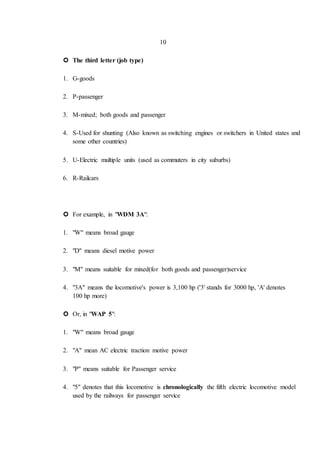
 The third letter (job type)
1. G-goods
2. P-passenger
3. M-mixed; both goods and passenger
4. S-Used for shunting (Also known as switching engines or switchers in United states and
some other countries)
5. U-Electric multiple units (used as commuters in city suburbs)
6. R-Railcars
 For example, in "WDM 3A":
1. "W" means broad gauge
2. "D" means diesel motive power
3. "M" means suitable for mixed(for both goods and passenger)service
4. "3A" means the locomotive's power is 3,100 hp ('3' stands for 3000 hp, 'A' denotes
100 hp more)
 Or, in "WAP 5":
1. "W" means broad gauge
2. "A" mean AC electric traction motive power
3. "P" means suitable for Passenger service
4. "5" denotes that this locomotive is chronologically the fifth electric locomotive model
used by the railways for passenger service
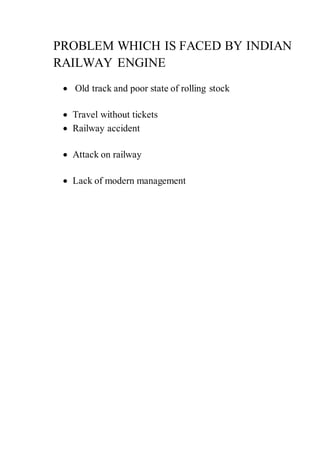
PROBLEM WHICH IS FACED BY INDIAN
RAILWAY ENGINE
 Old track and poor state of rolling stock
 Travel without tickets
 Railway accident
 Attack on railway
 Lack of modern management
Diesel locomotive work

Diesel locomotive work

  • 1.
    DIESLE LOCOMOTIVE WORK(DLW) VARANASI, UTTERPRADESH A TECHNICAL SEMINAR BACHELOR OF TECHNOLOGY (Mechanical Engineering) SUBMITTED TO AMC ENGINEERING COLLEGE , BANGALORE SUBMITTED BY University Reg.no VIPIN KUMAR RAI 1AM12ME103 AMC ENGINEERINGCOLLEGE, BANGALORE KARNATAKA
  • 2.
    Diesel Locomotive Works Varanasi,(Uttar Pradesh) A TRAINING REPORT TABLE OF CONTENTS  Training Certificate  Acknowledgement  Preface  Introduction to D.L.W  Welding Lab TTC  Rotor Shop  Loco Painting Shop  Machining Lab TTC  Sub Assembly Shop  Tool Room  Demerit
  • 3.
    ACKNOWLEDGEMENT I would liketo thank “DLW Technical Training Centre (TTC), Varanasi” for the solemnly support to the students for their Industrial training program. I express my sincere gratitude to Mr. _________________________, Principal of Technical Training Centre for the support and encouragement he provided. I also wish to extend my thanks to the Respected Engineers, Junior Engineers and the Workers of different sections and sub-sections of DLW who provided us the knowledge about the different machining processes, Assembling process and their workings. I am extremely thankful to prof._________________, HOD, Amc engineering college , Bangalore, for his valuable suggestions and encouragement. I am also thankful to Mr.________________, Training and placement officer, AMC, Bangalore for providing the opportunity to us by which we can get some industrial knowledge. Signature of student Vipin kumar rai (1am12me103)
  • 4.
    i PREFACE The objectives ofthe practical training are to learn something about industries practically and to be familiar with the working style of a technical person to adjust simply according to the industrial environment. It is rightly said practical life is far away from theoretical one. We learn in class room can give the practical exposer real life experience no doubt they help in improving the personality of the student, but the practical exposure in the field will help the student in long run of life and will be able to implement the theoretical knowledge. As a part of academic syllabus of four year degree course in Mechanical Engineering, every student is required to undergo a practical training. I am student of third year mechanical and this report is written on the basis of practical knowledge acquired by me during the period of practical training taken at Diesel Locomotive Works, Varanasi.
  • 5.
    INTRODUCTION TO D.L.W DLW,was founded by Late Railway Minister Mr. Lal Bahadur Shastri on 23 April 1956.It is spread in 300 acres area at Varanasi.It is a production unit owned by Indian railways, for which it manufactures diesel–electric locomotives and its spares parts.To meet the increased transportation needs of the Indian railways it was established in collaboration with ALCO(American Locomotive Company), USA in 1961.DLW rolled out its first locomotive three years later, on January 3, 1964. It manufactures locomotives. Got its first ISO certification in 1997 and ISO-9001 and ISO-14001 in December 2002.With technology transfer agreement from manufacturers such as GM-EMD, DLW today produces advance locomotives having output range from 2600 to 4000 hp.At present the latest locomotive produced by DLW; i.e. WDG 5 has capacity up to 5000 HP & trying to make it 5500 HP.It has supplied locomotives to other countries such as Sri Lanka, Bangladesh, Malaysia, Tanzania and Vietnam etc.DLW is supplying locos to PSU’s & Industries like NTPC, COAL, and INDOGULF etc. DLW Varanasi is further divided into sections and sub-sections from where the job get completed.A flagship production unit of Indian Railways offering complete range of products in its area of operation with annual turnover of over 2124 Crore. State of the art Design and Manufacturing facility to manufacture 200 locomotives per annum with wide range of related products viz. DG Sets, Loco components and sub-assemblies. Supply of spares required to maintain Diesel Locomotives and DG sets. DLW VISION:"To be a world class manufacturer of reliable, cost-effective, state of the art Diesel - electric locomotives." DLW MISSION:We shall achieve our vision through ♦ Focus on quality for sustained and continuous improvement in reliability & performance on the product leading to customer satisfaction. ♦ Developing core competence with due emphasis on innovation, human resource development and team work.
  • 6.
    ♦ Achieving environmentalexcellence by prevention of pollution, reduction of emissions, energy conservation and preservation of natural resources. 1 DLW PRODUCTION WORKSHOPFLOWCHART PRODUCTIONSHOPS BLOCK DIVISION ENGINE DIVISION LOCO DVISION BLOCK DIVISION HEAVY WELD SHOP HEAVY MACHINE SHOP
  • 7.
    2 ENGINE DIVISION LIGHT MACHINE SHOP SUBASSEMBLY SHOP ROTOR SHOP HEAT TREATMENT SHOP ENGINE ERECTION SHOP ENGINE TESTING SHOP LOCO DIVISION LOCO TEST SHOP LOCO FRAME SHOP PIPE SHOP TRUCK MACHINE SHOP TRACTION ASSEMBLY SHOP SHEET METAL SHOP LOCO ASEEMBLY SHOP LOCO PAINT SHOP
  • 8.
    3 SOME BASIC FACTABOUT DIESEL ELECTRIC LOCOMOTIVE  DLW’s annual production - 250  Cost of one loco - 12 to 14 crore (EMD) 8 crore (Alco)  Weight of one Loco - 121 Ton  Fuel Consumption; At Full Load - 540 ltr /hr. Idle Load - 40 ltr/hr.  Max. Speed - 160 Km/hr.  Diameter of Wheel - 1092 mm  Wheel to Wheel Distance - 1596.5 mm  Length of Under Frame - 19962 mm TYPES OF LOCOMOTIVES PRODUCED  Following types of diesel loco are being produced in the DLW: 1. WDM - Wide Diesel Mixed 2. WDP - Wide Diesel Passenger 3. WDG - Wide Diesel Goods 4. WDS - Wide Diesel Saunter
  • 9.
    4 WIDE DIESEL MIXED(WDM)  Specification of WDM class Power type Diesel Builder Alco, DLW Model DL560C Build date 1962 onwards
  • 10.
    5 Total production 2700+ Gauge1,676 mm (5 ft 6 in) Wheel diameter 1,092 mm (3 ft 7.0 in) Wheelbase 12.834 m (42 ft 1.3 in) Length 17.12 m (56 ft 2 in) Width 2.864 m (9 ft 4.8 in) Height 4.185 m (13 ft 8.8 in) Axle load 18,800 kg (41,000 lb) Locomotive weight 112,800 kg (249,000 lb) Fuel capacity 5,000 ltr (1,100 imp gal; 1,300 US gal) Prime mover ALCO 251-B Engine RPM range 400 - 1000 rpm Aspiration Turbo-supercharged Cylinders 16
  • 11.
    6 Top speed 120km/hr (75 mph) Power output 2,400 hp (1,800 kW)  The class WDM-2 is Indian Railways' workhorse diesel locomotive. The first units were imported fully built from the American Locomotive Company (Alco) in 1962. Since 1964, it has been manufactured in India by the Diesel Locomotive Works (DLW), Varanasi. The model name stands for broad gauge (W), diesel (D), mixed traffic (M) engine. The WDM-2 is the most common diesel locomotive of Indian Railways.  The WDM-2A is a variant of the original WDM-2. These units have been retro-fitted with air brakes, in addition to the original vacuum brakes. TheWDM-2B is a more recent locomotive, built with air brakes as original equipment. The WDM-2 locos have a maximum speed of 120 km/h (75 mph), restricted to 100 km/h (62 mph) when run long hood forward - the gear ratio is 65:18.
  • 12.
    7 WIDE DIESEL GOOD(WDG) Builder EMD & DLW Model GT46PAC
  • 13.
    8 Build date Powertype Total production (EMD) 10; (DLW) 80+ under license (in production) Gauge 5 ft 6 in (1.68 m) Trucks HTSC Fuel type Diesel Fuel capacity 6,000 liters Prime mover 16-710G3B Engine type 2-stroke diesel Aspiration Turbocharged Displacement 11,360 in² (186.2 liters) Alternator TA-17-CA6A Traction motors AC Cylinders V16 Transmission electric; AC alternator, 1 inverter per truck, AC traction motors
  • 14.
    Power output 9 • 4,000hp (WDP-4) 4500 hp (WDP-4B and WDP-4D) Locomotive brakes Air Train brakes Air  The WDP-4 is capable of hauling 24 coach trains at 110-120 km/hour. It has also been used for speed trials where it has hauled 8 coach trains at 160 km/hour. NOMENCLATUREOF LOCOMOTIVES  The first letter (gauge) 1. W-Indian broad gauge (The "W" Stands for Wide Gauge - 5 Feet) 2. Y-meter gauge (The "Y" stands for Yard Gauge - 3 Feet) 3. Z-narrow gauge(2 ft. 6 in) 4. N-narrow gauge (2 ft.)  The second letter (motive power) 1. D-Diesel 2. C-DC electric (can run under DC traction only) 3. A-AC electric (can run under AC traction only) 4. CA-Both DC and AC (can run under both AC and DC tractions), 'CA' is considered a single letter 5. B-Battery electric locomotive (rare)
  • 15.
    10  The thirdletter (job type) 1. G-goods 2. P-passenger 3. M-mixed; both goods and passenger 4. S-Used for shunting (Also known as switching engines or switchers in United states and some other countries) 5. U-Electric multiple units (used as commuters in city suburbs) 6. R-Railcars  For example, in "WDM 3A": 1. "W" means broad gauge 2. "D" means diesel motive power 3. "M" means suitable for mixed(for both goods and passenger)service 4. "3A" means the locomotive's power is 3,100 hp ('3' stands for 3000 hp, 'A' denotes 100 hp more)  Or, in "WAP 5": 1. "W" means broad gauge 2. "A" mean AC electric traction motive power 3. "P" means suitable for Passenger service 4. "5" denotes that this locomotive is chronologically the fifth electric locomotive model used by the railways for passenger service
  • 16.
    PROBLEM WHICH ISFACED BY INDIAN RAILWAY ENGINE  Old track and poor state of rolling stock  Travel without tickets  Railway accident  Attack on railway  Lack of modern management