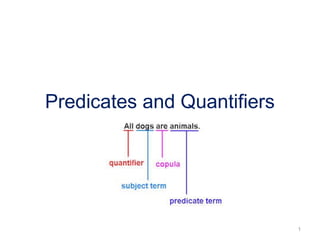
Predicates and Quantifiers 
1
Limitations of proposition logic 
• Proposition logic cannot adequately express 
the meaning of statements 
• Suppose we know 
“Every computer connected to the university 
network is functioning property” 
• No rules of propositional logic allow us to 
conclude 
“MATH3 is functioning property” 
where MATH3 is one of the computers connected to 
the university network 2
Example 
• Cannot use the rules of propositional logic to 
conclude from 
“CS2 is under attack by an intruder” 
where CS2 is a computer on the university network 
to conclude the truth 
“There is a computer on the university network that 
is under attack by an intruder” 
3
Predicate and quantifiers 
• Can be used to express the meaning of a wide 
range of statements 
• Allow us to reason and explore relationship 
between objects 
• Predicates: statements involving variables, 
e.g., “x > 3”, “x=y+3”, “x+y=z”, “computer x is 
under attack by an intruder”, “computer x is 
functioning property” 
4
Example: x > 3 
• The variable x is the subject of the statement 
• Predicate “is greater than 3” refers to a property 
that the subject of the statement can have 
• Can denote the statement by p(x) where p denotes 
the predicate “is greater than 3” and x is the variable 
• p(x): also called the value of the propositional 
function p at x 
• Once a value is assigned to the variable x, p(x) 
becomes a proposition and has a truth value 
5
Example 
• Let p(x) denote the statement “x > 3” 
– p(4): setting x=4, thus p(4) is true 
– p(2): setting x=2, thus p(2) is false 
• Let a(x) denote the statement “computer x is under 
attack by an intruder”. Suppose that only CS2 and 
MATH1 are currently under attack 
– a(CS1)? : false 
– a(CS2)? : true 
– a(MATH1)?: true 
6
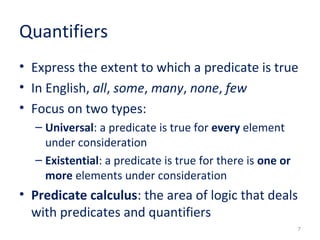
Quantifiers 
• Express the extent to which a predicate is true 
• In English, all, some, many, none, few 
• Focus on two types: 
– Universal: a predicate is true for every element 
under consideration 
– Existential: a predicate is true for there is one or 
more elements under consideration 
• Predicate calculus: the area of logic that deals 
with predicates and quantifiers 
7
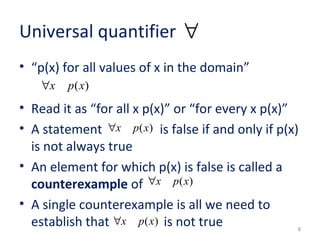
Universal quantifier 
• “p(x) for all values of x in the domain” 
• Read it as “for all x p(x)” or “for every x p(x)” 
• A statement is false if and only if p(x) 
is not always true 
• An element for which p(x) is false is called a 
counterexample of 
• A single counterexample is all we need to 
establish that is not true 
8 
"x p(x) 
" 
"x p(x) 
"x p(x) 
"x p(x)
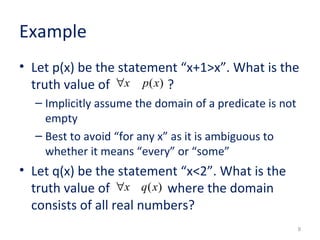
Example 
• Let p(x) be the statement “x+1>x”. What is the 
truth value of ? 
– Implicitly assume the domain of a predicate is not 
empty 
– Best to avoid “for any x” as it is ambiguous to 
whether it means “every” or “some” 
• Let q(x) be the statement “x<2”. What is the 
truth value of where the domain 
consists of all real numbers? 
9 
"x p(x) 
"x q(x)
Example 
• Let p(x) be “x2>0”. To show that the statement 
is false where the domain consists of 
all integers 
– Show a counterexample with x=0 
• When all the elements can be listed, e.g., x1, x2, 
…, xn, it follows that the universal 
quantification is the same as the 
conjunction p(x1) ˄p(x2) ˄…˄ p(xn) 
10 
"x p(x) 
"x p(x)
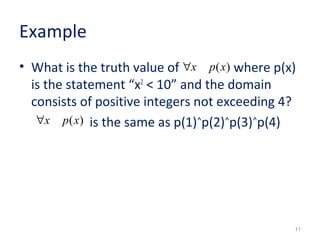
Example 
• What is the truth value of where p(x) 
is the statement “x2 < 10” and the domain 
consists of positive integers not exceeding 4? 
is the same as p(1)˄p(2)˄p(3)˄p(4) 
11 
"x p(x) 
"x p(x)
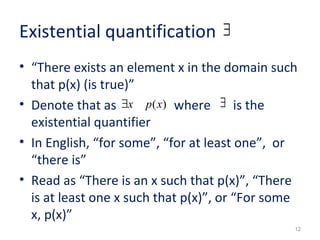
Existential quantification 
• “There exists an element x in the domain such 
that p(x) (is true)” 
• Denote that as where is the 
existential quantifier 
• In English, “for some”, “for at least one”, or 
“there is” 
• Read as “There is an x such that p(x)”, “There 
is at least one x such that p(x)”, or “For some 
x, p(x)” 
12 
$ 
$x p(x) $
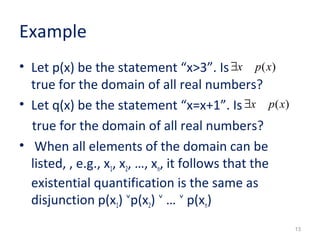
Example 
• Let p(x) be the statement “x>3”. Is 
true for the domain of all real numbers? 
• Let q(x) be the statement “x=x+1”. Is 
true for the domain of all real numbers? 
• When all elements of the domain can be 
listed, , e.g., x1, x2, …, xn, it follows that the 
existential quantification is the same as 
disjunction p(x1) ˅p(x2) ˅ … ˅ p(xn) 
13 
$x p(x) 
$x p(x)
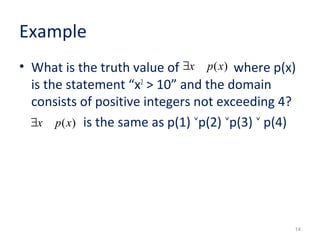
Example 
• What is the truth value of where p(x) 
is the statement “x2 > 10” and the domain 
consists of positive integers not exceeding 4? 
is the same as p(1) ˅p(2) ˅p(3) ˅ p(4) 
14 
$x p(x) 
$x p(x)
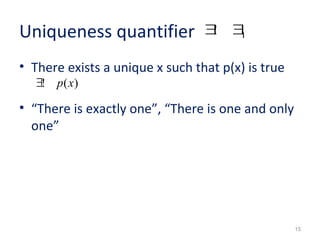
Uniqueness quantifier 
• There exists a unique x such that p(x) is true 
• “There is exactly one”, “There is one and only 
one” 
15 
$! p(x) 
1 $! $
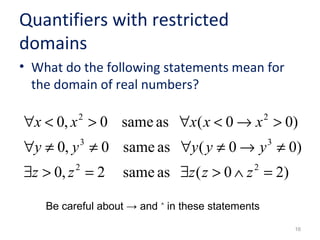
Quantifiers with restricted 
domains 
• What do the following statements mean for 
the domain of real numbers? 
2 2 
x x x x x 
" < > " < ® > 
0, 0 same as ( 0 0) 
3 3 
y y y y y 
" ¹ ¹ " ¹ ® ¹ 
0, 0 same as ( 0 0) 
16 
2 2 
z z z z z 
$ > = $ > Ù = 
0, 2 same as ( 0 2) 
Be careful about → and ˄ in these statements
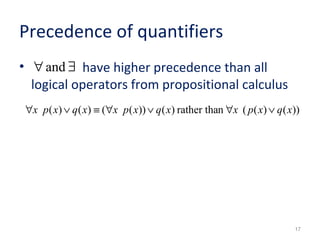
Precedence of quantifiers 
• have higher precedence than all 
logical operators from propositional calculus 
17 
" and $ 
"x p(x) Ú q(x) º ("x p(x))Ú q(x) rather than "x ( p(x) Ú q(x))
Binding variables 
• When a quantifier is used on the variable x, 
this occurrence of variable is bound 
• If a variable is not bound, then it is free 
• All variables occur in propositional function of 
predicate calculus must be bound or set to a 
particular value to turn it into a proposition 
• The part of a logical expression to which a 
quantifier is applied is the scope of this 
quantifier 
18
Example 
19 
What are the scope of these expressions? 
Are all the variables bound? 
x x y 
$ + = 
( 1) 
x p x q x xR x 
$ Ù Ú" 
( ( ) ( )) ( ) 
x p x q x yR y 
$ Ù Ú" 
( ( ) ( )) ( ) 
The same letter is often used to represent variables 
bound by different quantifiers with scopes 
that do not overlap
20 
Negating quantifications 
• Consider the statement: 
– All students in this class have red hair 
• What is required to show the statement is false? 
– There exists a student in this class that does NOT have red 
hair 
• To negate a universal quantification: 
– You negate the propositional function 
– AND you change to an existential quantification 
– ¬"x P(x) = $x ¬P(x)
21 
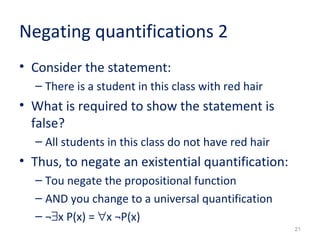
Negating quantifications 2 
• Consider the statement: 
– There is a student in this class with red hair 
• What is required to show the statement is 
false? 
– All students in this class do not have red hair 
• Thus, to negate an existential quantification: 
– Tou negate the propositional function 
– AND you change to a universal quantification 
– ¬$x P(x) = "x ¬P(x)
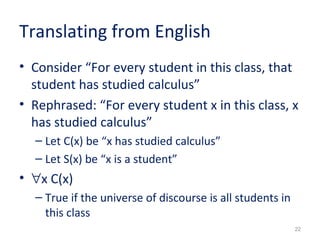
Translating from English 
• Consider “For every student in this class, that 
student has studied calculus” 
• Rephrased: “For every student x in this class, x 
has studied calculus” 
– Let C(x) be “x has studied calculus” 
– Let S(x) be “x is a student” 
• "x C(x) 
– True if the universe of discourse is all students in 
22 
this class
23 
Translating from English 2 
• What about if the unvierse of discourse is all 
students (or all people?) 
– "x (S(x)ÙC(x)) 
• This is wrong! Why? 
– "x (S(x)→C(x)) 
• Another option: 
– Let Q(x,y) be “x has stuided y” 
– "x (S(x)→Q(x, calculus))
24 
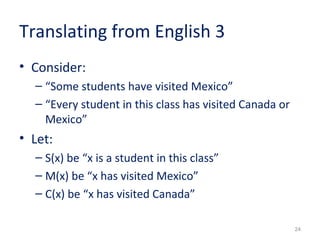
Translating from English 3 
• Consider: 
– “Some students have visited Mexico” 
– “Every student in this class has visited Canada or 
Mexico” 
• Let: 
– S(x) be “x is a student in this class” 
– M(x) be “x has visited Mexico” 
– C(x) be “x has visited Canada”
25 
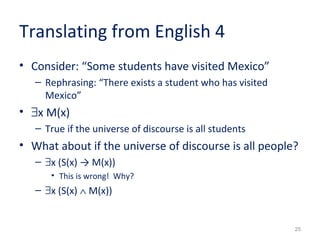
Translating from English 4 
• Consider: “Some students have visited Mexico” 
– Rephrasing: “There exists a student who has visited 
Mexico” 
• $x M(x) 
– True if the universe of discourse is all students 
• What about if the universe of discourse is all people? 
– $x (S(x) → M(x)) 
• This is wrong! Why? 
– $x (S(x) Ù M(x))
26 
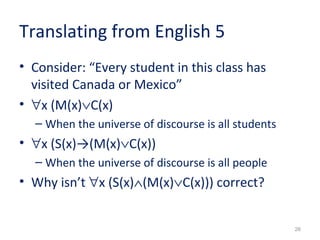
Translating from English 5 
• Consider: “Every student in this class has 
visited Canada or Mexico” 
• "x (M(x)ÚC(x) 
– When the universe of discourse is all students 
• "x (S(x)→(M(x)ÚC(x)) 
– When the universe of discourse is all people 
• Why isn’t "x (S(x)Ù(M(x)ÚC(x))) correct?
27 
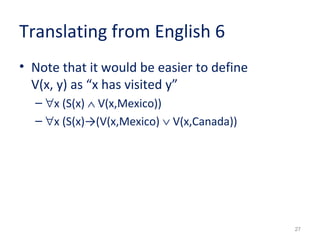
Translating from English 6 
• Note that it would be easier to define 
V(x, y) as “x has visited y” 
– "x (S(x) Ù V(x,Mexico)) 
– "x (S(x)→(V(x,Mexico) Ú V(x,Canada))
28 
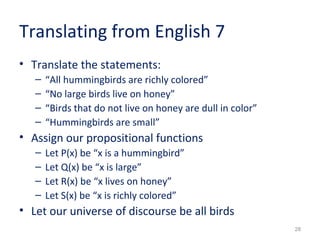
Translating from English 7 
• Translate the statements: 
– “All hummingbirds are richly colored” 
– “No large birds live on honey” 
– “Birds that do not live on honey are dull in color” 
– “Hummingbirds are small” 
• Assign our propositional functions 
– Let P(x) be “x is a hummingbird” 
– Let Q(x) be “x is large” 
– Let R(x) be “x lives on honey” 
– Let S(x) be “x is richly colored” 
• Let our universe of discourse be all birds
29 
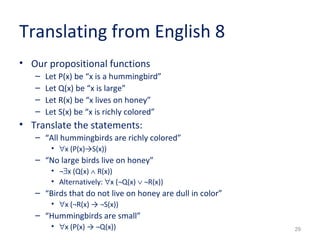
Translating from English 8 
• Our propositional functions 
– Let P(x) be “x is a hummingbird” 
– Let Q(x) be “x is large” 
– Let R(x) be “x lives on honey” 
– Let S(x) be “x is richly colored” 
• Translate the statements: 
– “All hummingbirds are richly colored” 
• "x (P(x)→S(x)) 
– “No large birds live on honey” 
• ¬$x (Q(x) Ù R(x)) 
• Alternatively: "x (¬Q(x) Ú ¬R(x)) 
– “Birds that do not live on honey are dull in color” 
• "x (¬R(x) → ¬S(x)) 
– “Hummingbirds are small” 
• "x (P(x) → ¬Q(x))
30 
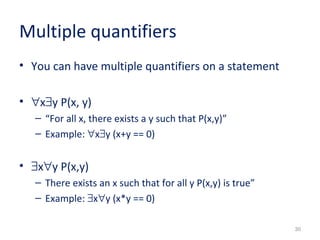
Multiple quantifiers 
• You can have multiple quantifiers on a statement 
• "x$y P(x, y) 
– “For all x, there exists a y such that P(x,y)” 
– Example: "x$y (x+y == 0) 
• $x"y P(x,y) 
– There exists an x such that for all y P(x,y) is true” 
– Example: $x"y (x*y == 0)
31 
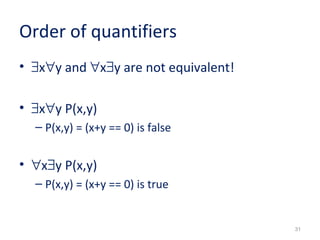
Order of quantifiers 
• $x"y and "x$y are not equivalent! 
• $x"y P(x,y) 
– P(x,y) = (x+y == 0) is false 
• "x$y P(x,y) 
– P(x,y) = (x+y == 0) is true
32 
Negating multiple quantifiers 
• Recall negation rules for single quantifiers: 
– ¬"x P(x) = $x ¬P(x) 
– ¬$x P(x) = "x ¬P(x) 
– Essentially, you change the quantifier(s), and negate what 
it’s quantifying 
• Examples: 
– ¬("x$y P(x,y)) 
= $x ¬$y P(x,y) 
= $x"y ¬P(x,y) 
– ¬("x$y"z P(x,y,z)) 
= $x¬$y"z P(x,y,z) 
= $x"y¬"z P(x,y,z) 
= $x"y$z ¬P(x,y,z)
33 
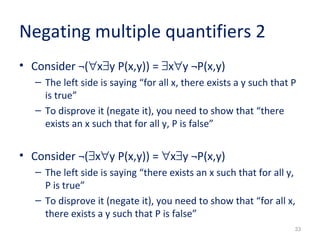
Negating multiple quantifiers 2 
• Consider ¬("x$y P(x,y)) = $x"y ¬P(x,y) 
– The left side is saying “for all x, there exists a y such that P 
is true” 
– To disprove it (negate it), you need to show that “there 
exists an x such that for all y, P is false” 
• Consider ¬($x"y P(x,y)) = "x$y ¬P(x,y) 
– The left side is saying “there exists an x such that for all y, 
P is true” 
– To disprove it (negate it), you need to show that “for all x, 
there exists a y such that P is false”
34 
Translating between English and 
quantifiers 
• The product of two negative integers is positive 
– "x"y ((x<0) Ù (y<0) → (xy > 0)) 
– Why conditional instead of and? 
• The average of two positive integers is positive 
– "x"y ((x>0) Ù (y>0) → ((x+y)/2 > 0)) 
• The difference of two negative integers is not 
necessarily negative 
– $x$y ((x<0) Ù (y<0) Ù (x-y≥0)) 
– Why and instead of conditional? 
• The absolute value of the sum of two integers does 
not exceed the sum of the absolute values of these 
integers 
– "x"y (|x+y| ≤ |x| + |y|)
35 
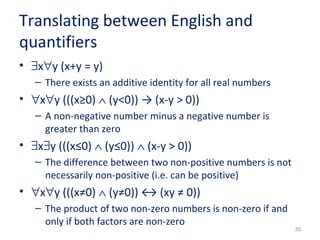
Translating between English and 
quantifiers 
• $x"y (x+y = y) 
– There exists an additive identity for all real numbers 
• "x"y (((x≥0) Ù (y<0)) → (x-y > 0)) 
– A non-negative number minus a negative number is 
greater than zero 
• $x$y (((x≤0) Ù (y≤0)) Ù (x-y > 0)) 
– The difference between two non-positive numbers is not 
necessarily non-positive (i.e. can be positive) 
• "x"y (((x≠0) Ù (y≠0)) ↔ (xy ≠ 0)) 
– The product of two non-zero numbers is non-zero if and 
only if both factors are non-zero
36 
Negation examples 
• Rewrite these statements so that the negations 
only appear within the predicates 
a) Ø$y$x P(x,y) 
"yØ$x P(x,y) 
"y"x ØP(x,y) 
a) Ø"x$y P(x,y) 
$xØ$y P(x,y) 
$x"y ØP(x,y) 
a) Ø$y (Q(y) Ù "x ØR(x,y)) 
"y Ø(Q(y) Ù "x ØR(x,y)) 
"y (ØQ(y) Ú Ø("x ØR(x,y))) 
"y (ØQ(y) Ú $x R(x,y))
37 
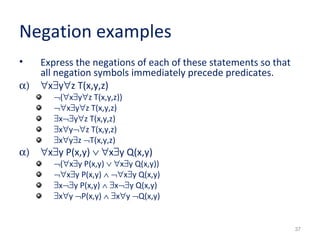
Negation examples 
• Express the negations of each of these statements so that 
all negation symbols immediately precede predicates. 
a) "x$y"z T(x,y,z) 
Ø("x$y"z T(x,y,z)) 
Ø"x$y"z T(x,y,z) 
$xØ$y"z T(x,y,z) 
$x"yØ"z T(x,y,z) 
$x"y$z ØT(x,y,z) 
a) "x$y P(x,y) Ú "x$y Q(x,y) 
Ø("x$y P(x,y) Ú "x$y Q(x,y)) 
Ø"x$y P(x,y) Ù Ø"x$y Q(x,y) 
$xØ$y P(x,y) Ù $xØ$y Q(x,y) 
$x"y ØP(x,y) Ù $x"y ØQ(x,y)

Predicates and Quantifiers

  • 1.
  • 2.
    Limitations of propositionlogic • Proposition logic cannot adequately express the meaning of statements • Suppose we know “Every computer connected to the university network is functioning property” • No rules of propositional logic allow us to conclude “MATH3 is functioning property” where MATH3 is one of the computers connected to the university network 2
  • 3.
    Example • Cannotuse the rules of propositional logic to conclude from “CS2 is under attack by an intruder” where CS2 is a computer on the university network to conclude the truth “There is a computer on the university network that is under attack by an intruder” 3
  • 4.
    Predicate and quantifiers • Can be used to express the meaning of a wide range of statements • Allow us to reason and explore relationship between objects • Predicates: statements involving variables, e.g., “x > 3”, “x=y+3”, “x+y=z”, “computer x is under attack by an intruder”, “computer x is functioning property” 4
  • 5.
    Example: x >3 • The variable x is the subject of the statement • Predicate “is greater than 3” refers to a property that the subject of the statement can have • Can denote the statement by p(x) where p denotes the predicate “is greater than 3” and x is the variable • p(x): also called the value of the propositional function p at x • Once a value is assigned to the variable x, p(x) becomes a proposition and has a truth value 5
  • 6.
    Example • Letp(x) denote the statement “x > 3” – p(4): setting x=4, thus p(4) is true – p(2): setting x=2, thus p(2) is false • Let a(x) denote the statement “computer x is under attack by an intruder”. Suppose that only CS2 and MATH1 are currently under attack – a(CS1)? : false – a(CS2)? : true – a(MATH1)?: true 6
  • 7.
    Quantifiers • Expressthe extent to which a predicate is true • In English, all, some, many, none, few • Focus on two types: – Universal: a predicate is true for every element under consideration – Existential: a predicate is true for there is one or more elements under consideration • Predicate calculus: the area of logic that deals with predicates and quantifiers 7
  • 8.
    Universal quantifier •“p(x) for all values of x in the domain” • Read it as “for all x p(x)” or “for every x p(x)” • A statement is false if and only if p(x) is not always true • An element for which p(x) is false is called a counterexample of • A single counterexample is all we need to establish that is not true 8 "x p(x) " "x p(x) "x p(x) "x p(x)
  • 9.
    Example • Letp(x) be the statement “x+1>x”. What is the truth value of ? – Implicitly assume the domain of a predicate is not empty – Best to avoid “for any x” as it is ambiguous to whether it means “every” or “some” • Let q(x) be the statement “x<2”. What is the truth value of where the domain consists of all real numbers? 9 "x p(x) "x q(x)
  • 10.
    Example • Letp(x) be “x2>0”. To show that the statement is false where the domain consists of all integers – Show a counterexample with x=0 • When all the elements can be listed, e.g., x1, x2, …, xn, it follows that the universal quantification is the same as the conjunction p(x1) ˄p(x2) ˄…˄ p(xn) 10 "x p(x) "x p(x)
  • 11.
    Example • Whatis the truth value of where p(x) is the statement “x2 < 10” and the domain consists of positive integers not exceeding 4? is the same as p(1)˄p(2)˄p(3)˄p(4) 11 "x p(x) "x p(x)
  • 12.
    Existential quantification •“There exists an element x in the domain such that p(x) (is true)” • Denote that as where is the existential quantifier • In English, “for some”, “for at least one”, or “there is” • Read as “There is an x such that p(x)”, “There is at least one x such that p(x)”, or “For some x, p(x)” 12 $ $x p(x) $
  • 13.
    Example • Letp(x) be the statement “x>3”. Is true for the domain of all real numbers? • Let q(x) be the statement “x=x+1”. Is true for the domain of all real numbers? • When all elements of the domain can be listed, , e.g., x1, x2, …, xn, it follows that the existential quantification is the same as disjunction p(x1) ˅p(x2) ˅ … ˅ p(xn) 13 $x p(x) $x p(x)
  • 14.
    Example • Whatis the truth value of where p(x) is the statement “x2 > 10” and the domain consists of positive integers not exceeding 4? is the same as p(1) ˅p(2) ˅p(3) ˅ p(4) 14 $x p(x) $x p(x)
  • 15.
    Uniqueness quantifier •There exists a unique x such that p(x) is true • “There is exactly one”, “There is one and only one” 15 $! p(x) 1 $! $
  • 16.
    Quantifiers with restricted domains • What do the following statements mean for the domain of real numbers? 2 2 x x x x x " < > " < ® > 0, 0 same as ( 0 0) 3 3 y y y y y " ¹ ¹ " ¹ ® ¹ 0, 0 same as ( 0 0) 16 2 2 z z z z z $ > = $ > Ù = 0, 2 same as ( 0 2) Be careful about → and ˄ in these statements
  • 17.
    Precedence of quantifiers • have higher precedence than all logical operators from propositional calculus 17 " and $ "x p(x) Ú q(x) º ("x p(x))Ú q(x) rather than "x ( p(x) Ú q(x))
  • 18.
    Binding variables •When a quantifier is used on the variable x, this occurrence of variable is bound • If a variable is not bound, then it is free • All variables occur in propositional function of predicate calculus must be bound or set to a particular value to turn it into a proposition • The part of a logical expression to which a quantifier is applied is the scope of this quantifier 18
  • 19.
    Example 19 Whatare the scope of these expressions? Are all the variables bound? x x y $ + = ( 1) x p x q x xR x $ Ù Ú" ( ( ) ( )) ( ) x p x q x yR y $ Ù Ú" ( ( ) ( )) ( ) The same letter is often used to represent variables bound by different quantifiers with scopes that do not overlap
  • 20.
    20 Negating quantifications • Consider the statement: – All students in this class have red hair • What is required to show the statement is false? – There exists a student in this class that does NOT have red hair • To negate a universal quantification: – You negate the propositional function – AND you change to an existential quantification – ¬"x P(x) = $x ¬P(x)
  • 21.
    21 Negating quantifications2 • Consider the statement: – There is a student in this class with red hair • What is required to show the statement is false? – All students in this class do not have red hair • Thus, to negate an existential quantification: – Tou negate the propositional function – AND you change to a universal quantification – ¬$x P(x) = "x ¬P(x)
  • 22.
    Translating from English • Consider “For every student in this class, that student has studied calculus” • Rephrased: “For every student x in this class, x has studied calculus” – Let C(x) be “x has studied calculus” – Let S(x) be “x is a student” • "x C(x) – True if the universe of discourse is all students in 22 this class
  • 23.
    23 Translating fromEnglish 2 • What about if the unvierse of discourse is all students (or all people?) – "x (S(x)ÙC(x)) • This is wrong! Why? – "x (S(x)→C(x)) • Another option: – Let Q(x,y) be “x has stuided y” – "x (S(x)→Q(x, calculus))
  • 24.
    24 Translating fromEnglish 3 • Consider: – “Some students have visited Mexico” – “Every student in this class has visited Canada or Mexico” • Let: – S(x) be “x is a student in this class” – M(x) be “x has visited Mexico” – C(x) be “x has visited Canada”
  • 25.
    25 Translating fromEnglish 4 • Consider: “Some students have visited Mexico” – Rephrasing: “There exists a student who has visited Mexico” • $x M(x) – True if the universe of discourse is all students • What about if the universe of discourse is all people? – $x (S(x) → M(x)) • This is wrong! Why? – $x (S(x) Ù M(x))
  • 26.
    26 Translating fromEnglish 5 • Consider: “Every student in this class has visited Canada or Mexico” • "x (M(x)ÚC(x) – When the universe of discourse is all students • "x (S(x)→(M(x)ÚC(x)) – When the universe of discourse is all people • Why isn’t "x (S(x)Ù(M(x)ÚC(x))) correct?
  • 27.
    27 Translating fromEnglish 6 • Note that it would be easier to define V(x, y) as “x has visited y” – "x (S(x) Ù V(x,Mexico)) – "x (S(x)→(V(x,Mexico) Ú V(x,Canada))
  • 28.
    28 Translating fromEnglish 7 • Translate the statements: – “All hummingbirds are richly colored” – “No large birds live on honey” – “Birds that do not live on honey are dull in color” – “Hummingbirds are small” • Assign our propositional functions – Let P(x) be “x is a hummingbird” – Let Q(x) be “x is large” – Let R(x) be “x lives on honey” – Let S(x) be “x is richly colored” • Let our universe of discourse be all birds
  • 29.
    29 Translating fromEnglish 8 • Our propositional functions – Let P(x) be “x is a hummingbird” – Let Q(x) be “x is large” – Let R(x) be “x lives on honey” – Let S(x) be “x is richly colored” • Translate the statements: – “All hummingbirds are richly colored” • "x (P(x)→S(x)) – “No large birds live on honey” • ¬$x (Q(x) Ù R(x)) • Alternatively: "x (¬Q(x) Ú ¬R(x)) – “Birds that do not live on honey are dull in color” • "x (¬R(x) → ¬S(x)) – “Hummingbirds are small” • "x (P(x) → ¬Q(x))
  • 30.
    30 Multiple quantifiers • You can have multiple quantifiers on a statement • "x$y P(x, y) – “For all x, there exists a y such that P(x,y)” – Example: "x$y (x+y == 0) • $x"y P(x,y) – There exists an x such that for all y P(x,y) is true” – Example: $x"y (x*y == 0)
  • 31.
    31 Order ofquantifiers • $x"y and "x$y are not equivalent! • $x"y P(x,y) – P(x,y) = (x+y == 0) is false • "x$y P(x,y) – P(x,y) = (x+y == 0) is true
  • 32.
    32 Negating multiplequantifiers • Recall negation rules for single quantifiers: – ¬"x P(x) = $x ¬P(x) – ¬$x P(x) = "x ¬P(x) – Essentially, you change the quantifier(s), and negate what it’s quantifying • Examples: – ¬("x$y P(x,y)) = $x ¬$y P(x,y) = $x"y ¬P(x,y) – ¬("x$y"z P(x,y,z)) = $x¬$y"z P(x,y,z) = $x"y¬"z P(x,y,z) = $x"y$z ¬P(x,y,z)
  • 33.
    33 Negating multiplequantifiers 2 • Consider ¬("x$y P(x,y)) = $x"y ¬P(x,y) – The left side is saying “for all x, there exists a y such that P is true” – To disprove it (negate it), you need to show that “there exists an x such that for all y, P is false” • Consider ¬($x"y P(x,y)) = "x$y ¬P(x,y) – The left side is saying “there exists an x such that for all y, P is true” – To disprove it (negate it), you need to show that “for all x, there exists a y such that P is false”
  • 34.
    34 Translating betweenEnglish and quantifiers • The product of two negative integers is positive – "x"y ((x<0) Ù (y<0) → (xy > 0)) – Why conditional instead of and? • The average of two positive integers is positive – "x"y ((x>0) Ù (y>0) → ((x+y)/2 > 0)) • The difference of two negative integers is not necessarily negative – $x$y ((x<0) Ù (y<0) Ù (x-y≥0)) – Why and instead of conditional? • The absolute value of the sum of two integers does not exceed the sum of the absolute values of these integers – "x"y (|x+y| ≤ |x| + |y|)
  • 35.
    35 Translating betweenEnglish and quantifiers • $x"y (x+y = y) – There exists an additive identity for all real numbers • "x"y (((x≥0) Ù (y<0)) → (x-y > 0)) – A non-negative number minus a negative number is greater than zero • $x$y (((x≤0) Ù (y≤0)) Ù (x-y > 0)) – The difference between two non-positive numbers is not necessarily non-positive (i.e. can be positive) • "x"y (((x≠0) Ù (y≠0)) ↔ (xy ≠ 0)) – The product of two non-zero numbers is non-zero if and only if both factors are non-zero
  • 36.
    36 Negation examples • Rewrite these statements so that the negations only appear within the predicates a) Ø$y$x P(x,y) "yØ$x P(x,y) "y"x ØP(x,y) a) Ø"x$y P(x,y) $xØ$y P(x,y) $x"y ØP(x,y) a) Ø$y (Q(y) Ù "x ØR(x,y)) "y Ø(Q(y) Ù "x ØR(x,y)) "y (ØQ(y) Ú Ø("x ØR(x,y))) "y (ØQ(y) Ú $x R(x,y))
  • 37.
    37 Negation examples • Express the negations of each of these statements so that all negation symbols immediately precede predicates. a) "x$y"z T(x,y,z) Ø("x$y"z T(x,y,z)) Ø"x$y"z T(x,y,z) $xØ$y"z T(x,y,z) $x"yØ"z T(x,y,z) $x"y$z ØT(x,y,z) a) "x$y P(x,y) Ú "x$y Q(x,y) Ø("x$y P(x,y) Ú "x$y Q(x,y)) Ø"x$y P(x,y) Ù Ø"x$y Q(x,y) $xØ$y P(x,y) Ù $xØ$y Q(x,y) $x"y ØP(x,y) Ù $x"y ØQ(x,y)