Dividends Policy


                   19-1
8.1 Different Types of Payouts

• Many companies pay a regular cash dividend.
   – Public companies often pay quarterly.
   – Sometimes firms will pay an extra cash dividend.
   – The extreme case would be a liquidating dividend.
• Companies will often declare stock dividends.
   – No cash leaves the firm.
   – The firm increases the number of shares outstanding.
• Some companies declare a dividend in kind.
   – Wrigley’s Gum sends a box of chewing gum.
• Other companies use stock buybacks.
                                                            19-2
Advantages of paying dividend
• Cash dividend can underscore good results and provides
  support to the share price.
• Dividends may attract institutional investors who prefer some
  mix return in the form of dividends. A mix of institutions and
  individual investors may allow a firm to raise capital at lower
  cost because of the ability of the firm to reach a wider
  market.
• Share price usually increase with the announcement of a new
  or increased dividends.
• Dividends absorb excess cash flow and many reduce agency
  costs that arise from conflicts between management and
  shareholders.
                                                                    19-3
Disadvantages of paying dividend
• Dividends can reduce internal sources of financing.
  Dividends may force the firm to forgo positive NPV
  projects or to rely on costly external equity financing.
• Once established, dividends cuts are hard to make
  without adversely affecting the firm’s share price.


                                                             19-4
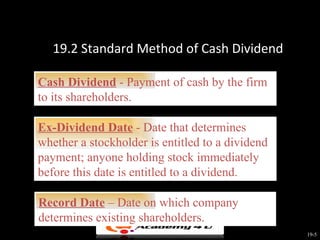
19.2 Standard Method of Cash Dividend

Cash Dividend - Payment of cash by the firm
to its shareholders.

Ex-Dividend Date - Date that determines
whether a stockholder is entitled to a dividend
payment; anyone holding stock immediately
before this date is entitled to a dividend.

Record Date – Date on which company
determines existing shareholders.
                                                  19-5
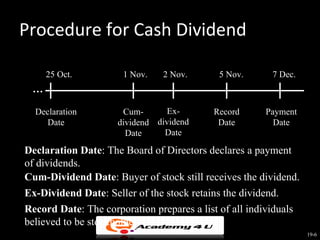
Procedure for Cash Dividend

     25 Oct.          1 Nov.   2 Nov.       5 Nov.      7 Dec.
 …

  Declaration         Cum-       Ex-       Record      Payment
    Date             dividend dividend      Date         Date
                       Date     Date

Declaration Date: The Board of Directors declares a payment
of dividends.
Cum-Dividend Date: Buyer of stock still receives the dividend.
Ex-Dividend Date: Seller of the stock retains the dividend.
Record Date: The corporation prepares a list of all individuals
believed to be stockholders as of 5 November.
                                                                  19-6
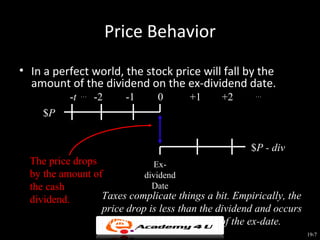
Price Behavior
• In a perfect world, the stock price will fall by the
  amount of the dividend on the ex-dividend date.
           -t   …
                    -2     -1   0      +1     +2      …


     $P


                                                     $P - div
  The price drops              Ex-
  by the amount of          dividend
  the cash                     Date
  dividend.       Taxes complicate things a bit. Empirically, the
                  price drop is less than the dividend and occurs
                  within the first few minutes of the ex-date.
                                                                    19-7
8.3 The Irrelevance of Dividend Policy
• A compelling case can be made that dividend
  policy is irrelevant.
• Since investors do not need dividends to
  convert shares to cash; they will not pay
  higher prices for firms with higher dividends.
• In other words, dividend policy will have no
  impact on the value of the firm because
  investors can create whatever income stream
  they prefer by using homemade dividends.

                                                   19-8
Homemade Dividends
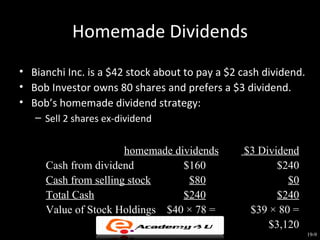
• Bianchi Inc. is a $42 stock about to pay a $2 cash dividend.
• Bob Investor owns 80 shares and prefers a $3 dividend.
• Bob’s homemade dividend strategy:
   – Sell 2 shares ex-dividend


                      homemade dividends        $3 Dividend
     Cash from dividend          $160                  $240
     Cash from selling stock      $80                    $0
     Total Cash                  $240                  $240
     Value of Stock Holdings $40 × 78 =          $39 × 80 =
                               $3,120                $3,120
                                                                 19-9
Dividend Policy Is Irrelevant

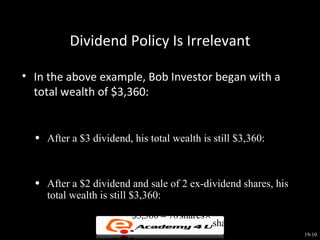
• In the above example, Bob Investor began with a
  total wealth of $3,360:
                                               $42
                         $3,360 = 80 shares ×
                                              share
  • After a $3 dividend, his total wealth is still $3,360:
                                               $39
                         $3,360 = 80 shares ×       + $240
                                              share
  • After a $2 dividend and sale of 2 ex-dividend shares, his
    total wealth is still $3,360:
                                                 $40
                         $3,360 = 78 shares ×         + $160 + $80
                                                share
                                                                     19-10
Dividends and Investment Policy
• Firms should never forgo positive NPV
  projects to increase a dividend (or to pay a
  dividend for the first time).
• Recall that one of the assumptions underlying
  the dividend-irrelevance argument is: “The
  investment policy of the firm is set ahead of
  time and is not altered by changes in dividend
  policy.”

                                                   19-11
8.4 Repurchase of Stock
• Instead of declaring cash dividends, firms can
  rid themselves of excess cash through buying
  shares of their own stock.
• Recently, share repurchase has become an
  important way of distributing earnings to
  shareholders.


                                                   19-12
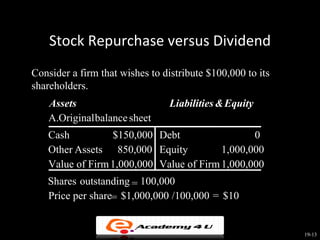
Stock Repurchase versus Dividend
Consider a firm that wishes to distribute $100,000 to its
shareholders.
    Assets                       Liabilities & Equity
    A.Original balance sheet
    Cash          $150,000 Debt                  0
    Other Assets 850,000 Equity           1,000,000
    Value of Firm 1,000,000 Value of Firm 1,000,000
   Shares outstanding = 100,000
   Price per share= $1,000,000 /100,000 = $10


                                                            19-13
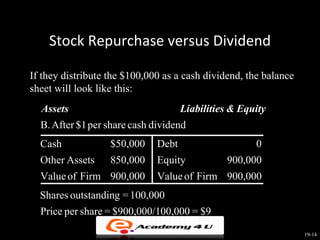
Stock Repurchase versus Dividend

If they distribute the $100,000 as a cash dividend, the balance
sheet will look like this:
  Assets                             Liabilities & Equity
  B. After $1 per share cash dividend
  Cash             $50,000    Debt                    0
  Other Assets     850,000    Equity           900,000
  Value of Firm 900,000       Value of Firm 900,000
  Shares outstanding = 100,000
  Price per share = $900,000/100,000 = $9

                                                                  19-14
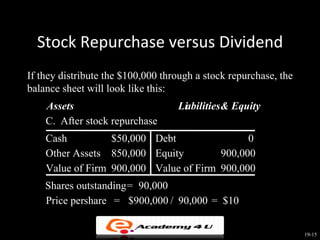
Stock Repurchase versus Dividend
If they distribute the $100,000 through a stock repurchase, the
balance sheet will look like this:
    Assets                         Liabilities& Equity
    C. After stock repurchase
    Cash          $50,000 Debt                0
    Other Assets 850,000 Equity         900,000
    Value of Firm 900,000 Value of Firm 900,000
    Shares outstanding= 90,000
    Price pershare = $900,000 / 90,000 = $10


                                                                  19-15
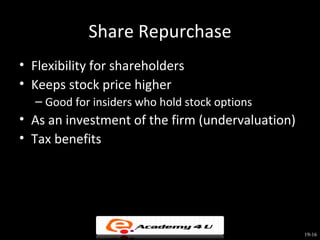
Share Repurchase
• Flexibility for shareholders
• Keeps stock price higher
  – Good for insiders who hold stock options
• As an investment of the firm (undervaluation)
• Tax benefits


                                                  19-16
Share repurchase and cash
                dividend
• Similarities
      • Share repurchase and cash dividend programs are mechanism for
        transferring excess finds from a corporation to its shareholders.
• Differences
      • Dividend programs require an ongoing cash outflow that is
        difficult to reduce or terminate.
      • Share repurchase programs on the other hand, are structured
        such that a firm can be control both the timing and the amount of
        the cash outflows.
      • While a share program is frequently announced, there is no
        commitment to actually purchase the shares.
      • This provides a lot more flexibility to the firm than a dividend
        program.

                                                                            19-17
8.5 Personal Taxes, Dividends, and Stock
              Repurchases
• To get the result that dividend policy is irrelevant, we
  needed three assumptions:
   – No taxes
   – No transactions costs
   – No uncertainty
• In the United States, both cash dividends and capital
  gains are (currently) taxed at a maximum rate of 15
  percent.
• Since capital gains can be deferred, the tax rate on
  dividends is greater than the effective rate on capital
  gains.

                                                             19-18
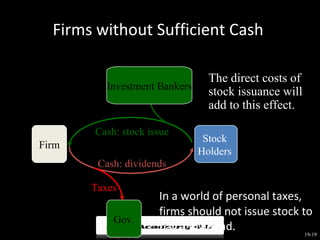
Firms without Sufficient Cash

                                 The direct costs of
          Investment Bankers
                                 stock issuance will
                                 add to this effect.

       Cash: stock issue
                                Stock
Firm
                               Holders
        Cash: dividends

       Taxes
                     In a world of personal taxes,
                     firms should not issue stock to
           Gov.
                     pay a dividend.               19-19
Firms with Sufficient Cash

• The above argument does not necessarily
  apply to firms with excess cash.
• Consider a firm that has $1 million in cash
  after selecting all available positive NPV
  projects.
  – Select additional capital budgeting projects (by
    assumption, these are negative NPV).
  – Acquire other companies
  – Purchase financial assets
  – Repurchase shares                                  19-20
Taxes and Dividends
• In the presence of personal taxes:
  1. A firm should not issue stock to pay a dividend.
  2. Managers have an incentive to seek alternative
     uses for funds to reduce dividends.
  3. Though personal taxes mitigate against the
     payment of dividends, these taxes are not
     sufficient to lead firms to eliminate all dividends.


                                                            19-21
8.6 Real-World Factors Favoring High
                 Dividends
• Desire for Current Income
• Behavioral Finance
  – It forces investors to be disciplined.
• Tax Arbitrage
  – Investors can create positions in high dividend
    yield securities that avoid tax liabilities.
• Agency Costs
  – High dividends reduce free cash flow.

                                                      19-22
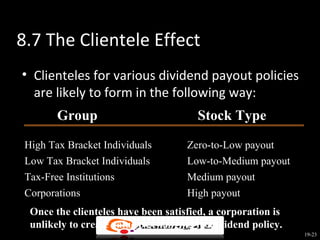
8.7 The Clientele Effect
• Clienteles for various dividend payout policies
  are likely to form in the following way:
        Group                          Stock Type

 High Tax Bracket Individuals        Zero-to-Low payout
 Low Tax Bracket Individuals         Low-to-Medium payout
 Tax-Free Institutions               Medium payout
 Corporations                        High payout
  Once the clienteles have been satisfied, a corporation is
  unlikely to create value by changing its dividend policy.
                                                              19-23
8.8 What We Know and Do Not Know
•   Corporations “smooth” dividends.
•   Fewer companies are paying dividends.
•   Dividends provide information to the market.
•   Firms should follow a sensible policy:
     – Do not forgo positive NPV projects just to pay a
       dividend.
     – Avoid issuing stock to pay dividends.
     – Consider share repurchase when there are few
       better uses for the cash.
                                                          19-24
8.9 Putting It All Together
• Aggregate payouts are massive and have
  increased over time.
• Dividends are concentrated among a small
  number of large, mature firms.
• Managers are reluctant to cut dividends.
• Managers smooth dividends.
• Stock prices react to unanticipated changes in
  dividends.


                                                   19-25
8.10 Stock Dividends
• Pay additional shares of stock instead of cash
• Increases the number of outstanding shares
• Small stock dividend
  – Less than 20 to 25%
  – If you own 100 shares and the company declared
    a 10% stock dividend, you would receive an
    additional 10 shares.
• Large stock dividend – more than 20 to 25%


                                                     19-26
Stock Splits
• Stock splits – essentially the same as a stock
  dividend except it is expressed as a ratio
  – For example, a 2 for 1 stock split is the same as a
    100% stock dividend.
• Stock price is reduced when the stock splits.
• Common explanation for split is to return
  price to a “more desirable trading range.”


                                                          19-27

Dividends policy

  • 1.
  • 2.
    8.1 Different Typesof Payouts • Many companies pay a regular cash dividend. – Public companies often pay quarterly. – Sometimes firms will pay an extra cash dividend. – The extreme case would be a liquidating dividend. • Companies will often declare stock dividends. – No cash leaves the firm. – The firm increases the number of shares outstanding. • Some companies declare a dividend in kind. – Wrigley’s Gum sends a box of chewing gum. • Other companies use stock buybacks. 19-2
  • 3.
    Advantages of payingdividend • Cash dividend can underscore good results and provides support to the share price. • Dividends may attract institutional investors who prefer some mix return in the form of dividends. A mix of institutions and individual investors may allow a firm to raise capital at lower cost because of the ability of the firm to reach a wider market. • Share price usually increase with the announcement of a new or increased dividends. • Dividends absorb excess cash flow and many reduce agency costs that arise from conflicts between management and shareholders. 19-3
  • 4.
    Disadvantages of payingdividend • Dividends can reduce internal sources of financing. Dividends may force the firm to forgo positive NPV projects or to rely on costly external equity financing. • Once established, dividends cuts are hard to make without adversely affecting the firm’s share price. 19-4
  • 5.
    19.2 Standard Methodof Cash Dividend Cash Dividend - Payment of cash by the firm to its shareholders. Ex-Dividend Date - Date that determines whether a stockholder is entitled to a dividend payment; anyone holding stock immediately before this date is entitled to a dividend. Record Date – Date on which company determines existing shareholders. 19-5
  • 6.
    Procedure for CashDividend 25 Oct. 1 Nov. 2 Nov. 5 Nov. 7 Dec. … Declaration Cum- Ex- Record Payment Date dividend dividend Date Date Date Date Declaration Date: The Board of Directors declares a payment of dividends. Cum-Dividend Date: Buyer of stock still receives the dividend. Ex-Dividend Date: Seller of the stock retains the dividend. Record Date: The corporation prepares a list of all individuals believed to be stockholders as of 5 November. 19-6
  • 7.
    Price Behavior • Ina perfect world, the stock price will fall by the amount of the dividend on the ex-dividend date. -t … -2 -1 0 +1 +2 … $P $P - div The price drops Ex- by the amount of dividend the cash Date dividend. Taxes complicate things a bit. Empirically, the price drop is less than the dividend and occurs within the first few minutes of the ex-date. 19-7
  • 8.
    8.3 The Irrelevanceof Dividend Policy • A compelling case can be made that dividend policy is irrelevant. • Since investors do not need dividends to convert shares to cash; they will not pay higher prices for firms with higher dividends. • In other words, dividend policy will have no impact on the value of the firm because investors can create whatever income stream they prefer by using homemade dividends. 19-8
  • 9.
    Homemade Dividends • BianchiInc. is a $42 stock about to pay a $2 cash dividend. • Bob Investor owns 80 shares and prefers a $3 dividend. • Bob’s homemade dividend strategy: – Sell 2 shares ex-dividend homemade dividends $3 Dividend Cash from dividend $160 $240 Cash from selling stock $80 $0 Total Cash $240 $240 Value of Stock Holdings $40 × 78 = $39 × 80 = $3,120 $3,120 19-9
  • 10.
    Dividend Policy IsIrrelevant • In the above example, Bob Investor began with a total wealth of $3,360: $42 $3,360 = 80 shares × share • After a $3 dividend, his total wealth is still $3,360: $39 $3,360 = 80 shares × + $240 share • After a $2 dividend and sale of 2 ex-dividend shares, his total wealth is still $3,360: $40 $3,360 = 78 shares × + $160 + $80 share 19-10
  • 11.
    Dividends and InvestmentPolicy • Firms should never forgo positive NPV projects to increase a dividend (or to pay a dividend for the first time). • Recall that one of the assumptions underlying the dividend-irrelevance argument is: “The investment policy of the firm is set ahead of time and is not altered by changes in dividend policy.” 19-11
  • 12.
    8.4 Repurchase ofStock • Instead of declaring cash dividends, firms can rid themselves of excess cash through buying shares of their own stock. • Recently, share repurchase has become an important way of distributing earnings to shareholders. 19-12
  • 13.
    Stock Repurchase versusDividend Consider a firm that wishes to distribute $100,000 to its shareholders. Assets Liabilities & Equity A.Original balance sheet Cash $150,000 Debt 0 Other Assets 850,000 Equity 1,000,000 Value of Firm 1,000,000 Value of Firm 1,000,000 Shares outstanding = 100,000 Price per share= $1,000,000 /100,000 = $10 19-13
  • 14.
    Stock Repurchase versusDividend If they distribute the $100,000 as a cash dividend, the balance sheet will look like this: Assets Liabilities & Equity B. After $1 per share cash dividend Cash $50,000 Debt 0 Other Assets 850,000 Equity 900,000 Value of Firm 900,000 Value of Firm 900,000 Shares outstanding = 100,000 Price per share = $900,000/100,000 = $9 19-14
  • 15.
    Stock Repurchase versusDividend If they distribute the $100,000 through a stock repurchase, the balance sheet will look like this: Assets Liabilities& Equity C. After stock repurchase Cash $50,000 Debt 0 Other Assets 850,000 Equity 900,000 Value of Firm 900,000 Value of Firm 900,000 Shares outstanding= 90,000 Price pershare = $900,000 / 90,000 = $10 19-15
  • 16.
    Share Repurchase • Flexibilityfor shareholders • Keeps stock price higher – Good for insiders who hold stock options • As an investment of the firm (undervaluation) • Tax benefits 19-16
  • 17.
    Share repurchase andcash dividend • Similarities • Share repurchase and cash dividend programs are mechanism for transferring excess finds from a corporation to its shareholders. • Differences • Dividend programs require an ongoing cash outflow that is difficult to reduce or terminate. • Share repurchase programs on the other hand, are structured such that a firm can be control both the timing and the amount of the cash outflows. • While a share program is frequently announced, there is no commitment to actually purchase the shares. • This provides a lot more flexibility to the firm than a dividend program. 19-17
  • 18.
    8.5 Personal Taxes,Dividends, and Stock Repurchases • To get the result that dividend policy is irrelevant, we needed three assumptions: – No taxes – No transactions costs – No uncertainty • In the United States, both cash dividends and capital gains are (currently) taxed at a maximum rate of 15 percent. • Since capital gains can be deferred, the tax rate on dividends is greater than the effective rate on capital gains. 19-18
  • 19.
    Firms without SufficientCash The direct costs of Investment Bankers stock issuance will add to this effect. Cash: stock issue Stock Firm Holders Cash: dividends Taxes In a world of personal taxes, firms should not issue stock to Gov. pay a dividend. 19-19
  • 20.
    Firms with SufficientCash • The above argument does not necessarily apply to firms with excess cash. • Consider a firm that has $1 million in cash after selecting all available positive NPV projects. – Select additional capital budgeting projects (by assumption, these are negative NPV). – Acquire other companies – Purchase financial assets – Repurchase shares 19-20
  • 21.
    Taxes and Dividends •In the presence of personal taxes: 1. A firm should not issue stock to pay a dividend. 2. Managers have an incentive to seek alternative uses for funds to reduce dividends. 3. Though personal taxes mitigate against the payment of dividends, these taxes are not sufficient to lead firms to eliminate all dividends. 19-21
  • 22.
    8.6 Real-World FactorsFavoring High Dividends • Desire for Current Income • Behavioral Finance – It forces investors to be disciplined. • Tax Arbitrage – Investors can create positions in high dividend yield securities that avoid tax liabilities. • Agency Costs – High dividends reduce free cash flow. 19-22
  • 23.
    8.7 The ClienteleEffect • Clienteles for various dividend payout policies are likely to form in the following way: Group Stock Type High Tax Bracket Individuals Zero-to-Low payout Low Tax Bracket Individuals Low-to-Medium payout Tax-Free Institutions Medium payout Corporations High payout Once the clienteles have been satisfied, a corporation is unlikely to create value by changing its dividend policy. 19-23
  • 24.
    8.8 What WeKnow and Do Not Know • Corporations “smooth” dividends. • Fewer companies are paying dividends. • Dividends provide information to the market. • Firms should follow a sensible policy: – Do not forgo positive NPV projects just to pay a dividend. – Avoid issuing stock to pay dividends. – Consider share repurchase when there are few better uses for the cash. 19-24
  • 25.
    8.9 Putting ItAll Together • Aggregate payouts are massive and have increased over time. • Dividends are concentrated among a small number of large, mature firms. • Managers are reluctant to cut dividends. • Managers smooth dividends. • Stock prices react to unanticipated changes in dividends. 19-25
  • 26.
    8.10 Stock Dividends •Pay additional shares of stock instead of cash • Increases the number of outstanding shares • Small stock dividend – Less than 20 to 25% – If you own 100 shares and the company declared a 10% stock dividend, you would receive an additional 10 shares. • Large stock dividend – more than 20 to 25% 19-26
  • 27.
    Stock Splits • Stocksplits – essentially the same as a stock dividend except it is expressed as a ratio – For example, a 2 for 1 stock split is the same as a 100% stock dividend. • Stock price is reduced when the stock splits. • Common explanation for split is to return price to a “more desirable trading range.” 19-27

Editor's Notes

  • #6 5
  • #11 19
  • #14 15
  • #15 16
  • #16 17
  • #19 The dividend and capital gains tax rates are subject to change at the discretion of Congress.
  • #28 www: Click on the web surfer icon to find out about upcoming stock splits and dividends