Pertemuan 6
Rabu, 14 November 2012
DIVIDENDS AND DIVIDEND POLICY
Introduction
• Dividend: A payment made out of a firm’s
earnings to its owner
• Distribution: a payment made by a firm to its
owner from sources other than current or
accumulated retained earning
• Jenis Dividend:
– Cash Dividend
– Stock Dividend
– Liquidating Dividendl
Dividend?
• Dividends are irrelevant?
• Dividends policy is irrelevant?
• Why do we pay lower dividend?
– Tax
– Flotation Cost
– Restriction
• Why do we pay higher dividend?
– Desire Income
– Uncertainty Resolution
– Tax
Dividend Policy
• Residual Dividend Approach
– Meet corporate’s investment needs and maintain
its desired debt to equity ratio
• Step
– Determine the amount of funds that can be
generated without selling new equity
– Decide whether or not a dividend will be paid
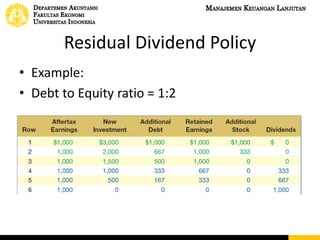
Residual Dividend Policy
• Example:
• Debt to Equity ratio = 1:2
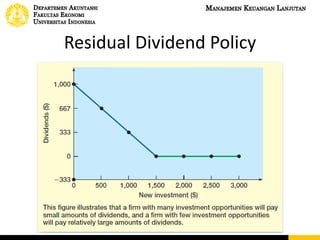
Residual Dividend Policy
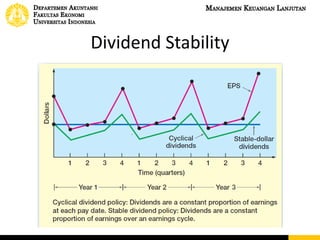
Dividend Stability
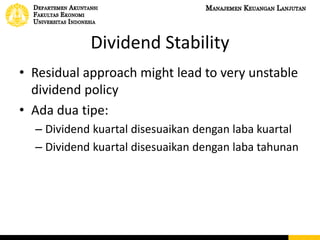
• Residual approach might lead to very unstable
dividend policy
• Ada dua tipe:
– Dividend kuartal disesuaikan dengan laba kuartal
– Dividend kuartal disesuaikan dengan laba tahunan
Dividend Stability
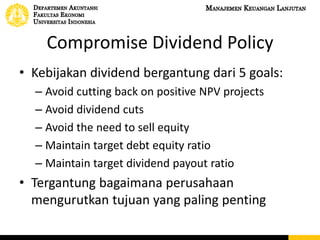
Compromise Dividend Policy
• Kebijakan dividend bergantung dari 5 goals:
– Avoid cutting back on positive NPV projects
– Avoid dividend cuts
– Avoid the need to sell equity
– Maintain target debt equity ratio
– Maintain target dividend payout ratio
• Tergantung bagaimana perusahaan
mengurutkan tujuan yang paling penting
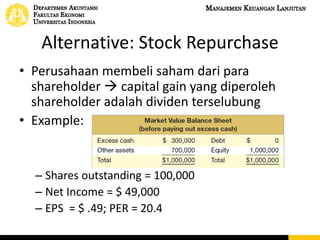
Alternative: Stock Repurchase
• Perusahaan membeli saham dari para
shareholder  capital gain yang diperoleh
shareholder adalah dividen terselubung
• Example:
– Shares outstanding = 100,000
– Net Income = $ 49,000
– EPS = $ .49; PER = 20.4
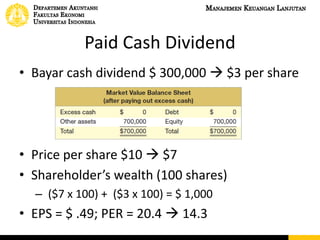
Paid Cash Dividend
• Bayar cash dividend $ 300,000  $3 per share
• Price per share $10  $7
• Shareholder’s wealth (100 shares)
– ($7 x 100) + ($3 x 100) = $ 1,000
• EPS = $ .49; PER = 20.4  14.3
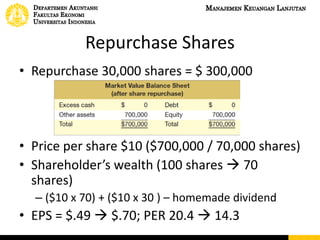
Repurchase Shares
• Repurchase 30,000 shares = $ 300,000
• Price per share $10 ($700,000 / 70,000 shares)
• Shareholder’s wealth (100 shares  70
shares)
– ($10 x 70) + ($10 x 30 ) – homemade dividend
• EPS = $.49  $.70; PER 20.4  14.3
Issues
• Real World Consideration
– Transaction Cost
– Tax Treatment
• Tax on dividend and tax on capital gain
• EPS
– EPS is just an accounting adjustment

Dividend

  • 1.
    Pertemuan 6 Rabu, 14November 2012
  • 2.
  • 3.
    Introduction • Dividend: Apayment made out of a firm’s earnings to its owner • Distribution: a payment made by a firm to its owner from sources other than current or accumulated retained earning • Jenis Dividend: – Cash Dividend – Stock Dividend – Liquidating Dividendl
  • 4.
    Dividend? • Dividends areirrelevant? • Dividends policy is irrelevant? • Why do we pay lower dividend? – Tax – Flotation Cost – Restriction • Why do we pay higher dividend? – Desire Income – Uncertainty Resolution – Tax
  • 5.
    Dividend Policy • ResidualDividend Approach – Meet corporate’s investment needs and maintain its desired debt to equity ratio • Step – Determine the amount of funds that can be generated without selling new equity – Decide whether or not a dividend will be paid
  • 6.
    Residual Dividend Policy •Example: • Debt to Equity ratio = 1:2
  • 7.
  • 8.
    Dividend Stability • Residualapproach might lead to very unstable dividend policy • Ada dua tipe: – Dividend kuartal disesuaikan dengan laba kuartal – Dividend kuartal disesuaikan dengan laba tahunan
  • 9.
  • 10.
    Compromise Dividend Policy •Kebijakan dividend bergantung dari 5 goals: – Avoid cutting back on positive NPV projects – Avoid dividend cuts – Avoid the need to sell equity – Maintain target debt equity ratio – Maintain target dividend payout ratio • Tergantung bagaimana perusahaan mengurutkan tujuan yang paling penting
  • 11.
    Alternative: Stock Repurchase •Perusahaan membeli saham dari para shareholder  capital gain yang diperoleh shareholder adalah dividen terselubung • Example: – Shares outstanding = 100,000 – Net Income = $ 49,000 – EPS = $ .49; PER = 20.4
  • 12.
    Paid Cash Dividend •Bayar cash dividend $ 300,000  $3 per share • Price per share $10  $7 • Shareholder’s wealth (100 shares) – ($7 x 100) + ($3 x 100) = $ 1,000 • EPS = $ .49; PER = 20.4  14.3
  • 13.
    Repurchase Shares • Repurchase30,000 shares = $ 300,000 • Price per share $10 ($700,000 / 70,000 shares) • Shareholder’s wealth (100 shares  70 shares) – ($10 x 70) + ($10 x 30 ) – homemade dividend • EPS = $.49  $.70; PER 20.4  14.3
  • 14.
    Issues • Real WorldConsideration – Transaction Cost – Tax Treatment • Tax on dividend and tax on capital gain • EPS – EPS is just an accounting adjustment