




Dividend policy refers to the decision of the board regarding
distribution of residual earnings to its shareholders. The primary objective of a
finance manager is the maximization of wealth of the shareholders. Payment of
dividend leads to increase in the price of shares on the one hand but leads to a
crunch in liquid resources for financing of prospective projects.
There is an inverse relationship between dividend payment
and retained earnings.
DIVIDEND POLICY
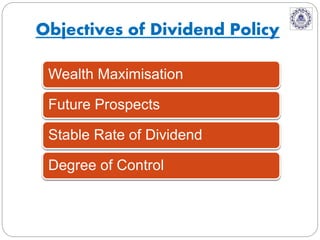
Wealth Maximisation
Future Prospects
Stable Rate of Dividend
Degree of Control
Objectives of Dividend Policy
I . Wealth Maximization:
According to some schools of thought dividend policy has significant impact
on the value of the firm.
Therefore the dividend policy should be developed keeping in mind the
wealth maximization objective of the firm.
II . Future Prospects:
Dividend policy is a financing decision and leads to cash outflows and also leads to
decrease in availability of cash for financing of profitable projects.
If sufficient funds are not available, a firm has to depend on external financing.
Therefore the dividend policy needs to be devised in such a manner that prospective
projects may be financed
through retained earnings.
Objectives of Dividend Policy
iii. Stable Rate of Dividend:
Fluctuation in the rate of return adversely affects the market price of shares.
In order to have a stable rate of dividend, a firm should retain a high proportion
of earnings so that the firm can keep sufficient funds for payment of
dividend when it faces loss.
iv. Degree of Control:
Issue of new shares or dependence on external financing will dilute the degree
of
control of the existing shareholders. Therefore, a more conservative dividend
policy should be followed in order that the interest of existing shareholders is
not hampered.
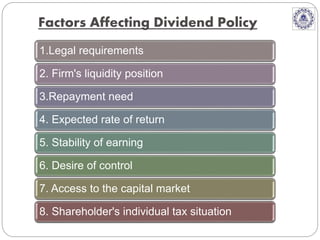
1.Legal requirements
2. Firm's liquidity position
3.Repayment need
4. Expected rate of return
5. Stability of earning
6. Desire of control
7. Access to the capital market
8. Shareholder's individual tax situation
Factors Affecting Dividend Policy
1. Legal Requirements
There is no legal compulsion on the part of a company to distribute
dividend. However, there certain conditions imposed by law
regarding the way dividend is distributed.
Basically there are three rules relating to dividend payments.
They are the net profit rule, the capital impairment rule and
insolvency rule.
2. Firm's liquidity position
Dividend payout is also affected by firm's liquidity position. In spite of sufficient
retained earnings, the firm may not be able to pay cash dividend if the earnings are
not held in cash.
3. Repayment need
A firm uses several forms of debt financing to meet its investment needs.
These debt must be repaid at the maturity. If the firm has to retain its profits for the
purpose of repaying debt, the dividend payment capacity reduces.
4. Expected rate of return
If a firm has relatively higher expected rate of return on the
new investment, the firm prefers to retain the earnings for reinvestment
rather than distributing cash dividend.
5. Stability of earning
If a firm has relatively stable earnings, it is more likely to pay relatively larger
dividend than a firm with relatively Fluctuating earnings.
6. Desire of control
When the needs for additional financing arise, the management of the firm may
not prefer to issue additional common stock because of the fear of dilution in
control on management. Therefore, a firm prefers to retain more earnings to
satisfy additional financing need which reduces dividend payment capacity.
7.Access to the capital market
If a firm has easy access to capital markets in raising additional financing,
it does not require more retained earnings. So a firm's dividend payment
capacity becomes high.
8. Shareholder's individual tax situation
For a closely held company, stockholders prefer relatively lower cash dividend
because of higher tax to be paid on dividend income. The stockholders in higher
personal tax bracket prefer capital gain rather than dividend gains.
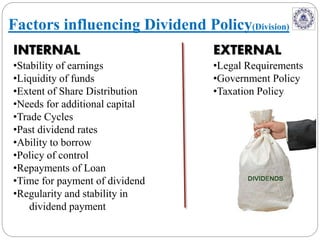
INTERNAL
•Stability of earnings
•Liquidity of funds
•Extent of Share Distribution
•Needs for additional capital
•Trade Cycles
•Past dividend rates
•Ability to borrow
•Policy of control
•Repayments of Loan
•Time for payment of dividend
•Regularity and stability in
dividend payment
EXTERNAL
•Legal Requirements
•Government Policy
•Taxation Policy
Factors influencing Dividend Policy(Division)
Aswathy s

Aswathy s

  • 3.
    Dividend policy refersto the decision of the board regarding distribution of residual earnings to its shareholders. The primary objective of a finance manager is the maximization of wealth of the shareholders. Payment of dividend leads to increase in the price of shares on the one hand but leads to a crunch in liquid resources for financing of prospective projects. There is an inverse relationship between dividend payment and retained earnings. DIVIDEND POLICY
  • 4.
    Wealth Maximisation Future Prospects StableRate of Dividend Degree of Control Objectives of Dividend Policy
  • 5.
    I . WealthMaximization: According to some schools of thought dividend policy has significant impact on the value of the firm. Therefore the dividend policy should be developed keeping in mind the wealth maximization objective of the firm. II . Future Prospects: Dividend policy is a financing decision and leads to cash outflows and also leads to decrease in availability of cash for financing of profitable projects. If sufficient funds are not available, a firm has to depend on external financing. Therefore the dividend policy needs to be devised in such a manner that prospective projects may be financed through retained earnings. Objectives of Dividend Policy
  • 6.
    iii. Stable Rateof Dividend: Fluctuation in the rate of return adversely affects the market price of shares. In order to have a stable rate of dividend, a firm should retain a high proportion of earnings so that the firm can keep sufficient funds for payment of dividend when it faces loss. iv. Degree of Control: Issue of new shares or dependence on external financing will dilute the degree of control of the existing shareholders. Therefore, a more conservative dividend policy should be followed in order that the interest of existing shareholders is not hampered.
  • 7.
    1.Legal requirements 2. Firm'sliquidity position 3.Repayment need 4. Expected rate of return 5. Stability of earning 6. Desire of control 7. Access to the capital market 8. Shareholder's individual tax situation Factors Affecting Dividend Policy
  • 8.
    1. Legal Requirements Thereis no legal compulsion on the part of a company to distribute dividend. However, there certain conditions imposed by law regarding the way dividend is distributed. Basically there are three rules relating to dividend payments. They are the net profit rule, the capital impairment rule and insolvency rule. 2. Firm's liquidity position Dividend payout is also affected by firm's liquidity position. In spite of sufficient retained earnings, the firm may not be able to pay cash dividend if the earnings are not held in cash. 3. Repayment need A firm uses several forms of debt financing to meet its investment needs. These debt must be repaid at the maturity. If the firm has to retain its profits for the purpose of repaying debt, the dividend payment capacity reduces.
  • 9.
    4. Expected rateof return If a firm has relatively higher expected rate of return on the new investment, the firm prefers to retain the earnings for reinvestment rather than distributing cash dividend. 5. Stability of earning If a firm has relatively stable earnings, it is more likely to pay relatively larger dividend than a firm with relatively Fluctuating earnings. 6. Desire of control When the needs for additional financing arise, the management of the firm may not prefer to issue additional common stock because of the fear of dilution in control on management. Therefore, a firm prefers to retain more earnings to satisfy additional financing need which reduces dividend payment capacity.
  • 10.
    7.Access to thecapital market If a firm has easy access to capital markets in raising additional financing, it does not require more retained earnings. So a firm's dividend payment capacity becomes high. 8. Shareholder's individual tax situation For a closely held company, stockholders prefer relatively lower cash dividend because of higher tax to be paid on dividend income. The stockholders in higher personal tax bracket prefer capital gain rather than dividend gains.
  • 11.
    INTERNAL •Stability of earnings •Liquidityof funds •Extent of Share Distribution •Needs for additional capital •Trade Cycles •Past dividend rates •Ability to borrow •Policy of control •Repayments of Loan •Time for payment of dividend •Regularity and stability in dividend payment EXTERNAL •Legal Requirements •Government Policy •Taxation Policy Factors influencing Dividend Policy(Division)