Impact of Dividend Policy on Shareholders’
Wealth: A Study of Selected Manufacturing
Industries of Pakistan
Presented By:
 Aasim Mushtaq
Zafar Iqbal1, Muhammad Arfaq Waseem2, and Muhammad Asad3
1Assistant Professor Mirpur University of Science and Technology AJK, Pakistan
2Research Associate University of Azad Jammu & Kashmir Campus Kotli AJK, Pakistan
3Lecturer Mirpur University of Science and Technology AJK, Pakistan
 This study examines the impact of dividend policy on shareholders’ wealth in context
of Pakistan.
 Thirty five companies randomly from three sectors; Textile, Sugar and Chemical are
observed in the study.
 The annual data for these companies from 2006 to 2011 is used in the study.
 Simple OLS technique for analysis is used to derive the results of the study.
 The findings showed that dividend policy of the firm has significant positive impact
on shareholders wealth. Similarly firm growth rate also has significant positive impact
on shareholders’ wealth.
 Firm size has significant positive impact on shareholders wealth; indicating that large
domain of operations of a business make it more capable to exploit maximum
opportunities and in position to earn greater amount of return due to greater
growth prospects so it ultimately place greater value to shares of large size
companies.
 The results of study help the corporate management to better decide the level of
dividend to be distributed so that shareholders wealth could be maximized.
• Dividend policy has the significant importance in the financial decisions of
the corporation.
• Dividend policy is cause to increase the wealth of shareholders, finance
manager make different financial decisions.
• Dividend decision has great impact on firm financial decision and stock
price.
• The stock price increases when there is smooth payment of dividend exist.
• Investors do not prefer to purchase the shares of such type of companies
which cannot make payment regularly and of which the dividend decisions
have variability because of the risk of loss associated with these variations.
• Dividend policy plays a vital role at company in financial markets and it
directly affects the stock price of the company.
• If a company pays handsome return to its shareholders it will attract to the
new investors to invest their money in the company and vice versa.
• So we can say dividend policy have a strong impact on its share price.
Dividend policy is guidelines for financial managers, how to pay dividend to
the shareholders either through cash dividend or through fixed percentage
dividend.
Dividend distribution is considered one of the strategic corporate
decisions. The sudden increase or decrease in the dividend
payout can affect stock price both positively and negatively
(Fama et al. 1996). Further, Petit (1972) holds the similar view about
the company’s dividend policy and stock price reaction. In the
same vein, Asquith and Mullins (1983) find that, like dividend
increases, dividend initiations have a significant positive impact on
shareholder wealth. Much subsequent research has focused on
explaining the dividend increase induced positive stock market
reaction. The predominant explanation, by far, has been the
information signaling hypothesis significant impact on their wealth.
Relevance theory explains that dividend policy has significant effect
on shareholders wealth as well as firms’ values. If the dividend is paid
on regular basis, there must be an optimum payout ratio, that ratio
increase the market value of per share.
The life cycle theory is also quoted as one of the clarifications for dividend
payments. The main theme of the theory is that the firms face different stages
in their lives; they change their dividend policy according to the need of every
stage. This theory explained that firms pay fewer dividends in growth stage as
compared to their maturity stage; firms pay more dividends when there are no
growth opportunities in future.
Residual theory of dividend given by Miller & Modigliani (1961) explained that if
external financing for reinvestment is either not available or the external financing too
costly in any profitability opportunity. If firm has better investment opportunity
available for investment, so firm make investment and reduce dividend or pay no
dividend at all. There is no investment opportunity for firm, so firm pays more
dividends to shareholders.
The impact of dividend policy on shareholders wealth remains controversial issue. The
harder we look at the dividend picture, the more it seems like a puzzle, with pieces that just
don't fit together. Previous research in context of Pakistan has been incapable to provide
clear direction about dividend policy, a shift in importance is proposed. Despite the healthy
body research exists, there is a lack of clarity that either dividend policy has significant
impact on shareholders wealth or not.
The present study focuses on dividend policies and shareholder wealth. To achieve the
objectives of the study, the researcher has adopted the following question:
Does dividend policy have an impact on shareholders wealth?
• The objectives of the study are as follow:
To describe the concept of the dividend and its policy.
To identify the effect of dividend policy on the shareholders wealth.
Dividend payment policy is one of the most discussed topics and an essentialtheory of corporate
finance which still has its significance. Many researchers presented numerous theories and
pragmatic evidences, however the problem is quietunsettled and open for further debate. It is
among the top ten unsettled issues in economic literature and one that does not have
satisfactory clarification for the observed dividend behavior of the firms (Allen and Michaely,
2003; Black, 1976; Brealey and Myers, 2005). In advanced economies the stakeholders and
management of the firms decides very deviously whether to pay dividends to shareholders or to
retain in the business (Glen et al., 1995). The first model about dividend adjustment was
presented by Lintner in 1956. He suggests in his model that the changes in dividend are because
of the dividend payout ratio of current and last year. He found that the shareholders wish to
continue and return on their investment so managers tend to make partial adjustment in
payment ratio instead of changes in payment. However, the impact of dividend policy on a
corporation's market value is a subject of long standing controversy. Black (1974) exemplifies the
lack of consensus by stating "The harder we look at the dividend picture, the more it seems like a
puzzle, with pieces that just don't fit together.“ Because the academic community has been
unable to provide clear guidance about dividend policy, a shift in emphasis is proposed. In the
spirit of Lintner's seminal work, we asked a sample of corporate financial managers what factors
they considered most important in determining their firm's dividend policy. The academicians
also engaged in finding out the facts and issues relating to dividend policy and they made
different theories on this topic. There are various models presented by these researchers (Joos
and Plesko 2004). They used the survey method for finding the issues and factors that have
impact on such policy. On the basis of this survey they had found different views on such policy.
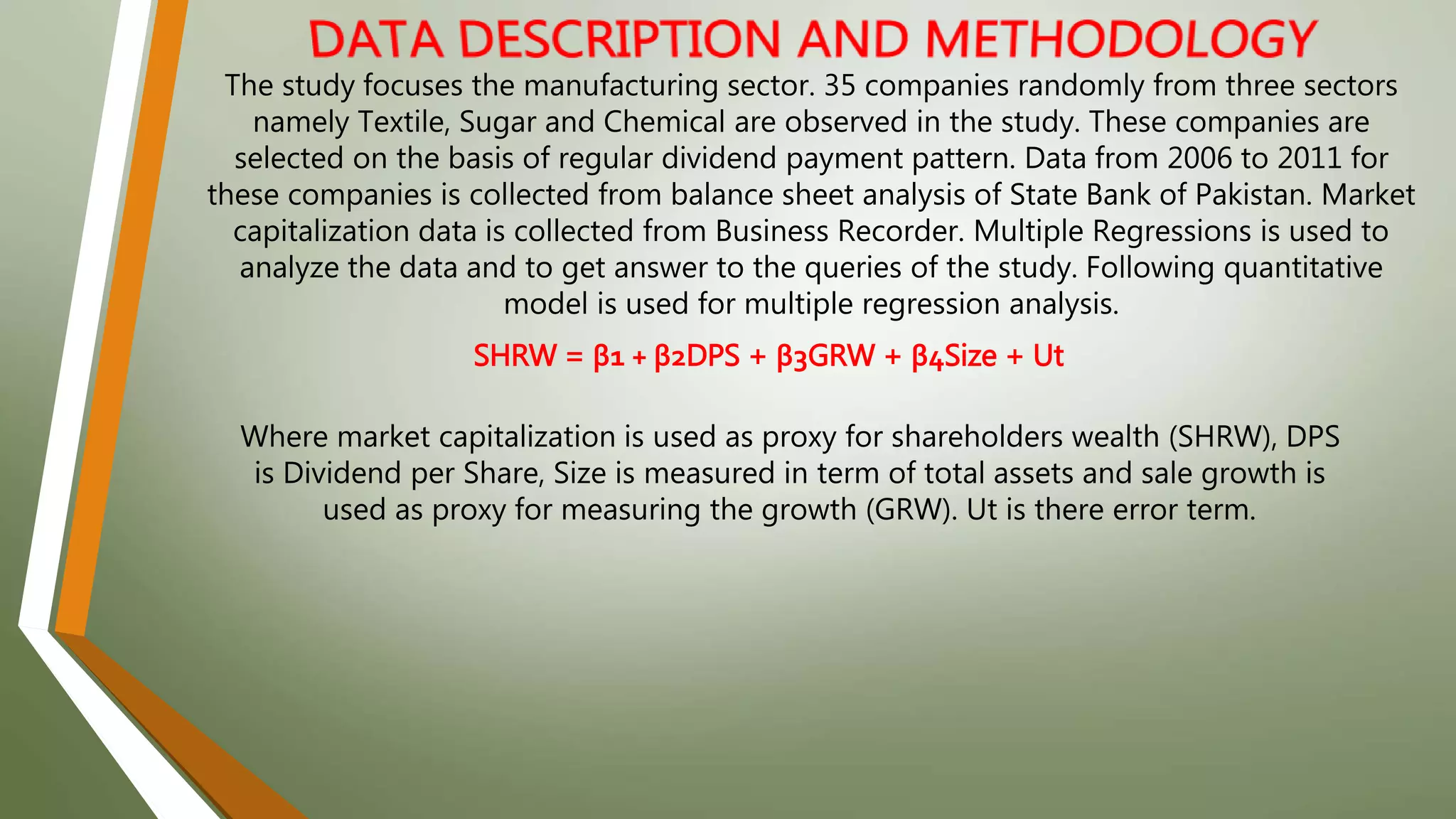
The study focuses the manufacturing sector. 35 companies randomly from three sectors
namely Textile, Sugar and Chemical are observed in the study. These companies are
selected on the basis of regular dividend payment pattern. Data from 2006 to 2011 for
these companies is collected from balance sheet analysis of State Bank of Pakistan. Market
capitalization data is collected from Business Recorder. Multiple Regressions is used to
analyze the data and to get answer to the queries of the study. Following quantitative
model is used for multiple regression analysis.
SHRW = β1 + β2DPS + β3GRW + β4Size + Ut
Where market capitalization is used as proxy for shareholders wealth (SHRW), DPS
is Dividend per Share, Size is measured in term of total assets and sale growth is
used as proxy for measuring the growth (GRW). Ut is there error term.
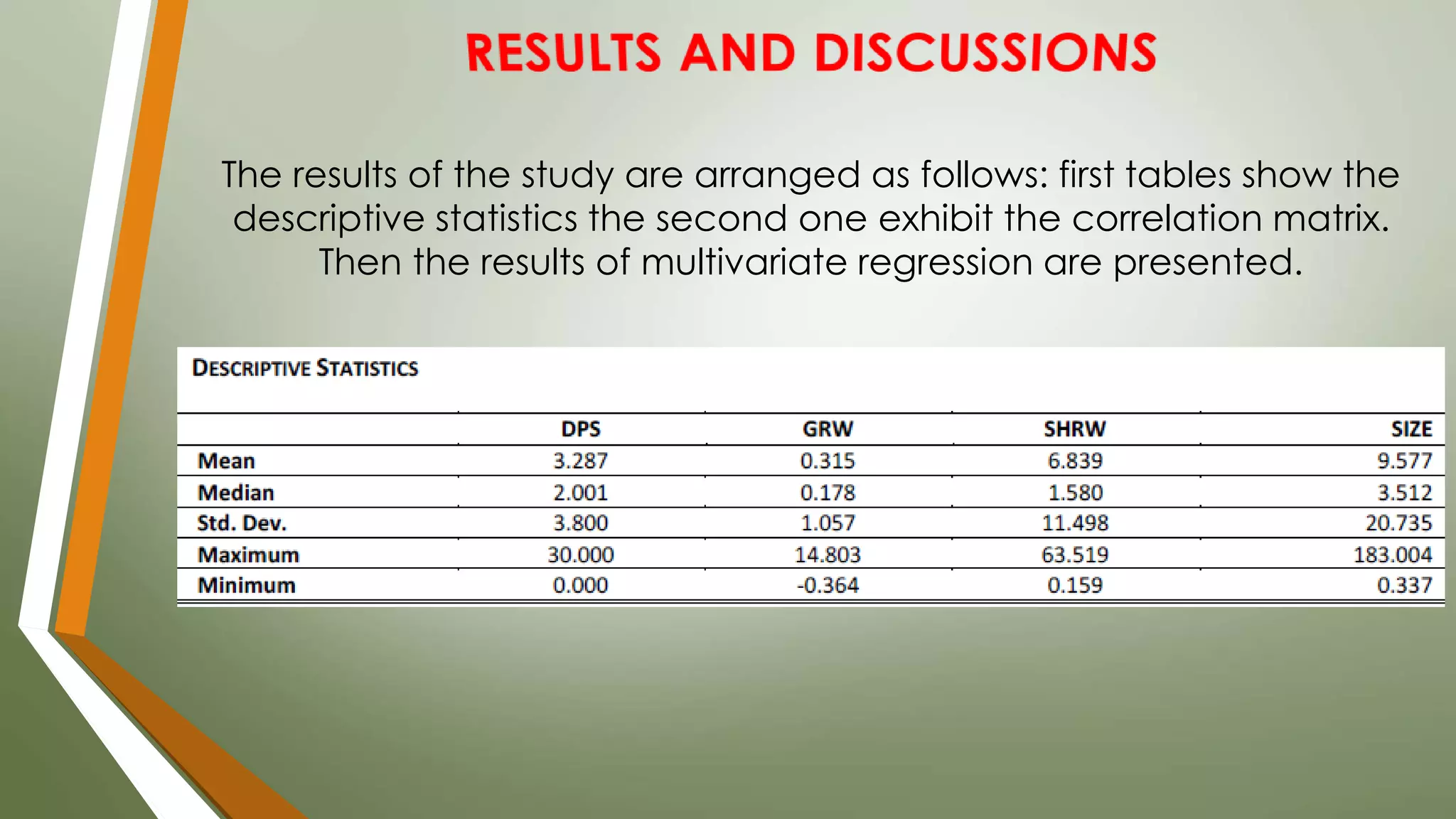
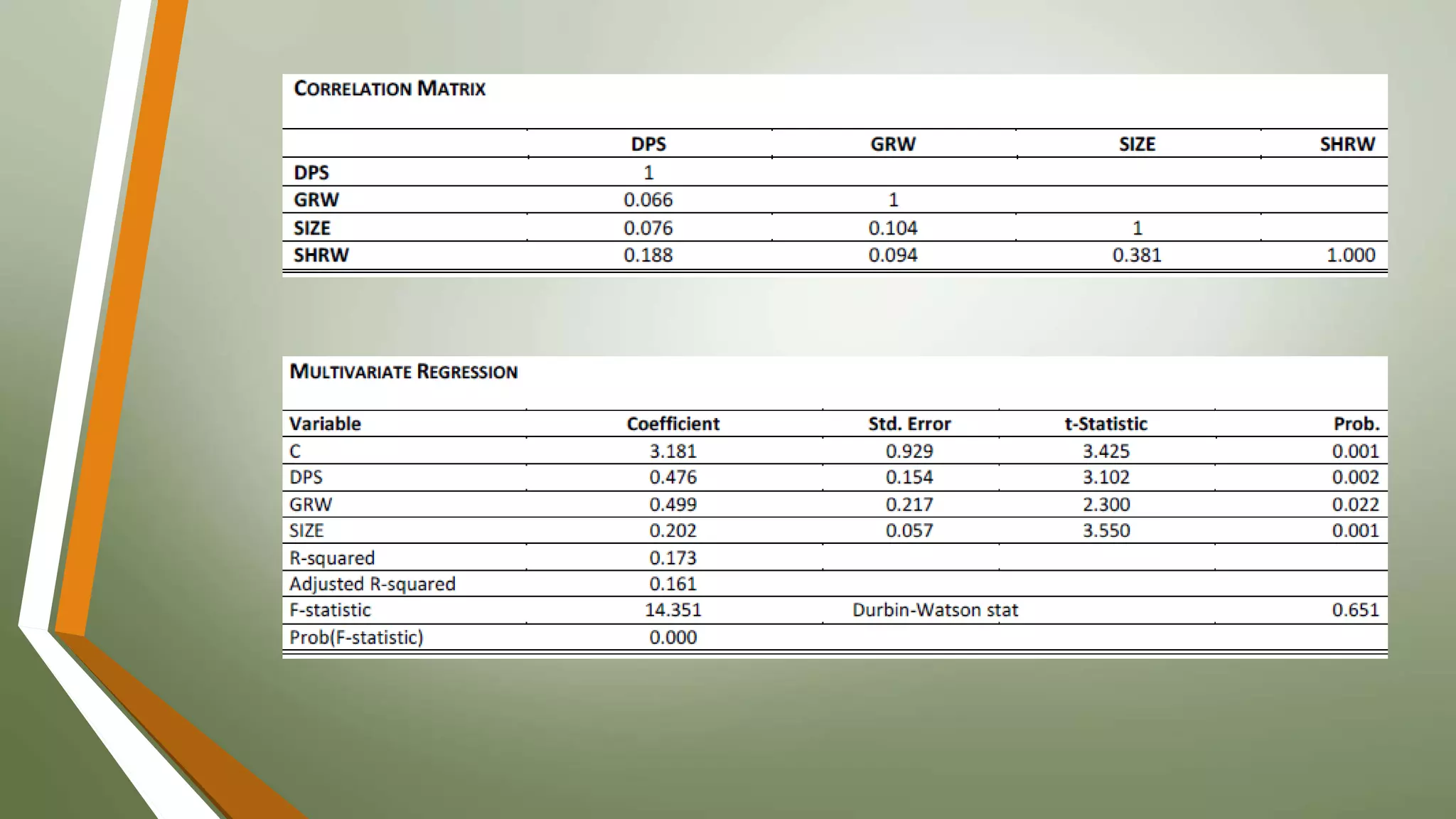
The results of the study are arranged as follows: first tables show the
descriptive statistics the second one exhibit the correlation matrix.
Then the results of multivariate regression are presented.
This study provided orientation towards impact of dividend policy on
shareholder wealth in scenario of Pakistan. The results of the study reveal that
dividend policy of the firm has significant positive impact on shareholders
wealth in context of Pakistan. So our hypothesis is accepted. Dividend
payment effect is relevant to influence the shareholders wealth; current
payment of dividend reduces the uncertainty of investors and they place
high value on share price of the company. Similarly firm growth rate has
significant positive impact on shareholders’ wealth. This result also in line with
the general argument and theories propositions that level of firms’ growth
and shareholders’ wealth always move in same direction. Firm size has
significant positive impact on shareholders wealth; this too is in discipline with
theoretical argument as well as empirical realities. As large domain of
operations of a business is in position to exploit maximum opportunities and in
position to earn greater amount of return due to greater growth prospects so
it ultimately place greater value to shares of large size companies.
Impact of Dividend policy on Shareholders Wealth

Impact of Dividend policy on Shareholders Wealth

  • 1.
    Impact of DividendPolicy on Shareholders’ Wealth: A Study of Selected Manufacturing Industries of Pakistan Presented By:  Aasim Mushtaq Zafar Iqbal1, Muhammad Arfaq Waseem2, and Muhammad Asad3 1Assistant Professor Mirpur University of Science and Technology AJK, Pakistan 2Research Associate University of Azad Jammu & Kashmir Campus Kotli AJK, Pakistan 3Lecturer Mirpur University of Science and Technology AJK, Pakistan
  • 2.
     This studyexamines the impact of dividend policy on shareholders’ wealth in context of Pakistan.  Thirty five companies randomly from three sectors; Textile, Sugar and Chemical are observed in the study.  The annual data for these companies from 2006 to 2011 is used in the study.  Simple OLS technique for analysis is used to derive the results of the study.  The findings showed that dividend policy of the firm has significant positive impact on shareholders wealth. Similarly firm growth rate also has significant positive impact on shareholders’ wealth.  Firm size has significant positive impact on shareholders wealth; indicating that large domain of operations of a business make it more capable to exploit maximum opportunities and in position to earn greater amount of return due to greater growth prospects so it ultimately place greater value to shares of large size companies.  The results of study help the corporate management to better decide the level of dividend to be distributed so that shareholders wealth could be maximized.
  • 3.
    • Dividend policyhas the significant importance in the financial decisions of the corporation. • Dividend policy is cause to increase the wealth of shareholders, finance manager make different financial decisions. • Dividend decision has great impact on firm financial decision and stock price. • The stock price increases when there is smooth payment of dividend exist. • Investors do not prefer to purchase the shares of such type of companies which cannot make payment regularly and of which the dividend decisions have variability because of the risk of loss associated with these variations. • Dividend policy plays a vital role at company in financial markets and it directly affects the stock price of the company. • If a company pays handsome return to its shareholders it will attract to the new investors to invest their money in the company and vice versa. • So we can say dividend policy have a strong impact on its share price. Dividend policy is guidelines for financial managers, how to pay dividend to the shareholders either through cash dividend or through fixed percentage dividend.
  • 4.
    Dividend distribution isconsidered one of the strategic corporate decisions. The sudden increase or decrease in the dividend payout can affect stock price both positively and negatively (Fama et al. 1996). Further, Petit (1972) holds the similar view about the company’s dividend policy and stock price reaction. In the same vein, Asquith and Mullins (1983) find that, like dividend increases, dividend initiations have a significant positive impact on shareholder wealth. Much subsequent research has focused on explaining the dividend increase induced positive stock market reaction. The predominant explanation, by far, has been the information signaling hypothesis significant impact on their wealth.
  • 5.
    Relevance theory explainsthat dividend policy has significant effect on shareholders wealth as well as firms’ values. If the dividend is paid on regular basis, there must be an optimum payout ratio, that ratio increase the market value of per share. The life cycle theory is also quoted as one of the clarifications for dividend payments. The main theme of the theory is that the firms face different stages in their lives; they change their dividend policy according to the need of every stage. This theory explained that firms pay fewer dividends in growth stage as compared to their maturity stage; firms pay more dividends when there are no growth opportunities in future.
  • 6.
    Residual theory ofdividend given by Miller & Modigliani (1961) explained that if external financing for reinvestment is either not available or the external financing too costly in any profitability opportunity. If firm has better investment opportunity available for investment, so firm make investment and reduce dividend or pay no dividend at all. There is no investment opportunity for firm, so firm pays more dividends to shareholders. The impact of dividend policy on shareholders wealth remains controversial issue. The harder we look at the dividend picture, the more it seems like a puzzle, with pieces that just don't fit together. Previous research in context of Pakistan has been incapable to provide clear direction about dividend policy, a shift in importance is proposed. Despite the healthy body research exists, there is a lack of clarity that either dividend policy has significant impact on shareholders wealth or not.
  • 7.
    The present studyfocuses on dividend policies and shareholder wealth. To achieve the objectives of the study, the researcher has adopted the following question: Does dividend policy have an impact on shareholders wealth? • The objectives of the study are as follow: To describe the concept of the dividend and its policy. To identify the effect of dividend policy on the shareholders wealth.
  • 8.
    Dividend payment policyis one of the most discussed topics and an essentialtheory of corporate finance which still has its significance. Many researchers presented numerous theories and pragmatic evidences, however the problem is quietunsettled and open for further debate. It is among the top ten unsettled issues in economic literature and one that does not have satisfactory clarification for the observed dividend behavior of the firms (Allen and Michaely, 2003; Black, 1976; Brealey and Myers, 2005). In advanced economies the stakeholders and management of the firms decides very deviously whether to pay dividends to shareholders or to retain in the business (Glen et al., 1995). The first model about dividend adjustment was presented by Lintner in 1956. He suggests in his model that the changes in dividend are because of the dividend payout ratio of current and last year. He found that the shareholders wish to continue and return on their investment so managers tend to make partial adjustment in payment ratio instead of changes in payment. However, the impact of dividend policy on a corporation's market value is a subject of long standing controversy. Black (1974) exemplifies the lack of consensus by stating "The harder we look at the dividend picture, the more it seems like a puzzle, with pieces that just don't fit together.“ Because the academic community has been unable to provide clear guidance about dividend policy, a shift in emphasis is proposed. In the spirit of Lintner's seminal work, we asked a sample of corporate financial managers what factors they considered most important in determining their firm's dividend policy. The academicians also engaged in finding out the facts and issues relating to dividend policy and they made different theories on this topic. There are various models presented by these researchers (Joos and Plesko 2004). They used the survey method for finding the issues and factors that have impact on such policy. On the basis of this survey they had found different views on such policy.
  • 9.
    The study focusesthe manufacturing sector. 35 companies randomly from three sectors namely Textile, Sugar and Chemical are observed in the study. These companies are selected on the basis of regular dividend payment pattern. Data from 2006 to 2011 for these companies is collected from balance sheet analysis of State Bank of Pakistan. Market capitalization data is collected from Business Recorder. Multiple Regressions is used to analyze the data and to get answer to the queries of the study. Following quantitative model is used for multiple regression analysis. SHRW = β1 + β2DPS + β3GRW + β4Size + Ut Where market capitalization is used as proxy for shareholders wealth (SHRW), DPS is Dividend per Share, Size is measured in term of total assets and sale growth is used as proxy for measuring the growth (GRW). Ut is there error term.
  • 10.
    The results ofthe study are arranged as follows: first tables show the descriptive statistics the second one exhibit the correlation matrix. Then the results of multivariate regression are presented.
  • 12.
    This study providedorientation towards impact of dividend policy on shareholder wealth in scenario of Pakistan. The results of the study reveal that dividend policy of the firm has significant positive impact on shareholders wealth in context of Pakistan. So our hypothesis is accepted. Dividend payment effect is relevant to influence the shareholders wealth; current payment of dividend reduces the uncertainty of investors and they place high value on share price of the company. Similarly firm growth rate has significant positive impact on shareholders’ wealth. This result also in line with the general argument and theories propositions that level of firms’ growth and shareholders’ wealth always move in same direction. Firm size has significant positive impact on shareholders wealth; this too is in discipline with theoretical argument as well as empirical realities. As large domain of operations of a business is in position to exploit maximum opportunities and in position to earn greater amount of return due to greater growth prospects so it ultimately place greater value to shares of large size companies.