OPTICAL TRANSMISSION TECHNIQUE
What is SONET
1.Introduction to SONET
      Synchronous optical network (SONET) is a
  standard for optical telecommunications transport.
        The comprehensive SONET/synchronous
  digital hierarchy (SDH) standard is expected to
  provide the transport infrastructure for worldwide
  telecommunications for at least the next two or
  three decades.
     The increased configuration flexibility and
  bandwidth availability of SONET provides
  significant    advantages     over     the    older
  telecommunications
  system.
Background
 Before SONET, the first generations of fiber-optic systems in
the public telephone network used proprietary architectures,
equipment, line codes, multiplexing formats, and maintenance
procedures.
The users of this equipment regional Bell operating companies
and interexchange carriers (IXCs) in the United States,
Canada, Korea, Taiwan, and Hong Kong standards so that
they could mix and match equipment from different suppliers.
The task of creating such a standard was taken up in 1984 by
the ECSA (Exchange Carriers Standards Association) to establish a
standard for connecting one fiber system to another. This
standard is called SONET.
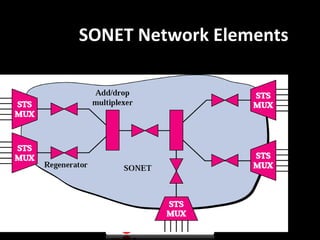
SONET Network Elements
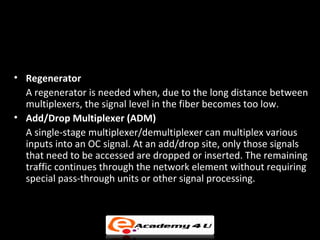
• Regenerator
  A regenerator is needed when, due to the long distance between
  multiplexers, the signal level in the fiber becomes too low.
• Add/Drop Multiplexer (ADM)
  A single-stage multiplexer/demultiplexer can multiplex various
  inputs into an OC signal. At an add/drop site, only those signals
  that need to be accessed are dropped or inserted. The remaining
  traffic continues through the network element without requiring
  special pass-through units or other signal processing.
Synchronous & Asynchronous
                Communication
1. Synchronous Transformations
   A synchronous transformation processes incoming rows
   and passes them on in the data flow one row at a time.
   Output is synchronous with input, meaning that it
   occurs at the same time. Therefore, to process a given
   row, the transformation does not need information
   about other rows in the data set. In the actual
   implementation, rows are grouped into buffers as they
   pass from one component to the next, but these buffers
   are transparent to the user, and you can assume that
   each row is processed separately.
Synchronous & Asynchronous
               Communication

Asynchronous transmission
  Primarily when the data to be transmitted is generated at
  random intervals
    – the user keys in each character at an indeterminate rate
    – with possibly long random time intervals between each
      successive typed character
  Start bit and one or more stop bits
    – each transmitted character or byte is encapsulated
SONET
   In a synchronous system such as SONET, the average frequency
  of all clocks in the system will be the same (synchronous) or
  nearly the same (Every clock can be traced back to a highly
  stable reference supply.
What Are the Benefits of SONET?


• Reduction in equipment requirements and an increase
  in network reliability

• Definition of a synchronous multiplexing format for
  carrying lower level digital signals and a synchronous
  structure that greatly simplifies the interface to digital
  switches, digital cross-connect switches, and add-drop
  multiplexers
What Are the Benefits of SONET?


• Availability of a set of generic standards that
  enable products from different vendors to be
  connected

• Definition of a flexible architecture capable of
  accommodating future applications, with a
  variety of transmission rates
Wavelength-division
               multiplexing
• In fiber-optic communications, wavelength-division
multiplexing (WDM) is a technology which multiplexes
multiple optical carrier signals on a single optical fiber by
using different wavelengths (colours) of laser light to carry
different signals.
•This allows for a multiplication in capacity, in addition to
enabling bidirectional communications over one strand of
fiber.
•This is a form of frequency division multiplexing (FDM)
but is commonly called wavelength division multiplexing.
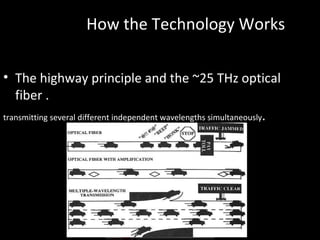
How the Technology Works

• The highway principle and the ~25 THz optical
   fiber .
transmitting several different independent wavelengths simultaneously.
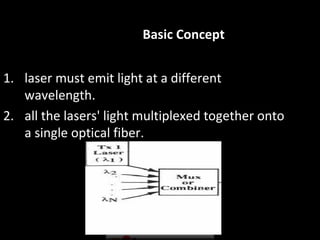
Basic Concept


1. laser must emit light at a different
   wavelength.
2. all the lasers' light multiplexed together onto
   a single optical fiber.
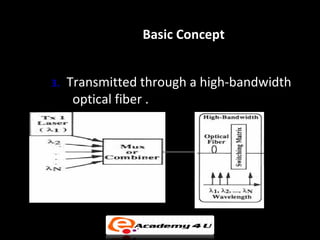
Basic Concept


3.   Transmitted through a high-bandwidth
      optical fiber .
Basic Concept


4.    Signals must be demultiplexed at the
     receiving end( by distributing the total optical power to each
     output port and then requiring that each receiver selectively recover only one
     wavelength by using a tunable optical filter

Optical transmission technique

  • 1.
  • 2.
    What is SONET 1.Introductionto SONET  Synchronous optical network (SONET) is a standard for optical telecommunications transport.  The comprehensive SONET/synchronous digital hierarchy (SDH) standard is expected to provide the transport infrastructure for worldwide telecommunications for at least the next two or three decades.  The increased configuration flexibility and bandwidth availability of SONET provides significant advantages over the older telecommunications system.
  • 3.
    Background Before SONET,the first generations of fiber-optic systems in the public telephone network used proprietary architectures, equipment, line codes, multiplexing formats, and maintenance procedures. The users of this equipment regional Bell operating companies and interexchange carriers (IXCs) in the United States, Canada, Korea, Taiwan, and Hong Kong standards so that they could mix and match equipment from different suppliers. The task of creating such a standard was taken up in 1984 by the ECSA (Exchange Carriers Standards Association) to establish a standard for connecting one fiber system to another. This standard is called SONET.
  • 4.
  • 5.
    • Regenerator A regenerator is needed when, due to the long distance between multiplexers, the signal level in the fiber becomes too low. • Add/Drop Multiplexer (ADM) A single-stage multiplexer/demultiplexer can multiplex various inputs into an OC signal. At an add/drop site, only those signals that need to be accessed are dropped or inserted. The remaining traffic continues through the network element without requiring special pass-through units or other signal processing.
  • 6.
    Synchronous & Asynchronous Communication 1. Synchronous Transformations A synchronous transformation processes incoming rows and passes them on in the data flow one row at a time. Output is synchronous with input, meaning that it occurs at the same time. Therefore, to process a given row, the transformation does not need information about other rows in the data set. In the actual implementation, rows are grouped into buffers as they pass from one component to the next, but these buffers are transparent to the user, and you can assume that each row is processed separately.
  • 7.
    Synchronous & Asynchronous Communication Asynchronous transmission Primarily when the data to be transmitted is generated at random intervals – the user keys in each character at an indeterminate rate – with possibly long random time intervals between each successive typed character Start bit and one or more stop bits – each transmitted character or byte is encapsulated SONET In a synchronous system such as SONET, the average frequency of all clocks in the system will be the same (synchronous) or nearly the same (Every clock can be traced back to a highly stable reference supply.
  • 8.
    What Are theBenefits of SONET? • Reduction in equipment requirements and an increase in network reliability • Definition of a synchronous multiplexing format for carrying lower level digital signals and a synchronous structure that greatly simplifies the interface to digital switches, digital cross-connect switches, and add-drop multiplexers
  • 9.
    What Are theBenefits of SONET? • Availability of a set of generic standards that enable products from different vendors to be connected • Definition of a flexible architecture capable of accommodating future applications, with a variety of transmission rates
  • 10.
    Wavelength-division multiplexing • In fiber-optic communications, wavelength-division multiplexing (WDM) is a technology which multiplexes multiple optical carrier signals on a single optical fiber by using different wavelengths (colours) of laser light to carry different signals. •This allows for a multiplication in capacity, in addition to enabling bidirectional communications over one strand of fiber. •This is a form of frequency division multiplexing (FDM) but is commonly called wavelength division multiplexing.
  • 11.
    How the TechnologyWorks • The highway principle and the ~25 THz optical fiber . transmitting several different independent wavelengths simultaneously.
  • 12.
    Basic Concept 1. lasermust emit light at a different wavelength. 2. all the lasers' light multiplexed together onto a single optical fiber.
  • 13.
    Basic Concept 3. Transmitted through a high-bandwidth optical fiber .
  • 14.
    Basic Concept 4. Signals must be demultiplexed at the receiving end( by distributing the total optical power to each output port and then requiring that each receiver selectively recover only one wavelength by using a tunable optical filter