LAN TECHNOLOGIES
LAN Topologies

• There are three main types of LAN systems:
  – Star Topology
  – Ring Topology
  – Bus Topology
• Some topologies are actually hybrids of the
  above!
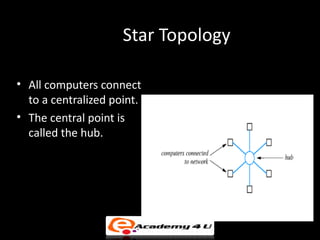
Star Topology

• All computers connect
  to a centralized point.
• The central point is
  called the hub.
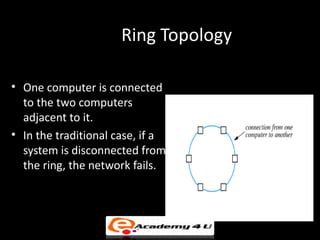
Ring Topology

• One computer is connected
  to the two computers
  adjacent to it.
• In the traditional case, if a
  system is disconnected from
  the ring, the network fails.
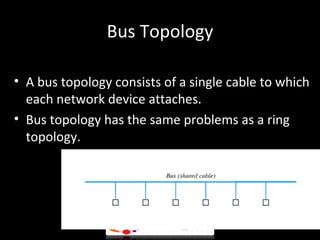
Bus Topology

• A bus topology consists of a single cable to which
  each network device attaches.
• Bus topology has the same problems as a ring
  topology.
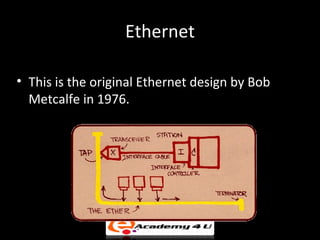
Ethernet

• This is the original Ethernet design by Bob
  Metcalfe in 1976.
Ethernet (cont.)

• The Ethernet specification details how devices
  are supposed to interact on the segment,
  distances between devices, and a whole other
  multitude of other things.
• Carrier Sense On Multi-Access Networks (CSMA)
  with Collision Detection (CD) was the most
  important part of the specification.
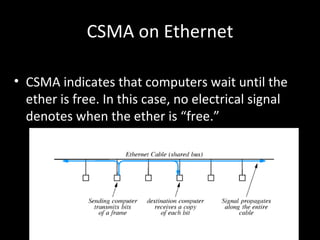
CSMA on Ethernet

• CSMA indicates that computers wait until the
  ether is free. In this case, no electrical signal
  denotes when the ether is “free.”
CSMA on Ethernet (cont.)


• The “signal” is the carrier of the ether.
• The act of waiting for the opportunity to send on
  the ether is carrier sense.
Collision Detection

• Since networks are not instantaneous, it is possible for
  two stations to check the ether, deem it time to send,
  and both send at the same time.
• This is called a collision.
• When a collision occurs, the sender immediately stops
  transmission, and waits some random length of time,
  and then begins transmission again.
Collision Detection (cont.)

• A busy segment will always have collisions.
• Collisions do not damage the equipment, but it
  forces the two machines that caused the
  collision to wait, and therefore it slows down the
  network.
• Fewer machines on a segment, smaller
  segments, can improve the collision count.
LocalTalk

• LocalTalk is another form of a bus network.
• LocalTalk differs from Ethernet in a few ways:
  – When a machine senses the segment is free, it holds
    it until the frame transmission is over. All other
    machines know to wait for transmission to
    complete.
  – Bandwidth is quite small at ~230Kbps. That’s 2.3% of
    the earliest Ethernet specification!
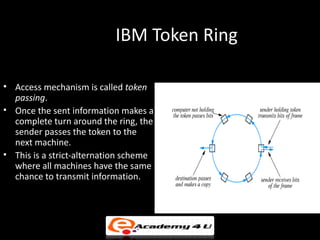
IBM Token Ring

• Access mechanism is called token
  passing.
• Once the sent information makes a
  complete turn around the ring, the
  sender passes the token to the
  next machine.
• This is a strict-alternation scheme
  where all machines have the same
  chance to transmit information.
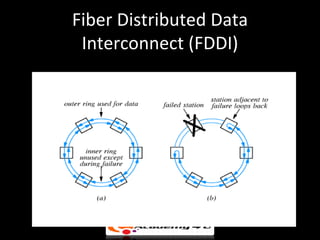
Fiber Distributed Data
 Interconnect (FDDI)

Lan technologies

  • 1.
  • 2.
    LAN Topologies • Thereare three main types of LAN systems: – Star Topology – Ring Topology – Bus Topology • Some topologies are actually hybrids of the above!
  • 3.
    Star Topology • Allcomputers connect to a centralized point. • The central point is called the hub.
  • 4.
    Ring Topology • Onecomputer is connected to the two computers adjacent to it. • In the traditional case, if a system is disconnected from the ring, the network fails.
  • 5.
    Bus Topology • Abus topology consists of a single cable to which each network device attaches. • Bus topology has the same problems as a ring topology.
  • 6.
    Ethernet • This isthe original Ethernet design by Bob Metcalfe in 1976.
  • 7.
    Ethernet (cont.) • TheEthernet specification details how devices are supposed to interact on the segment, distances between devices, and a whole other multitude of other things. • Carrier Sense On Multi-Access Networks (CSMA) with Collision Detection (CD) was the most important part of the specification.
  • 8.
    CSMA on Ethernet •CSMA indicates that computers wait until the ether is free. In this case, no electrical signal denotes when the ether is “free.”
  • 9.
    CSMA on Ethernet(cont.) • The “signal” is the carrier of the ether. • The act of waiting for the opportunity to send on the ether is carrier sense.
  • 10.
    Collision Detection • Sincenetworks are not instantaneous, it is possible for two stations to check the ether, deem it time to send, and both send at the same time. • This is called a collision. • When a collision occurs, the sender immediately stops transmission, and waits some random length of time, and then begins transmission again.
  • 11.
    Collision Detection (cont.) •A busy segment will always have collisions. • Collisions do not damage the equipment, but it forces the two machines that caused the collision to wait, and therefore it slows down the network. • Fewer machines on a segment, smaller segments, can improve the collision count.
  • 12.
    LocalTalk • LocalTalk isanother form of a bus network. • LocalTalk differs from Ethernet in a few ways: – When a machine senses the segment is free, it holds it until the frame transmission is over. All other machines know to wait for transmission to complete. – Bandwidth is quite small at ~230Kbps. That’s 2.3% of the earliest Ethernet specification!
  • 13.
    IBM Token Ring •Access mechanism is called token passing. • Once the sent information makes a complete turn around the ring, the sender passes the token to the next machine. • This is a strict-alternation scheme where all machines have the same chance to transmit information.
  • 14.
    Fiber Distributed Data Interconnect (FDDI)