
INVESTMENT
INVESTMENT Investment refers to  current commitment of funds  for a specified time period to  derive benefits in future. The future benefits derived from an investment are known as ‘ returns ’ Giving loan : with an expectation to get the principal back along with the interest at a future date Buying gold : with an expectation of appreciation in its value in future Buying an insurance plan : for various benefits derivable in future &/or in case of an eventuality Buying shares of companies : for dividend &/ or capital appreciation CURRENT SACRIFICE  FUTURE REWARD As the reward would accrue only in future, it involves  ‘risk’  (of realized return being lower than that expected)
Objective of an investor Maximization of return Minimization of risk Hedge against inflation (if the investment cannot earn as much as the rise in price level, the ‘real’ rate of return will be negative)
INVESTMENT ALTERNATIVES FINANCIAL ASSETS Equity shares Bonds Preference shares Non- marketable financial assets Money market instruments Mutual funds Life insurance Financial derivatives REAL ASSETS Real estate Precious objects
EQUITY SHARES Represents ownership capital They elect the board of directors and have a right to vote on every resolution placed before the company They enjoy the preemptive right which enables them to maintain their proportional ownership  Risk: residual claim over income Reward: partners in progress The amount of capital that a company can issue as per its memorandum represents  authorized capital The amount offered by the company to the investors is called  issued capital The part of issued capital that is subscribed to by the investors is called  subscribed capital / paid up capital
EQUITY SHARES Par / Face / Nominal value   of a share is stated in the memorandum and written on the share scrip Issue of shares at a value above its par value is called   issue at a premium Issue of shares at a value below its par value is called   issue at a discount The price at which the share currently trades in the market is called the   market value
EQUITY SHARES Blue chip shares Shares of large, well established and financially strong companies with impressive record of earnings and dividend Growth shares Shares of companies having fairly strong position in the growing market and having an above average rate of growth and profitability Income shares Shares of companies having fairly stable operations, limited growth opportunities and high dividend payouts Cyclical shares Shares of companies performing as per the business cycles Defensive shares Shares of companies relatively unaffected by the ups and downs in the general economic conditions Speculative shares shares of companies whose prices fluctuate widely because of a lot of speculative trading being done on them
BONDS They are long term debt instruments issued for a fixed time period Bonds  are debt securities issued by the government or PSUs Debentures  are debt securities issued by private sector companies They comprise of periodic interest payments over the life of the instrument and the principal repayment at the time of redemption Debt securities issued by the central government , state government and quasi government agencies are referred to as  gilt-edged securities Callable bonds  are the ones that can be called for redemption earlier than their date of maturity. This right to call is available with the company Convertible bonds  are the ones that can be converted into equity shares at a later date either fully or partly. This option is available with the bond holder Coupon rate  is the nominal rate of interest fixed and printed on the bond certificate. It is calculated on the face value and is payable by the company till maturity
PREFERENCE SHARES Represents a  hybrid security  that has attributes of both equity shares and debentures.  They carry a  fixed rate of dividend . However it is payable only out of distributable profits Dividend on preference shares is generally  cumulative . Dividend skipped in one year has to be paid subsequently before equity dividend can be paid Only  redeemable preference shares  can be issued
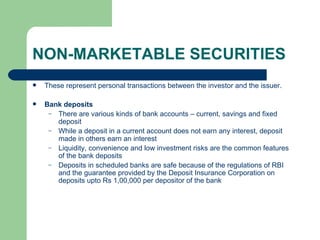
NON-MARKETABLE SECURITIES These represent personal transactions between the investor and the issuer. Bank deposits There are various kinds of bank accounts – current, savings and fixed deposit While a deposit in a current account does not earn any interest, deposit made in others earn an interest Liquidity, convenience and low investment risks are the common features of the bank deposits Deposits in scheduled banks are safe because of the regulations of RBI and the guarantee provided by the Deposit Insurance Corporation on deposits upto Rs 1,00,000 per depositor of the bank
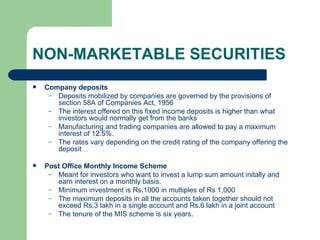
NON-MARKETABLE SECURITIES Company deposits Deposits mobilized by companies are governed by the provisions of section 58A of Companies Act, 1956 The interest offered on this fixed income deposits is higher than what investors would normally get from the banks Manufacturing and trading companies are allowed to pay a maximum interest of 12.5%. The rates vary depending on the credit rating of the company offering the deposit Post Office Monthly Income Scheme Meant for investors who want to invest a lump sum amount initally and earn interest on a monthly basis. Minimum investment is Rs.1000 in multiples of Rs 1,000 The maximum deposits in all the accounts taken together should not exceed Rs.3 lakh in a single account and Rs.6 lakh in a joint account The tenure of the MIS scheme is six years.
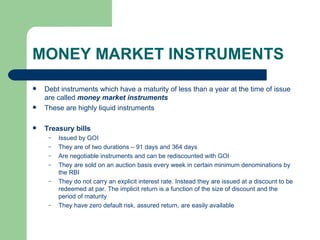
MONEY MARKET INSTRUMENTS Debt instruments which have a maturity of less than a year at the time of issue are called  money market instruments These are highly liquid instruments Treasury bills Issued by GOI They are of two durations – 91 days and 364 days Are negotiable instruments and can be rediscounted with GOI They are sold on an auction basis every week in certain minimum denominations by the RBI They do not carry an explicit interest rate. Instead they are issued at a discount to be redeemed at par. The implicit return is a function of the size of discount and the period of maturity They have zero default risk, assured return, are easily available
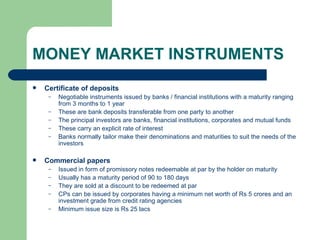
MONEY MARKET INSTRUMENTS Certificate of deposits Negotiable instruments issued by banks / financial institutions with a maturity ranging from 3 months to 1 year These are bank deposits transferable from one party to another The principal investors are banks, financial institutions, corporates and mutual funds These carry an explicit rate of interest Banks normally tailor make their denominations and maturities to suit the needs of the investors Commercial papers Issued in form of promissory notes redeemable at par by the holder on maturity Usually has a maturity period of 90 to 180 days They are sold at a discount to be redeemed at par CPs can be issued by corporates having a minimum net worth of Rs 5 crores and an investment grade from credit rating agencies Minimum issue size is Rs 25 lacs
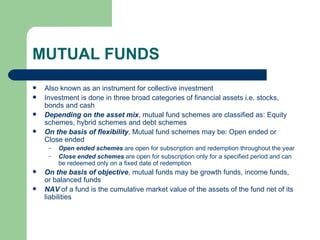
MUTUAL FUNDS Also known as an instrument for collective investment Investment is done in three broad categories of financial assets i.e. stocks, bonds and cash Depending on the asset mix , mutual fund schemes are classified as: Equity schemes, hybrid schemes and debt schemes On the basis of flexibility , Mutual fund schemes may be: Open ended or Close ended Open ended schemes  are open for subscription and redemption throughout the year Close ended schemes  are open for subscription only for a specified period and can be redeemed only on a fixed date of redemption On the basis of objective , mutual funds may be growth funds, income funds, or balanced funds NAV  of a fund is the cumulative market value of the assets of the fund net of its liabilities
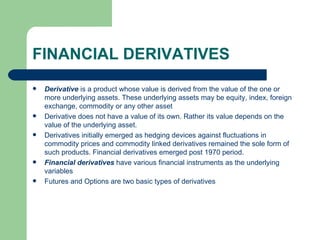
FINANCIAL DERIVATIVES Derivative  is a product whose value is derived from the value of the one or more underlying assets. These underlying assets may be equity, index, foreign exchange, commodity or any other asset Derivative does not have a value of its own. Rather its value depends on the value of the underlying asset. Derivatives initially emerged as hedging devices against fluctuations in commodity prices and commodity linked derivatives remained the sole form of such products. Financial derivatives emerged post 1970 period. Financial derivatives  have various financial instruments as the underlying variables Futures and Options are two basic types of derivatives
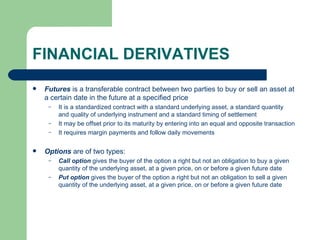
FINANCIAL DERIVATIVES Futures  is a transferable contract between two parties to buy or sell an asset at a certain date in the future at a specified price It is a standardized contract with a standard underlying asset, a standard quantity and quality of underlying instrument and a standard timing of settlement It may be offset prior to its maturity by entering into an equal and opposite transaction It requires margin payments and follow daily movements Options  are of two types: Call option  gives the buyer of the option a right but not an obligation to buy a given quantity of the underlying asset, at a given price, on or before a given future date Put option  gives the buyer of the option a right but not an obligation to sell a given quantity of the underlying asset, at a given price, on or before a given future date

Investment Alternatives

  • 1.
  • 2.
    INVESTMENT Investment refersto current commitment of funds for a specified time period to derive benefits in future. The future benefits derived from an investment are known as ‘ returns ’ Giving loan : with an expectation to get the principal back along with the interest at a future date Buying gold : with an expectation of appreciation in its value in future Buying an insurance plan : for various benefits derivable in future &/or in case of an eventuality Buying shares of companies : for dividend &/ or capital appreciation CURRENT SACRIFICE FUTURE REWARD As the reward would accrue only in future, it involves ‘risk’ (of realized return being lower than that expected)
  • 3.
    Objective of aninvestor Maximization of return Minimization of risk Hedge against inflation (if the investment cannot earn as much as the rise in price level, the ‘real’ rate of return will be negative)
  • 4.
    INVESTMENT ALTERNATIVES FINANCIALASSETS Equity shares Bonds Preference shares Non- marketable financial assets Money market instruments Mutual funds Life insurance Financial derivatives REAL ASSETS Real estate Precious objects
  • 5.
    EQUITY SHARES Representsownership capital They elect the board of directors and have a right to vote on every resolution placed before the company They enjoy the preemptive right which enables them to maintain their proportional ownership Risk: residual claim over income Reward: partners in progress The amount of capital that a company can issue as per its memorandum represents authorized capital The amount offered by the company to the investors is called issued capital The part of issued capital that is subscribed to by the investors is called subscribed capital / paid up capital
  • 6.
    EQUITY SHARES Par/ Face / Nominal value of a share is stated in the memorandum and written on the share scrip Issue of shares at a value above its par value is called issue at a premium Issue of shares at a value below its par value is called issue at a discount The price at which the share currently trades in the market is called the market value
  • 7.
    EQUITY SHARES Bluechip shares Shares of large, well established and financially strong companies with impressive record of earnings and dividend Growth shares Shares of companies having fairly strong position in the growing market and having an above average rate of growth and profitability Income shares Shares of companies having fairly stable operations, limited growth opportunities and high dividend payouts Cyclical shares Shares of companies performing as per the business cycles Defensive shares Shares of companies relatively unaffected by the ups and downs in the general economic conditions Speculative shares shares of companies whose prices fluctuate widely because of a lot of speculative trading being done on them
  • 8.
    BONDS They arelong term debt instruments issued for a fixed time period Bonds are debt securities issued by the government or PSUs Debentures are debt securities issued by private sector companies They comprise of periodic interest payments over the life of the instrument and the principal repayment at the time of redemption Debt securities issued by the central government , state government and quasi government agencies are referred to as gilt-edged securities Callable bonds are the ones that can be called for redemption earlier than their date of maturity. This right to call is available with the company Convertible bonds are the ones that can be converted into equity shares at a later date either fully or partly. This option is available with the bond holder Coupon rate is the nominal rate of interest fixed and printed on the bond certificate. It is calculated on the face value and is payable by the company till maturity
  • 9.
    PREFERENCE SHARES Representsa hybrid security that has attributes of both equity shares and debentures. They carry a fixed rate of dividend . However it is payable only out of distributable profits Dividend on preference shares is generally cumulative . Dividend skipped in one year has to be paid subsequently before equity dividend can be paid Only redeemable preference shares can be issued
  • 10.
    NON-MARKETABLE SECURITIES Theserepresent personal transactions between the investor and the issuer. Bank deposits There are various kinds of bank accounts – current, savings and fixed deposit While a deposit in a current account does not earn any interest, deposit made in others earn an interest Liquidity, convenience and low investment risks are the common features of the bank deposits Deposits in scheduled banks are safe because of the regulations of RBI and the guarantee provided by the Deposit Insurance Corporation on deposits upto Rs 1,00,000 per depositor of the bank
  • 11.
    NON-MARKETABLE SECURITIES Companydeposits Deposits mobilized by companies are governed by the provisions of section 58A of Companies Act, 1956 The interest offered on this fixed income deposits is higher than what investors would normally get from the banks Manufacturing and trading companies are allowed to pay a maximum interest of 12.5%. The rates vary depending on the credit rating of the company offering the deposit Post Office Monthly Income Scheme Meant for investors who want to invest a lump sum amount initally and earn interest on a monthly basis. Minimum investment is Rs.1000 in multiples of Rs 1,000 The maximum deposits in all the accounts taken together should not exceed Rs.3 lakh in a single account and Rs.6 lakh in a joint account The tenure of the MIS scheme is six years.
  • 12.
    MONEY MARKET INSTRUMENTSDebt instruments which have a maturity of less than a year at the time of issue are called money market instruments These are highly liquid instruments Treasury bills Issued by GOI They are of two durations – 91 days and 364 days Are negotiable instruments and can be rediscounted with GOI They are sold on an auction basis every week in certain minimum denominations by the RBI They do not carry an explicit interest rate. Instead they are issued at a discount to be redeemed at par. The implicit return is a function of the size of discount and the period of maturity They have zero default risk, assured return, are easily available
  • 13.
    MONEY MARKET INSTRUMENTSCertificate of deposits Negotiable instruments issued by banks / financial institutions with a maturity ranging from 3 months to 1 year These are bank deposits transferable from one party to another The principal investors are banks, financial institutions, corporates and mutual funds These carry an explicit rate of interest Banks normally tailor make their denominations and maturities to suit the needs of the investors Commercial papers Issued in form of promissory notes redeemable at par by the holder on maturity Usually has a maturity period of 90 to 180 days They are sold at a discount to be redeemed at par CPs can be issued by corporates having a minimum net worth of Rs 5 crores and an investment grade from credit rating agencies Minimum issue size is Rs 25 lacs
  • 14.
    MUTUAL FUNDS Alsoknown as an instrument for collective investment Investment is done in three broad categories of financial assets i.e. stocks, bonds and cash Depending on the asset mix , mutual fund schemes are classified as: Equity schemes, hybrid schemes and debt schemes On the basis of flexibility , Mutual fund schemes may be: Open ended or Close ended Open ended schemes are open for subscription and redemption throughout the year Close ended schemes are open for subscription only for a specified period and can be redeemed only on a fixed date of redemption On the basis of objective , mutual funds may be growth funds, income funds, or balanced funds NAV of a fund is the cumulative market value of the assets of the fund net of its liabilities
  • 15.
    FINANCIAL DERIVATIVES Derivative is a product whose value is derived from the value of the one or more underlying assets. These underlying assets may be equity, index, foreign exchange, commodity or any other asset Derivative does not have a value of its own. Rather its value depends on the value of the underlying asset. Derivatives initially emerged as hedging devices against fluctuations in commodity prices and commodity linked derivatives remained the sole form of such products. Financial derivatives emerged post 1970 period. Financial derivatives have various financial instruments as the underlying variables Futures and Options are two basic types of derivatives
  • 16.
    FINANCIAL DERIVATIVES Futures is a transferable contract between two parties to buy or sell an asset at a certain date in the future at a specified price It is a standardized contract with a standard underlying asset, a standard quantity and quality of underlying instrument and a standard timing of settlement It may be offset prior to its maturity by entering into an equal and opposite transaction It requires margin payments and follow daily movements Options are of two types: Call option gives the buyer of the option a right but not an obligation to buy a given quantity of the underlying asset, at a given price, on or before a given future date Put option gives the buyer of the option a right but not an obligation to sell a given quantity of the underlying asset, at a given price, on or before a given future date