STERILIZATION : CHEMICAL METHOD
Mr. Naresh Pokhrel
M.Sc Clinical Microbiology
Department of Microbiology
Father Muller Medical College, Mangalore
CHEMICAL METHODSCHEMICAL METHODS
 Alcohols
 Aldehydes
 Dyes
 Halogens
 Phenols
 Gases
-- Ethylene Oxide
- Formaldehyde gas
- Betapropiolactone (BPL)
 Surface active agents
Properties of an ideal disinfectant or
antiseptic
 Should have wide spectrum of activity and be
effective against all microorganism.
 Be active in presence of organic matter.
 Have speedy action.
 Have high penetrating power.
 Stable and non corrosive
 Cheap, easy to use
 Be effective in acid as well as alkaline media
 Be compatible with other antiseptics and
disinfectants
 Not cause local irritation or sensitization
THE FACTORS THAT
DETERMINE THE POTENCY OF
DISINFECTANTS ARE:
 Concentration of the substance ,
 Time of action,
 pH of the medium ,
 Temperature
 Nature of organism
 Presence of extraneous material
CHEMICAL AGENTS ACT IN VARIOUS
WAYS :
 Protein coagulation ,
 Disruption of cell membrane resulting exposure,
damage or loss of the contents
 Removal of free sulphydryl groups essential for the
functioning of the enzymes and
 Substrate competition- a compound resembling the
essential substrate of the enzyme diverts or
misleads the enzymes necessary for the
metabolism of the cell and cause cell death.
ALCOHOLSALCOHOLS
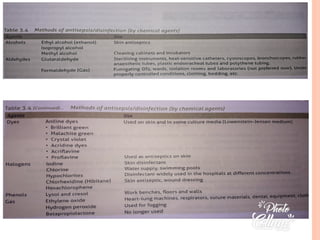
 Ethanol, methanol, isopropyl alcohol are frequently
used.
 Act by denaturing proteins.
 They have no action on spores.
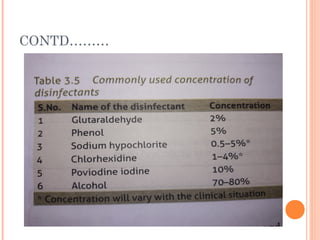
 To be effective working concentration is 70-80 % in
water..
 Protein Slow its action whereas 1 % mineral acid and
alkali enhances it.
CONTD……
 Methyl alcohol is effective against fungal spores.
 Evaporate, leaving no residue
 The inside of the Chambers are wiped with liberal
amounts of methanol.
 A pad moistened with methanol and a dish of
water(to ensure high humidity) are kept inside ,
 And the incubator is left at working temperature
for several hours.
CONTD……..
 Uses: To disinfect skin prior to injections.
 Methyl alcohol is used to clean incubators and
biosafety cabinets
 Isopropyl alcohol is preferred as it is better fat
solvent, more bactericidal and less volatile
 Mainly used for disinfection of clinical thermometer.
ALDEHYDESALDEHYDES::
 Mechanism: active against the amino group in the
protein molecule.
 bactericidal, sporicidial and virucidal
 Commonly used aldehydes are Formaldehyde,
glutaraldehyde
FORMALDEHYDE GAS
 Excellent disinfectant
 Formalin(10%) was used extensively to preserve
biological specimens and for destroying anthrax
spores in hair and wool.
 Irritates mucous membranes, strong odour.
 10 % formalin containing 0.5 % sodium tetra borate
in water is used to sterilise clean metal instruments
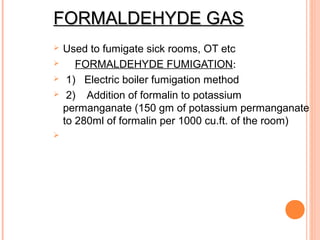
 Formaldehyde in gaseous form is used to fumigate
sick rooms, operation theaters, labs
Glutaraldehyde:
 Less irritating and more effective than
formaldehyde.
 sterilizing agent : 2% solution of glutaraldehyde
(Cidex) which is Bactericidal, tuberculocidal,
virucidal in 10 minutes.
 Sporicidal in 3 to 10 hours
CONTD……….
 Commonly used to disinfect hospital instruments-
cystoscopes, endoscopes, corrugated rubber tubes,
face masks, metal instruments, polythene tubes
ORTHOPHTALALDEHYDE
 Has bactericidal activity
 Uses to Clean endoscopes between as it is
quick, effective and safe.
DYES
 ANILINE DYES -Brilliant green, malachite green
and crystal violet
 More active against gram+ve than gram-ve bacteria
 No activity against tubercle bacilli hence Malachite
green is used in Lowenstein Jensen media
 Non irritant, Non toxic
 These dyes are used in the microbiology laboratory
as selective agents in culture media.
 Lethal effects on bacteria are believed to be due to
their reaction with the acid group in the cell.
ACRIDINE DYES
 Are not selective as the aniline dyes.
 Proflavine, acriflavine, euflavine, aminacrine
 Impair DNA complexes of organisms and destroy
reproductive capacity of the cell
HALOGENS
Iodine:
 Tincture of iodine (alcohol solution) was one of
first antiseptics used.
 Combines with amino acid tyrosine in proteins and
denatures proteins.
 Stains skin and clothes
 bactericidal, virucidal and fairly active against
spores
Iodophors:
 Iodine compounds with non ionic wetting or surface
active agents
 It inhibits protein synthesis and oxidizes –SH groups
of amino acids
 Used as skin antiseptic in surgery.
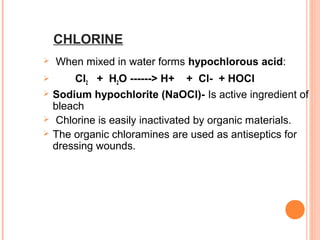
CHLORINE
 When mixed in water forms hypochlorous acid:
 Cl2 + H2O ------> H+ + Cl- + HOCl
 Sodium hypochlorite (NaOCl)- Is active ingredient of
bleach
 Chlorine is easily inactivated by organic materials.
 The organic chloramines are used as antiseptics for
dressing wounds.
CONTD…….
 Not much useful against spores
 Used to disinfect drinking water, pools, and sewage
 For household use (bleach) it is used in conc. of
0.2-1%.
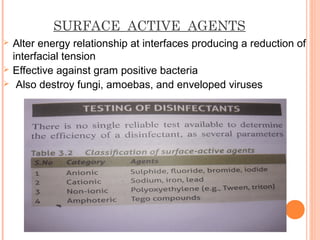
SURFACE ACTIVE AGENTS
 Alter energy relationship at interfaces producing a reduction of
interfacial tension
 Effective against gram positive bacteria
 Also destroy fungi, amoebas, and enveloped viruses
 Anionic compounds: Common soap and detergents
 Cationic compounds: Cetrimide and bezalkonium
chloride- used as antiseptics.
 Advantages: Strong antimicrobial action, colorless,
odorless, tasteless, stable, and nontoxic.
 Disadvantages: Form foam. Organic matter
interferes with effectiveness
OXIDIZING AGENTS
 Hydrogen peroxide and peracetic acid.
 H2O2 kills most organisms at 3-6% conc.
 At 10-25% kills even spores
 Used to disinfect plastic implants, contact lenses
and surgical prosthesis
Peracetic Acid:
 Has good sterilization effect on
bacteria,particulary common antibiotic
resistant bacteria such as methicilin
resistant Staphylococcus aureus,
vancomycin resistant Enterococcus and
Clostridium defficile
Ozone:
 Highly reactive form of oxygen
 Used along with chlorine to disinfect water
 More effective killing agent than chlorine
 Less stable and more expensive
PHENOLS AND PHENOLICS
 Phenol (carbolic acid) was first used by Lister as a
disinfectant.
 Obtained by distillation of coal tar between temp
170-270 0
C
 Active against gram+ve and –ve bacteria,
mycobacteria
 Little activity against spores and viruses
 Act by causing cell membrane damage, releasing
cell contents and causing lysis
 Resistant to inactivation by organic matter
 2% phenol is used to disinfect surfaces, floors,
tables etc
PHENOLICS
 Are chemical derivatives of phenol
 Cresols: Derived from coal tar (Lysol)
 LYSOL is used to disinfect linen- 3% lysol
 Advantages: Stable, persist for long times after
applied, and remain active in the presence of
organic compounds
 Related products chlorophenols and
chloroxyphenols are less toxic, less irritant but
inactive against pseudomonas
 Chlorhexidine is a nontoxic skin antiseptic- most
active against gram+ve and fairly against gram-ve
ones
HEAVY METALS
A. Silver
 1% silver nitrate used to protect infants against
gonorrheal eye infections
 B. Mercury
 Organic mercury compounds like merthiolate and
mercurochrome are used to disinfect skin wounds.
 C. Copper
 Bactericidal
 Fungicidal
GASES
 ETHYLENE OXIDE :
 Colourless liquid
 Boiling point 10.70
C
 At normal temp and pressure, it is a highly
penetrating gas with ethereal smell
 Acts by alkylating the amino, carboxyl, hydroxyl
and sulphydryl groups in protein molecule and also
by damaging DNA and RNA
 Highly inflammable
 Highly explosive at a concentration of >3% in air
 Carcinogenic and mutagenic
 Explosive tendency eliminated by mixing with inert
gases like CO2 and N2 to a concentration of 10%
 Sterilizing property
 USES : heat and moisture sensitive articles like
plastic and rubber articles, blankets,
pharmaceutical products, sutures, heart lung
machines, ventilators, catheters
 Objects to be sterilized are put in a cabinet from
which air has been removed using vacuum, and a
non explosive mixture containing ETO gas is
introduced to a pressure of 5-30 lb/in2
above atm
pressure,temp to be maintained at 45-55 0
C and
relative humidity 20-40%
 ETO GAS TEST ORGANISM : Bacillus subtilis
var.globigii
 A long period of aeration (to remove all traces of the
gas) is required before the equipment can be
distributed.
 The operating cycle ranges from 2-24 hours
 It is a relatively expensive
FORMALDEHYDE GASFORMALDEHYDE GAS
 Used to fumigate sick rooms, OT etc
 FORMALDEHYDE FUMIGATION:
 1) Electric boiler fumigation method
 2) Addition of formalin to potassium
permanganate (150 gm of potassium permanganate
to 280ml of formalin per 1000 cu.ft. of the room)

PROCEDURE:
 Close all doors & windows air tight and switch off
fans and A.C.
 Heat formalin solution till boiling
 Leave the OT unentered over night
 Enter the OT next day morning with
ammonia( 250ml/litre of formaldehyde)
 Keep the ammonia solution for 2-3 hrs to neutralize
formalin vapours
Betapropriolactone (BPL):
 More efficient than formaldehyde for fumigation
 carcinogenic
CONTD………
Sterilization Chemical Method

Sterilization Chemical Method

  • 1.
    STERILIZATION : CHEMICALMETHOD Mr. Naresh Pokhrel M.Sc Clinical Microbiology Department of Microbiology Father Muller Medical College, Mangalore
  • 2.
    CHEMICAL METHODSCHEMICAL METHODS Alcohols  Aldehydes  Dyes  Halogens  Phenols  Gases -- Ethylene Oxide - Formaldehyde gas - Betapropiolactone (BPL)  Surface active agents
  • 3.
    Properties of anideal disinfectant or antiseptic  Should have wide spectrum of activity and be effective against all microorganism.  Be active in presence of organic matter.  Have speedy action.  Have high penetrating power.  Stable and non corrosive  Cheap, easy to use  Be effective in acid as well as alkaline media  Be compatible with other antiseptics and disinfectants  Not cause local irritation or sensitization
  • 4.
    THE FACTORS THAT DETERMINETHE POTENCY OF DISINFECTANTS ARE:  Concentration of the substance ,  Time of action,  pH of the medium ,  Temperature  Nature of organism  Presence of extraneous material
  • 5.
    CHEMICAL AGENTS ACTIN VARIOUS WAYS :  Protein coagulation ,  Disruption of cell membrane resulting exposure, damage or loss of the contents  Removal of free sulphydryl groups essential for the functioning of the enzymes and  Substrate competition- a compound resembling the essential substrate of the enzyme diverts or misleads the enzymes necessary for the metabolism of the cell and cause cell death.
  • 6.
    ALCOHOLSALCOHOLS  Ethanol, methanol,isopropyl alcohol are frequently used.  Act by denaturing proteins.  They have no action on spores.  To be effective working concentration is 70-80 % in water..  Protein Slow its action whereas 1 % mineral acid and alkali enhances it.
  • 7.
    CONTD……  Methyl alcoholis effective against fungal spores.  Evaporate, leaving no residue  The inside of the Chambers are wiped with liberal amounts of methanol.  A pad moistened with methanol and a dish of water(to ensure high humidity) are kept inside ,  And the incubator is left at working temperature for several hours.
  • 8.
    CONTD……..  Uses: Todisinfect skin prior to injections.  Methyl alcohol is used to clean incubators and biosafety cabinets  Isopropyl alcohol is preferred as it is better fat solvent, more bactericidal and less volatile  Mainly used for disinfection of clinical thermometer.
  • 9.
    ALDEHYDESALDEHYDES::  Mechanism: activeagainst the amino group in the protein molecule.  bactericidal, sporicidial and virucidal  Commonly used aldehydes are Formaldehyde, glutaraldehyde
  • 10.
    FORMALDEHYDE GAS  Excellentdisinfectant  Formalin(10%) was used extensively to preserve biological specimens and for destroying anthrax spores in hair and wool.  Irritates mucous membranes, strong odour.  10 % formalin containing 0.5 % sodium tetra borate in water is used to sterilise clean metal instruments  Formaldehyde in gaseous form is used to fumigate sick rooms, operation theaters, labs
  • 11.
    Glutaraldehyde:  Less irritatingand more effective than formaldehyde.  sterilizing agent : 2% solution of glutaraldehyde (Cidex) which is Bactericidal, tuberculocidal, virucidal in 10 minutes.  Sporicidal in 3 to 10 hours
  • 12.
    CONTD……….  Commonly usedto disinfect hospital instruments- cystoscopes, endoscopes, corrugated rubber tubes, face masks, metal instruments, polythene tubes
  • 13.
    ORTHOPHTALALDEHYDE  Has bactericidalactivity  Uses to Clean endoscopes between as it is quick, effective and safe.
  • 14.
    DYES  ANILINE DYES-Brilliant green, malachite green and crystal violet  More active against gram+ve than gram-ve bacteria  No activity against tubercle bacilli hence Malachite green is used in Lowenstein Jensen media  Non irritant, Non toxic  These dyes are used in the microbiology laboratory as selective agents in culture media.  Lethal effects on bacteria are believed to be due to their reaction with the acid group in the cell.
  • 15.
    ACRIDINE DYES  Arenot selective as the aniline dyes.  Proflavine, acriflavine, euflavine, aminacrine  Impair DNA complexes of organisms and destroy reproductive capacity of the cell
  • 16.
    HALOGENS Iodine:  Tincture ofiodine (alcohol solution) was one of first antiseptics used.  Combines with amino acid tyrosine in proteins and denatures proteins.  Stains skin and clothes  bactericidal, virucidal and fairly active against spores
  • 17.
    Iodophors:  Iodine compoundswith non ionic wetting or surface active agents  It inhibits protein synthesis and oxidizes –SH groups of amino acids  Used as skin antiseptic in surgery.
  • 18.
    CHLORINE  When mixedin water forms hypochlorous acid:  Cl2 + H2O ------> H+ + Cl- + HOCl  Sodium hypochlorite (NaOCl)- Is active ingredient of bleach  Chlorine is easily inactivated by organic materials.  The organic chloramines are used as antiseptics for dressing wounds.
  • 19.
    CONTD…….  Not muchuseful against spores  Used to disinfect drinking water, pools, and sewage  For household use (bleach) it is used in conc. of 0.2-1%.
  • 20.
    SURFACE ACTIVE AGENTS Alter energy relationship at interfaces producing a reduction of interfacial tension  Effective against gram positive bacteria  Also destroy fungi, amoebas, and enveloped viruses
  • 21.
     Anionic compounds:Common soap and detergents  Cationic compounds: Cetrimide and bezalkonium chloride- used as antiseptics.  Advantages: Strong antimicrobial action, colorless, odorless, tasteless, stable, and nontoxic.  Disadvantages: Form foam. Organic matter interferes with effectiveness
  • 22.
    OXIDIZING AGENTS  Hydrogenperoxide and peracetic acid.  H2O2 kills most organisms at 3-6% conc.  At 10-25% kills even spores  Used to disinfect plastic implants, contact lenses and surgical prosthesis
  • 23.
    Peracetic Acid:  Hasgood sterilization effect on bacteria,particulary common antibiotic resistant bacteria such as methicilin resistant Staphylococcus aureus, vancomycin resistant Enterococcus and Clostridium defficile
  • 24.
    Ozone:  Highly reactiveform of oxygen  Used along with chlorine to disinfect water  More effective killing agent than chlorine  Less stable and more expensive
  • 25.
    PHENOLS AND PHENOLICS Phenol (carbolic acid) was first used by Lister as a disinfectant.  Obtained by distillation of coal tar between temp 170-270 0 C  Active against gram+ve and –ve bacteria, mycobacteria  Little activity against spores and viruses
  • 26.
     Act bycausing cell membrane damage, releasing cell contents and causing lysis  Resistant to inactivation by organic matter  2% phenol is used to disinfect surfaces, floors, tables etc
  • 27.
    PHENOLICS  Are chemicalderivatives of phenol  Cresols: Derived from coal tar (Lysol)  LYSOL is used to disinfect linen- 3% lysol  Advantages: Stable, persist for long times after applied, and remain active in the presence of organic compounds
  • 28.
     Related productschlorophenols and chloroxyphenols are less toxic, less irritant but inactive against pseudomonas  Chlorhexidine is a nontoxic skin antiseptic- most active against gram+ve and fairly against gram-ve ones
  • 29.
    HEAVY METALS A. Silver 1% silver nitrate used to protect infants against gonorrheal eye infections  B. Mercury  Organic mercury compounds like merthiolate and mercurochrome are used to disinfect skin wounds.  C. Copper  Bactericidal  Fungicidal
  • 30.
    GASES  ETHYLENE OXIDE:  Colourless liquid  Boiling point 10.70 C  At normal temp and pressure, it is a highly penetrating gas with ethereal smell  Acts by alkylating the amino, carboxyl, hydroxyl and sulphydryl groups in protein molecule and also by damaging DNA and RNA
  • 31.
     Highly inflammable Highly explosive at a concentration of >3% in air  Carcinogenic and mutagenic  Explosive tendency eliminated by mixing with inert gases like CO2 and N2 to a concentration of 10%  Sterilizing property
  • 32.
     USES :heat and moisture sensitive articles like plastic and rubber articles, blankets, pharmaceutical products, sutures, heart lung machines, ventilators, catheters
  • 33.
     Objects tobe sterilized are put in a cabinet from which air has been removed using vacuum, and a non explosive mixture containing ETO gas is introduced to a pressure of 5-30 lb/in2 above atm pressure,temp to be maintained at 45-55 0 C and relative humidity 20-40%
  • 34.
     ETO GASTEST ORGANISM : Bacillus subtilis var.globigii  A long period of aeration (to remove all traces of the gas) is required before the equipment can be distributed.  The operating cycle ranges from 2-24 hours  It is a relatively expensive
  • 35.
    FORMALDEHYDE GASFORMALDEHYDE GAS Used to fumigate sick rooms, OT etc  FORMALDEHYDE FUMIGATION:  1) Electric boiler fumigation method  2) Addition of formalin to potassium permanganate (150 gm of potassium permanganate to 280ml of formalin per 1000 cu.ft. of the room) 
  • 36.
    PROCEDURE:  Close alldoors & windows air tight and switch off fans and A.C.  Heat formalin solution till boiling  Leave the OT unentered over night  Enter the OT next day morning with ammonia( 250ml/litre of formaldehyde)  Keep the ammonia solution for 2-3 hrs to neutralize formalin vapours
  • 37.
    Betapropriolactone (BPL):  Moreefficient than formaldehyde for fumigation  carcinogenic
  • 39.