Dr. Dinesh Kr Jain, MD.,
Assistantprofessor,
Department of Microbiology,
SMS Medical college, Jaipur
STERILIZATION
 Definition: It is a process by which all living
microorganisms, including viable spores, are
either destroyed or removed from an article,
body surface or medium.
 It results in reduction of more than 106 log
colony- forming units of microorganism and
their spores.
 It can be achieved by physical agents
or chemical agents.
OTHER DEFINITIONS
DISINFECTION: It refers to a process that destroys or
removes most if not all pathogenic organisms but
not bacterial spores.
• It results in reduction of at least 103 log colony-
forming units of microorganism but not spores.
• The primary goal is to destroy potential
pathogens, but is also substantially reduces the
total microbial population.
• ASEPSIS: It is a process where the chemical
agents (called antiseptics) are applied on to the
body surfaces(skin), which kill or inhibit the
microorganisms present on skin.
• They prevent the entry of pathogens into sterile
tissues and prevents infection or sepsis.
• However, they are generally not as toxic as
disinfectants .
• Hand washing( scrub): Reduction of ≥ 1 log
colony forming units of microorganisms.
• Hand disinfection(rub -in): Reduction of ≥ 2.5 log
colony forming units of microorganisms.
• DECONTAMINATION: It refers to the reduction
of pathogenic microbial population to a level at
which items are considered as safe to handle
without protective attire.
• It results in reduction of at least 1 log colony-
forming unit of most of the microorganisms,
but not spores.
• Examples include manual or mechanical
cleaning by soap and detergents to eliminate
debris or organic matter from the medical
devices.
OTHER TERMS
• BACTERIO STATIC AGENT: Agent that inhibit the
growth of bacteria(does not kill).
• BACTERICIDE: Agents that kills bacteria but do
not endospores.
• VIRICIDE: Agents that destroys or inactivates
viruses.
• FUNGICIDE: Agent that kills fungi.
• SPORICIDE: Agent that kills bacterial
endospores or fungal spores.
STERILIZATION CYCLE
NEED FOR STERILIZATION??
• Microorganisms are constantly present in the
external environment and on the human body.
• Microorganisms are capable of causing
contamination and infection.
HOW CAN MICROORGANISM BE
KILLED??
• Denaturation of proteins.
• Oxidation.
• Toxic effect of elevated level
of electrolytes.
• Interruption of DNA synthesis/repair.
• Interference with protein synthesis.
• Disruption of cell membranes.
USES OF STERILIZATION
• To sterilize materials, instruments used in
surgical and diagnostic procedures.
• To sterilize media and reagents used in
microbiological laboratory.
• To ensure safety of food and drug
manufacturing from contamination.
MOST RESISTANT
Prions
Bacterial spores
Cryptosporidium oocyst
Mycobacteria
Small non-enveloped viruses
Gram-negative bacteria
Fungi
Large non-enveloped viruses
Gram positive bacteria
Enveloped viruses
LEAST RESISTANT
FACTORS INFLUENCING EFFICACY OF
STERILIZATION
• Organism load:
• Nature of organisms:
• Concentration:
• Nature of the sterilzant/disinfectant agent:
• Duration of exposure:
• Temperature:
• Local environment:
(i) pH
(ii) Organic matter
(iii) Biofilm
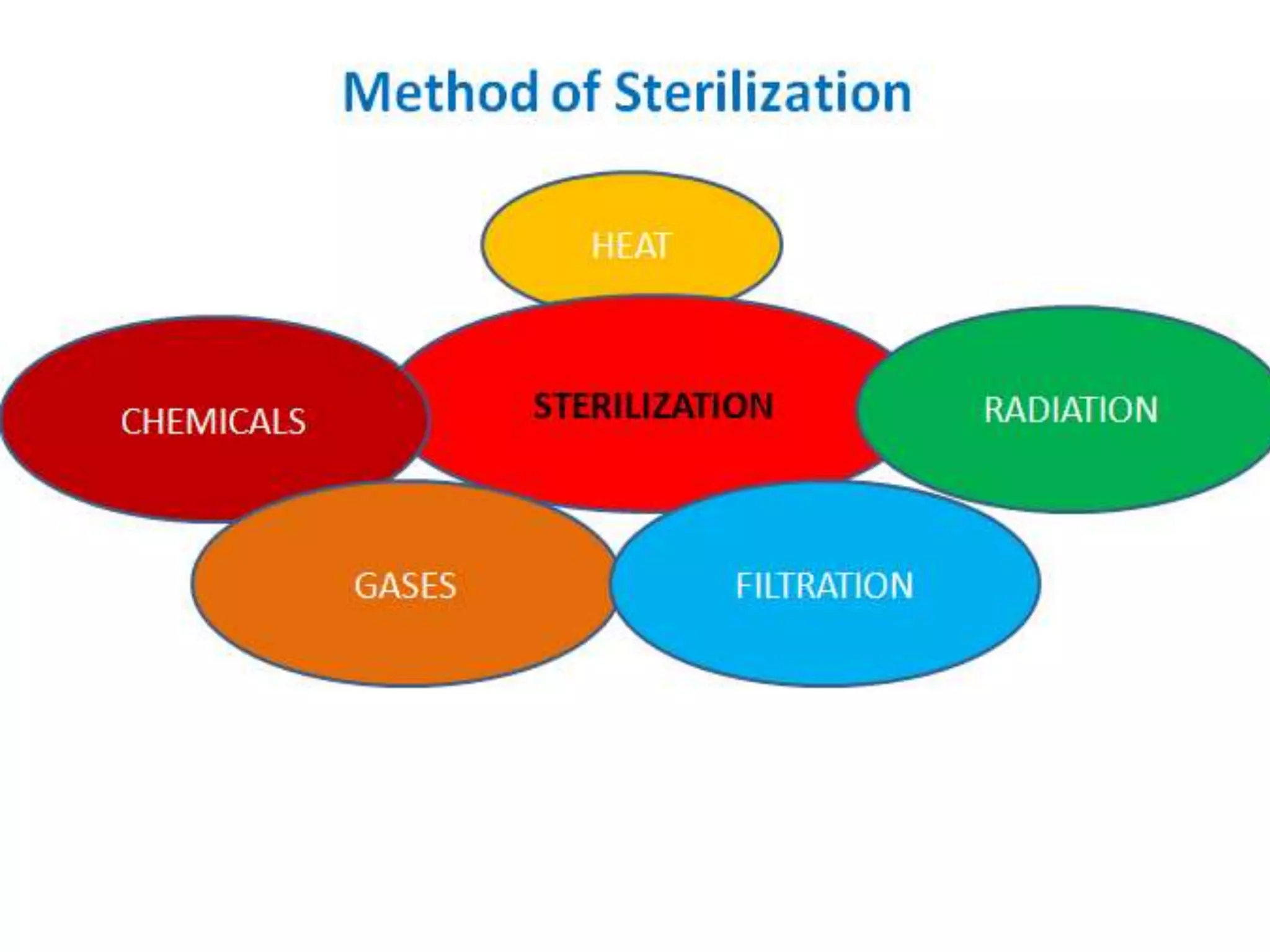
CLASSIFICATION OF STERILIZATION
PHYSICAL METHODS
• SUNLIGHT(unreliable)
• DRYING(unreliable)
• HEAT:
i) DRY HEAT
ii) MOIST HEAT
• FILTRATION
• RADIATION
• ULTRA SONIC VIBRATIONS
CHEMICAL METHODS
• ALCOHOLS
• ALDEHYDES
• PHENOLIC COMPOUNDS
• HALOGENS
• OXIDIZING AGENTS
• SALTS
• SURFACE ACTIVE AGENTS
• DYES
• GASES
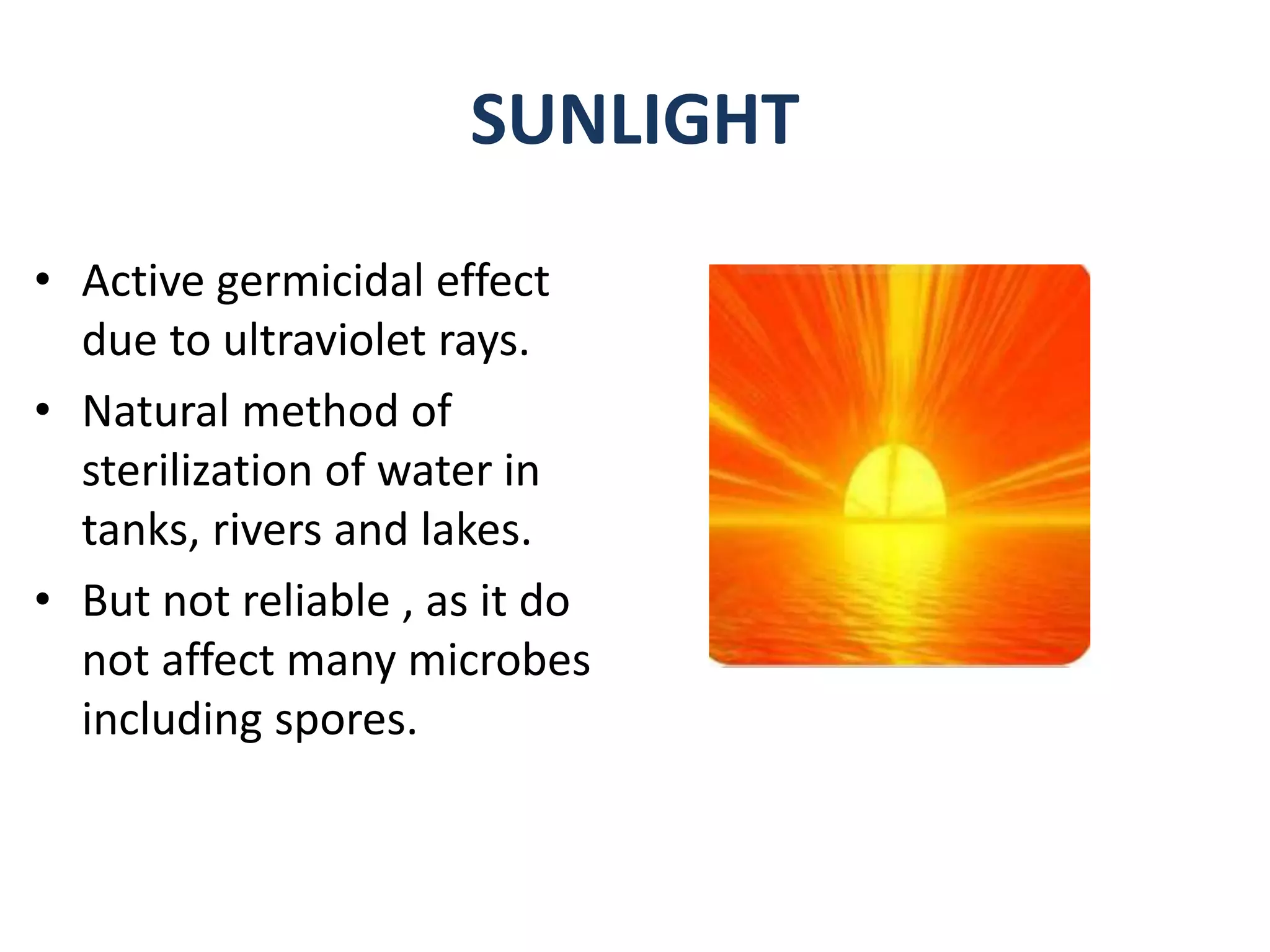
SUNLIGHT
• Active germicidal effect
due to ultraviolet rays.
• Natural method of
sterilization of water in
tanks, rivers and lakes.
• But not reliable , as it do
not affect many microbes
including spores.
HEAT
• Most reliable and commonly employed
method.
• Mechanism:
- Dry heat kills the organism by charring,
denaturation of bacterial protiens, oxidative
damage and by the toxic effect of elevated
level of electrolytes.
- Moist heat kills the microorganism by
denaturation and coagulation of proteins.
DRY HEAT
1. Flaming
2. Incineration
3. Hot air oven
MOIST HEAT
1.Moist heat (below 100⁰C)
- Pasteurization
- Water bath
- Inspissation
2. Moist heat ( at 100⁰C)
- Boiling
- Steaming
- Tyndallization
3. Moist heat (above 100⁰C)
- Autoclave
FLAMMING
• Items are held in the flame of
Bunsen burner either for long
time or short time
- longer time exposure in flame till
they become red hot(250-300°C)
: done for inoculating wires or
loops, tips of forceps, etc.
- Shorter period of time without
allowing the items to become
red hot: done for fragile items
,e.g. glass slides,
mouth of test tubes and flask.
INCINERATION
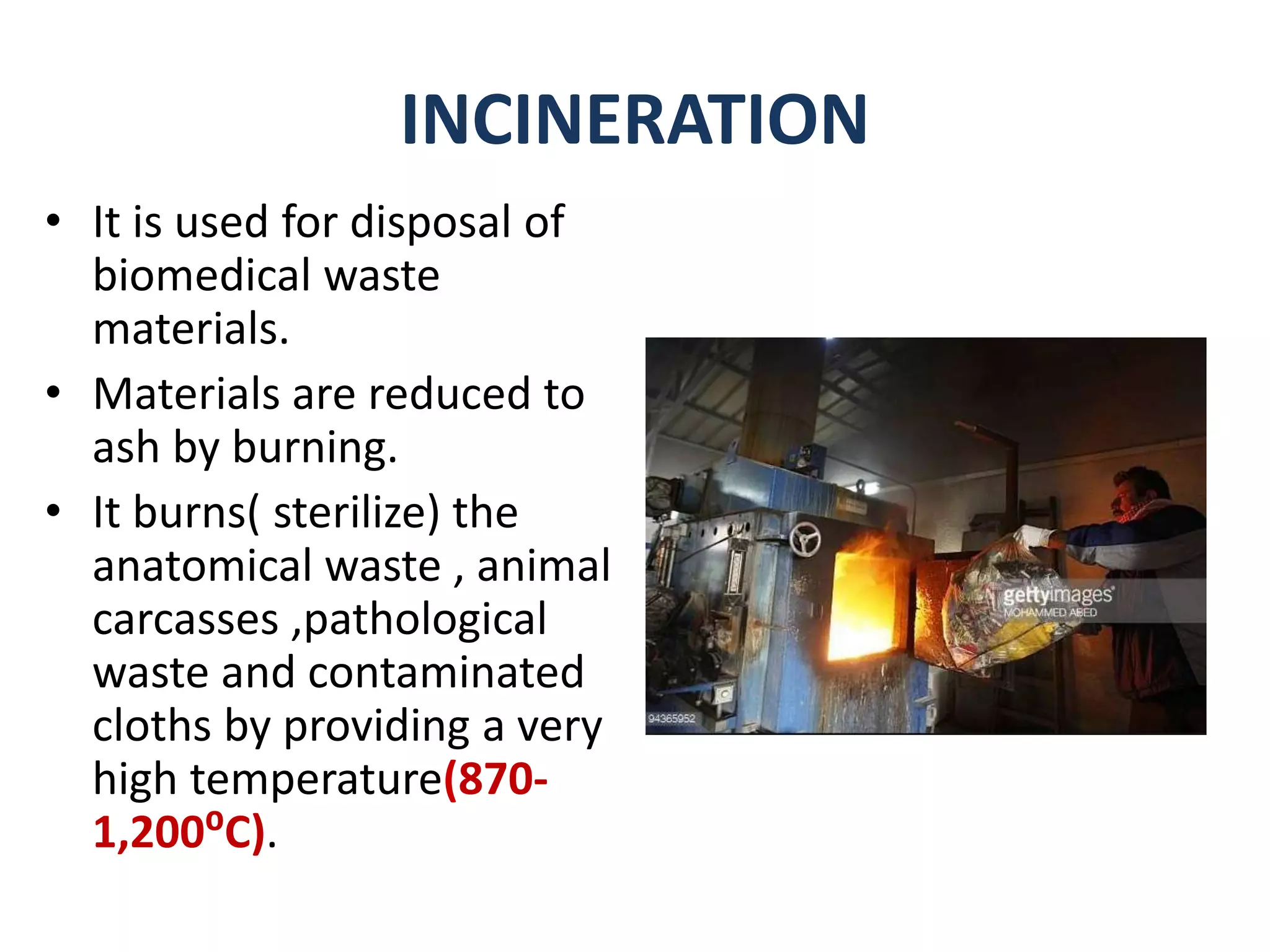
• It is used for disposal of
biomedical waste
materials.
• Materials are reduced to
ash by burning.
• It burns( sterilize) the
anatomical waste , animal
carcasses ,pathological
waste and contaminated
cloths by providing a very
high temperature(870-
1,200⁰C).
HOT AIR OVEN
• Most widely used method for sterilization by dry heat.
• It employs higher temperatures in the range of 160⁰C -
180⁰C and requires exposure time upto 2hours,
depending upon the temperature employed.
• Temperature: 160⁰C for 45 minutes
170⁰C for 18 minutes
180⁰C for 7.5 minutes
190⁰C for 1.5 minutes
• Maximum temperature limit- 350⁰C
• Material sterilized: glassware like glass syringes, petri
dishes, flasks, pipettes and test tubes.
-surgical instruments like scalpels, scissors, forceps, etc.
-chemicals, such as liquid paraffin, fats , glycerol, and
glove powder, grease etc.
• Cutting instruments such as those used in
ophthalmic surgery, should ideally be sterilized
for 2 hours.
• Holding time of 1 hour at 150°C for oils, glycerol
and dusting powder.
• Cotton plugs may get
charred at 180°C.
Components of Hot air oven:
• An insulated chamber surrounded by an outer
case containing electric heaters.
• A fan to ensure even distribution of air and
elimination of air pockets
• Shelves to keep materials for sterilization.
• Thermocouples
• Temperature sensor
• Door locking controls.
Precautions:
• Should not be overloaded.
• Arranged in a manner which allows free
circulation of air.
• Material to be sterilized should be perfectly dry.
• Test tubes, flasks etc. should be fitted with cotton
plugs.
• Paper wrapping of the items should be done.
• Rubber materials and inflammable materials
should not be kept inside.
• The oven must be allowed to cool for two hours
before opening, since glassware may crack by
sudden cooling.
Sterilization control:
Effectiveness of sterilization can be monitored by:
• Biological indicators: – Paper strips with 106 Spores of
Clostridium tetani or Bacillus subtilis placed with
other material. Later culture the strips in thioglycollate
broth at 370C for 5 days. Growth indicates failure of
sterilization.
• Thermocouples: records the temperature by a
potentiometer.
• Browne’s tube: contains a heat sensitive dye which
turns green after being exposed to 160°C for 60
minutes or 150°C for 115 minutes.
PASTEURIZATION
• Definition: It is method used for control of
microorganisms from beverages like fruit and
vegetable juices, beer and diary products such as
milk.
• Unlike sterilization, pasteurization is not intended
to kill all microorganisms in the food. Instead ,
pasteurization aims to achieve a “logarithmic
reduction” in number of viable organism,
reducing their number so they are unlikely to
cause disease.
PASTEURIZATION PROCESS
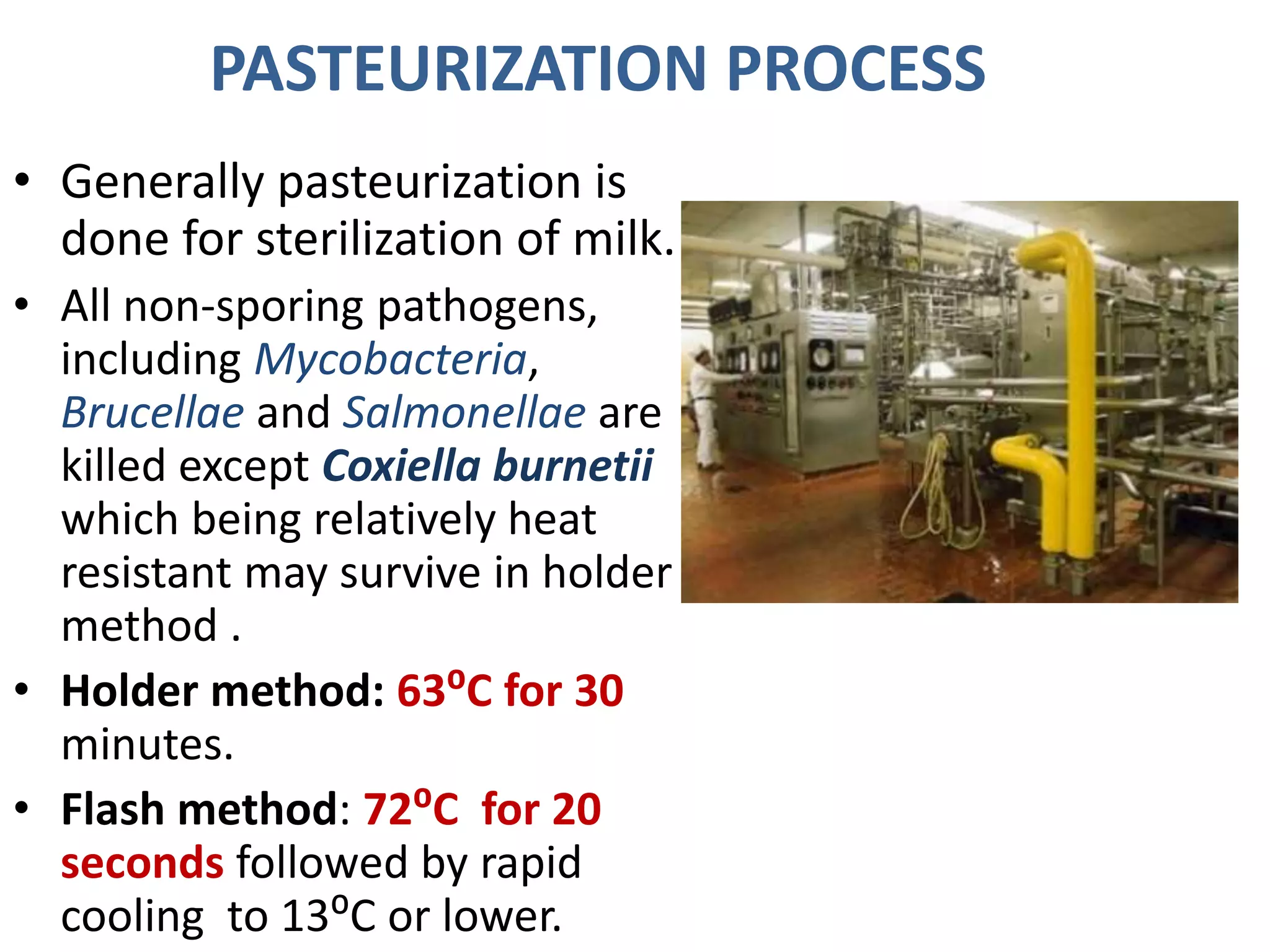
• Generally pasteurization is
done for sterilization of milk.
• All non-sporing pathogens,
including Mycobacteria,
Brucellae and Salmonellae are
killed except Coxiella burnetii
which being relatively heat
resistant may survive in holder
method .
• Holder method: 63⁰C for 30
minutes.
• Flash method: 72⁰C for 20
seconds followed by rapid
cooling to 13⁰C or lower.
HOLDER METHOD FLASH METHOD
Types of pasteurization:
1. Vat pasteurization -63°C for 30 minutes.
2.High temperature short time pasteurization(HTST)-
72°C for 15 seconds
3. High temperature short time pasteurization(HHST)-
89°C for 1.0 second
90°C for 0.5 seconds
94°C for 0.1 seconds
96°C for 0.05 seconds
100°C for 0.01seconds
4. Ultra pasteurization (UP)- 138°C for 2.0 seconds
- Vat pasteurization is the simplest and oldest
method of pasteurizing milk.
- The most common method used across India and
many parts of the world is High temperature
short time pasteurization(HTST) also called as
Flash pasteurization.
- HTST is faster , for higher volume processing and
more energy efficient than Vat pasteurization.
- The newly packed pasteurized milk is now fortified
with the added benefits of many vitamins. If we
boil pasteurized milk, we end up diminishing its
nutritive value.
WATER BATH
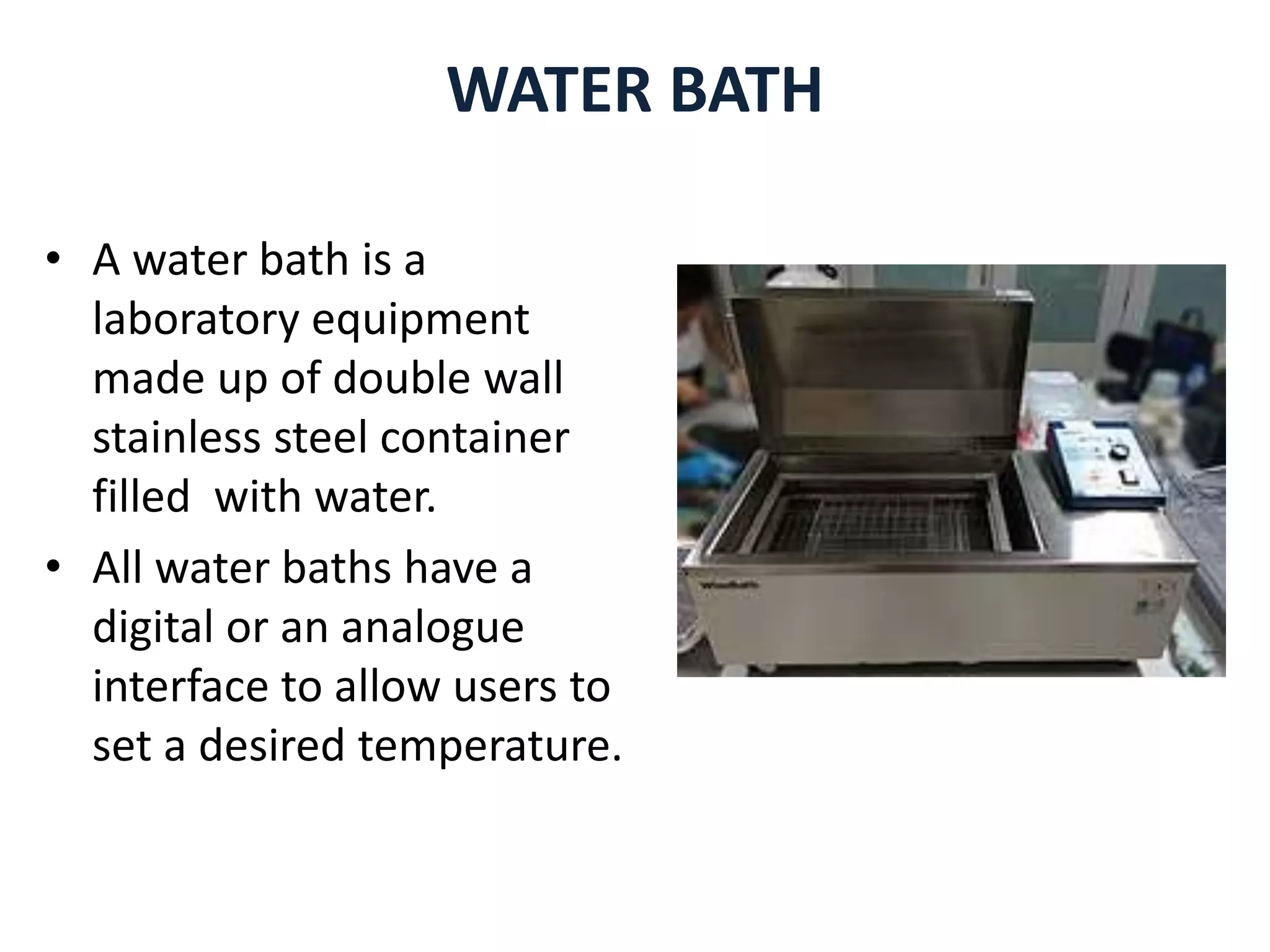
• A water bath is a
laboratory equipment
made up of double wall
stainless steel container
filled with water.
• All water baths have a
digital or an analogue
interface to allow users to
set a desired temperature.
Types of water bath:
1. Circulating water bath- are ideal for applications
when temperature uniformity and consistency are
critical, such as enzymatic and serological experiments.
Water is thoroughly circulated throughout the bath
resulting in more uniform temperature.
2. Non- circulating water bath- this type of water bath
relies primarily on convection instead of water being
uniformly heated. Therefore, it is less accurate in terms
of temperature control.
3. Shaking water bath- this type of water bath has extra
control for shaking, which moves liquid s around. This
shaking feature can be done on and off. Constant
shaking allows liquid- grown cell cultures to constantly
mix with the air
Uses:
• It is used to incubate samples in water at a
constant temperature over a long period of
time.
• It is used for disinfection of serum, body fluids
and vaccine.
• Bacterial vaccine are disinfected at 60⁰C for
1 hour.
• Serum or heat labile body fluids can be
disinfected at 56 ⁰C for 1 hour.
INSPISSATION
• Also known as Fractional Sterilization.
• It is a process of heating an article on 3
successive days at 80-85⁰C for 30 minutes by a
special instrument called Inspissator.
• Principle: the first exposure kills all the
vegetative forms, and in the intervals between
heatings the remaining spores germinate into
vegetative forms which are then killed on
subsequent heating.
Uses:
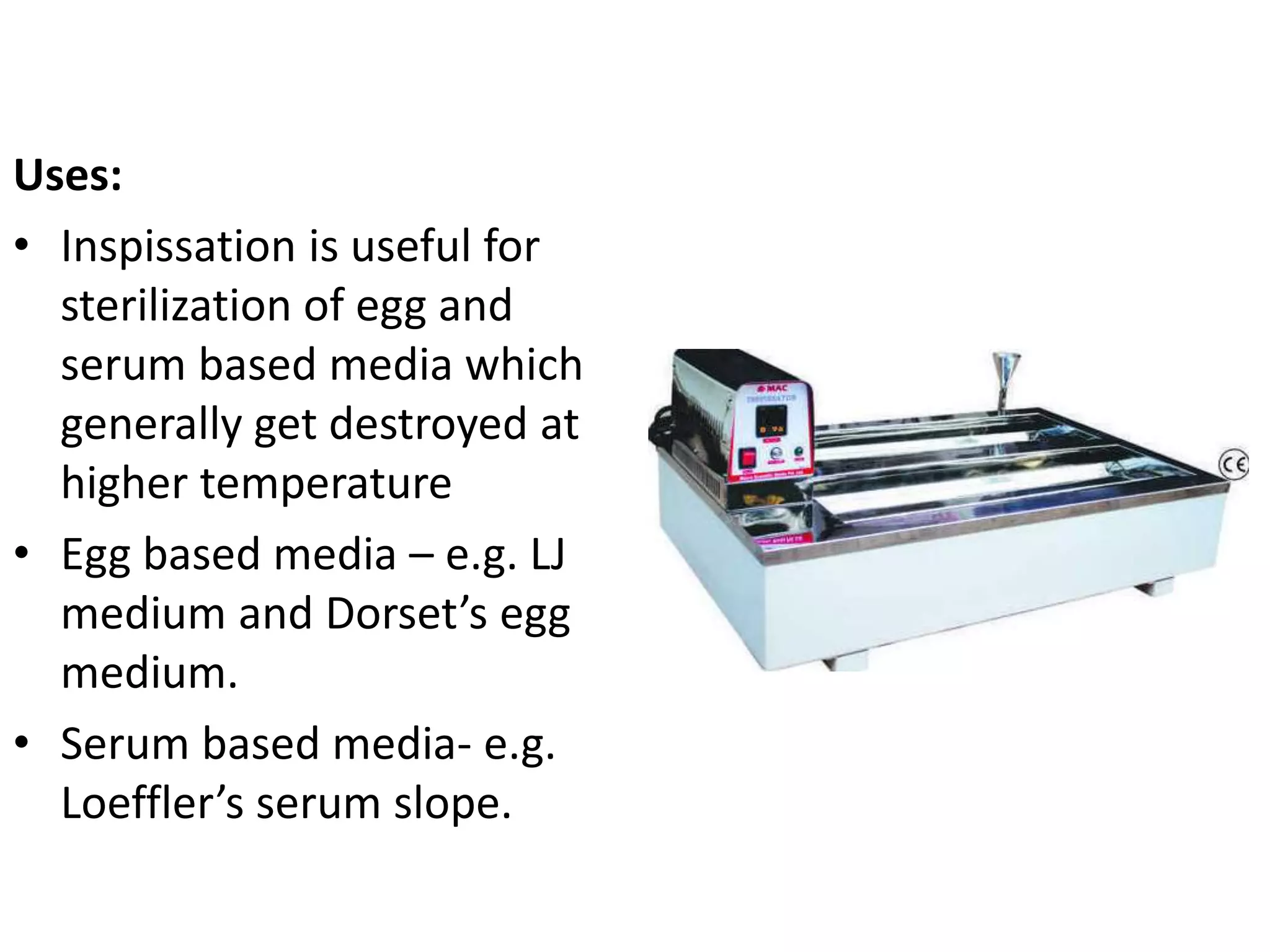
• Inspissation is useful for
sterilization of egg and
serum based media which
generally get destroyed at
higher temperature
• Egg based media – e.g. LJ
medium and Dorset’s egg
medium.
• Serum based media- e.g.
Loeffler’s serum slope.
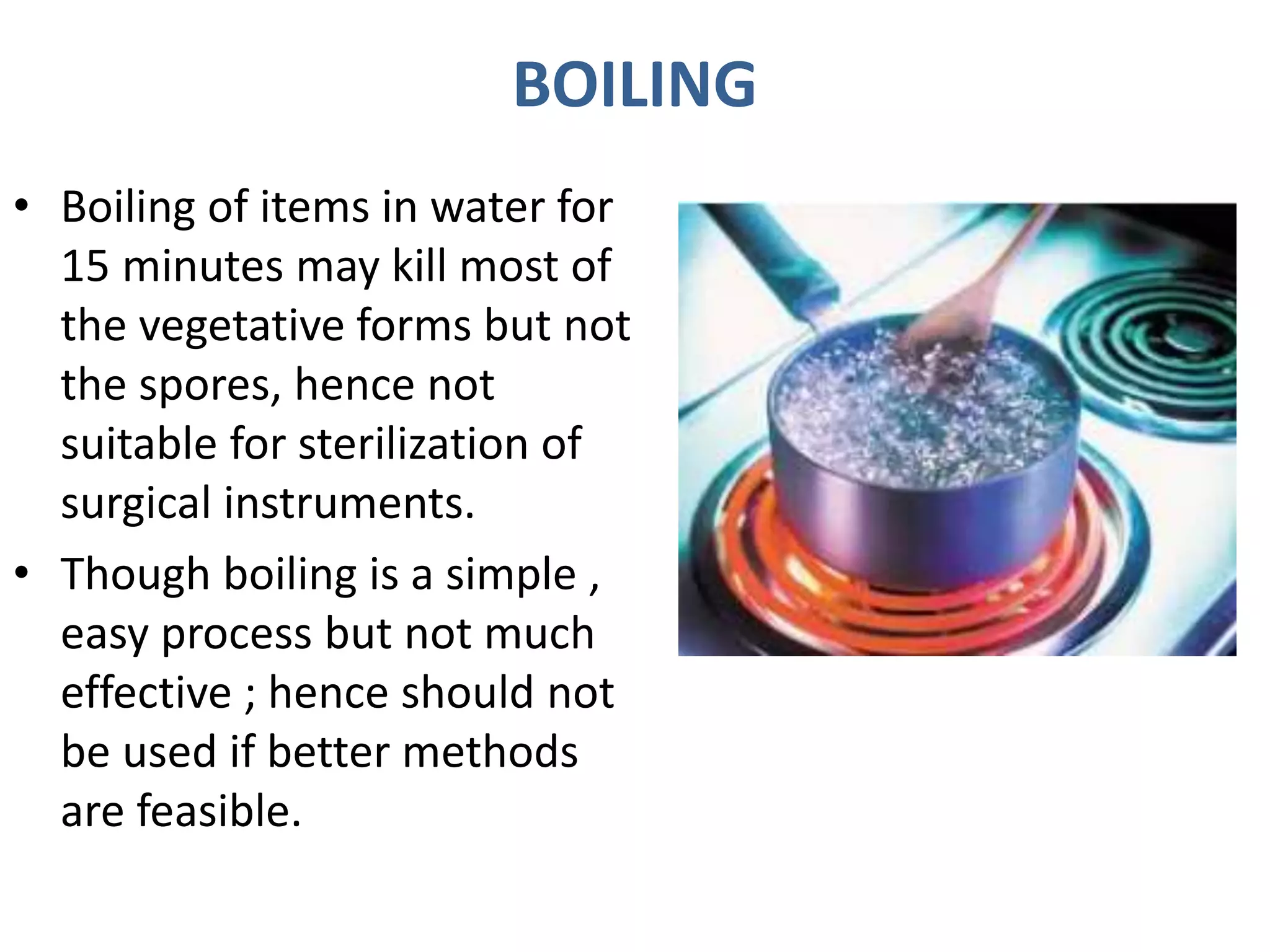
BOILING
• Boiling of items in water for
15 minutes may kill most of
the vegetative forms but not
the spores, hence not
suitable for sterilization of
surgical instruments.
• Though boiling is a simple ,
easy process but not much
effective ; hence should not
be used if better methods
are feasible.
STEAMING
• Koch’s or Arnold’s steam
sterilizer are useful for those
media which are decomposed
at high temperature.
• The articles are kept on a
perforated tray through which
steam can pass.
• They are exposed to steam
(100⁰C) at atmospheric pressure
for 90 minutes.
• Most of the vegetative forms
are killed by this method except
thermophiles and spores.
TYNDALLIZATION
• Also known as Intermittent sterilization.
• Steaming at 100⁰C for 20 minutes for 3
consecutive days.
• Principle: similar to that of inspissation, except
that here, the temperature provided is 100 ⁰C,
instead of 80⁰C.
• it is used for sterilization of gelatin and eggs,
serum or sugar containing media, which are
damaged at higher temperature of autoclave.
AUTOCLAVE
It is a high pressure device used to allow the
application of moist heat above the normal-
atmosphere boiling point of water
Principle: water boils when its vapour pressure
equals that of the surrounding atmosphere. So,
when the atmospheric pressure raised, the boiling
temperature is also raised.
• Temperature of steam determined by pressure in
the closed vessel.
• Energy is stored in two forms
-Latent heat (given up on condensation )
-Sensible heat (given up on cooling)
• It is a tough double wall chamber in which air is
replaced by pure saturated steam under pressure.
• Exposure to 1210C at 15 lb for 15 min is sufficient to
sterilize
• In microbiology , it is mainly used for sterilization of
media, linen as well as destruction of biological waste.
Types of Autoclave:
• Gravity displacement type autoclave
-vertical type( small volume capacity)
-horizontal type(large volume capacity)
• Positive pressure displacement type autoclave
• Negative pressure (vacuum) displacement type
autoclave.
Positive pressure displacement
autoclave
Negative pressure
displacement autoclave
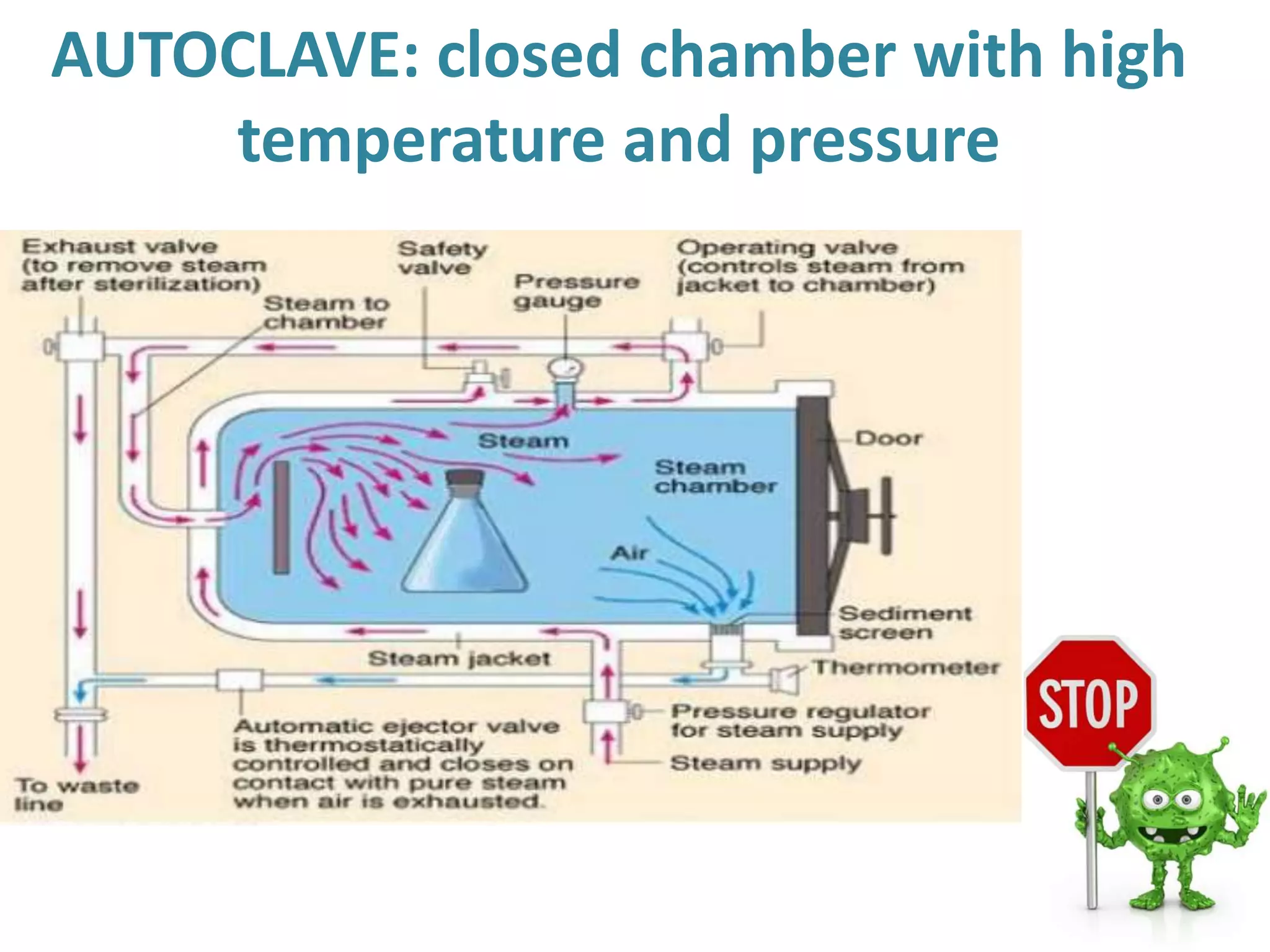
Components of Autoclave:
• Pressure chamber consist of vertical or
horizontal cylinder of gunmetal or stainless steel.
• Lid is fastened by screw clamps and rendered air
tight by an asbestos washer.
• Lid bears a discharge tap for air and steam.
• A pressure gauge sets the pressure at a particular
level.
• A safety valve to remove the excess steam.
• An electrical heater is attached to the jacket that
heats the water to produce steam.
AUTOCLAVE: closed chamber with high
temperature and pressure
Mechanism:
• Chamber is filled with sufficient water.
• Material to be sterilized placed inside the
pressure chamber.
• The lid is closed and the electrical heater is put
on.
• The safety valves are adjusted to the required
pressure.
• After the water boils, the steam and the air
mixture is allowed to escape through the
discharge tap till all the air has been displaced.
• When the steam starts to comes out, close the
tape.
• Pressure rises to desired level.
• When the steam pressure reaches the desired level
,the safety valves opens and excess steam escapes
out.
• The holding period is counted. Keep it for 15
minutes
• After the holding period of 15 minutes, the
electrical heater is stopped and the autoclave is
allowed to cool.
• when the pressure inside the chamber equals to
atmospheric pressure then discharge tap is opened
slowly to allow air to go inside.
Condensation of Steam
Results in
1. Wetting the microbes so helps in killing it.
2. It liberates the latent heat so rapidly heats up items in load
3. It cases significant contraction of steam drawing more to
the site.
amount of latent heat liberated in dry saturated steam at 136c is
4 times greater than amount of boiling water
Steam condenses into water. Contraction in volume is from 1670
Vol to 1 vol.
Negative pressure created draws fresh steam on surface of
articles
Causing condensation, liberation of latent heat and drawing of
fresh steam is repeated
• Efficient condensation takes place only if steam
is on boundary between vapour and liquid
phases.
ADVANTAGES
• Most rapid and effective method of
sterilization.
• Provides excellent penetration.
DISADVANTAGES
• Corrosion of carbon steel instruments .
• May damage plastic and rubber items.
• Unprotected cutting edged may become blunt.
• Uses: Autoclave is particularly useful for media
containing water that can not be sterilized by
dry heat. It is the method of choice for
sterilizing the following:
- Surgical instruments
- Culture media
- Autoclavable plastic containers
- Plastic tubes and pipette tips
- Solutions and water
- Biohazardous wastes
- Glasswares
Sterilization control
1. Biological indicators: spores of
Geobacillus stearothermophilus
are the best indicators, because
they are resistant to steaming.
Their spores are killed in
12 minutes at 121⁰C.
2. Other indicators:
Browne’s tube
Thermocouple
3. Autoclave tapes.
Before After
Sterilization by heat

Sterilization by heat

  • 1.
    Dr. Dinesh KrJain, MD., Assistantprofessor, Department of Microbiology, SMS Medical college, Jaipur
  • 2.
    STERILIZATION  Definition: Itis a process by which all living microorganisms, including viable spores, are either destroyed or removed from an article, body surface or medium.  It results in reduction of more than 106 log colony- forming units of microorganism and their spores.  It can be achieved by physical agents or chemical agents.
  • 3.
    OTHER DEFINITIONS DISINFECTION: Itrefers to a process that destroys or removes most if not all pathogenic organisms but not bacterial spores. • It results in reduction of at least 103 log colony- forming units of microorganism but not spores. • The primary goal is to destroy potential pathogens, but is also substantially reduces the total microbial population.
  • 4.
    • ASEPSIS: Itis a process where the chemical agents (called antiseptics) are applied on to the body surfaces(skin), which kill or inhibit the microorganisms present on skin. • They prevent the entry of pathogens into sterile tissues and prevents infection or sepsis. • However, they are generally not as toxic as disinfectants . • Hand washing( scrub): Reduction of ≥ 1 log colony forming units of microorganisms. • Hand disinfection(rub -in): Reduction of ≥ 2.5 log colony forming units of microorganisms.
  • 5.
    • DECONTAMINATION: Itrefers to the reduction of pathogenic microbial population to a level at which items are considered as safe to handle without protective attire. • It results in reduction of at least 1 log colony- forming unit of most of the microorganisms, but not spores. • Examples include manual or mechanical cleaning by soap and detergents to eliminate debris or organic matter from the medical devices.
  • 6.
    OTHER TERMS • BACTERIOSTATIC AGENT: Agent that inhibit the growth of bacteria(does not kill). • BACTERICIDE: Agents that kills bacteria but do not endospores. • VIRICIDE: Agents that destroys or inactivates viruses. • FUNGICIDE: Agent that kills fungi. • SPORICIDE: Agent that kills bacterial endospores or fungal spores.
  • 7.
  • 8.
    NEED FOR STERILIZATION?? •Microorganisms are constantly present in the external environment and on the human body. • Microorganisms are capable of causing contamination and infection.
  • 9.
    HOW CAN MICROORGANISMBE KILLED?? • Denaturation of proteins. • Oxidation. • Toxic effect of elevated level of electrolytes. • Interruption of DNA synthesis/repair. • Interference with protein synthesis. • Disruption of cell membranes.
  • 10.
    USES OF STERILIZATION •To sterilize materials, instruments used in surgical and diagnostic procedures. • To sterilize media and reagents used in microbiological laboratory. • To ensure safety of food and drug manufacturing from contamination.
  • 11.
    MOST RESISTANT Prions Bacterial spores Cryptosporidiumoocyst Mycobacteria Small non-enveloped viruses Gram-negative bacteria Fungi Large non-enveloped viruses Gram positive bacteria Enveloped viruses LEAST RESISTANT
  • 12.
    FACTORS INFLUENCING EFFICACYOF STERILIZATION • Organism load: • Nature of organisms: • Concentration: • Nature of the sterilzant/disinfectant agent: • Duration of exposure: • Temperature: • Local environment: (i) pH (ii) Organic matter (iii) Biofilm
  • 13.
    CLASSIFICATION OF STERILIZATION PHYSICALMETHODS • SUNLIGHT(unreliable) • DRYING(unreliable) • HEAT: i) DRY HEAT ii) MOIST HEAT • FILTRATION • RADIATION • ULTRA SONIC VIBRATIONS CHEMICAL METHODS • ALCOHOLS • ALDEHYDES • PHENOLIC COMPOUNDS • HALOGENS • OXIDIZING AGENTS • SALTS • SURFACE ACTIVE AGENTS • DYES • GASES
  • 15.
    SUNLIGHT • Active germicidaleffect due to ultraviolet rays. • Natural method of sterilization of water in tanks, rivers and lakes. • But not reliable , as it do not affect many microbes including spores.
  • 16.
    HEAT • Most reliableand commonly employed method. • Mechanism: - Dry heat kills the organism by charring, denaturation of bacterial protiens, oxidative damage and by the toxic effect of elevated level of electrolytes. - Moist heat kills the microorganism by denaturation and coagulation of proteins.
  • 17.
    DRY HEAT 1. Flaming 2.Incineration 3. Hot air oven MOIST HEAT 1.Moist heat (below 100⁰C) - Pasteurization - Water bath - Inspissation 2. Moist heat ( at 100⁰C) - Boiling - Steaming - Tyndallization 3. Moist heat (above 100⁰C) - Autoclave
  • 18.
    FLAMMING • Items areheld in the flame of Bunsen burner either for long time or short time - longer time exposure in flame till they become red hot(250-300°C) : done for inoculating wires or loops, tips of forceps, etc. - Shorter period of time without allowing the items to become red hot: done for fragile items ,e.g. glass slides, mouth of test tubes and flask.
  • 19.
    INCINERATION • It isused for disposal of biomedical waste materials. • Materials are reduced to ash by burning. • It burns( sterilize) the anatomical waste , animal carcasses ,pathological waste and contaminated cloths by providing a very high temperature(870- 1,200⁰C).
  • 20.
    HOT AIR OVEN •Most widely used method for sterilization by dry heat. • It employs higher temperatures in the range of 160⁰C - 180⁰C and requires exposure time upto 2hours, depending upon the temperature employed. • Temperature: 160⁰C for 45 minutes 170⁰C for 18 minutes 180⁰C for 7.5 minutes 190⁰C for 1.5 minutes • Maximum temperature limit- 350⁰C • Material sterilized: glassware like glass syringes, petri dishes, flasks, pipettes and test tubes. -surgical instruments like scalpels, scissors, forceps, etc. -chemicals, such as liquid paraffin, fats , glycerol, and glove powder, grease etc.
  • 21.
    • Cutting instrumentssuch as those used in ophthalmic surgery, should ideally be sterilized for 2 hours. • Holding time of 1 hour at 150°C for oils, glycerol and dusting powder. • Cotton plugs may get charred at 180°C.
  • 22.
    Components of Hotair oven: • An insulated chamber surrounded by an outer case containing electric heaters. • A fan to ensure even distribution of air and elimination of air pockets • Shelves to keep materials for sterilization. • Thermocouples • Temperature sensor • Door locking controls.
  • 23.
    Precautions: • Should notbe overloaded. • Arranged in a manner which allows free circulation of air. • Material to be sterilized should be perfectly dry. • Test tubes, flasks etc. should be fitted with cotton plugs. • Paper wrapping of the items should be done. • Rubber materials and inflammable materials should not be kept inside. • The oven must be allowed to cool for two hours before opening, since glassware may crack by sudden cooling.
  • 24.
    Sterilization control: Effectiveness ofsterilization can be monitored by: • Biological indicators: – Paper strips with 106 Spores of Clostridium tetani or Bacillus subtilis placed with other material. Later culture the strips in thioglycollate broth at 370C for 5 days. Growth indicates failure of sterilization. • Thermocouples: records the temperature by a potentiometer. • Browne’s tube: contains a heat sensitive dye which turns green after being exposed to 160°C for 60 minutes or 150°C for 115 minutes.
  • 25.
    PASTEURIZATION • Definition: Itis method used for control of microorganisms from beverages like fruit and vegetable juices, beer and diary products such as milk. • Unlike sterilization, pasteurization is not intended to kill all microorganisms in the food. Instead , pasteurization aims to achieve a “logarithmic reduction” in number of viable organism, reducing their number so they are unlikely to cause disease.
  • 26.
    PASTEURIZATION PROCESS • Generallypasteurization is done for sterilization of milk. • All non-sporing pathogens, including Mycobacteria, Brucellae and Salmonellae are killed except Coxiella burnetii which being relatively heat resistant may survive in holder method . • Holder method: 63⁰C for 30 minutes. • Flash method: 72⁰C for 20 seconds followed by rapid cooling to 13⁰C or lower.
  • 27.
  • 28.
    Types of pasteurization: 1.Vat pasteurization -63°C for 30 minutes. 2.High temperature short time pasteurization(HTST)- 72°C for 15 seconds 3. High temperature short time pasteurization(HHST)- 89°C for 1.0 second 90°C for 0.5 seconds 94°C for 0.1 seconds 96°C for 0.05 seconds 100°C for 0.01seconds 4. Ultra pasteurization (UP)- 138°C for 2.0 seconds
  • 29.
    - Vat pasteurizationis the simplest and oldest method of pasteurizing milk. - The most common method used across India and many parts of the world is High temperature short time pasteurization(HTST) also called as Flash pasteurization. - HTST is faster , for higher volume processing and more energy efficient than Vat pasteurization. - The newly packed pasteurized milk is now fortified with the added benefits of many vitamins. If we boil pasteurized milk, we end up diminishing its nutritive value.
  • 30.
    WATER BATH • Awater bath is a laboratory equipment made up of double wall stainless steel container filled with water. • All water baths have a digital or an analogue interface to allow users to set a desired temperature.
  • 31.
    Types of waterbath: 1. Circulating water bath- are ideal for applications when temperature uniformity and consistency are critical, such as enzymatic and serological experiments. Water is thoroughly circulated throughout the bath resulting in more uniform temperature. 2. Non- circulating water bath- this type of water bath relies primarily on convection instead of water being uniformly heated. Therefore, it is less accurate in terms of temperature control. 3. Shaking water bath- this type of water bath has extra control for shaking, which moves liquid s around. This shaking feature can be done on and off. Constant shaking allows liquid- grown cell cultures to constantly mix with the air
  • 32.
    Uses: • It isused to incubate samples in water at a constant temperature over a long period of time. • It is used for disinfection of serum, body fluids and vaccine. • Bacterial vaccine are disinfected at 60⁰C for 1 hour. • Serum or heat labile body fluids can be disinfected at 56 ⁰C for 1 hour.
  • 33.
    INSPISSATION • Also knownas Fractional Sterilization. • It is a process of heating an article on 3 successive days at 80-85⁰C for 30 minutes by a special instrument called Inspissator. • Principle: the first exposure kills all the vegetative forms, and in the intervals between heatings the remaining spores germinate into vegetative forms which are then killed on subsequent heating.
  • 34.
    Uses: • Inspissation isuseful for sterilization of egg and serum based media which generally get destroyed at higher temperature • Egg based media – e.g. LJ medium and Dorset’s egg medium. • Serum based media- e.g. Loeffler’s serum slope.
  • 35.
    BOILING • Boiling ofitems in water for 15 minutes may kill most of the vegetative forms but not the spores, hence not suitable for sterilization of surgical instruments. • Though boiling is a simple , easy process but not much effective ; hence should not be used if better methods are feasible.
  • 36.
    STEAMING • Koch’s orArnold’s steam sterilizer are useful for those media which are decomposed at high temperature. • The articles are kept on a perforated tray through which steam can pass. • They are exposed to steam (100⁰C) at atmospheric pressure for 90 minutes. • Most of the vegetative forms are killed by this method except thermophiles and spores.
  • 37.
    TYNDALLIZATION • Also knownas Intermittent sterilization. • Steaming at 100⁰C for 20 minutes for 3 consecutive days. • Principle: similar to that of inspissation, except that here, the temperature provided is 100 ⁰C, instead of 80⁰C. • it is used for sterilization of gelatin and eggs, serum or sugar containing media, which are damaged at higher temperature of autoclave.
  • 38.
    AUTOCLAVE It is ahigh pressure device used to allow the application of moist heat above the normal- atmosphere boiling point of water Principle: water boils when its vapour pressure equals that of the surrounding atmosphere. So, when the atmospheric pressure raised, the boiling temperature is also raised. • Temperature of steam determined by pressure in the closed vessel. • Energy is stored in two forms -Latent heat (given up on condensation ) -Sensible heat (given up on cooling)
  • 39.
    • It isa tough double wall chamber in which air is replaced by pure saturated steam under pressure. • Exposure to 1210C at 15 lb for 15 min is sufficient to sterilize • In microbiology , it is mainly used for sterilization of media, linen as well as destruction of biological waste. Types of Autoclave: • Gravity displacement type autoclave -vertical type( small volume capacity) -horizontal type(large volume capacity) • Positive pressure displacement type autoclave • Negative pressure (vacuum) displacement type autoclave.
  • 41.
  • 42.
    Components of Autoclave: •Pressure chamber consist of vertical or horizontal cylinder of gunmetal or stainless steel. • Lid is fastened by screw clamps and rendered air tight by an asbestos washer. • Lid bears a discharge tap for air and steam. • A pressure gauge sets the pressure at a particular level. • A safety valve to remove the excess steam. • An electrical heater is attached to the jacket that heats the water to produce steam.
  • 43.
    AUTOCLAVE: closed chamberwith high temperature and pressure
  • 44.
    Mechanism: • Chamber isfilled with sufficient water. • Material to be sterilized placed inside the pressure chamber. • The lid is closed and the electrical heater is put on. • The safety valves are adjusted to the required pressure. • After the water boils, the steam and the air mixture is allowed to escape through the discharge tap till all the air has been displaced.
  • 45.
    • When thesteam starts to comes out, close the tape. • Pressure rises to desired level. • When the steam pressure reaches the desired level ,the safety valves opens and excess steam escapes out. • The holding period is counted. Keep it for 15 minutes • After the holding period of 15 minutes, the electrical heater is stopped and the autoclave is allowed to cool. • when the pressure inside the chamber equals to atmospheric pressure then discharge tap is opened slowly to allow air to go inside.
  • 46.
    Condensation of Steam Resultsin 1. Wetting the microbes so helps in killing it. 2. It liberates the latent heat so rapidly heats up items in load 3. It cases significant contraction of steam drawing more to the site. amount of latent heat liberated in dry saturated steam at 136c is 4 times greater than amount of boiling water Steam condenses into water. Contraction in volume is from 1670 Vol to 1 vol. Negative pressure created draws fresh steam on surface of articles Causing condensation, liberation of latent heat and drawing of fresh steam is repeated
  • 47.
    • Efficient condensationtakes place only if steam is on boundary between vapour and liquid phases.
  • 48.
    ADVANTAGES • Most rapidand effective method of sterilization. • Provides excellent penetration. DISADVANTAGES • Corrosion of carbon steel instruments . • May damage plastic and rubber items. • Unprotected cutting edged may become blunt.
  • 49.
    • Uses: Autoclaveis particularly useful for media containing water that can not be sterilized by dry heat. It is the method of choice for sterilizing the following: - Surgical instruments - Culture media - Autoclavable plastic containers - Plastic tubes and pipette tips - Solutions and water - Biohazardous wastes - Glasswares
  • 50.
    Sterilization control 1. Biologicalindicators: spores of Geobacillus stearothermophilus are the best indicators, because they are resistant to steaming. Their spores are killed in 12 minutes at 121⁰C. 2. Other indicators: Browne’s tube Thermocouple
  • 51.