26/04/2010


 OPHTHALMOSCOPY

                                  Dr Frank FAMOSE
                            DVM, CES Ophtalmologie
                             Ekaterinburg May 2010


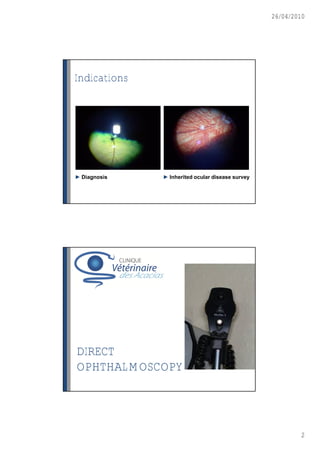
What is ophthalmoscopy ?
â–şFundus examination           â–şDirect
  ď‚§   Tapetum                  ophthalmoscopy
  ď‚§   Non-tapetal zone
  ď‚§   Vascularisation         â–şIndirect
  ď‚§   Optic nerve papilla      ophthalmoscopy

                              â–şSkiascopy


                                                             1
26/04/2010


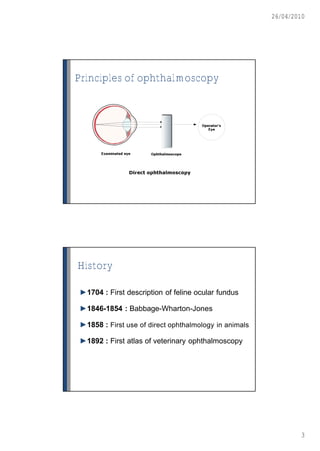
Indications


â–ş Diagnosis   â–ş Inherited ocular disease survey


DIRECT
OPHTHALMOSCOPY


                                                          2
26/04/2010


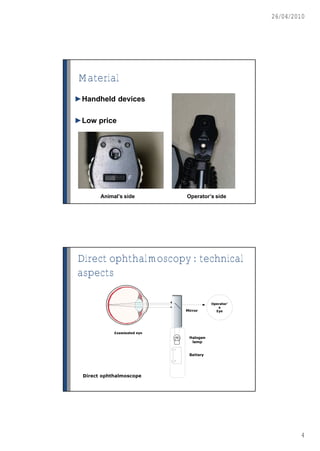
Principles of ophthalmoscopy


History

â–ş1704 : First description of feline ocular fundus

â–ş1846-1854 : Babbage-Wharton-Jones

â–ş1858 : First use of direct ophthalmology in animals

â–ş1892 : First atlas of veterinary ophthalmoscopy


                                                               3
26/04/2010


Material
â–şHandheld devices

â–şLow price


      Animal’s side   Operator’s side


Direct ophthalmoscopy : technical
aspects


                                                4
26/04/2010


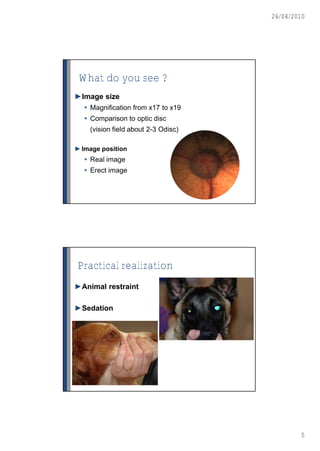
What do you see ?
â–şImage size
  ď‚§ Magnification from x17 to x19
  ď‚§ Comparison to optic disc
    (vision field about 2-3 Odisc)

â–ş Image position
  ď‚§ Real image
  ď‚§ Erect image


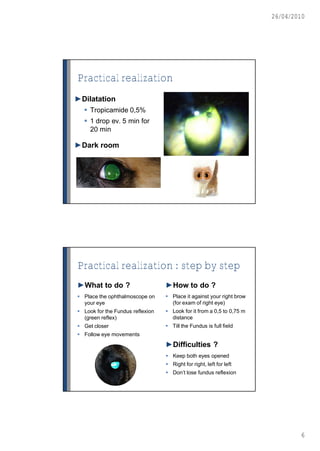
Practical realization
â–şAnimal restraint

â–şSedation


                                             5
26/04/2010


Practical realization
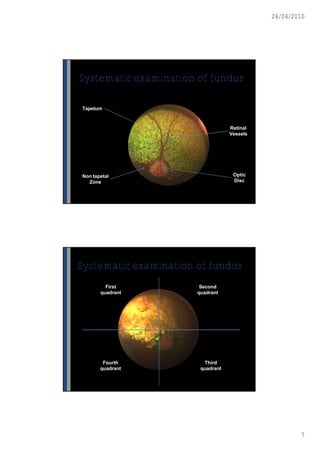
â–şDilatation
  ď‚§ Tropicamide 0,5%
  ď‚§ 1 drop ev. 5 min for
    20 min

â–şDark room


Practical realization : step by step
â–şWhat to do ?                     â–şHow to do ?
ď‚§ Place the ophthalmoscope on     ď‚§ Place it against your right brow
  your eye                          (for exam of right eye)
ď‚§ Look for the Fundus reflexion   ď‚§ Look for it from a 0,5 to 0,75 m
  (green reflex)                    distance
ď‚§ Get closer                      ď‚§ Till the Fundus is full field
ď‚§ Follow eye movements
                                  â–şDifficulties ?
                                  ď‚§ Keep both eyes opened
                                  ď‚§ Right for right, left for left
                                   Don’t lose fundus reflexion


                                                                               6
26/04/2010


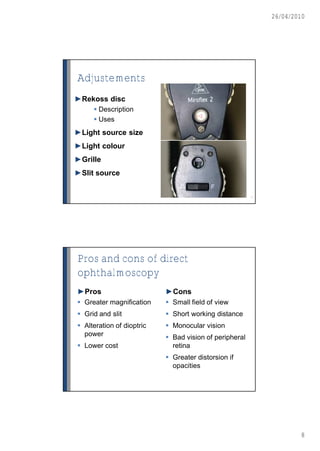
Systematic examination of fundus

Tapetum


                                   Retinal
                                   Vessels


Non tapetal                         Optic
  Zone                              Disc


Systematic examination of fundus
         First          Second
       quadrant        quadrant


        Fourth           Third
       quadrant         quadrant


                                                     7
26/04/2010


Adjustements
â–şRekoss disc
     ď‚§ Description
                                      -2
     ď‚§ Uses
â–şLight source size
â–şLight colour
â–şGrille
â–şSlit source


                                                        15


Pros and cons of direct
ophthalmoscopy
â–şPros                      â–şCons
ď‚§ Greater magnification    ď‚§ Small field of view
ď‚§ Grid and slit            ď‚§ Short working distance
ď‚§ Alteration of dioptric   ď‚§ Monocular vision
  power                    ď‚§ Bad vision of peripheral
ď‚§ Lower cost                 retina
                           ď‚§ Greater distorsion if
                             opacities


                                                                     8
26/04/2010


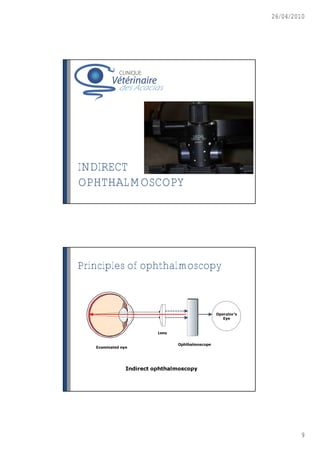
INDIRECT
OPHTHALMOSCOPY


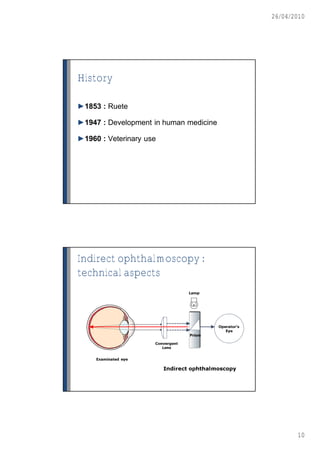
Principles of ophthalmoscopy


                                       9
26/04/2010


History

â–ş1853 : Ruete

â–ş1947 : Development in human medicine

â–ş1960 : Veterinary use


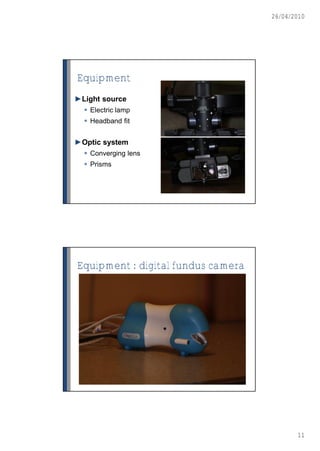
Indirect ophthalmoscopy :
technical aspects


                                               10
26/04/2010


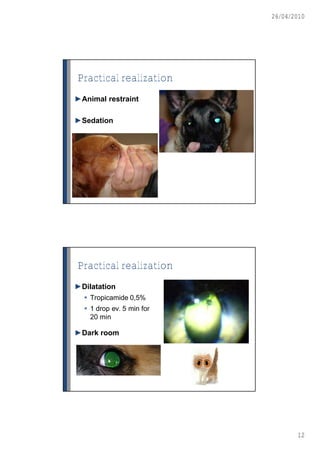
Equipment
â–şLight source
  ď‚§ Electric lamp
  ď‚§ Headband fit


â–şOptic system
  ď‚§ Converging lens
  ď‚§ Prisms


Equipment : digital fundus camera


                                           11
26/04/2010


Practical realization
â–şAnimal restraint

â–şSedation


Practical realization
â–şDilatation
  ď‚§ Tropicamide 0,5%
  ď‚§ 1 drop ev. 5 min for
    20 min

â–şDark room


                                  12
26/04/2010


 Practical realization : step by step
 â–şWhat to do ?                      â–şHow to do ?
ď‚§ Place the ophthalmoscope on      ď‚§ Adjust pupillary space and
  your head                          direction of light source
ď‚§ Look for the Fundus reflexion    ď‚§ Look for it from a 0,5 to 0,75 cm
  (green reflex)                     distance
ď‚§ Place the lens 2-3 cm from the   ď‚§ Move it till the Fundus is full field
  eye
ď‚§ Follow eye movements
                                    â–şDifficulties ?
                                   ď‚§ Placement of lens
                                   ď‚§ Inversion of movements
                                    Don’t lose fundus reflexion


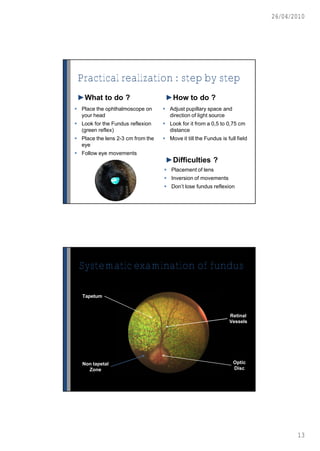
 Systematic examination of fundus

   Tapetum


                                                                 Retinal
                                                                 Vessels


   Non tapetal                                                     Optic
     Zone                                                          Disc


                                                                                    13
26/04/2010


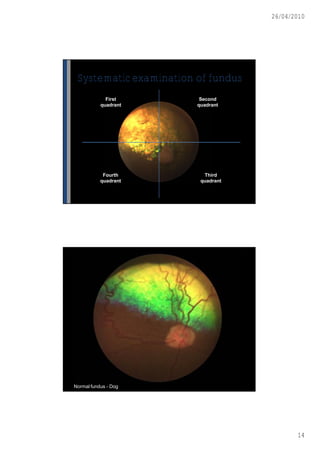
 Systematic examination of fundus
             First       Second
           quadrant     quadrant


            Fourth        Third
           quadrant      quadrant


Normal fundus - Dog


                                           14
26/04/2010


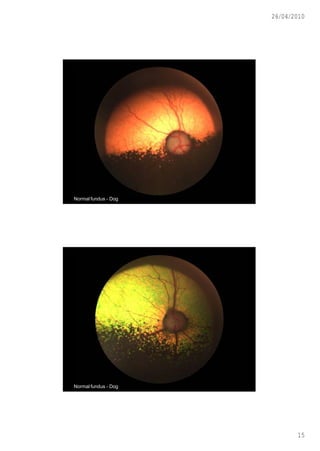
Normal fundus - Dog


Normal fundus - Dog


                             15
26/04/2010


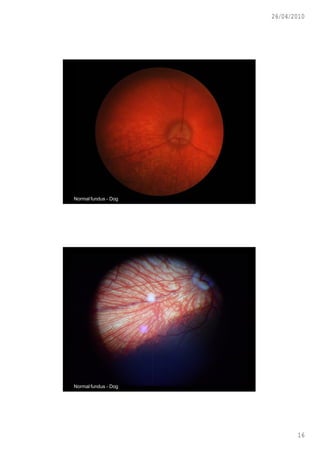
Normal fundus - Dog


Normal fundus - Dog


                             16
26/04/2010


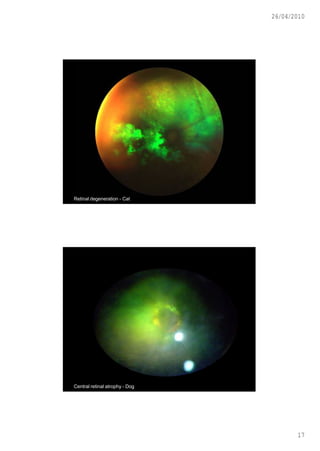
Retinal degeneration - Cat


Central retinal atrophy - Dog


                                       17
26/04/2010


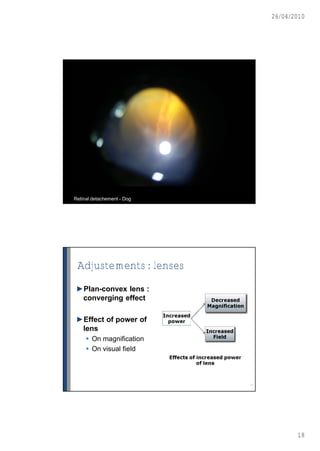
Retinal detachement - Dog


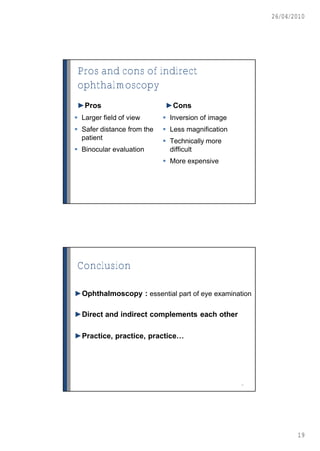
 Adjustements : lenses
 â–şPlan-convex lens :
  converging effect

 â–şEffect of power of
  lens
     ď‚§ On magnification
     ď‚§ On visual field


                            36


                                        18
26/04/2010


Pros and cons of indirect
ophthalmoscopy
â–şPros                       â–şCons
ď‚§ Larger field of view      ď‚§ Inversion of image
ď‚§ Safer distance from the   ď‚§ Less magnification
  patient                   ď‚§ Technically more
ď‚§ Binocular evaluation        difficult
                            ď‚§ More expensive


Conclusion

â–şOphthalmoscopy : essential part of eye examination

â–şDirect and indirect complements each other

►Practice, practice, practice…


                                                   38


                                                               19

Ophthalmoscopy

  • 1.
    26/04/2010 OPHTHALMOSCOPY Dr Frank FAMOSE DVM, CES Ophtalmologie Ekaterinburg May 2010 What is ophthalmoscopy ? â–şFundus examination â–şDirect ď‚§ Tapetum ophthalmoscopy ď‚§ Non-tapetal zone ď‚§ Vascularisation â–şIndirect ď‚§ Optic nerve papilla ophthalmoscopy â–şSkiascopy 1
  • 2.
    26/04/2010 Indications â–ş Diagnosis â–ş Inherited ocular disease survey DIRECT OPHTHALMOSCOPY 2
  • 3.
    26/04/2010 Principles of ophthalmoscopy History â–ş1704: First description of feline ocular fundus â–ş1846-1854 : Babbage-Wharton-Jones â–ş1858 : First use of direct ophthalmology in animals â–ş1892 : First atlas of veterinary ophthalmoscopy 3
  • 4.
    26/04/2010 Material ►Handheld devices ►Low price Animal’s side Operator’s side Direct ophthalmoscopy : technical aspects 4
  • 5.
    26/04/2010 What do yousee ? â–şImage size ď‚§ Magnification from x17 to x19 ď‚§ Comparison to optic disc (vision field about 2-3 Odisc) â–ş Image position ď‚§ Real image ď‚§ Erect image Practical realization â–şAnimal restraint â–şSedation 5
  • 6.
    26/04/2010 Practical realization ►Dilatation  Tropicamide 0,5%  1 drop ev. 5 min for 20 min ►Dark room Practical realization : step by step ►What to do ? ►How to do ?  Place the ophthalmoscope on  Place it against your right brow your eye (for exam of right eye)  Look for the Fundus reflexion  Look for it from a 0,5 to 0,75 m (green reflex) distance  Get closer  Till the Fundus is full field  Follow eye movements ►Difficulties ?  Keep both eyes opened  Right for right, left for left  Don’t lose fundus reflexion 6
  • 7.
    26/04/2010 Systematic examination offundus Tapetum Retinal Vessels Non tapetal Optic Zone Disc Systematic examination of fundus First Second quadrant quadrant Fourth Third quadrant quadrant 7
  • 8.
    26/04/2010 Adjustements â–şRekoss disc ď‚§ Description -2 ď‚§ Uses â–şLight source size â–şLight colour â–şGrille â–şSlit source 15 Pros and cons of direct ophthalmoscopy â–şPros â–şCons ď‚§ Greater magnification ď‚§ Small field of view ď‚§ Grid and slit ď‚§ Short working distance ď‚§ Alteration of dioptric ď‚§ Monocular vision power ď‚§ Bad vision of peripheral ď‚§ Lower cost retina ď‚§ Greater distorsion if opacities 8
  • 9.
  • 10.
    26/04/2010 History â–ş1853 : Ruete â–ş1947: Development in human medicine â–ş1960 : Veterinary use Indirect ophthalmoscopy : technical aspects 10
  • 11.
    26/04/2010 Equipment â–şLight source ď‚§ Electric lamp ď‚§ Headband fit â–şOptic system ď‚§ Converging lens ď‚§ Prisms Equipment : digital fundus camera 11
  • 12.
    26/04/2010 Practical realization â–şAnimal restraint â–şSedation Practicalrealization â–şDilatation ď‚§ Tropicamide 0,5% ď‚§ 1 drop ev. 5 min for 20 min â–şDark room 12
  • 13.
    26/04/2010 Practical realization: step by step ►What to do ? ►How to do ?  Place the ophthalmoscope on  Adjust pupillary space and your head direction of light source  Look for the Fundus reflexion  Look for it from a 0,5 to 0,75 cm (green reflex) distance  Place the lens 2-3 cm from the  Move it till the Fundus is full field eye  Follow eye movements ►Difficulties ?  Placement of lens  Inversion of movements  Don’t lose fundus reflexion Systematic examination of fundus Tapetum Retinal Vessels Non tapetal Optic Zone Disc 13
  • 14.
    26/04/2010 Systematic examinationof fundus First Second quadrant quadrant Fourth Third quadrant quadrant Normal fundus - Dog 14
  • 15.
    26/04/2010 Normal fundus -Dog Normal fundus - Dog 15
  • 16.
    26/04/2010 Normal fundus -Dog Normal fundus - Dog 16
  • 17.
    26/04/2010 Retinal degeneration -Cat Central retinal atrophy - Dog 17
  • 18.
    26/04/2010 Retinal detachement -Dog Adjustements : lenses â–şPlan-convex lens : converging effect â–şEffect of power of lens ď‚§ On magnification ď‚§ On visual field 36 18
  • 19.
    26/04/2010 Pros and consof indirect ophthalmoscopy ►Pros ►Cons  Larger field of view  Inversion of image  Safer distance from the  Less magnification patient  Technically more  Binocular evaluation difficult  More expensive Conclusion ►Ophthalmoscopy : essential part of eye examination ►Direct and indirect complements each other ►Practice, practice, practice… 38 19