DISSOCIATED VERTICAL
DEVIATION (DVD)
ANJALI KAVTHEKAR
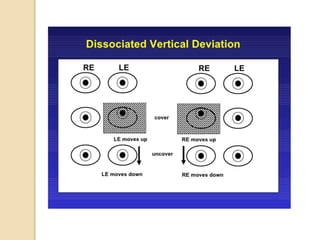
Spontaneous upward turning of dissociated
eye
 DVD syndrome
Excycloduction
Abduction
Latent nystagmus
 The upward excursion = Dissociated Vertical
Deviation
 The excyclotorsion = Dissociated Tortional
Deviation
 The lateral movement = Dissociated Horizontal
Deviation.
History
 The term was given byBielschowsky (1938).
 First described by Stevens as double vertical
strabismus
Other common names :
 Alternating hyperphoria (Crone)
 Anaphoria / anatropia (Stevens)
 Periodic vertical squint (Anderson)
 Strabismus sursoadductorius (Cords)
Clinical features
 Significant cosmetic blemish.
 2-5 years of age
 The condition is usually bilateral and asymmetric.
 It is usually associated with :
Infantile Esotropia,
Sensory heterotropia
Duane ‘s retraction syndrome
 The signs are more profound in an amblyopic, non-
dominant or non-fixing eye.
 The characteristic excursion of the eye :
As phoria :
Manifesting only under cover
As tropia :
When it manifests spontaneously, in conditions of
fatigue daydreaming, inattentiveness or during
poor health.
Consequences
 Cosmetic (Manifest DVD)
 Longstanding DVD ⇒ SR contracture ⇒ true
hypertropia
 Amblyopia in children
 Visual disturbances -diplopia, rare
Types :
 Comitant DVD :
Vertical deviation (with in ± 7 PD) measures same
in abduction, primary position and adduction.
 Incomitant DVD :
Difference in the magnitude of deviation in
abduction, primary position and adduction.
Measurement of DVD
 Mild (0-9 PD)
 Moderate (10-19 PD)
 Severe (> 20 PD)
 It is difficult to measure the DVD, as there is
change in deviation depending upon the alertness
and co-operation of the patient.
 It is best examined by :
Translucent occluder (Spielmann)
Plus 4 diopter lens
 It violates Herring's law of ocular motility.
 No movement is seen in the fixing eye when the
deviated eye returns for re fixation.
 On uncovering the eye, it slowly drifts back rather
than show a rapid re fixation movement as seen in
any other hyperphoria or hypertropia.
Tests :
 Hirshberg's test : Gross estimate.
 Prism Bar Under Cover Test (PBUCT) :
Base down prism and a cover is placed in front of
the dissociated eye, as the cover is shifted in front
of the fixing eye the downward movement of the
dissociated eye is noted
keep increasing prisms till no movement is seen on
switching occlusion
 Bielschowcky's phenomenon
As the intensity of light shown to the fixing eye is
decreased, the dissociated eye gradually comes
down.
Depth of DVD can be measured
Suggests sensory component
 Red glass test
The eye under the red glass dissociates and
moves upwards.
Differentiates DVD from hypertropia
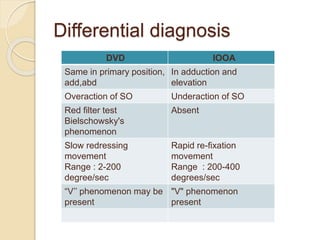
Differential diagnosis
DVD IOOA
Same in primary position,
add,abd
In adduction and
elevation
Overaction of SO Underaction of SO
Red filter test
Bielschowsky's
phenomenon
Absent
Slow redressing
movement
Range : 2-200
degree/sec
Rapid re-fixation
movement
Range : 200-400
degrees/sec
“V’’ phenomenon may be
present
"V" phenomenon
present
 A difficult situation can arise when there is DVD in
presence of IOOA.
 In such cases the rapid re fixation movement of the
hypotropic eye can be measured with the help of
prism bar cover test. Then the total upward
deviation may be measured using the PBUCT.
 DVD is the difference between the two readings
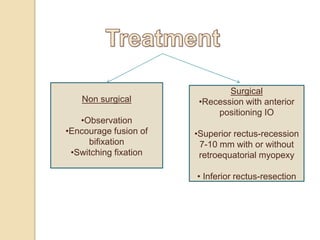
Non surgical
•Observation
•Encourage fusion of
bifixation
•Switching fixation
Surgical
•Recession with anterior
positioning IO
•Superior rectus-recession
7-10 mm with or without
retroequatorial myopexy
• Inferior rectus-resection
Indications for surgery
 If DVD is increasing in frequency
 Phoric deviation is gradually converting to a
manifest
 Head posture to the opposite side indicates a
poorer control or a larger magnitude of DVD.
Surgery indicated to improve the head posture
 A large and cosmetically unacceptable deviation
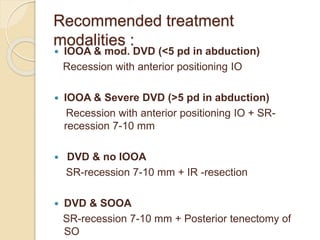
Recommended treatment
modalities :
 IOOA & mod. DVD (<5 pd in abduction)
Recession with anterior positioning IO
 IOOA & Severe DVD (>5 pd in abduction)
Recession with anterior positioning IO + SR-
recession 7-10 mm
 DVD & no IOOA
SR-recession 7-10 mm + IR -resection
 DVD & SOOA
SR-recession 7-10 mm + Posterior tenectomy of
SO
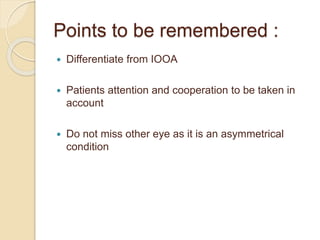
Points to be remembered :
 Differentiate from IOOA
 Patients attention and cooperation to be taken in
account
 Do not miss other eye as it is an asymmetrical
condition
Dissociated vertical deviation

Dissociated vertical deviation

  • 1.
  • 2.
    Spontaneous upward turningof dissociated eye  DVD syndrome Excycloduction Abduction Latent nystagmus  The upward excursion = Dissociated Vertical Deviation  The excyclotorsion = Dissociated Tortional Deviation  The lateral movement = Dissociated Horizontal Deviation.
  • 3.
    History  The termwas given byBielschowsky (1938).  First described by Stevens as double vertical strabismus Other common names :  Alternating hyperphoria (Crone)  Anaphoria / anatropia (Stevens)  Periodic vertical squint (Anderson)  Strabismus sursoadductorius (Cords)
  • 4.
    Clinical features  Significantcosmetic blemish.  2-5 years of age  The condition is usually bilateral and asymmetric.  It is usually associated with : Infantile Esotropia, Sensory heterotropia Duane ‘s retraction syndrome  The signs are more profound in an amblyopic, non- dominant or non-fixing eye.
  • 5.
     The characteristicexcursion of the eye : As phoria : Manifesting only under cover As tropia : When it manifests spontaneously, in conditions of fatigue daydreaming, inattentiveness or during poor health.
  • 6.
    Consequences  Cosmetic (ManifestDVD)  Longstanding DVD ⇒ SR contracture ⇒ true hypertropia  Amblyopia in children  Visual disturbances -diplopia, rare
  • 7.
    Types :  ComitantDVD : Vertical deviation (with in ± 7 PD) measures same in abduction, primary position and adduction.  Incomitant DVD : Difference in the magnitude of deviation in abduction, primary position and adduction.
  • 8.
    Measurement of DVD Mild (0-9 PD)  Moderate (10-19 PD)  Severe (> 20 PD)  It is difficult to measure the DVD, as there is change in deviation depending upon the alertness and co-operation of the patient.  It is best examined by : Translucent occluder (Spielmann) Plus 4 diopter lens
  • 9.
     It violatesHerring's law of ocular motility.  No movement is seen in the fixing eye when the deviated eye returns for re fixation.  On uncovering the eye, it slowly drifts back rather than show a rapid re fixation movement as seen in any other hyperphoria or hypertropia.
  • 10.
    Tests :  Hirshberg'stest : Gross estimate.  Prism Bar Under Cover Test (PBUCT) : Base down prism and a cover is placed in front of the dissociated eye, as the cover is shifted in front of the fixing eye the downward movement of the dissociated eye is noted keep increasing prisms till no movement is seen on switching occlusion
  • 11.
     Bielschowcky's phenomenon Asthe intensity of light shown to the fixing eye is decreased, the dissociated eye gradually comes down. Depth of DVD can be measured Suggests sensory component  Red glass test The eye under the red glass dissociates and moves upwards. Differentiates DVD from hypertropia
  • 12.
    Differential diagnosis DVD IOOA Samein primary position, add,abd In adduction and elevation Overaction of SO Underaction of SO Red filter test Bielschowsky's phenomenon Absent Slow redressing movement Range : 2-200 degree/sec Rapid re-fixation movement Range : 200-400 degrees/sec “V’’ phenomenon may be present "V" phenomenon present
  • 13.
     A difficultsituation can arise when there is DVD in presence of IOOA.  In such cases the rapid re fixation movement of the hypotropic eye can be measured with the help of prism bar cover test. Then the total upward deviation may be measured using the PBUCT.  DVD is the difference between the two readings
  • 15.
    Non surgical •Observation •Encourage fusionof bifixation •Switching fixation Surgical •Recession with anterior positioning IO •Superior rectus-recession 7-10 mm with or without retroequatorial myopexy • Inferior rectus-resection
  • 16.
    Indications for surgery If DVD is increasing in frequency  Phoric deviation is gradually converting to a manifest  Head posture to the opposite side indicates a poorer control or a larger magnitude of DVD. Surgery indicated to improve the head posture  A large and cosmetically unacceptable deviation
  • 17.
    Recommended treatment modalities : IOOA & mod. DVD (<5 pd in abduction) Recession with anterior positioning IO  IOOA & Severe DVD (>5 pd in abduction) Recession with anterior positioning IO + SR- recession 7-10 mm  DVD & no IOOA SR-recession 7-10 mm + IR -resection  DVD & SOOA SR-recession 7-10 mm + Posterior tenectomy of SO
  • 18.
    Points to beremembered :  Differentiate from IOOA  Patients attention and cooperation to be taken in account  Do not miss other eye as it is an asymmetrical condition

Editor's Notes

  • #5 The patients do not complain of diplopia as there is poor fusion and suppression of the deviating eye.