NELSON.R.MANDELA SCHOOL OF MEDICINE
                              2012
   For this module, you need to be able to examine the
    fundus – on a model or a simulated patient - know
    the features and significance of papilloedema, and be
    able to recognise it clinically.

   You should also become familiar with other common
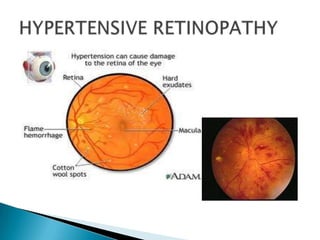
    abnormalities such as optic atrophy, hypertensive and
    diabetic retinopathy and retinitis pigmentosa – look
    at illustrations in your textbooks eg Talley Page 299

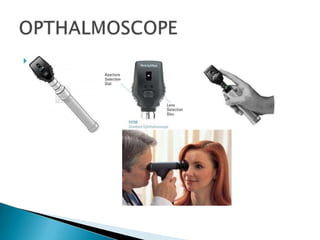
   Note that we also have panoptic as well as standard
    ophthalmoscopes available in the Skills Lab. You
    must, however, be competent in the use of the
    standard opththalmoscope.
   a
   Explain the procedure to the patient.
   Dim the lights in the room.

To examine the right eye, you must:
  Sit on right side of the patient.
  Use your right eye to look into the patient’s
   right eye.
   Turn the ophthalmoscope on.
   Rotate the rheostat to the desired light output . You
    may start at full illumination and reduce it to a level
    that is comfortable to the patient.
   Select 0 on the lens dial. (If you wear
    spectacles, remove these and use the
    ophthalmoscope to correct your vision by focusing on
    an object 3-4 metres away and selecting the lens
    which provides the best focus for you)
   Select the correct aperture
   You may start with the small aperture and lower light
    intensity to avoid patient discomfort, but ultimately
    use the largest possible aperture for good viewing of
    the retina.
•    Hold the ophthalmoscope in your right
hand, vertically in front of your right eye.

•    Place your index finger on the lens dial to
enable you to change lenses easily in order to
focus.

•    Instruct the patient to look straight ahead
and focus on an object in the distance.
•    Place your left hand on the patient’s
forehead, using your left thumb to hold the
patient’s right upper eyelid open.

•    Position the ophthalmoscope +/- 15cm
away from and 25 degrees to the right of the
patient.

•    Direct the light beam onto the pupil as
you move towards the eye.
•     The red reflex should appear as you look
at the pupil.

•    Keep the reflex in view, as you move
slowly closer to the patient’s eye.

•     When you are +/- 5cm away from the
eye, the optic disc should come into view (or
locate and follow a large retinal vein back
towards the disc - all vessels radiate from the
optic disc.)
     Rotate the lens dial until the optic disc is focused
  clearly.
(Red numbers/negative numbers in myopia or short-
sightedness.
Green numbers/positive numbers in hyperopia or far-
sightedness.)

 Examine the optic disc for:
      Shape – normally round or slightly oval
      Clarity of the outline-clear outline or rim
      Colour-rich yellow contrast to rich red of rest of
fundus
      Elevation –disc is a shallow (physiological) cup
      Condition of vessels
         Follow each vessel as far to the periphery as you
    can

       Ask the patient to look up, down, temporally and
    nasally and move as necessary as well to examine all
    areas of the retina, making sure to examine all 4
    quadrants.

       The procedure is made difficult if the light is
    reflecting off the patient’s cornea, into your eye
    (corneal reflection). Use the appropriate filter
    (crossed polarising filter) to reduce this reflection.
   Examine the macula last.

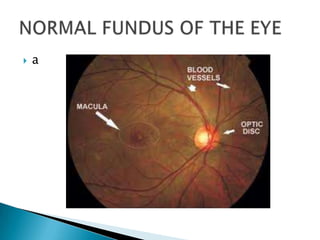
   To locate the macula, focus on the disc, then
    move 2 disc diameters temporally. The
    macula is darker in colour than the
    surrounding fundus, and devoid of blood
    vessels.
   You may also ask the patient to look at the
    light. This automatically puts the macula into
    full view.
   Do the opposite to examine the patient’s left
    eye.
1)The optic disc
2)The retinal blood vessels
3)The periphery of the fundus
4) The macula

(Assess the vessels and look for other
abnormalities such as hypertensive or diabetic
retinopathy.)
   a
   MGM - updated 2012-02-27
   Year 3
   Clinical Skills
   Fundoscopy protocol - Practical approach

Fundoscopy ppt 2012

  • 1.
  • 2.
    For this module, you need to be able to examine the fundus – on a model or a simulated patient - know the features and significance of papilloedema, and be able to recognise it clinically.  You should also become familiar with other common abnormalities such as optic atrophy, hypertensive and diabetic retinopathy and retinitis pigmentosa – look at illustrations in your textbooks eg Talley Page 299  Note that we also have panoptic as well as standard ophthalmoscopes available in the Skills Lab. You must, however, be competent in the use of the standard opththalmoscope.
  • 3.
  • 4.
    Explain the procedure to the patient.  Dim the lights in the room. To examine the right eye, you must:  Sit on right side of the patient.  Use your right eye to look into the patient’s right eye.
  • 6.
    Turn the ophthalmoscope on.  Rotate the rheostat to the desired light output . You may start at full illumination and reduce it to a level that is comfortable to the patient.  Select 0 on the lens dial. (If you wear spectacles, remove these and use the ophthalmoscope to correct your vision by focusing on an object 3-4 metres away and selecting the lens which provides the best focus for you)  Select the correct aperture  You may start with the small aperture and lower light intensity to avoid patient discomfort, but ultimately use the largest possible aperture for good viewing of the retina.
  • 7.
    Hold the ophthalmoscope in your right hand, vertically in front of your right eye. • Place your index finger on the lens dial to enable you to change lenses easily in order to focus. • Instruct the patient to look straight ahead and focus on an object in the distance.
  • 8.
    Place your left hand on the patient’s forehead, using your left thumb to hold the patient’s right upper eyelid open. • Position the ophthalmoscope +/- 15cm away from and 25 degrees to the right of the patient. • Direct the light beam onto the pupil as you move towards the eye.
  • 9.
    The red reflex should appear as you look at the pupil. • Keep the reflex in view, as you move slowly closer to the patient’s eye. • When you are +/- 5cm away from the eye, the optic disc should come into view (or locate and follow a large retinal vein back towards the disc - all vessels radiate from the optic disc.)
  • 10.
    Rotate the lens dial until the optic disc is focused clearly. (Red numbers/negative numbers in myopia or short- sightedness. Green numbers/positive numbers in hyperopia or far- sightedness.)  Examine the optic disc for: Shape – normally round or slightly oval Clarity of the outline-clear outline or rim Colour-rich yellow contrast to rich red of rest of fundus Elevation –disc is a shallow (physiological) cup Condition of vessels
  • 11.
    Follow each vessel as far to the periphery as you can  Ask the patient to look up, down, temporally and nasally and move as necessary as well to examine all areas of the retina, making sure to examine all 4 quadrants.  The procedure is made difficult if the light is reflecting off the patient’s cornea, into your eye (corneal reflection). Use the appropriate filter (crossed polarising filter) to reduce this reflection.
  • 12.
    Examine the macula last.  To locate the macula, focus on the disc, then move 2 disc diameters temporally. The macula is darker in colour than the surrounding fundus, and devoid of blood vessels.  You may also ask the patient to look at the light. This automatically puts the macula into full view.
  • 13.
    Do the opposite to examine the patient’s left eye.
  • 14.
    1)The optic disc 2)Theretinal blood vessels 3)The periphery of the fundus 4) The macula (Assess the vessels and look for other abnormalities such as hypertensive or diabetic retinopathy.)
  • 15.
  • 18.
    MGM - updated 2012-02-27  Year 3  Clinical Skills  Fundoscopy protocol - Practical approach