DIRECT OPHTHALMOSCOPY
DR. IFRAD TASNIM
RESIDENT ( PHASE-A)
DEPARTMENT OF OPHTHALMOLOGY
Ophthalmoscopy
It is the method by which
magnified image of the
fundus can be seen.
DO :Image is erect.
IDO: Image is inverted.
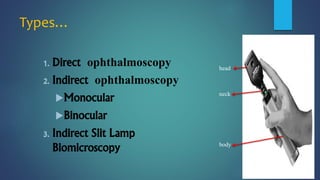
Types…
1. Direct ophthalmoscopy
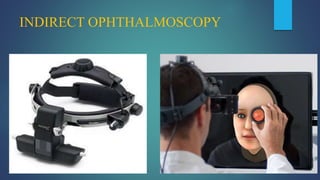
2. Indirect ophthalmoscopy
Monocular
Binocular
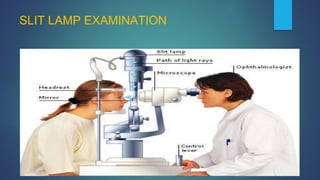
3. Indirect Slit Lamp
Biomicroscopy
head
body
neck
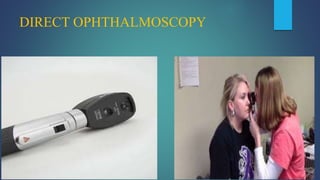
DIRECT OPHTHALMOSCOPY
INDIRECT OPHTHALMOSCOPY
SLIT LAMP EXAMINATION
A Bit History……
 Jan Purkinje (Latin -1823) - Complete technique of
ophthalmoscopy
 Next 25 years: Kussmaul, Cumming, Brucke, and
Babbage worked on the ophthalmoscope
 1851 Helmholtz - First useable direct
ophthalmoscope
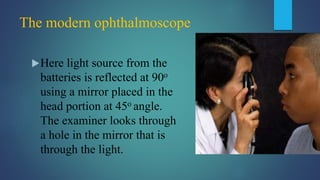
The modern ophthalmoscope
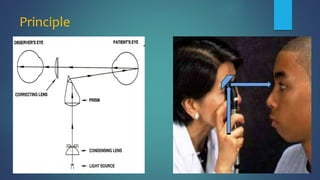
Here light source from the
batteries is reflected at 90o
using a mirror placed in the
head portion at 45o angle.
The examiner looks through
a hole in the mirror that is
through the light.
Characteristics of the image
 Virtual, erect and magnified Image.
 Field of view ~ 10°
 To enlarge field of view examiner’s eye must be closer to patient’s eye with patient’s pupils
dilated
 Enlargement capacity of any magnification lens = 1/4th of lens power
 Retinal image in emmetropic eye (60 D)- magnified by 60/4, or ×15
 In aphakic eyes (20 D natural lens removed )
=magnification for the observer is reduced to about 40/4 or ×10.
 Hyperopic eye of +10D ---power of eye= 50D
Thus magnification = 50/4= X 12.5
 Myopic eye of -10D---power of eye= 70D
Thus magnification = 70/4= X 17.5
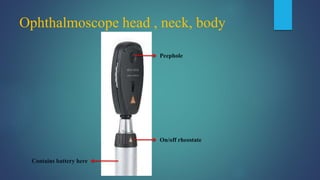
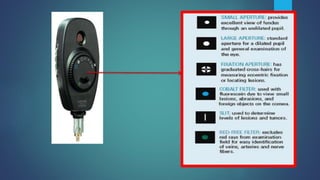
Ophthalmoscope head , neck, body
Peephole
On/off rheostate
Contains battery here
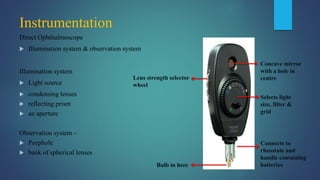
Instrumentation
Direct Ophthalmoscope
 Illumination system & observation system
Illumination system
 Light source
 condensing lenses
 reflecting prism
 an aperture
Observation system –
 Peephole
 bank of spherical lenses
Lens strength selector
wheel
Bulb in here
Concave mirror
with a hole in
centre
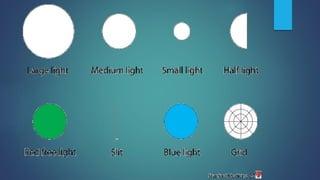
Selects light
size, filter &
grid
Connects to
rheostate and
handle containing
batteries
Principle
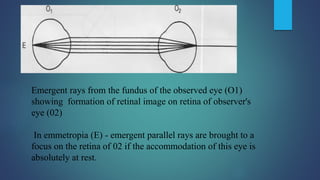
Emergent rays from the fundus of the observed eye (O1)
showing formation of retinal image on retina of observer's
eye (02)
In emmetropia (E) - emergent parallel rays are brought to a
focus on the retina of 02 if the accommodation of this eye is
absolutely at rest.
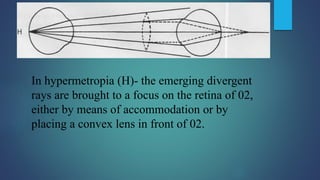
In hypermetropia (H)- the emerging divergent
rays are brought to a focus on the retina of 02,
either by means of accommodation or by
placing a convex lens in front of 02.
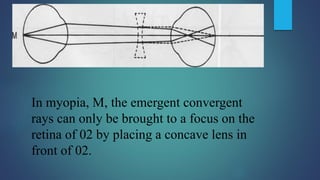
In myopia, M, the emergent convergent
rays can only be brought to a focus on the
retina of 02 by placing a concave lens in
front of 02.
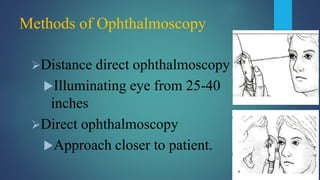
Methods of Ophthalmoscopy
Distance direct ophthalmoscopy
Illuminating eye from 25-40
inches
Direct ophthalmoscopy
Approach closer to patient.
Procedure
Of Direct Ophthalmoscopy…
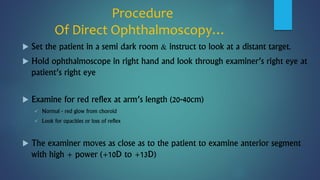
 Set the patient in a semi dark room & instruct to look at a distant target.
 Hold ophthalmoscope in right hand and look through examiner’s right eye at
patient’s right eye
 Examine for red reflex at arm’s length (20-40cm)
 Normal - red glow from choroid
 Look for opacities or loss of reflex
 The examiner moves as close as to the patient to examine anterior segment
with high + power (+10D to +13D)
Cont…
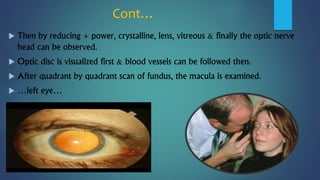
 Then by reducing + power, crystalline, lens, vitreous & finally the optic nerve
head can be observed.
 Optic disc is visualized first & blood vessels can be followed then.
 After quadrant by quadrant scan of fundus, the macula is examined.
 …left eye…
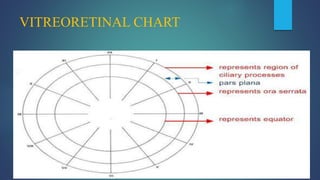
VITREORETINAL CHART
Advantages
 It is relatively easy procedure to master as compare to
IO.
 IT has the greatest amount of magnification of any
procedure used for fundus examination.
 By using the lens wheel to adjust focus, the clinician is
able to examine the various structures of the eye.
 It can be used in non dilated pupil.
 It is portable.
Disadvantages
Limited field of view & monocular
view.
A stereoscopic view is not possible.
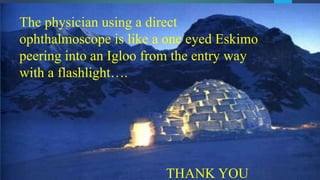
The physician using a direct
ophthalmoscope is like a one eyed Eskimo
peering into an Igloo from the entry way
with a flashlight….
THANK YOU

Direct ophthalmoscopy final

  • 1.
    DIRECT OPHTHALMOSCOPY DR. IFRADTASNIM RESIDENT ( PHASE-A) DEPARTMENT OF OPHTHALMOLOGY
  • 2.
    Ophthalmoscopy It is themethod by which magnified image of the fundus can be seen. DO :Image is erect. IDO: Image is inverted.
  • 3.
    Types… 1. Direct ophthalmoscopy 2.Indirect ophthalmoscopy Monocular Binocular 3. Indirect Slit Lamp Biomicroscopy head body neck
  • 4.
  • 5.
  • 6.
  • 7.
    A Bit History…… Jan Purkinje (Latin -1823) - Complete technique of ophthalmoscopy  Next 25 years: Kussmaul, Cumming, Brucke, and Babbage worked on the ophthalmoscope  1851 Helmholtz - First useable direct ophthalmoscope
  • 8.
    The modern ophthalmoscope Herelight source from the batteries is reflected at 90o using a mirror placed in the head portion at 45o angle. The examiner looks through a hole in the mirror that is through the light.
  • 9.
    Characteristics of theimage  Virtual, erect and magnified Image.  Field of view ~ 10°  To enlarge field of view examiner’s eye must be closer to patient’s eye with patient’s pupils dilated  Enlargement capacity of any magnification lens = 1/4th of lens power  Retinal image in emmetropic eye (60 D)- magnified by 60/4, or ×15  In aphakic eyes (20 D natural lens removed ) =magnification for the observer is reduced to about 40/4 or ×10.  Hyperopic eye of +10D ---power of eye= 50D Thus magnification = 50/4= X 12.5  Myopic eye of -10D---power of eye= 70D Thus magnification = 70/4= X 17.5
  • 10.
    Ophthalmoscope head ,neck, body Peephole On/off rheostate Contains battery here
  • 11.
    Instrumentation Direct Ophthalmoscope  Illuminationsystem & observation system Illumination system  Light source  condensing lenses  reflecting prism  an aperture Observation system –  Peephole  bank of spherical lenses Lens strength selector wheel Bulb in here Concave mirror with a hole in centre Selects light size, filter & grid Connects to rheostate and handle containing batteries
  • 14.
  • 15.
    Emergent rays fromthe fundus of the observed eye (O1) showing formation of retinal image on retina of observer's eye (02) In emmetropia (E) - emergent parallel rays are brought to a focus on the retina of 02 if the accommodation of this eye is absolutely at rest.
  • 16.
    In hypermetropia (H)-the emerging divergent rays are brought to a focus on the retina of 02, either by means of accommodation or by placing a convex lens in front of 02.
  • 17.
    In myopia, M,the emergent convergent rays can only be brought to a focus on the retina of 02 by placing a concave lens in front of 02.
  • 18.
    Methods of Ophthalmoscopy Distancedirect ophthalmoscopy Illuminating eye from 25-40 inches Direct ophthalmoscopy Approach closer to patient.
  • 19.
    Procedure Of Direct Ophthalmoscopy… Set the patient in a semi dark room & instruct to look at a distant target.  Hold ophthalmoscope in right hand and look through examiner’s right eye at patient’s right eye  Examine for red reflex at arm’s length (20-40cm)  Normal - red glow from choroid  Look for opacities or loss of reflex  The examiner moves as close as to the patient to examine anterior segment with high + power (+10D to +13D)
  • 20.
    Cont…  Then byreducing + power, crystalline, lens, vitreous & finally the optic nerve head can be observed.  Optic disc is visualized first & blood vessels can be followed then.  After quadrant by quadrant scan of fundus, the macula is examined.  …left eye…
  • 21.
  • 22.
    Advantages  It isrelatively easy procedure to master as compare to IO.  IT has the greatest amount of magnification of any procedure used for fundus examination.  By using the lens wheel to adjust focus, the clinician is able to examine the various structures of the eye.  It can be used in non dilated pupil.  It is portable.
  • 23.
    Disadvantages Limited field ofview & monocular view. A stereoscopic view is not possible.
  • 24.
    The physician usinga direct ophthalmoscope is like a one eyed Eskimo peering into an Igloo from the entry way with a flashlight…. THANK YOU