In the name of ALLAH….the most beneficent
and most merciful.
Presentation:
Direct and Indirect Speech
Direct & Indirect Speech
• There two ways to convey a message of a
person, or the words spoken by a person to
other person.
•  Direct speech
•  Indirect speech
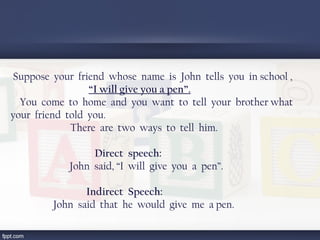
Suppose your friend whose name is John tells you in school ,
“I will give you a pen”.
You come to home and you want to tell your brother what
your friend told you.
There are two ways to tell him.
Direct speech:
  John said, “I will give you a pen”.
Indirect Speech:
  John said that he would give me a pen.
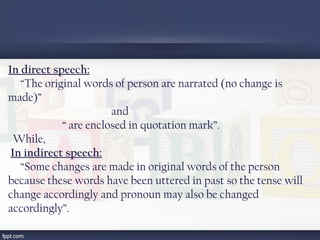
In direct speech:
“The original words of person are narrated (no change is
made)”
and
“ are enclosed in quotation mark”.
While,
In indirect speech:
“Some changes are made in original words of the person
because these words have been uttered in past so the tense will
change accordingly and pronoun may also be changed
accordingly”.
Reporting Verb
 
The verb first part of sentence
(i.e. he said, she said, he says, they said, she says,)
before the statement of a person in sentence
is called
“Reporting Verb”.
Examples
He said, “I work in a factory” 
                           (Direct speech)
            He said that he worked in a factory.    
             (Indirect speech)
           They said, “we are going to cinema”
                (Direct speech)
      They said that they were going to cinema.
      (Indirect speech)
 
Reported Speech
The second part of indirect speech
in which something has been told by a person
(which is enclosed in quotation marks in
direct speech)
is called
“Reported Speech”.
Example
  A sentence of indirect speech is,
 He said that he worked in a factory.
In this sentence:
the second part
“he worked in a factory”
is called
“Reported Speech”
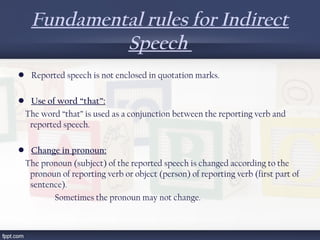
Fundamental rules for Indirect
Speech
•  Reported speech is not enclosed in quotation marks.
•  Use of word “that”:
  The word “that” is used as a conjunction between the reporting verb and
reported speech.
•  Change in pronoun:
  The pronoun (subject) of the reported speech is changed according to the
pronoun of reporting verb or object (person) of reporting verb (first part of
sentence).
Sometimes the pronoun may not change.
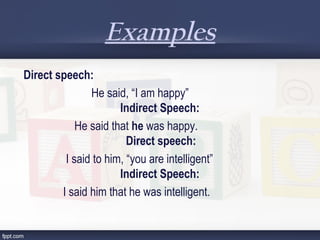
Examples
Direct speech:
  He said, “I am happy”
        Indirect Speech:
He said that he was happy.
        Direct speech:
  I said to him, “you are intelligent”
        Indirect Speech:
I said him that he was intelligent.
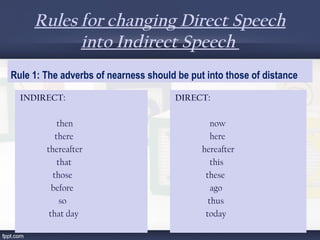
Rules for changing Direct Speech
into Indirect Speech
Rule 1: The adverbs of nearness should be put into those of distance
INDIRECT:
then
there
thereafter
that
those
before
so
that day
DIRECT:
now
here
hereafter
this
these
ago
thus
today
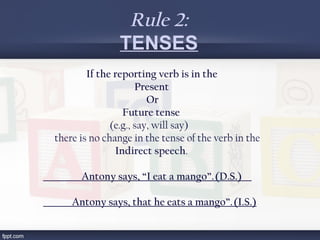
Rule 2:
TENSES
If the reporting verb is in the
Present
Or
Future tense
(e.g., say, will say)
there is no change in the tense of the verb in the
Indirect speech.
Antony says, “I eat a mango”. (D.S.)
Antony says, that he eats a mango”. (I.S.)
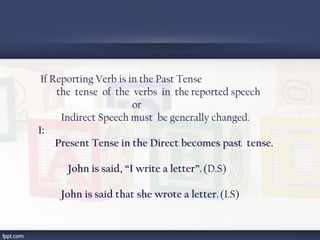
If Reporting Verb is in the Past Tense
the tense of the verbs in the reported speech
or
Indirect Speech must be generally changed.
1:
Present Tense in the Direct becomes past tense.
John is said, “I write a letter”. (D.S)
John is said that she wrote a letter. (I.S)
2:
Past Tense in the direct becomes past perfect or remains unchanged.
Angel said, “I brought a pen yesterday”. (D.S)
Angel said that she had bought a pen the day before. (I.S)
3:
Present Continuous in the direct becomes past continuous.
John said, “I am going to church”. (D.S)
John said that he was going to church. (I.S)
Presented to:
Sir Muhammad
Asif

Direct & indirect presentation

  • 1.
    In the nameof ALLAH….the most beneficent and most merciful.
  • 2.
  • 4.
    Direct & IndirectSpeech • There two ways to convey a message of a person, or the words spoken by a person to other person. •  Direct speech •  Indirect speech
  • 5.
    Suppose your friendwhose name is John tells you in school , “I will give you a pen”. You come to home and you want to tell your brother what your friend told you. There are two ways to tell him. Direct speech:   John said, “I will give you a pen”. Indirect Speech:   John said that he would give me a pen.
  • 6.
    In direct speech: “Theoriginal words of person are narrated (no change is made)” and “ are enclosed in quotation mark”. While, In indirect speech: “Some changes are made in original words of the person because these words have been uttered in past so the tense will change accordingly and pronoun may also be changed accordingly”.
  • 7.
    Reporting Verb   The verbfirst part of sentence (i.e. he said, she said, he says, they said, she says,) before the statement of a person in sentence is called “Reporting Verb”.
  • 8.
    Examples He said, “Iwork in a factory”                             (Direct speech)             He said that he worked in a factory.                  (Indirect speech)            They said, “we are going to cinema”                 (Direct speech)       They said that they were going to cinema.       (Indirect speech)  
  • 9.
    Reported Speech The secondpart of indirect speech in which something has been told by a person (which is enclosed in quotation marks in direct speech) is called “Reported Speech”.
  • 10.
    Example   A sentenceof indirect speech is,  He said that he worked in a factory. In this sentence: the second part “he worked in a factory” is called “Reported Speech”
  • 11.
    Fundamental rules forIndirect Speech •  Reported speech is not enclosed in quotation marks. •  Use of word “that”:   The word “that” is used as a conjunction between the reporting verb and reported speech. •  Change in pronoun:   The pronoun (subject) of the reported speech is changed according to the pronoun of reporting verb or object (person) of reporting verb (first part of sentence). Sometimes the pronoun may not change.
  • 12.
    Examples Direct speech:   Hesaid, “I am happy”         Indirect Speech: He said that he was happy.         Direct speech:   I said to him, “you are intelligent”         Indirect Speech: I said him that he was intelligent.
  • 13.
    Rules for changingDirect Speech into Indirect Speech Rule 1: The adverbs of nearness should be put into those of distance INDIRECT: then there thereafter that those before so that day DIRECT: now here hereafter this these ago thus today
  • 14.
    Rule 2: TENSES If thereporting verb is in the Present Or Future tense (e.g., say, will say) there is no change in the tense of the verb in the Indirect speech. Antony says, “I eat a mango”. (D.S.) Antony says, that he eats a mango”. (I.S.)
  • 15.
    If Reporting Verbis in the Past Tense the tense of the verbs in the reported speech or Indirect Speech must be generally changed. 1: Present Tense in the Direct becomes past tense. John is said, “I write a letter”. (D.S) John is said that she wrote a letter. (I.S)
  • 16.
    2: Past Tense inthe direct becomes past perfect or remains unchanged. Angel said, “I brought a pen yesterday”. (D.S) Angel said that she had bought a pen the day before. (I.S) 3: Present Continuous in the direct becomes past continuous. John said, “I am going to church”. (D.S) John said that he was going to church. (I.S)
  • 17.