DIRECT AND INDIRECT
NARRATION
By Atif Nauman (University
of Gujrat)
REPORTING SPEECH
There are two ways of reporting what somebody says;
• Direct speech
• Indirect (or reported) speech.
A SPEAKER’S WORD CAN BE
REPORTED IN TWO WAYS:
Direct Speech- Exact words of speaker
e.g. The teacher said to Ali, “You have a bright future.”
Indirect Speech- What the speaker has said without using the exact
words
E.g. The teacher told Ali that he had a bright future.
PUNCTUATING DIRECT SPEECH.
When using direct speech in your writing you need to use the
correct punctuation.
• The exact words spoken must be enclosed in speech marks.
• The first word of the speech must begin with a capital letter.
• The words in the speech marks must be separated from the
rest of the sentence by a comma.
• You must use a new line when a new speaker begins to
speak.
WHAT CHANGES DID YOU NOTICE?
•Omission of commas
•Use of ‘that’
•Change of pronoun
•Change of tense
•Change of adverb
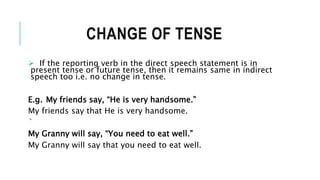
CHANGE OF TENSE
 If the reporting verb in the direct speech statement is in
present tense or future tense, then it remains same in indirect
speech too i.e. no change in tense.
E.g. My friends say, “He is very handsome.”
My friends say that He is very handsome.
`
My Granny will say, “You need to eat well.”
My Granny will say that you need to eat well.
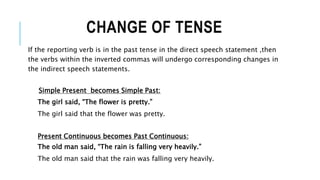
CHANGE OF TENSE
If the reporting verb is in the past tense in the direct speech statement ,then
the verbs within the inverted commas will undergo corresponding changes in
the indirect speech statements.
Simple Present becomes Simple Past:
The girl said, “The flower is pretty.”
The girl said that the flower was pretty.
Present Continuous becomes Past Continuous:
The old man said, “The rain is falling very heavily.”
The old man said that the rain was falling very heavily.
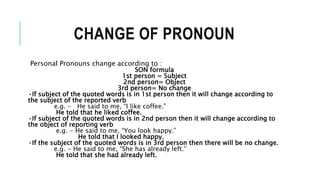
CHANGE OF PRONOUN
Personal Pronouns change according to :
SON formula
1st person = Subject
2nd person= Object
3rd person= No change
•If subject of the quoted words is in 1st person then it will change according to
the subject of the reported verb
e.g. - He said to me, “I like coffee.”
He told that he liked coffee.
•If subject of the quoted words is in 2nd person then it will change according to
the object of reporting verb
e.g. - He said to me, “You look happy.”
He told that I looked happy.
•If the subject of the quoted words is in 3rd person then there will be no change.
e.g. - He said to me, “She has already left.”
He told that she had already left.
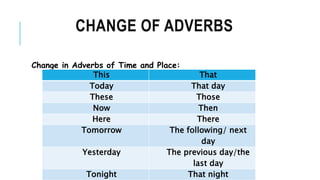
CHANGE OF ADVERBS
Change in Adverbs of Time and Place:
This That
Today That day
These Those
Now Then
Here There
Tomorrow The following/ next
day
Yesterday The previous day/the
last day
Tonight That night
ASSERTIVE SENTENCES
• There is an object after reporting verb, change ‘say to’ into ‘tell’,
‘says to’ into ‘tell’, ‘said to’ into ‘told’. If there is no object after the
reporting verb, do not change the verb.
Remember ‘to’ is not used after tell(s) or told.
• Remove comma and inverted commas, and use ‘that’ in place of the
opening quote.
• If object of the reporting verb is found in reported speech instead of
reporting verb itself, make it object of the reporting verb.
• Change pronouns and tense of the verb of reported speech
according to the rules.
ASSERTIVE SENTENCES
For Example:
Direct: Rahim said, “I had done my work”.
Indirect: Rahim said that he had done his work.
Direct: Rahim said to me, “I cannot help you in your work.”
Indirect: Rahim told me that he could not help me in my work.
Direct: The thief said, ‘I am innocent.
Indirect: The thief said that he was innocent.
IMPERATIVE SENTENCES
• In Imperative sentences, reporting verb is changed into
ask/advice/request.
Tense remains the same.
The verb is put in the infinitive ‘to‘.
• I said, “ Take your seat.”
I asked him to take his seat.
• He said, “ Give me some food, please.”
He requested me to give him some food.
INTERROGATIVE SENTENCES
•A Question is changed into a Statement.
•In a direct ‘Yes/No’ question , reporting verb is changed into
ask/inquire and if/whether’ is used.
i. She said, “ Are you writing a poem.?”
She asked me whether I was writing a poem.
i. I said to him, “ Do you know when she will go home?”
I asked him if he knew when she would go home.
EXCLAMATORY SENTENCES
• In Exclamatory Sentences, reporting verb is changed into
exclaimed with joy/sorrow/ anger/surprise, etc. That is used.
• He said, “ How beautiful a place!”
He exclaimed with joy that it was a very beautiful place.
• Rohan said, “ Alas! His father died.”
Rohan exclaimed with sorrow that his father had died.
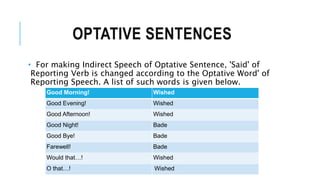
OPTATIVE SENTENCES
• For making Indirect Speech of Optative Sentence, 'Said' of
Reporting Verb is changed according to the Optative Word' of
Reporting Speech. A list of such words is given below.
Good Morning! Wished
Good Evening! Wished
Good Afternoon! Wished
Good Night! Bade
Good Bye! Bade
Farewell! Bade
Would that…! Wished
O that…! Wished
OPTATIVE SENTENCES
For Example:
a) Direct : He said to me, "May you live long !"
Indirect : He wished that I might live long.
b) Direct : She said, "May your enemy go to hell !"
Indirect : She cursed that my enemy might go to hell.
c) Direct : Seema said to me, "May God bless you with children !"
Indirect : Seema prayed that God might bless me with children.
MISCELLANEOUS SENTENCES
In few sentences, emotions are very important. While converting
their Direct Speech to Indirect Speech, word of the same
emotion is used in place of 'Said To'.
For Example:
Ali said to Talha, "May you live long!"
Ali prayed that Talha might live long.
She said to Raza , "May God bless you with a son!"
She prayed that God might bless raza with a son.
Direct and indirect Narration

Direct and indirect Narration

  • 1.
    DIRECT AND INDIRECT NARRATION ByAtif Nauman (University of Gujrat)
  • 2.
    REPORTING SPEECH There aretwo ways of reporting what somebody says; • Direct speech • Indirect (or reported) speech.
  • 3.
    A SPEAKER’S WORDCAN BE REPORTED IN TWO WAYS: Direct Speech- Exact words of speaker e.g. The teacher said to Ali, “You have a bright future.” Indirect Speech- What the speaker has said without using the exact words E.g. The teacher told Ali that he had a bright future.
  • 4.
    PUNCTUATING DIRECT SPEECH. Whenusing direct speech in your writing you need to use the correct punctuation. • The exact words spoken must be enclosed in speech marks. • The first word of the speech must begin with a capital letter. • The words in the speech marks must be separated from the rest of the sentence by a comma. • You must use a new line when a new speaker begins to speak.
  • 5.
    WHAT CHANGES DIDYOU NOTICE? •Omission of commas •Use of ‘that’ •Change of pronoun •Change of tense •Change of adverb
  • 6.
    CHANGE OF TENSE If the reporting verb in the direct speech statement is in present tense or future tense, then it remains same in indirect speech too i.e. no change in tense. E.g. My friends say, “He is very handsome.” My friends say that He is very handsome. ` My Granny will say, “You need to eat well.” My Granny will say that you need to eat well.
  • 7.
    CHANGE OF TENSE Ifthe reporting verb is in the past tense in the direct speech statement ,then the verbs within the inverted commas will undergo corresponding changes in the indirect speech statements. Simple Present becomes Simple Past: The girl said, “The flower is pretty.” The girl said that the flower was pretty. Present Continuous becomes Past Continuous: The old man said, “The rain is falling very heavily.” The old man said that the rain was falling very heavily.
  • 8.
    CHANGE OF PRONOUN PersonalPronouns change according to : SON formula 1st person = Subject 2nd person= Object 3rd person= No change •If subject of the quoted words is in 1st person then it will change according to the subject of the reported verb e.g. - He said to me, “I like coffee.” He told that he liked coffee. •If subject of the quoted words is in 2nd person then it will change according to the object of reporting verb e.g. - He said to me, “You look happy.” He told that I looked happy. •If the subject of the quoted words is in 3rd person then there will be no change. e.g. - He said to me, “She has already left.” He told that she had already left.
  • 9.
    CHANGE OF ADVERBS Changein Adverbs of Time and Place: This That Today That day These Those Now Then Here There Tomorrow The following/ next day Yesterday The previous day/the last day Tonight That night
  • 10.
    ASSERTIVE SENTENCES • Thereis an object after reporting verb, change ‘say to’ into ‘tell’, ‘says to’ into ‘tell’, ‘said to’ into ‘told’. If there is no object after the reporting verb, do not change the verb. Remember ‘to’ is not used after tell(s) or told. • Remove comma and inverted commas, and use ‘that’ in place of the opening quote. • If object of the reporting verb is found in reported speech instead of reporting verb itself, make it object of the reporting verb. • Change pronouns and tense of the verb of reported speech according to the rules.
  • 11.
    ASSERTIVE SENTENCES For Example: Direct:Rahim said, “I had done my work”. Indirect: Rahim said that he had done his work. Direct: Rahim said to me, “I cannot help you in your work.” Indirect: Rahim told me that he could not help me in my work. Direct: The thief said, ‘I am innocent. Indirect: The thief said that he was innocent.
  • 12.
    IMPERATIVE SENTENCES • InImperative sentences, reporting verb is changed into ask/advice/request. Tense remains the same. The verb is put in the infinitive ‘to‘. • I said, “ Take your seat.” I asked him to take his seat. • He said, “ Give me some food, please.” He requested me to give him some food.
  • 13.
    INTERROGATIVE SENTENCES •A Questionis changed into a Statement. •In a direct ‘Yes/No’ question , reporting verb is changed into ask/inquire and if/whether’ is used. i. She said, “ Are you writing a poem.?” She asked me whether I was writing a poem. i. I said to him, “ Do you know when she will go home?” I asked him if he knew when she would go home.
  • 14.
    EXCLAMATORY SENTENCES • InExclamatory Sentences, reporting verb is changed into exclaimed with joy/sorrow/ anger/surprise, etc. That is used. • He said, “ How beautiful a place!” He exclaimed with joy that it was a very beautiful place. • Rohan said, “ Alas! His father died.” Rohan exclaimed with sorrow that his father had died.
  • 15.
    OPTATIVE SENTENCES • Formaking Indirect Speech of Optative Sentence, 'Said' of Reporting Verb is changed according to the Optative Word' of Reporting Speech. A list of such words is given below. Good Morning! Wished Good Evening! Wished Good Afternoon! Wished Good Night! Bade Good Bye! Bade Farewell! Bade Would that…! Wished O that…! Wished
  • 16.
    OPTATIVE SENTENCES For Example: a)Direct : He said to me, "May you live long !" Indirect : He wished that I might live long. b) Direct : She said, "May your enemy go to hell !" Indirect : She cursed that my enemy might go to hell. c) Direct : Seema said to me, "May God bless you with children !" Indirect : Seema prayed that God might bless me with children.
  • 17.
    MISCELLANEOUS SENTENCES In fewsentences, emotions are very important. While converting their Direct Speech to Indirect Speech, word of the same emotion is used in place of 'Said To'. For Example: Ali said to Talha, "May you live long!" Ali prayed that Talha might live long. She said to Raza , "May God bless you with a son!" She prayed that God might bless raza with a son.