SPEECH ACTS
AND EVENTS

         SPEECH ACTS
(AUSTIN, 1962)
Only if a sentence can be verified as truthful or
 false it is meaningful…

   Subjective statements like the one below
    would then be meaningless..
       a. shouting and screaming at your children is
        wrong.
       b. Elizabeth is more beautiful than Mary.
       Getting married and having children is better
        than… (Huang, 2007)
Sentences like:

      Good   morning!
      Is she a vegan?
      Put the car in the garage, please…


are not statements, therefore cannot be either true
or false…
   I bet you sixpence it will rain tomorrow.
   I hereby christen this ship the H.M.S. Flounder.
   I declare war on Zanzibar.
   I apologize.
   I dub thee Sir Walter
   I object.
   I sentence you to ten years of hard labour.
   I bequeath you my Raffael
   I give my word
   I warn you that trespassers will be prosecuted.
 UTTERANCES USED TO DO THINGS ARE
 CALLED ‘PERFORMATIVE”….

 “CONSTATIVES”   UTTERANCES USED TO
 STATE THINGS…
h

        People do not only produce utterances containing
          grammatical structures and words, they
          perform actions via those utterances.
           (1) You`re fired.
       The utterance can be used to perform the act of
        ending your employment. However, the actions
        performed by utterances do not have to be
        dramatic or unpleasant.
                    (2a) You `re welcome.
    speech event.
 Actions performed via utterances are
  called SPEECH ACTS …
(apology, complaint, promise, or request)

 The speaker and the hearer are helped in
 this process by the circumstances
 surrounding the utterance. These are
 called “Speech Events”.
 Inmany ways, the circumstances are the
  ones that determine the interpretation of
  the Speech Act…

 e.g.
“The tea is really cold.”
Speech acts
 The action performed by producing an utterance
 will consist of three related acts:

 LOCUTIONARY ACTS (basic act of utterance, or
 producing a meaningful linguistic expression)

    e.g.

    The coffee tastes great.
 ILLOCUTIONARYACT is performed via the
 communicative force of an utterance

 The   previous example might be
    to invite
    To offer
    or simply as statement of fact
 PERLOCUTIONARY   ACTS (we create an
 utterance with a function intending it to
 have an effect)

    e.g.

    The hearer, on hearing the sentence above
     might react by accepting a cup of coffee if
     Interprets the perlocutionary act.
 The
    illocutionary force of an utterance is
 what really counts…

    “I´ll be back.” (Terminator)

warning
promise
prediction
 Examples:


Give me an apple.
 Locutionary act: the utterance itself.
 Illocutionary act: Request, command.
 Perlocutionary act (presumably): A passes
  B an apple.
IFIDS

 Or,   Illocutionary Force Indicating Device

 The most obvious for indicating the
 illocutionary force is an expression shown
 in (6). The verb shown can be called a
 performative verb (Vp).

        6. I (Vp) you that…
 Speakers   sometimes perform their speech
 act…

 Him: Can I talk to Mary?
 Her: No, She`s not here.
 Him: I am asking you – can I talk to her?
 Her: And I am telling you – SHE IS NOT
  HERE!
OTHER IFIDS
 STRESS
 INTONATION
 WORD   ORDER
      e.g.
 You´re going   (I tell you)
 You´re going? (I request confirmation?
 Are you going? (I ask you if…)
FELICITY CONDITIONS
 APPROPRIATE  CIRCUMSTANCES FOR THE
  PERFORMANCE OF A SPEECH ACT TO BE
  RECOGNIZED AS SUCH.
      e.g. (9)
I sentence you to six months in prison…

In example 9, above, the performance will be infelicitous
(inappropriate) if the speaker is not a specific person in a
special context.
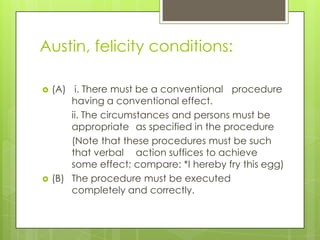
Austin, felicity conditions:

   (A) i. There must be a conventional procedure
        having a conventional effect.
        ii. The circumstances and persons must be
        appropriate as specified in the procedure
        (Note that these procedures must be such
        that verbal action suffices to achieve
        some effect; compare: *I hereby fry this egg)
   (B) The procedure must be executed
        completely and correctly.
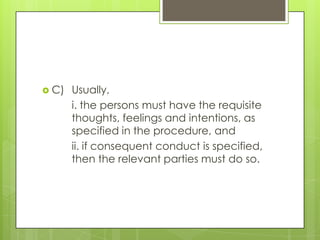
 C)   Usually,
       i. the persons must have the requisite
       thoughts, feelings and intentions, as
       specified in the procedure, and
       ii. if consequent conduct is specified,
       then the relevant parties must do so.
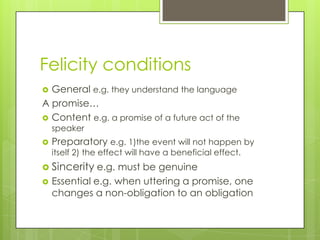
Felicity conditions
 General e.g. they understand the language
A promise…
 Content e.g. a promise of a future act of the
    speaker
   Preparatory e.g. 1)the event will not happen by
    itself 2) the effect will have a beneficial effect.
 Sincerity    e.g. must be genuine
   Essential e.g. when uttering a promise, one
    changes a non-obligation to an obligation
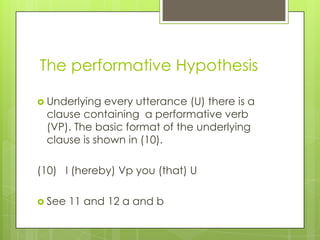
The performative Hypothesis

 Underlying every utterance (U) there is a
 clause containing a performative verb
 (VP). The basic format of the underlying
 clause is shown in (10).

(10) I (hereby) Vp you (that) U

 See   11 and 12 a and b
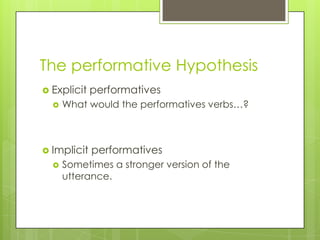
The performative Hypothesis
 Explicit   performatives
     What would the performatives verbs…?


 Implicit   performatives
     Sometimes a stronger version of the
      utterance.
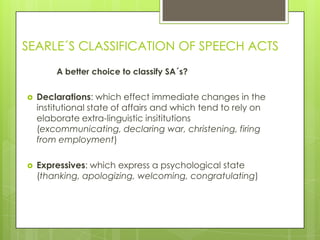
SEARLE´S CLASSIFICATION OF SPEECH ACTS
        A better choice to classify SA´s?


   Declarations: which effect immediate changes in the
    institutional state of affairs and which tend to rely on
    elaborate extra-linguistic insititutions
    (excommunicating, declaring war, christening, firing
    from employment)

   Expressives: which express a psychological state
    (thanking, apologizing, welcoming, congratulating)
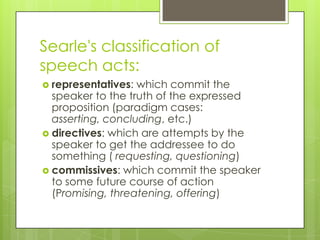
Searle's classification of
speech acts:
 representatives: which commit the
  speaker to the truth of the expressed
  proposition (paradigm cases:
  asserting, concluding, etc.)
 directives: which are attempts by the
  speaker to get the addressee to do
  something ( requesting, questioning)
 commissives: which commit the speaker
  to some future course of action
  (Promising, threatening, offering)
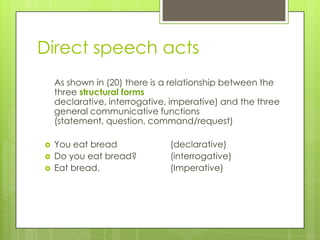
Direct speech acts
    As shown in (20) there is a relationship between the
    three structural forms
    declarative, interrogative, imperative) and the three
    general communicative functions
    (statement, question, command/request)

  You eat bread             (declarative)
 Do you eat bread?          (interrogative)
 Eat bread.                 (Imperative)
You wear a seat belt. (declarative) you wear a seat belt?
(interrogative)
Wear a seat belt! (imperative)
Indirect Speech Acts
 Whenever   there is an indirect relationship
    between a structure and function.

(It´s Winter and the window is open…)


   It´s cold in here… (indirect)
   I hereby request that you close the window. (Indir.)
Direct or Indirect?
   Move out of the way!
   You make a better door than a window.
   Pindy!!
   You´re standing in front of the Tele..

       Questions or requests?
   Could you pass the salt?
   Would you open this?
Speech events
   It is an activity in which participants interact
    via language in some conventional way to
    arrive at so me outcome.

   See page 35…

   In this case “do you have a minute” will
    portray the “we mean more than what we
    say.”
Politeness and
Interaction
 politenessshould be understood as
 strategic conflict-avoidance can be
 found, for example, in the view that the
 basic social role of politeness is in its ability
 to function as a way of controlling
 potential aggression between
 interactional parties (Brown & Levinson
 1987:1)
 Politenessis connected with avoiding
 disruption and maintaining the social
 equilibrium and friendly relations (Leech
 1983:17, 82)
 politenessis involved in social
 indexing, that is, politeness is socially
 appropriate behavior and what is socially
 appropriate depends on the speaker’s
 social position in relation to the hearer.
Politeness and interaction

  BASIC CONCEPTS
  Much of what we say and communicate is
   determined by our social relationships. A
   linguistic interaction is necessarily a social
   interaction
External factors relating to social
distance/closeness are established prior to an
interaction:
  relative status of the participants as
   determined by factors like age and power
-
 Speakers who see themselves as lower
 status tend to mark social distance
 between themselves.

 Higher status speakers use address forms
 that include a tittle and a last name, but
 not the first name (Mrs. Jones, Mr.
 Adams, Dr. Miller)
   Internal factors (amount of imposition, degree of
    friendliness) are negotiated during an interaction

   can result in the initial social distance changing
    and being marked as less or more during the
    course of the interaction (e.g., moving to first
    name basis)

        - these factors are more relevant to p
        participants whose social relationships are
        actually in the process of being worked out
        within the interaction
 Both  types of factors (external/internal)
  have an influence on what we say and
  how we are interpreted
 interpretation includes also evaluations
  such as 'rude', 'considerate' or 'thoughtful'
  which represent an additional aspect of
  communication perceived in terms of
  politeness
 General   idea of politeness:

Fixed concept of social behavior/etiquette
within a culture, involves certain general
principles as being
tactful, generous, modest, sympathetic
towards others.
Narrower concept of politeness within an
interaction:

 face = the public self-image of a person
  (emotional and social sense of self one
  has and expects everyone else to
  recognize)
 politeness
          = the means employed to show
 awareness of another person's face,

 -showing awareness for a socially distant
 person's face , i.e, respect, deference
 -showing awareness for a socially close
  person's face, i.e, friendliness, solidarity
Example (student to teacher)
a. Excuse me, Mr. Buckingham, but can I
talk to you for a minute?
b. Hey, Bucky, got a minute
  Different kinds of politeness are
   associated and marked linguistically with
   the assumption of relative social
   distance/closeness
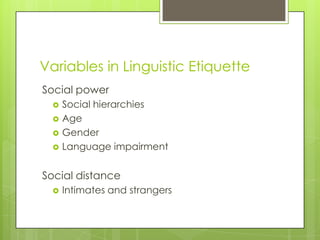
Variables in Linguistic Etiquette
Social power
     Social hierarchies
     Age
     Gender
     Language impairment


Social distance
     Intimates and strangers
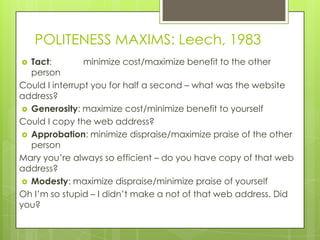
POLITENESS MAXIMS: Leech, 1983
  Tact:        minimize cost/maximize benefit to the other
   person
Could I interrupt you for half a second – what was the website
address?
  Generosity: maximize cost/minimize benefit to yourself
Could I copy the web address?
  Approbation: minimize dispraise/maximize praise of the other
   person
Mary you’re always so efficient – do you have copy of that web
address?
  Modesty: maximize dispraise/minimize praise of yourself
Oh I’m so stupid – I didn’t make a not of that web address. Did
you?
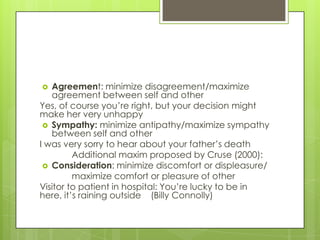
  Agreement: minimize disagreement/maximize
   agreement between self and other
Yes, of course you’re right, but your decision might
make her very unhappy
  Sympathy: minimize antipathy/maximize sympathy
   between self and other
I was very sorry to hear about your father’s death
         Additional maxim proposed by Cruse (2000):
  Consideration: minimize discomfort or displeasure/
         maximize comfort or pleasure of other
Visitor to patient in hospital: You’re lucky to be in
here, it’s raining outside (Billy Connolly)
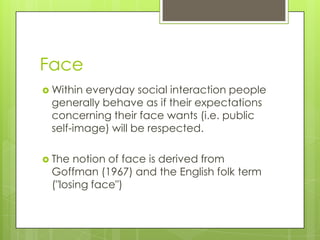
Face
 Withineveryday social interaction people
 generally behave as if their expectations
 concerning their face wants (i.e. public
 self-image) will be respected.

 The notion of face is derived from
 Goffman (1967) and the English folk term
 ("losing face")
 "the positive social value a person
 effectively claims for himself by the line
 others [from others]assume he has taken
 during a particular contact...an image of
 self delineated in terms of approved
 social attributes“ (Goffman 1955/67)
 [Face] is something that is emotionally
 invested, and that can be
 lost, maintained, or enhanced, and must
 be constantly attended to in interaction.
 In general, people cooperate (and
 assume each other's cooperation) in
 maintaining face in interaction, such
 cooperation being based on the mutual
 vulnerability of face. (Brown and Levinson
 1978:66
 Face is a sense of worth that comes from
 knowing one's status and reflects concern
 with the congruency between one's
 performance or appearance and one's
 real worth. (Huang 1987:71)
face threatening act:
 speaker says something that represents a
 threat to another individual's expectations
 regarding self-image
face saving act:
   speaker says something to lessen a possible threat

        Situation: Young neighbor is playing loud
        music late at night. Older couple cannot
        sleep.

   A: I'm going to tell him to stop that awful noise
    right now!
   B: Perhaps you could just ask him if he's going to
    stop soon because it's getting a bit late and
    people need to get to sleep.
 negativeface: need to be
 independent, to have freedom of
 action, not be imposed on by others

 positive
         face: need to be
 accepted/liked, to be treated as a
 member of the same group, to know that
 wants are shared by others.
Brown and Levinson (1978/87) in

   Negative face as the individual’s desire for
    freedom of action and freedom from
    imposition.

   positive face as the individual’s desire that
    her/his wants be appreciated in social
    interaction, and
Negative politeness

A face saving act oriented to a person's
 negative face tends to show
 deference, emphasizes the importance of
 the other's time or concerns and may
 include an apology for the imposition
Positive politeness

A face saving act concerned with the
 person's positive face will tend to show
 solidarity, emphasize that both speakers
 want the same thing and have a
 common goal
   You are about to land in the U.S. You want to
    fill your immigration form but realize that you
    do not have a pen. Fortunately, there is a
    person sitting next to you.
   First choice: say something or not
 rummage   in your bag, search through
  your pockets, go back to the bag
 other person offers a pen
 Many   people prefer to have their needs
 recognized by others without having to
 express them (less imposition) -- clearly a
 case of communicating more than what
 is said.
Off record
 statements
           not directly addressed to
 another person (i.e. hints)


 Uh,
    I forgot my pen.
 Where is the pen.
 Hmm, I wonder where I put my pen
On record
Directly address the other person to express
your needs
Using imperative forms is known as bald on
record (speaker assumes he/she has power
over the other)


 Give me a pan
 Lend me your pen
Mitigating devices
 (e.g.'please', 'would you') can be used to
 soften the demand
Caution: Not all imperatives are commands


 Havesome more cake
 Gimme that wet umbrella
 Inemergency situations, commands have
  no social/politeness component


 Don'ttouch that!
 Get out of here!
 Run!
 “Negativepoliteness is concerned with
 other people’s need not to be intruded or
 imposed upon

 “Positive
          politeness” is concerned with
 their need for inclusion and social
 approval.
A positive politeness strategy leads the
 requester to appeal to a common
 goal, even friendship


 How  about letting me use you pen?
 Hey, buddy, I'd appreciate it if
  you'd let me use your pen
A greater risk of refusal, therefore often
preceded by 'getting-to-know-you-talk' to
establish common ground …

 Hi,
    How's it going? Okay if I sit here? We
  must be interested in the same crazy stuff.
  You take a lot of notes too, huh? Say, do
  me a big favor and let me use one of your
  pens…
A negative politeness strategy is more
commonly performed in face saving
acts

   Could you lend me a pen?
   I'm sorry to bother you, but can I ask you for a
    pen?
   I know you're busy, might I ask you if - em - if
    you happen to have an extra pen
features:

- modal verbs
- apologies for the imposition
- Hesitations
- questions (even asking for permission to ask a
   question)
+ more indirect approach softens refusal
 Face  saving acts on record are less
 direct, longer, less clear, with a more
 complex structure, showing greater
 effort, concern for face (politeness)
Speech acts

  • 1.
    SPEECH ACTS AND EVENTS SPEECH ACTS (AUSTIN, 1962)
  • 2.
    Only if asentence can be verified as truthful or false it is meaningful…  Subjective statements like the one below would then be meaningless..  a. shouting and screaming at your children is wrong.  b. Elizabeth is more beautiful than Mary.  Getting married and having children is better than… (Huang, 2007)
  • 3.
    Sentences like:  Good morning!  Is she a vegan?  Put the car in the garage, please… are not statements, therefore cannot be either true or false…
  • 4.
    I bet you sixpence it will rain tomorrow.  I hereby christen this ship the H.M.S. Flounder.  I declare war on Zanzibar.  I apologize.  I dub thee Sir Walter  I object.  I sentence you to ten years of hard labour.  I bequeath you my Raffael  I give my word  I warn you that trespassers will be prosecuted.
  • 5.
     UTTERANCES USEDTO DO THINGS ARE CALLED ‘PERFORMATIVE”….  “CONSTATIVES” UTTERANCES USED TO STATE THINGS…
  • 7.
    h People do not only produce utterances containing grammatical structures and words, they perform actions via those utterances. (1) You`re fired.  The utterance can be used to perform the act of ending your employment. However, the actions performed by utterances do not have to be dramatic or unpleasant. (2a) You `re welcome. speech event.
  • 8.
     Actions performedvia utterances are called SPEECH ACTS … (apology, complaint, promise, or request)  The speaker and the hearer are helped in this process by the circumstances surrounding the utterance. These are called “Speech Events”.
  • 9.
     Inmany ways,the circumstances are the ones that determine the interpretation of the Speech Act…  e.g. “The tea is really cold.”
  • 10.
    Speech acts Theaction performed by producing an utterance will consist of three related acts:  LOCUTIONARY ACTS (basic act of utterance, or producing a meaningful linguistic expression)  e.g.  The coffee tastes great.
  • 11.
     ILLOCUTIONARYACT isperformed via the communicative force of an utterance  The previous example might be  to invite  To offer  or simply as statement of fact
  • 12.
     PERLOCUTIONARY ACTS (we create an utterance with a function intending it to have an effect)  e.g.  The hearer, on hearing the sentence above might react by accepting a cup of coffee if Interprets the perlocutionary act.
  • 13.
     The illocutionary force of an utterance is what really counts…  “I´ll be back.” (Terminator) warning promise prediction
  • 14.
     Examples: Give mean apple.  Locutionary act: the utterance itself.  Illocutionary act: Request, command.  Perlocutionary act (presumably): A passes B an apple.
  • 15.
    IFIDS  Or, Illocutionary Force Indicating Device  The most obvious for indicating the illocutionary force is an expression shown in (6). The verb shown can be called a performative verb (Vp). 6. I (Vp) you that…
  • 16.
     Speakers sometimes perform their speech act…  Him: Can I talk to Mary?  Her: No, She`s not here.  Him: I am asking you – can I talk to her?  Her: And I am telling you – SHE IS NOT HERE!
  • 17.
    OTHER IFIDS  STRESS INTONATION  WORD ORDER e.g.  You´re going (I tell you)  You´re going? (I request confirmation?  Are you going? (I ask you if…)
  • 18.
    FELICITY CONDITIONS  APPROPRIATE CIRCUMSTANCES FOR THE PERFORMANCE OF A SPEECH ACT TO BE RECOGNIZED AS SUCH. e.g. (9) I sentence you to six months in prison… In example 9, above, the performance will be infelicitous (inappropriate) if the speaker is not a specific person in a special context.
  • 19.
    Austin, felicity conditions:  (A) i. There must be a conventional procedure having a conventional effect. ii. The circumstances and persons must be appropriate as specified in the procedure (Note that these procedures must be such that verbal action suffices to achieve some effect; compare: *I hereby fry this egg)  (B) The procedure must be executed completely and correctly.
  • 20.
     C) Usually, i. the persons must have the requisite thoughts, feelings and intentions, as specified in the procedure, and ii. if consequent conduct is specified, then the relevant parties must do so.
  • 21.
    Felicity conditions  Generale.g. they understand the language A promise…  Content e.g. a promise of a future act of the speaker  Preparatory e.g. 1)the event will not happen by itself 2) the effect will have a beneficial effect.  Sincerity e.g. must be genuine  Essential e.g. when uttering a promise, one changes a non-obligation to an obligation
  • 22.
    The performative Hypothesis Underlying every utterance (U) there is a clause containing a performative verb (VP). The basic format of the underlying clause is shown in (10). (10) I (hereby) Vp you (that) U  See 11 and 12 a and b
  • 23.
    The performative Hypothesis Explicit performatives  What would the performatives verbs…?  Implicit performatives  Sometimes a stronger version of the utterance.
  • 24.
    SEARLE´S CLASSIFICATION OFSPEECH ACTS A better choice to classify SA´s?  Declarations: which effect immediate changes in the institutional state of affairs and which tend to rely on elaborate extra-linguistic insititutions (excommunicating, declaring war, christening, firing from employment)  Expressives: which express a psychological state (thanking, apologizing, welcoming, congratulating)
  • 25.
    Searle's classification of speechacts:  representatives: which commit the speaker to the truth of the expressed proposition (paradigm cases: asserting, concluding, etc.)  directives: which are attempts by the speaker to get the addressee to do something ( requesting, questioning)  commissives: which commit the speaker to some future course of action (Promising, threatening, offering)
  • 26.
    Direct speech acts As shown in (20) there is a relationship between the three structural forms declarative, interrogative, imperative) and the three general communicative functions (statement, question, command/request)  You eat bread (declarative)  Do you eat bread? (interrogative)  Eat bread. (Imperative) You wear a seat belt. (declarative) you wear a seat belt? (interrogative) Wear a seat belt! (imperative)
  • 27.
    Indirect Speech Acts Whenever there is an indirect relationship between a structure and function. (It´s Winter and the window is open…)  It´s cold in here… (indirect)  I hereby request that you close the window. (Indir.)
  • 28.
    Direct or Indirect?  Move out of the way!  You make a better door than a window.  Pindy!!  You´re standing in front of the Tele.. Questions or requests?  Could you pass the salt?  Would you open this?
  • 29.
    Speech events  It is an activity in which participants interact via language in some conventional way to arrive at so me outcome.  See page 35…  In this case “do you have a minute” will portray the “we mean more than what we say.”
  • 30.
  • 31.
     politenessshould beunderstood as strategic conflict-avoidance can be found, for example, in the view that the basic social role of politeness is in its ability to function as a way of controlling potential aggression between interactional parties (Brown & Levinson 1987:1)
  • 32.
     Politenessis connectedwith avoiding disruption and maintaining the social equilibrium and friendly relations (Leech 1983:17, 82)
  • 33.
     politenessis involvedin social indexing, that is, politeness is socially appropriate behavior and what is socially appropriate depends on the speaker’s social position in relation to the hearer.
  • 34.
    Politeness and interaction  BASIC CONCEPTS  Much of what we say and communicate is determined by our social relationships. A linguistic interaction is necessarily a social interaction External factors relating to social distance/closeness are established prior to an interaction:  relative status of the participants as determined by factors like age and power -
  • 35.
     Speakers whosee themselves as lower status tend to mark social distance between themselves.  Higher status speakers use address forms that include a tittle and a last name, but not the first name (Mrs. Jones, Mr. Adams, Dr. Miller)
  • 36.
    Internal factors (amount of imposition, degree of friendliness) are negotiated during an interaction  can result in the initial social distance changing and being marked as less or more during the course of the interaction (e.g., moving to first name basis) - these factors are more relevant to p participants whose social relationships are actually in the process of being worked out within the interaction
  • 37.
     Both types of factors (external/internal) have an influence on what we say and how we are interpreted  interpretation includes also evaluations such as 'rude', 'considerate' or 'thoughtful' which represent an additional aspect of communication perceived in terms of politeness
  • 38.
     General idea of politeness: Fixed concept of social behavior/etiquette within a culture, involves certain general principles as being tactful, generous, modest, sympathetic towards others.
  • 39.
    Narrower concept ofpoliteness within an interaction:  face = the public self-image of a person (emotional and social sense of self one has and expects everyone else to recognize)
  • 40.
     politeness = the means employed to show awareness of another person's face, -showing awareness for a socially distant person's face , i.e, respect, deference -showing awareness for a socially close person's face, i.e, friendliness, solidarity
  • 41.
    Example (student toteacher) a. Excuse me, Mr. Buckingham, but can I talk to you for a minute? b. Hey, Bucky, got a minute  Different kinds of politeness are associated and marked linguistically with the assumption of relative social distance/closeness
  • 42.
    Variables in LinguisticEtiquette Social power  Social hierarchies  Age  Gender  Language impairment Social distance  Intimates and strangers
  • 43.
    POLITENESS MAXIMS: Leech,1983  Tact: minimize cost/maximize benefit to the other person Could I interrupt you for half a second – what was the website address?  Generosity: maximize cost/minimize benefit to yourself Could I copy the web address?  Approbation: minimize dispraise/maximize praise of the other person Mary you’re always so efficient – do you have copy of that web address?  Modesty: maximize dispraise/minimize praise of yourself Oh I’m so stupid – I didn’t make a not of that web address. Did you?
  • 44.
     Agreement:minimize disagreement/maximize agreement between self and other Yes, of course you’re right, but your decision might make her very unhappy  Sympathy: minimize antipathy/maximize sympathy between self and other I was very sorry to hear about your father’s death Additional maxim proposed by Cruse (2000):  Consideration: minimize discomfort or displeasure/ maximize comfort or pleasure of other Visitor to patient in hospital: You’re lucky to be in here, it’s raining outside (Billy Connolly)
  • 45.
    Face  Withineveryday socialinteraction people generally behave as if their expectations concerning their face wants (i.e. public self-image) will be respected.  The notion of face is derived from Goffman (1967) and the English folk term ("losing face")
  • 46.
     "the positivesocial value a person effectively claims for himself by the line others [from others]assume he has taken during a particular contact...an image of self delineated in terms of approved social attributes“ (Goffman 1955/67)
  • 47.
     [Face] issomething that is emotionally invested, and that can be lost, maintained, or enhanced, and must be constantly attended to in interaction. In general, people cooperate (and assume each other's cooperation) in maintaining face in interaction, such cooperation being based on the mutual vulnerability of face. (Brown and Levinson 1978:66
  • 48.
     Face isa sense of worth that comes from knowing one's status and reflects concern with the congruency between one's performance or appearance and one's real worth. (Huang 1987:71)
  • 49.
    face threatening act: speaker says something that represents a threat to another individual's expectations regarding self-image
  • 50.
    face saving act:  speaker says something to lessen a possible threat Situation: Young neighbor is playing loud music late at night. Older couple cannot sleep.  A: I'm going to tell him to stop that awful noise right now!  B: Perhaps you could just ask him if he's going to stop soon because it's getting a bit late and people need to get to sleep.
  • 51.
     negativeface: needto be independent, to have freedom of action, not be imposed on by others  positive face: need to be accepted/liked, to be treated as a member of the same group, to know that wants are shared by others.
  • 52.
    Brown and Levinson(1978/87) in  Negative face as the individual’s desire for freedom of action and freedom from imposition.  positive face as the individual’s desire that her/his wants be appreciated in social interaction, and
  • 53.
    Negative politeness A facesaving act oriented to a person's negative face tends to show deference, emphasizes the importance of the other's time or concerns and may include an apology for the imposition
  • 54.
    Positive politeness A facesaving act concerned with the person's positive face will tend to show solidarity, emphasize that both speakers want the same thing and have a common goal
  • 55.
    You are about to land in the U.S. You want to fill your immigration form but realize that you do not have a pen. Fortunately, there is a person sitting next to you.  First choice: say something or not  rummage in your bag, search through your pockets, go back to the bag  other person offers a pen
  • 56.
     Many people prefer to have their needs recognized by others without having to express them (less imposition) -- clearly a case of communicating more than what is said.
  • 57.
    Off record  statements not directly addressed to another person (i.e. hints)  Uh, I forgot my pen.  Where is the pen.  Hmm, I wonder where I put my pen
  • 58.
    On record Directly addressthe other person to express your needs Using imperative forms is known as bald on record (speaker assumes he/she has power over the other)  Give me a pan  Lend me your pen
  • 59.
    Mitigating devices  (e.g.'please','would you') can be used to soften the demand Caution: Not all imperatives are commands  Havesome more cake  Gimme that wet umbrella
  • 60.
     Inemergency situations,commands have no social/politeness component  Don'ttouch that!  Get out of here!  Run!
  • 61.
     “Negativepoliteness isconcerned with other people’s need not to be intruded or imposed upon  “Positive politeness” is concerned with their need for inclusion and social approval.
  • 62.
    A positive politenessstrategy leads the requester to appeal to a common goal, even friendship  How about letting me use you pen?  Hey, buddy, I'd appreciate it if you'd let me use your pen
  • 63.
    A greater riskof refusal, therefore often preceded by 'getting-to-know-you-talk' to establish common ground …  Hi, How's it going? Okay if I sit here? We must be interested in the same crazy stuff. You take a lot of notes too, huh? Say, do me a big favor and let me use one of your pens…
  • 64.
    A negative politenessstrategy is more commonly performed in face saving acts  Could you lend me a pen?  I'm sorry to bother you, but can I ask you for a pen?  I know you're busy, might I ask you if - em - if you happen to have an extra pen
  • 65.
    features: - modal verbs -apologies for the imposition - Hesitations - questions (even asking for permission to ask a question) + more indirect approach softens refusal
  • 66.
     Face saving acts on record are less direct, longer, less clear, with a more complex structure, showing greater effort, concern for face (politeness)