This concept was proposed by John Langshaw
Austin in 1962 one of the founders of pragmatic
and later developed by John R. Searle in 1969,
both philosophers of language, they believe that
langauge is not only used to inform or to
describe things, it is often used “to do things”, to
perform acts. In other words actions performed
via utterances are generally called speech acts.
He further distinguished three acts in one
single speech act or event we perform.
1. illocutionary Act
2. Locutionary Act
3. Perlocutionary Act
iIlocutionary acts are the real actions
which are performed by the
utterance. We form an utterance with
some kind of function in mind. This
communicative force of an utterance
is known as illocutionary force.
(Intention/desire of the speaker)
Locutionary act is the basic act of
utterance, or producing a meaningful
linguistic expressions.
We can say performing an act of
saying something or physical
utterances of words.
Perlocutionary act is the effect
produced on the listner when they
listen a locutionary act or this is the
hears response.
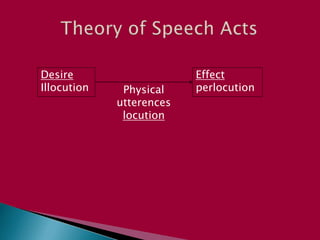
Desire
Illocution
Effect
perlocutionPhysical
utterences
locution
This theory was further classified by
John Searle. He states that the
taxonomy used by Austin is
defective, especially in its lack of
clear criteria for distinguishing one
kind of illocutionary force from
another.
Searle divides illocutionary acts into
five basic types.
1. Directive
2. Commissive
3. Representative/Assertive
4. Declarative
5. Expressive
It is conversation between 1st and 2nd
person here the speaker tries to
make the hearer do something, with
such words as: ask, order, command,
request, beg, plead, pray, entreat,
invite, permit, advise, demand etc.
Ex: Give me your pen.
Leave the town immediately.
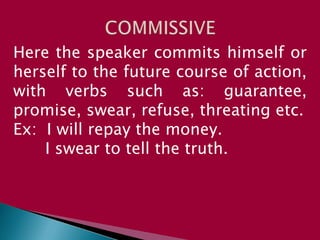
Here the speaker commits himself or
herself to the future course of action,
with verbs such as: guarantee,
promise, swear, refuse, threating etc.
Ex: I will repay the money.
I swear to tell the truth.
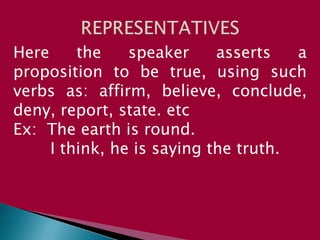
Here the speaker asserts a
proposition to be true, using such
verbs as: affirm, believe, conclude,
deny, report, state. etc
Ex: The earth is round.
I think, he is saying the truth.
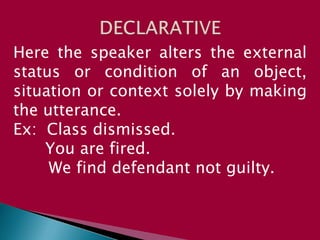
Here the speaker alters the external
status or condition of an object,
situation or context solely by making
the utterance.
Ex: Class dismissed.
You are fired.
We find defendant not guilty.
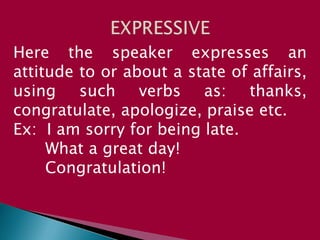
Here the speaker expresses an
attitude to or about a state of affairs,
using such verbs as: thanks,
congratulate, apologize, praise etc.
Ex: I am sorry for being late.
What a great day!
Congratulation!
SPEECH ACT THEORY
SPEECH ACT THEORY

SPEECH ACT THEORY

  • 3.
    This concept wasproposed by John Langshaw Austin in 1962 one of the founders of pragmatic and later developed by John R. Searle in 1969, both philosophers of language, they believe that langauge is not only used to inform or to describe things, it is often used “to do things”, to perform acts. In other words actions performed via utterances are generally called speech acts.
  • 4.
    He further distinguishedthree acts in one single speech act or event we perform. 1. illocutionary Act 2. Locutionary Act 3. Perlocutionary Act
  • 5.
    iIlocutionary acts arethe real actions which are performed by the utterance. We form an utterance with some kind of function in mind. This communicative force of an utterance is known as illocutionary force. (Intention/desire of the speaker)
  • 6.
    Locutionary act isthe basic act of utterance, or producing a meaningful linguistic expressions. We can say performing an act of saying something or physical utterances of words.
  • 7.
    Perlocutionary act isthe effect produced on the listner when they listen a locutionary act or this is the hears response.
  • 8.
  • 9.
    This theory wasfurther classified by John Searle. He states that the taxonomy used by Austin is defective, especially in its lack of clear criteria for distinguishing one kind of illocutionary force from another.
  • 10.
    Searle divides illocutionaryacts into five basic types. 1. Directive 2. Commissive 3. Representative/Assertive 4. Declarative 5. Expressive
  • 11.
    It is conversationbetween 1st and 2nd person here the speaker tries to make the hearer do something, with such words as: ask, order, command, request, beg, plead, pray, entreat, invite, permit, advise, demand etc. Ex: Give me your pen. Leave the town immediately.
  • 12.
    Here the speakercommits himself or herself to the future course of action, with verbs such as: guarantee, promise, swear, refuse, threating etc. Ex: I will repay the money. I swear to tell the truth.
  • 13.
    Here the speakerasserts a proposition to be true, using such verbs as: affirm, believe, conclude, deny, report, state. etc Ex: The earth is round. I think, he is saying the truth.
  • 14.
    Here the speakeralters the external status or condition of an object, situation or context solely by making the utterance. Ex: Class dismissed. You are fired. We find defendant not guilty.
  • 15.
    Here the speakerexpresses an attitude to or about a state of affairs, using such verbs as: thanks, congratulate, apologize, praise etc. Ex: I am sorry for being late. What a great day! Congratulation!