Act. # 13-14 
Activity Title: Direct and 
Indirect/Reported 
Speeches
Type of Activity: Noting Concepts, 
Answering Exercises, 
Act. # 13-14 
Activity Title: Direct and 
Indirect/Reported Speeches 
Values/Attitude: Education: Academically- 
Excellent – Proficient in Communications 
I. Learning Targets: At the end of the 
activity, the students must be able to: 
1.Differentiate between direct and indirect 
or reported forms of speeches.
http://www.youtube.com/watch?v=PbhNSdkmpyE 
II. Learning Experiences: 
A. Concept Notes 
Direct speech – is the exact words of the speaker 
enclosed in quotation marks. 
Indirect / Reported Speech – is a restatement of 
what the speaker has said. 
Example: 
• Direct: Clinton said, “I am very busy now.” 
• Indirect: Clinton said that he was very busy then. 
• Direct : He said, “ my mother is writing letter.” 
• Indirect: He said that his mother was writing letter.
• How to change Direct to Indirect Speech? 
It will be noticed that in Direct Speech, we use 
inverted commas to mark off the exact words of the 
speaker. In Indirect Speech we do not use the 
inverted commas. 
Thus: 
i. We have used the conjunction ‘that’ before the 
Indirect Statement. 
ii. The pronoun “I” is changed to “HE”. (The Pronoun 
is changed in Person) 
iii. The verb “am” is changed to “was”. 
iv. The adverb “now” is changed to “then”. 
v. The shall of the future is changed into should. 
The will of the future is changed into would. 
The can and may of the future are changed 
into could and might respectively.
DO NOT COPY THE NEXT 
SLIDES: 
PRINT THIS 
POWERPOINT AND PUT 
IT IN YOUR PORTFOLIO
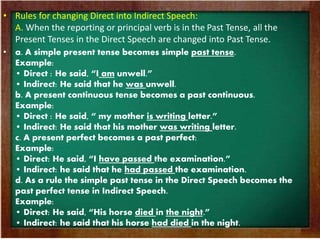
• Rules for changing Direct into Indirect Speech: 
A. When the reporting or principal verb is in the Past Tense, all the 
Present Tenses in the Direct Speech are changed into Past Tense. 
• a. A simple present tense becomes simple past tense. 
Example: 
• Direct : He said, “I am unwell.” 
• Indirect: He said that he was unwell. 
b. A present continuous tense becomes a past continuous. 
Example: 
• Direct : He said, “ my mother is writing letter.” 
• Indirect: He said that his mother was writing letter. 
c. A present perfect becomes a past perfect: 
Example: 
• Direct: He said, “I have passed the examination.” 
• Indirect: he said that he had passed the examination. 
d. As a rule the simple past tense in the Direct Speech becomes the 
past perfect tense in Indirect Speech. 
Example: 
• Direct: He said, “His horse died in the night.” 
• Indirect: he said that his horse had died in the night.
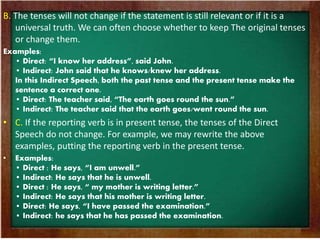
B. The tenses will not change if the statement is still relevant or if it is a 
universal truth. We can often choose whether to keep The original tenses 
or change them. 
Examples: 
• Direct: “I know her address”, said John. 
• Indirect: John said that he knows/knew her address. 
In this Indirect Speech, both the past tense and the present tense make the 
sentence a correct one. 
• Direct: The teacher said, “The earth goes round the sun.” 
• Indirect: The teacher said that the earth goes/went round the sun. 
• C. If the reporting verb is in present tense, the tenses of the Direct 
Speech do not change. For example, we may rewrite the above 
examples, putting the reporting verb in the present tense. 
• Examples: 
• Direct : He says, “I am unwell.” 
• Indirect: He says that he is unwell. 
• Direct : He says, “ my mother is writing letter.” 
• Indirect: He says that his mother is writing letter. 
• Direct: He says, “I have passed the examination.” 
• Indirect: he says that he has passed the examination.
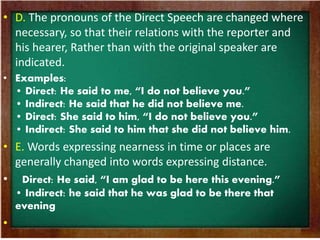
• D. The pronouns of the Direct Speech are changed where 
necessary, so that their relations with the reporter and 
his hearer, Rather than with the original speaker are 
indicated. 
• Examples: 
• Direct: He said to me, “I do not believe you.” 
• Indirect: He said that he did not believe me. 
• Direct: She said to him, “I do not believe you.” 
• Indirect: She said to him that she did not believe him. 
• E. Words expressing nearness in time or places are 
generally changed into words expressing distance. 
• Direct: He said, “I am glad to be here this evening.” 
• Indirect: he said that he was glad to be there that 
evening 
•
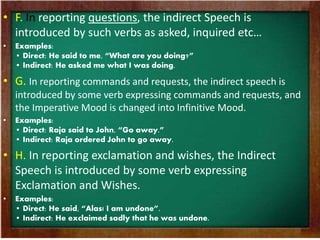
• F. In reporting questions, the indirect Speech is 
introduced by such verbs as asked, inquired etc… 
• Examples: 
• Direct: He said to me, “What are you doing?” 
• Indirect: He asked me what I was doing. 
• G. In reporting commands and requests, the indirect speech is 
introduced by some verb expressing commands and requests, and 
the Imperative Mood is changed into Infinitive Mood. 
• Examples: 
• Direct: Raja said to John, “Go away.” 
• Indirect: Raja ordered John to go away. 
• H. In reporting exclamation and wishes, the Indirect 
Speech is introduced by some verb expressing 
Exclamation and Wishes. 
• Examples: 
• Direct: He said, “Alas! I am undone”. 
• Indirect: He exclaimed sadly that he was undone.
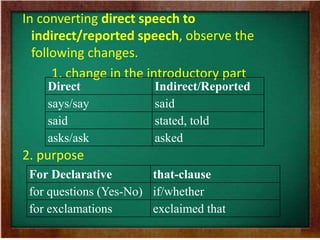
In converting direct speech to 
indirect/reported speech, observe the 
following changes. 
1. change in the introductory part 
Direct Indirect/Reported 
says/say said 
said stated, told 
asks/ask asked 
2. purpose 
For Declarative that-clause 
for questions (Yes-No) if/whether 
for exclamations exclaimed that
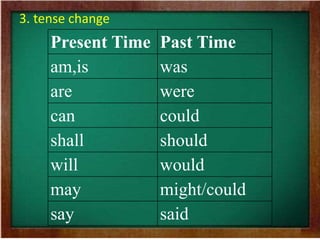
3. tense change 
Present Time Past Time 
am,is was 
are were 
can could 
shall should 
will would 
may might/could 
say said
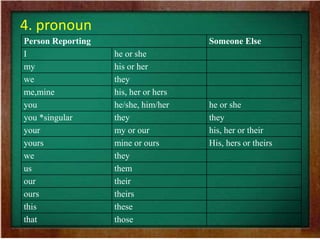
4. pronoun 
Person Reporting Someone Else 
I he or she 
my his or her 
we they 
me,mine his, her or hers 
you he/she, him/her he or she 
you *singular they they 
your my or our his, her or their 
yours mine or ours His, hers or theirs 
we they 
us them 
our their 
ours theirs 
this these 
that those
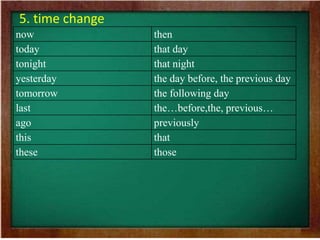
5. time change 
now then 
today that day 
tonight that night 
yesterday the day before, the previous day 
tomorrow the following day 
last the…before,the, previous… 
ago previously 
this that 
these those
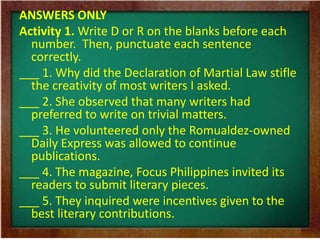
ANSWERS ONLY 
Activity 1. Write D or R on the blanks before each 
number. Then, punctuate each sentence 
correctly. 
___ 1. Why did the Declaration of Martial Law stifle 
the creativity of most writers I asked. 
___ 2. She observed that many writers had 
preferred to write on trivial matters. 
___ 3. He volunteered only the Romualdez-owned 
Daily Express was allowed to continue 
publications. 
___ 4. The magazine, Focus Philippines invited its 
readers to submit literary pieces. 
___ 5. They inquired were incentives given to the 
best literary contributions.
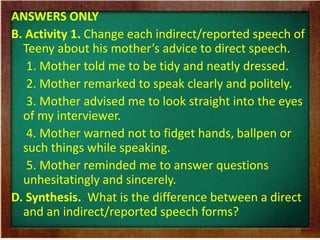
ANSWERS ONLY 
B. Activity 1. Change each indirect/reported speech of 
Teeny about his mother’s advice to direct speech. 
1. Mother told me to be tidy and neatly dressed. 
2. Mother remarked to speak clearly and politely. 
3. Mother advised me to look straight into the eyes 
of my interviewer. 
4. Mother warned not to fidget hands, ballpen or 
such things while speaking. 
5. Mother reminded me to answer questions 
unhesitatingly and sincerely. 
D. Synthesis. What is the difference between a direct 
and an indirect/reported speech forms?
Print and Study 
this in your 
GENYO account 
Quiz on Thursday

Direct and indirect speech

  • 1.
    Act. # 13-14 Activity Title: Direct and Indirect/Reported Speeches
  • 2.
    Type of Activity:Noting Concepts, Answering Exercises, Act. # 13-14 Activity Title: Direct and Indirect/Reported Speeches Values/Attitude: Education: Academically- Excellent – Proficient in Communications I. Learning Targets: At the end of the activity, the students must be able to: 1.Differentiate between direct and indirect or reported forms of speeches.
  • 3.
    http://www.youtube.com/watch?v=PbhNSdkmpyE II. LearningExperiences: A. Concept Notes Direct speech – is the exact words of the speaker enclosed in quotation marks. Indirect / Reported Speech – is a restatement of what the speaker has said. Example: • Direct: Clinton said, “I am very busy now.” • Indirect: Clinton said that he was very busy then. • Direct : He said, “ my mother is writing letter.” • Indirect: He said that his mother was writing letter.
  • 4.
    • How tochange Direct to Indirect Speech? It will be noticed that in Direct Speech, we use inverted commas to mark off the exact words of the speaker. In Indirect Speech we do not use the inverted commas. Thus: i. We have used the conjunction ‘that’ before the Indirect Statement. ii. The pronoun “I” is changed to “HE”. (The Pronoun is changed in Person) iii. The verb “am” is changed to “was”. iv. The adverb “now” is changed to “then”. v. The shall of the future is changed into should. The will of the future is changed into would. The can and may of the future are changed into could and might respectively.
  • 5.
    DO NOT COPYTHE NEXT SLIDES: PRINT THIS POWERPOINT AND PUT IT IN YOUR PORTFOLIO
  • 6.
    • Rules forchanging Direct into Indirect Speech: A. When the reporting or principal verb is in the Past Tense, all the Present Tenses in the Direct Speech are changed into Past Tense. • a. A simple present tense becomes simple past tense. Example: • Direct : He said, “I am unwell.” • Indirect: He said that he was unwell. b. A present continuous tense becomes a past continuous. Example: • Direct : He said, “ my mother is writing letter.” • Indirect: He said that his mother was writing letter. c. A present perfect becomes a past perfect: Example: • Direct: He said, “I have passed the examination.” • Indirect: he said that he had passed the examination. d. As a rule the simple past tense in the Direct Speech becomes the past perfect tense in Indirect Speech. Example: • Direct: He said, “His horse died in the night.” • Indirect: he said that his horse had died in the night.
  • 7.
    B. The tenseswill not change if the statement is still relevant or if it is a universal truth. We can often choose whether to keep The original tenses or change them. Examples: • Direct: “I know her address”, said John. • Indirect: John said that he knows/knew her address. In this Indirect Speech, both the past tense and the present tense make the sentence a correct one. • Direct: The teacher said, “The earth goes round the sun.” • Indirect: The teacher said that the earth goes/went round the sun. • C. If the reporting verb is in present tense, the tenses of the Direct Speech do not change. For example, we may rewrite the above examples, putting the reporting verb in the present tense. • Examples: • Direct : He says, “I am unwell.” • Indirect: He says that he is unwell. • Direct : He says, “ my mother is writing letter.” • Indirect: He says that his mother is writing letter. • Direct: He says, “I have passed the examination.” • Indirect: he says that he has passed the examination.
  • 8.
    • D. Thepronouns of the Direct Speech are changed where necessary, so that their relations with the reporter and his hearer, Rather than with the original speaker are indicated. • Examples: • Direct: He said to me, “I do not believe you.” • Indirect: He said that he did not believe me. • Direct: She said to him, “I do not believe you.” • Indirect: She said to him that she did not believe him. • E. Words expressing nearness in time or places are generally changed into words expressing distance. • Direct: He said, “I am glad to be here this evening.” • Indirect: he said that he was glad to be there that evening •
  • 9.
    • F. Inreporting questions, the indirect Speech is introduced by such verbs as asked, inquired etc… • Examples: • Direct: He said to me, “What are you doing?” • Indirect: He asked me what I was doing. • G. In reporting commands and requests, the indirect speech is introduced by some verb expressing commands and requests, and the Imperative Mood is changed into Infinitive Mood. • Examples: • Direct: Raja said to John, “Go away.” • Indirect: Raja ordered John to go away. • H. In reporting exclamation and wishes, the Indirect Speech is introduced by some verb expressing Exclamation and Wishes. • Examples: • Direct: He said, “Alas! I am undone”. • Indirect: He exclaimed sadly that he was undone.
  • 10.
    In converting directspeech to indirect/reported speech, observe the following changes. 1. change in the introductory part Direct Indirect/Reported says/say said said stated, told asks/ask asked 2. purpose For Declarative that-clause for questions (Yes-No) if/whether for exclamations exclaimed that
  • 11.
    3. tense change Present Time Past Time am,is was are were can could shall should will would may might/could say said
  • 12.
    4. pronoun PersonReporting Someone Else I he or she my his or her we they me,mine his, her or hers you he/she, him/her he or she you *singular they they your my or our his, her or their yours mine or ours His, hers or theirs we they us them our their ours theirs this these that those
  • 13.
    5. time change now then today that day tonight that night yesterday the day before, the previous day tomorrow the following day last the…before,the, previous… ago previously this that these those
  • 14.
    ANSWERS ONLY Activity1. Write D or R on the blanks before each number. Then, punctuate each sentence correctly. ___ 1. Why did the Declaration of Martial Law stifle the creativity of most writers I asked. ___ 2. She observed that many writers had preferred to write on trivial matters. ___ 3. He volunteered only the Romualdez-owned Daily Express was allowed to continue publications. ___ 4. The magazine, Focus Philippines invited its readers to submit literary pieces. ___ 5. They inquired were incentives given to the best literary contributions.
  • 15.
    ANSWERS ONLY B.Activity 1. Change each indirect/reported speech of Teeny about his mother’s advice to direct speech. 1. Mother told me to be tidy and neatly dressed. 2. Mother remarked to speak clearly and politely. 3. Mother advised me to look straight into the eyes of my interviewer. 4. Mother warned not to fidget hands, ballpen or such things while speaking. 5. Mother reminded me to answer questions unhesitatingly and sincerely. D. Synthesis. What is the difference between a direct and an indirect/reported speech forms?
  • 16.
    Print and Study this in your GENYO account Quiz on Thursday