Direct and Indirect
Speech
Mrunalini.K
Dept of S &H
MECS,Hyderabad
Outline:
1. Introduction
2. Rules to convert direct to indirect speech
3. Tense changes
4. Time and place changes
5. Pronouns
6. Reporting Verbs
7. Indirect Questions
8. Commands, Requests, Advice in Indirect Speech
9. Offers and Suggestions in Indirect Speech
10. Exclamations in Indirect Speech
11. Indirect Speech: MIXED TYPES
Introduction
English language has two ways to report the spoken
words of words of a person. These two ways are :-
□ Direct Speech
□ Indirect Speech
Direct speech
Direct speech is a sentence in which the exact words
spoken are reproduced in speech marks (also known
as quotation marks or inverted commas).
For example:
"You'll never guess what I've just seen!" said Sam,
excitedly.
"What's that?" asked Louise.
Indirect speech
Indirect speech is when the general points of what
someone has said are reported, without actually
writing the speech out in full. It is sometimes called
reported speech.
For example:
Sam was excited to see a broomstick and a black
pointy hat in the back of his teacher's car. He told his
friend Louise about this and that he thought their
teacher might be a witch. Louise had to point out that
the things in their teacher's car were for the school
play.
Rules
In all sentences, the quotation marks and the comma
immediately before the first quotation mark are
removed. Next, the word "that" is usually inserted after
the reporting verb. Then, there are certain changes to be
considered.
Tense Changes
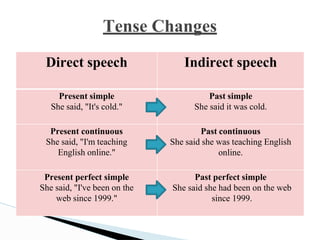
Direct speech Indirect speech
Present simple
She said, "It's cold."
Past simple
She said it was cold.
Present continuous
She said, "I'm teaching
English online."
Past continuous
She said she was teaching English
online.
Present perfect simple
She said, "I've been on the
web since 1999."
Past perfect simple
She said she had been on the web
since 1999.
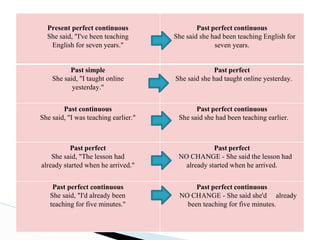
Present perfect continuous
She said, "I've been teaching
English for seven years."
Past perfect continuous
She said she had been teaching English for
seven years.
Past simple
She said, "I taught online
yesterday."
Past perfect
She said she had taught online yesterday.
Past continuous
She said, "I was teaching earlier."
Past perfect continuous
She said she had been teaching earlier.
Past perfect
She said, "The lesson had
already started when he arrived."
Past perfect
NO CHANGE - She said the lesson had
already started when he arrived.
Past perfect continuous
She said, "I'd already been
teaching for five minutes."
Past perfect continuous
NO CHANGE - She said she'd already
been teaching for five minutes.
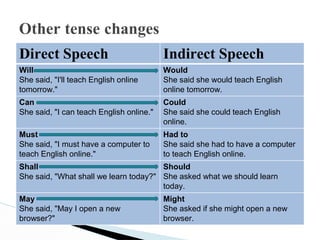
Other tense changes
Direct Speech Indirect Speech
Will
She said, "I'll teach English online
tomorrow."
Would
She said she would teach English
online tomorrow.
Can
She said, "I can teach English online."
Could
She said she could teach English
online.
Must
She said, "I must have a computer to
teach English online."
Had to
She said she had to have a computer
to teach English online.
Shall
She said, "What shall we learn today?"
Should
She asked what we should learn
today.
May
She said, "May I open a new
browser?"
Might
She asked if she might open a new
browser.
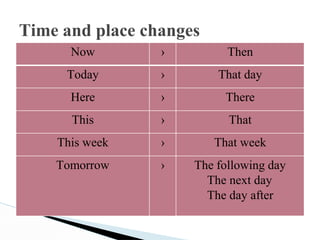
Time and place changes
Now › Then
Today › That day
Here › There
This › That
This week › That week
Tomorrow › The following day
The next day
The day after
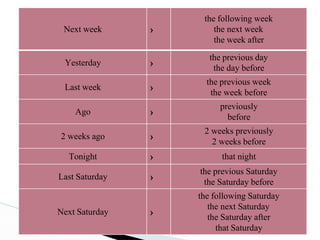
Next week ›
the following week
the next week
the week after
Yesterday ›
the previous day
the day before
Last week ›
the previous week
the week before
Ago ›
previously
before
2 weeks ago ›
2 weeks previously
2 weeks before
Tonight › that night
Last Saturday ›
the previous Saturday
the Saturday before
Next Saturday ›
the following Saturday
the next Saturday
the Saturday after
that Saturday
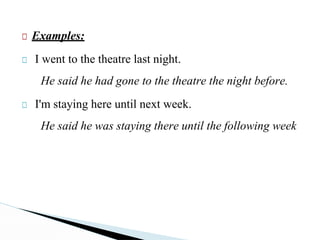
□ Examples:
□ I went to the theatre last night.
He said he had gone to the theatre the night before.
□ I'm staying here until next week.
He said he was staying there until the following week
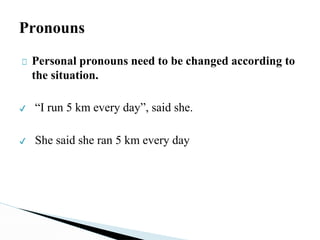
Pronouns
□ Personal pronouns need to be changed according to
the situation.
✔ “I run 5 km every day”, said she.
✔ She said she ran 5 km every day
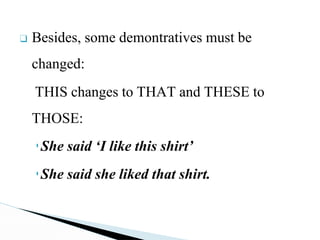
❑ Besides, some demontratives must be
changed:
THIS changes to THAT and THESE to
THOSE:
▪She said ‘I like this shirt’
▪She said she liked that shirt.
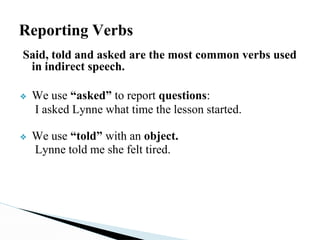
Reporting Verbs
Said, told and asked are the most common verbs used
in indirect speech.
❖ We use “asked” to report questions:
I asked Lynne what time the lesson started.
❖ We use “told” with an object.
Lynne told me she felt tired.
❖ We usually use “said” without an object.
Lynne said she was going to teach online.
If “said” is used with an object we must include “to”
Lynne said to me that she'd never been to China.
There are many other verbs we can use apart
from said, told and asked. These include:
□ accused, admitted, advised, alleged, agreed,
apologised, begged, boasted, complained, denied,
explained, implied, invited, offered, ordered,
promised, replied, suggested and thought.
Indirect Questions
□ Direct question: He said, “Where is she going?”
□ Indirect question: He asked where she was going.
A. Changes;
a. Tenses, pronouns and possessive adjectives, and
adverbs of time and place change as in statements.
b. The interrogative form of the verb changes to the
affirmative form.
c. The question mark is omitted in indirect questions.
B. Say must be changed to a verb of inquiry;
□ He said, “Where is the station?” He asked
where the station was.
C. Ask can be followed by the person addressed :
□ He asked, “What have you got in your bag?” He
asked (me) what I had got in my bag.
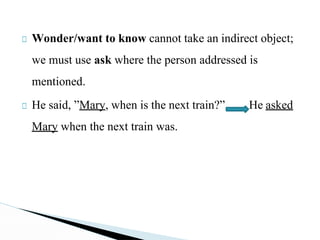
□ Wonder/want to know cannot take an indirect object;
we must use ask where the person addressed is
mentioned.
□ He said, ”Mary, when is the next train?” He asked
Mary when the next train was.
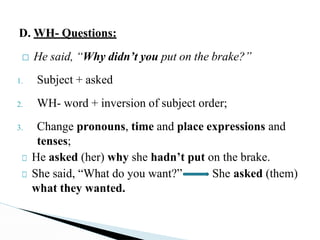
D. WH- Questions:
□ He said, “Why didn’t you put on the brake?”
1. Subject + asked
2. WH- word + inversion of subject order;
3. Change pronouns, time and place expressions and
tenses;
□ He asked (her) why she hadn’t put on the brake.
□ She said, “What do you want?” She asked (them)
what they wanted.
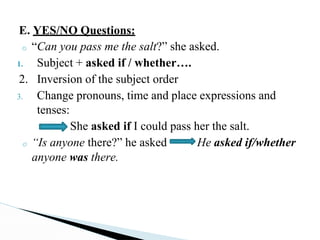
E. YES/NO Questions:
o “Can you pass me the salt?” she asked.
1. Subject + asked if / whether….
2. Inversion of the subject order
3. Change pronouns, time and place expressions and
tenses:
She asked if I could pass her the salt.
o “Is anyone there?” he asked He asked if/whether
anyone was there.
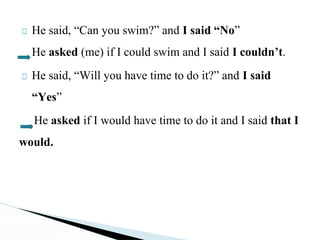
□ He said, “Can you swim?” and I said “No”
He asked (me) if I could swim and I said I couldn’t.
□ He said, “Will you have time to do it?” and I said
“Yes”
He asked if I would have time to do it and I said that I
would.
Commands, Requests, Advice and Order in
Indirect Speech
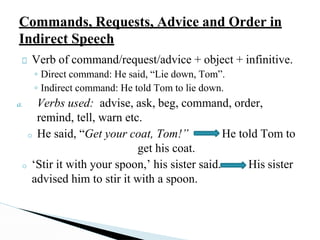
□ Verb of command/request/advice + object + infinitive.
◦ Direct command: He said, “Lie down, Tom”.
◦ Indirect command: He told Tom to lie down.
a. Verbs used: advise, ask, beg, command, order,
remind, tell, warn etc.
o He said, “Get your coat, Tom!” He told Tom to
get his coat.
o ‘Stir it with your spoon,’ his sister said. His sister
advised him to stir it with a spoon.
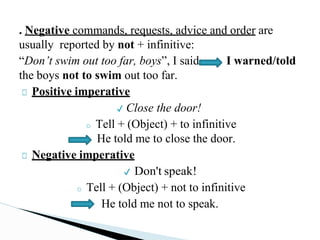
. Negative commands, requests, advice and order are
usually reported by not + infinitive:
“Don’t swim out too far, boys”, I said I warned/told
the boys not to swim out too far.
□ Positive imperative
✔ Close the door!
o Tell + (Object) + to infinitive
He told me to close the door.
□ Negative imperative
✔ Don't speak!
o Tell + (Object) + not to infinitive
He told me not to speak.
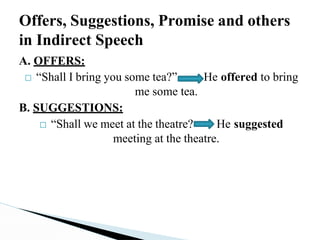
Offers, Suggestions, Promise and others
in Indirect Speech
A. OFFERS:
□ “Shall I bring you some tea?” He offered to bring
me some tea.
B. SUGGESTIONS:
□ “Shall we meet at the theatre? He suggested
meeting at the theatre.
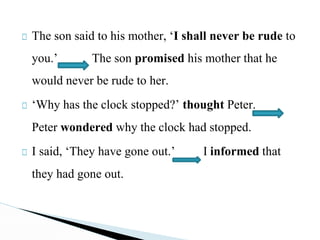
□ The son said to his mother, ‘I shall never be rude to
you.’ The son promised his mother that he
would never be rude to her.
□ ‘Why has the clock stopped?’ thought Peter.
Peter wondered why the clock had stopped.
□ I said, ‘They have gone out.’ I informed that
they had gone out.
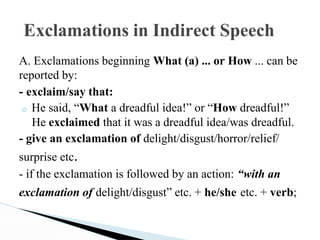
Exclamations in Indirect Speech
A. Exclamations beginning What (a) ... or How ... can be
reported by:
- exclaim/say that:
o He said, “What a dreadful idea!” or “How dreadful!”
He exclaimed that it was a dreadful idea/was dreadful.
- give an exclamation of delight/disgust/horror/relief/
surprise etc.
- if the exclamation is followed by an action: “with an
exclamation of delight/disgust” etc. + he/she etc. + verb;
With an exclamation of disgust she turned
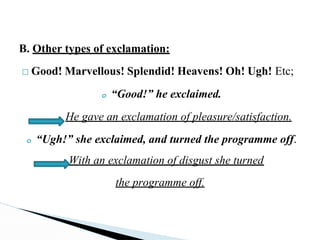
B. Other types of exclamation:
□ Good! Marvellous! Splendid! Heavens! Oh! Ugh! Etc;
o “Good!” he exclaimed.
He gave an exclamation of pleasure/satisfaction.
o “Ugh!” she exclaimed, and turned the programme off.
the programme off.
Exercise
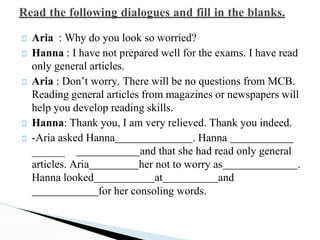
Read the following dialogues and fill in the blanks.
□ Aria : Why do you look so worried?
□ Hanna : I have not prepared well for the exams. I have read
only general articles.
□ Aria : Don’t worry. There will be no questions from MCB.
Reading general articles from magazines or newspapers will
help you develop reading skills.
□ Hanna: Thank you, I am very relieved. Thank you indeed.
□ -Aria asked Hanna . Hanna
and that she had read only general
articles. Aria her not to worry as .
Hanna looked at and
for her consoling words.
Thank you

Narration ppt

  • 1.
  • 2.
    Outline: 1. Introduction 2. Rulesto convert direct to indirect speech 3. Tense changes 4. Time and place changes 5. Pronouns 6. Reporting Verbs 7. Indirect Questions 8. Commands, Requests, Advice in Indirect Speech 9. Offers and Suggestions in Indirect Speech 10. Exclamations in Indirect Speech 11. Indirect Speech: MIXED TYPES
  • 3.
    Introduction English language hastwo ways to report the spoken words of words of a person. These two ways are :- □ Direct Speech □ Indirect Speech
  • 4.
    Direct speech Direct speechis a sentence in which the exact words spoken are reproduced in speech marks (also known as quotation marks or inverted commas). For example: "You'll never guess what I've just seen!" said Sam, excitedly. "What's that?" asked Louise.
  • 5.
    Indirect speech Indirect speechis when the general points of what someone has said are reported, without actually writing the speech out in full. It is sometimes called reported speech. For example: Sam was excited to see a broomstick and a black pointy hat in the back of his teacher's car. He told his friend Louise about this and that he thought their teacher might be a witch. Louise had to point out that the things in their teacher's car were for the school play.
  • 6.
    Rules In all sentences,the quotation marks and the comma immediately before the first quotation mark are removed. Next, the word "that" is usually inserted after the reporting verb. Then, there are certain changes to be considered.
  • 7.
    Tense Changes Direct speechIndirect speech Present simple She said, "It's cold." Past simple She said it was cold. Present continuous She said, "I'm teaching English online." Past continuous She said she was teaching English online. Present perfect simple She said, "I've been on the web since 1999." Past perfect simple She said she had been on the web since 1999.
  • 8.
    Present perfect continuous Shesaid, "I've been teaching English for seven years." Past perfect continuous She said she had been teaching English for seven years. Past simple She said, "I taught online yesterday." Past perfect She said she had taught online yesterday. Past continuous She said, "I was teaching earlier." Past perfect continuous She said she had been teaching earlier. Past perfect She said, "The lesson had already started when he arrived." Past perfect NO CHANGE - She said the lesson had already started when he arrived. Past perfect continuous She said, "I'd already been teaching for five minutes." Past perfect continuous NO CHANGE - She said she'd already been teaching for five minutes.
  • 9.
    Other tense changes DirectSpeech Indirect Speech Will She said, "I'll teach English online tomorrow." Would She said she would teach English online tomorrow. Can She said, "I can teach English online." Could She said she could teach English online. Must She said, "I must have a computer to teach English online." Had to She said she had to have a computer to teach English online. Shall She said, "What shall we learn today?" Should She asked what we should learn today. May She said, "May I open a new browser?" Might She asked if she might open a new browser.
  • 10.
    Time and placechanges Now › Then Today › That day Here › There This › That This week › That week Tomorrow › The following day The next day The day after
  • 11.
    Next week › thefollowing week the next week the week after Yesterday › the previous day the day before Last week › the previous week the week before Ago › previously before 2 weeks ago › 2 weeks previously 2 weeks before Tonight › that night Last Saturday › the previous Saturday the Saturday before Next Saturday › the following Saturday the next Saturday the Saturday after that Saturday
  • 12.
    □ Examples: □ Iwent to the theatre last night. He said he had gone to the theatre the night before. □ I'm staying here until next week. He said he was staying there until the following week
  • 13.
    Pronouns □ Personal pronounsneed to be changed according to the situation. ✔ “I run 5 km every day”, said she. ✔ She said she ran 5 km every day
  • 14.
    ❑ Besides, somedemontratives must be changed: THIS changes to THAT and THESE to THOSE: ▪She said ‘I like this shirt’ ▪She said she liked that shirt.
  • 15.
    Reporting Verbs Said, toldand asked are the most common verbs used in indirect speech. ❖ We use “asked” to report questions: I asked Lynne what time the lesson started. ❖ We use “told” with an object. Lynne told me she felt tired.
  • 16.
    ❖ We usuallyuse “said” without an object. Lynne said she was going to teach online. If “said” is used with an object we must include “to” Lynne said to me that she'd never been to China.
  • 17.
    There are manyother verbs we can use apart from said, told and asked. These include: □ accused, admitted, advised, alleged, agreed, apologised, begged, boasted, complained, denied, explained, implied, invited, offered, ordered, promised, replied, suggested and thought.
  • 18.
    Indirect Questions □ Directquestion: He said, “Where is she going?” □ Indirect question: He asked where she was going. A. Changes; a. Tenses, pronouns and possessive adjectives, and adverbs of time and place change as in statements. b. The interrogative form of the verb changes to the affirmative form. c. The question mark is omitted in indirect questions.
  • 19.
    B. Say mustbe changed to a verb of inquiry; □ He said, “Where is the station?” He asked where the station was. C. Ask can be followed by the person addressed : □ He asked, “What have you got in your bag?” He asked (me) what I had got in my bag.
  • 20.
    □ Wonder/want toknow cannot take an indirect object; we must use ask where the person addressed is mentioned. □ He said, ”Mary, when is the next train?” He asked Mary when the next train was.
  • 21.
    D. WH- Questions: □He said, “Why didn’t you put on the brake?” 1. Subject + asked 2. WH- word + inversion of subject order; 3. Change pronouns, time and place expressions and tenses; □ He asked (her) why she hadn’t put on the brake. □ She said, “What do you want?” She asked (them) what they wanted.
  • 22.
    E. YES/NO Questions: o“Can you pass me the salt?” she asked. 1. Subject + asked if / whether…. 2. Inversion of the subject order 3. Change pronouns, time and place expressions and tenses: She asked if I could pass her the salt. o “Is anyone there?” he asked He asked if/whether anyone was there.
  • 23.
    □ He said,“Can you swim?” and I said “No” He asked (me) if I could swim and I said I couldn’t. □ He said, “Will you have time to do it?” and I said “Yes” He asked if I would have time to do it and I said that I would.
  • 24.
    Commands, Requests, Adviceand Order in Indirect Speech □ Verb of command/request/advice + object + infinitive. ◦ Direct command: He said, “Lie down, Tom”. ◦ Indirect command: He told Tom to lie down. a. Verbs used: advise, ask, beg, command, order, remind, tell, warn etc. o He said, “Get your coat, Tom!” He told Tom to get his coat. o ‘Stir it with your spoon,’ his sister said. His sister advised him to stir it with a spoon.
  • 25.
    . Negative commands,requests, advice and order are usually reported by not + infinitive: “Don’t swim out too far, boys”, I said I warned/told the boys not to swim out too far. □ Positive imperative ✔ Close the door! o Tell + (Object) + to infinitive He told me to close the door. □ Negative imperative ✔ Don't speak! o Tell + (Object) + not to infinitive He told me not to speak.
  • 26.
    Offers, Suggestions, Promiseand others in Indirect Speech A. OFFERS: □ “Shall I bring you some tea?” He offered to bring me some tea. B. SUGGESTIONS: □ “Shall we meet at the theatre? He suggested meeting at the theatre.
  • 27.
    □ The sonsaid to his mother, ‘I shall never be rude to you.’ The son promised his mother that he would never be rude to her. □ ‘Why has the clock stopped?’ thought Peter. Peter wondered why the clock had stopped. □ I said, ‘They have gone out.’ I informed that they had gone out.
  • 28.
    Exclamations in IndirectSpeech A. Exclamations beginning What (a) ... or How ... can be reported by: - exclaim/say that: o He said, “What a dreadful idea!” or “How dreadful!” He exclaimed that it was a dreadful idea/was dreadful. - give an exclamation of delight/disgust/horror/relief/ surprise etc. - if the exclamation is followed by an action: “with an exclamation of delight/disgust” etc. + he/she etc. + verb;
  • 29.
    With an exclamationof disgust she turned B. Other types of exclamation: □ Good! Marvellous! Splendid! Heavens! Oh! Ugh! Etc; o “Good!” he exclaimed. He gave an exclamation of pleasure/satisfaction. o “Ugh!” she exclaimed, and turned the programme off. the programme off.
  • 30.
  • 31.
    Read the followingdialogues and fill in the blanks. □ Aria : Why do you look so worried? □ Hanna : I have not prepared well for the exams. I have read only general articles. □ Aria : Don’t worry. There will be no questions from MCB. Reading general articles from magazines or newspapers will help you develop reading skills. □ Hanna: Thank you, I am very relieved. Thank you indeed. □ -Aria asked Hanna . Hanna and that she had read only general articles. Aria her not to worry as . Hanna looked at and for her consoling words.
  • 32.