Tri Wahyuni
4SA02
19610846
Direct Speech

In the English language, there are two
ways of conveying what someone else
has said:
 direct/quoted speech and
 indirect/reported speech.
Direct Speech
What is it?
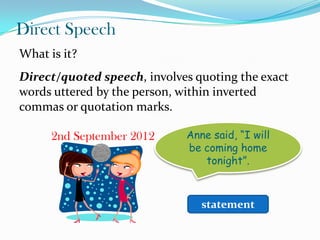
Direct/quoted speech, involves quoting the exact
words uttered by the person, within inverted
commas or quotation marks.
2nd September 2012

Anne said, “I will
be coming home
tonight”.

statement
Indirect Speech
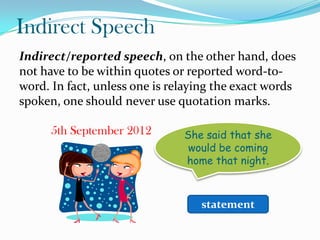
Indirect/reported speech, on the other hand, does
not have to be within quotes or reported word-toword. In fact, unless one is relaying the exact words
spoken, one should never use quotation marks.
5th September 2012

She said that she
would be coming
home that night.

statement
Indirect Speech of Exclamatory Sentences
Sentence which expresses state of joy or sorrow or
wonder is called exclamatory sentence.
For example.
 Hurrah! We won the match.
 Alas! I failed the test.
 Wow! What a nice shirt it is.
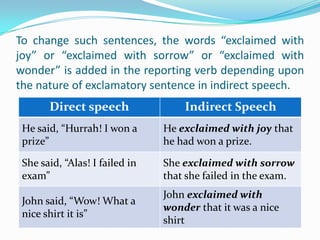
To change such sentences, the words “exclaimed with
joy” or “exclaimed with sorrow” or “exclaimed with
wonder” is added in the reporting verb depending upon
the nature of exclamatory sentence in indirect speech.
Direct speech

Indirect Speech

He said, “Hurrah! I won a
prize”

He exclaimed with joy that
he had won a prize.

She said, “Alas! I failed in
exam”

She exclaimed with sorrow
that she failed in the exam.

John said, “Wow! What a
nice shirt it is”

John exclaimed with
wonder that it was a nice
shirt
Indirect Speech of Imperative
Sentence
A sentence which expresses command, request, advice or
suggestion is called imperative sentence.
For example,
• Open the door.
• Please help me.
• Learn your lesson.
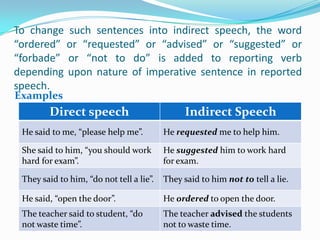
To change such sentences into indirect speech, the word
“ordered” or “requested” or “advised” or “suggested” or
“forbade” or “not to do” is added to reporting verb
depending upon nature of imperative sentence in reported
speech.
Examples

Direct speech

Indirect Speech

He said to me, “please help me”.

He requested me to help him.

She said to him, “you should work
hard for exam”.

He suggested him to work hard
for exam.

They said to him, “do not tell a lie”.

They said to him not to tell a lie.

He said, “open the door”.

He ordered to open the door.

The teacher said to student, “do
not waste time”.

The teacher advised the students
not to waste time.
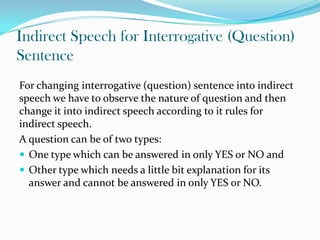
Indirect Speech for Interrogative (Question)
Sentence
For changing interrogative (question) sentence into indirect
speech we have to observe the nature of question and then
change it into indirect speech according to it rules for
indirect speech.
A question can be of two types:
 One type which can be answered in only YES or NO and
 Other type which needs a little bit explanation for its
answer and cannot be answered in only YES or NO.
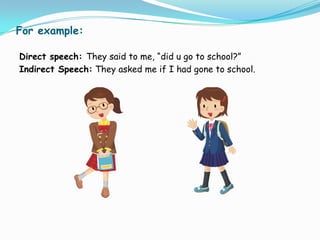
For example:
Direct speech: They said to me, “did u go to school?”
Indirect Speech: They asked me if I had gone to school.
How to Use Reported Speech
When we use reported speech, we are usually
talking about the past.
Therefore, verbs usually change to the past tense
in reported speech.
For example:
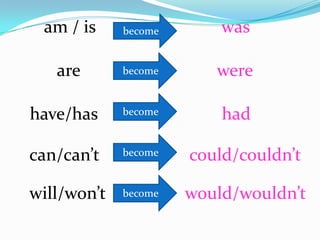
am / is

become

was

are

become

were

have/has

become

had

can/can’t

become

could/couldn’t

will/won’t

become

would/wouldn’t
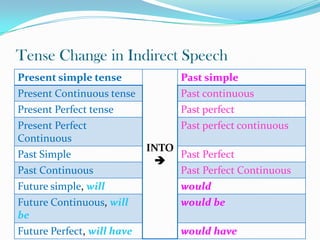
Tense Change in Indirect Speech
Present simple tense
Present Continuous tense
Present Perfect tense
Present Perfect
Continuous
Past Simple
Past Continuous
Future simple, will
Future Continuous, will
be
Future Perfect, will have

Past simple
Past continuous
Past perfect
Past perfect continuous
INTO
Past Perfect

Past Perfect Continuous

would
would be
would have
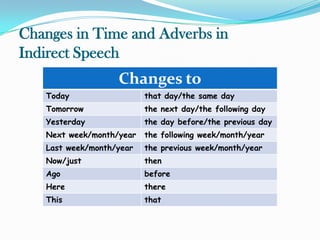
Changes in Time and Adverbs in
Indirect Speech
Changes to
Today

that day/the same day

Tomorrow

the next day/the following day

Yesterday

the day before/the previous day

Next week/month/year

the following week/month/year

Last week/month/year

the previous week/month/year

Now/just

then

Ago

before

Here

there

This

that
The End

Thank You

Direct And Indirect Speech

  • 1.
  • 2.
    Direct Speech In theEnglish language, there are two ways of conveying what someone else has said:  direct/quoted speech and  indirect/reported speech.
  • 3.
    Direct Speech What isit? Direct/quoted speech, involves quoting the exact words uttered by the person, within inverted commas or quotation marks. 2nd September 2012 Anne said, “I will be coming home tonight”. statement
  • 4.
    Indirect Speech Indirect/reported speech,on the other hand, does not have to be within quotes or reported word-toword. In fact, unless one is relaying the exact words spoken, one should never use quotation marks. 5th September 2012 She said that she would be coming home that night. statement
  • 5.
    Indirect Speech ofExclamatory Sentences Sentence which expresses state of joy or sorrow or wonder is called exclamatory sentence. For example.  Hurrah! We won the match.  Alas! I failed the test.  Wow! What a nice shirt it is.
  • 6.
    To change suchsentences, the words “exclaimed with joy” or “exclaimed with sorrow” or “exclaimed with wonder” is added in the reporting verb depending upon the nature of exclamatory sentence in indirect speech. Direct speech Indirect Speech He said, “Hurrah! I won a prize” He exclaimed with joy that he had won a prize. She said, “Alas! I failed in exam” She exclaimed with sorrow that she failed in the exam. John said, “Wow! What a nice shirt it is” John exclaimed with wonder that it was a nice shirt
  • 7.
    Indirect Speech ofImperative Sentence A sentence which expresses command, request, advice or suggestion is called imperative sentence. For example, • Open the door. • Please help me. • Learn your lesson.
  • 8.
    To change suchsentences into indirect speech, the word “ordered” or “requested” or “advised” or “suggested” or “forbade” or “not to do” is added to reporting verb depending upon nature of imperative sentence in reported speech. Examples Direct speech Indirect Speech He said to me, “please help me”. He requested me to help him. She said to him, “you should work hard for exam”. He suggested him to work hard for exam. They said to him, “do not tell a lie”. They said to him not to tell a lie. He said, “open the door”. He ordered to open the door. The teacher said to student, “do not waste time”. The teacher advised the students not to waste time.
  • 9.
    Indirect Speech forInterrogative (Question) Sentence For changing interrogative (question) sentence into indirect speech we have to observe the nature of question and then change it into indirect speech according to it rules for indirect speech. A question can be of two types:  One type which can be answered in only YES or NO and  Other type which needs a little bit explanation for its answer and cannot be answered in only YES or NO.
  • 10.
    For example: Direct speech:They said to me, “did u go to school?” Indirect Speech: They asked me if I had gone to school.
  • 12.
    How to UseReported Speech When we use reported speech, we are usually talking about the past. Therefore, verbs usually change to the past tense in reported speech. For example:
  • 13.
  • 14.
    Tense Change inIndirect Speech Present simple tense Present Continuous tense Present Perfect tense Present Perfect Continuous Past Simple Past Continuous Future simple, will Future Continuous, will be Future Perfect, will have Past simple Past continuous Past perfect Past perfect continuous INTO Past Perfect  Past Perfect Continuous would would be would have
  • 15.
    Changes in Timeand Adverbs in Indirect Speech Changes to Today that day/the same day Tomorrow the next day/the following day Yesterday the day before/the previous day Next week/month/year the following week/month/year Last week/month/year the previous week/month/year Now/just then Ago before Here there This that
  • 16.