MADE BY
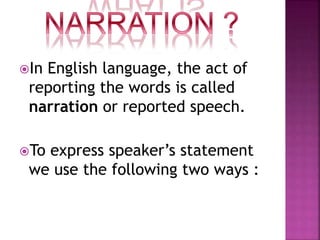
In English language, the act of
reporting the words is called
narration or reported speech.
To express speaker’s statement
we use the following two ways :
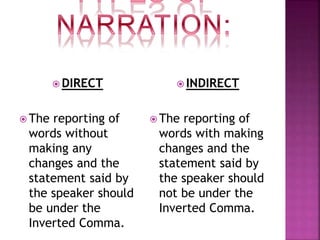
 DIRECT
 The reporting of
words without
making any
changes and the
statement said by
the speaker should
be under the
Inverted Comma.
 INDIRECT
 The reporting of
words with making
changes and the
statement said by
the speaker should
not be under the
Inverted Comma.
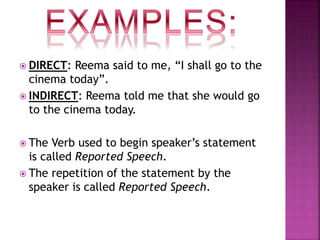
 DIRECT: Reema said to me, “I shall go to the
cinema today”.
 INDIRECT: Reema told me that she would go
to the cinema today.
 The Verb used to begin speaker’s statement
is called Reported Speech.
 The repetition of the statement by the
speaker is called Reported Speech.
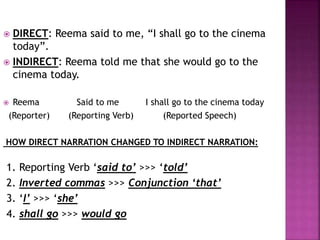
 DIRECT: Reema said to me, “I shall go to the cinema
today”.
 INDIRECT: Reema told me that she would go to the
cinema today.
 Reema Said to me I shall go to the cinema today
(Reporter) (Reporting Verb) (Reported Speech)
HOW DIRECT NARRATION CHANGED TO INDIRECT NARRATION:
1. Reporting Verb ‘said to’ >>> ‘told’
2. Inverted commas >>> Conjunction ‘that’
3. ‘I’ >>> ‘she’
4. shall go >>> would go
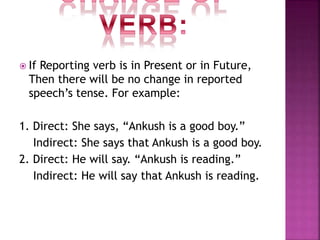
 If Reporting verb is in Present or in Future,
Then there will be no change in reported
speech’s tense. For example:
1. Direct: She says, “Ankush is a good boy.”
Indirect: She says that Ankush is a good boy.
2. Direct: He will say. “Ankush is reading.”
Indirect: He will say that Ankush is reading.
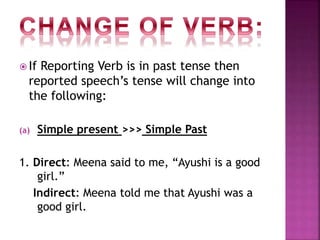
 If Reporting Verb is in past tense then
reported speech’s tense will change into
the following:
(a) Simple present >>> Simple Past
1. Direct: Meena said to me, “Ayushi is a good
girl.”
Indirect: Meena told me that Ayushi was a
good girl.
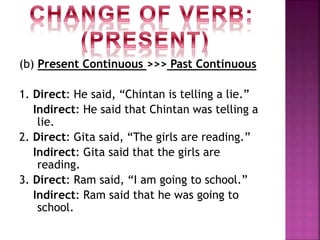
(b) Present Continuous >>> Past Continuous
1. Direct: He said, “Chintan is telling a lie.”
Indirect: He said that Chintan was telling a
lie.
2. Direct: Gita said, “The girls are reading.”
Indirect: Gita said that the girls are
reading.
3. Direct: Ram said, “I am going to school.”
Indirect: Ram said that he was going to
school.
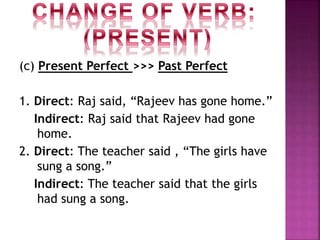
(c) Present Perfect >>> Past Perfect
1. Direct: Raj said, “Rajeev has gone home.”
Indirect: Raj said that Rajeev had gone
home.
2. Direct: The teacher said , “The girls have
sung a song.”
Indirect: The teacher said that the girls
had sung a song.
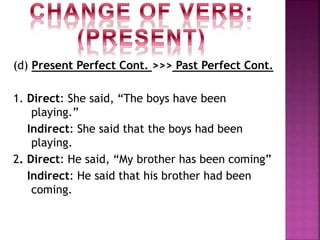
(d) Present Perfect Cont. >>> Past Perfect Cont.
1. Direct: She said, “The boys have been
playing.”
Indirect: She said that the boys had been
playing.
2. Direct: He said, “My brother has been coming”
Indirect: He said that his brother had been
coming.
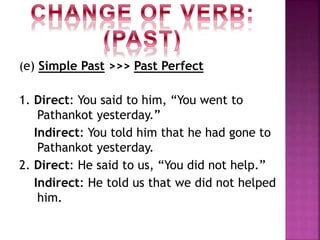
(e) Simple Past >>> Past Perfect
1. Direct: You said to him, “You went to
Pathankot yesterday.”
Indirect: You told him that he had gone to
Pathankot yesterday.
2. Direct: He said to us, “You did not help.”
Indirect: He told us that we did not helped
him.
(f) Past Continuous >>> Past Perfect Cont.
1. Direct: He said to me, “Rajesh was weeping.”
Indirect: He told me that Rajesh had been
weeping.
2. Direct: I said, “Manoj was going home.”
Indirect: I said that Manoj had been going
home.
***THERE WILL BE NO CHANGE IN PAST PERFECT AND
PASTPERFECT CONTINUOUS
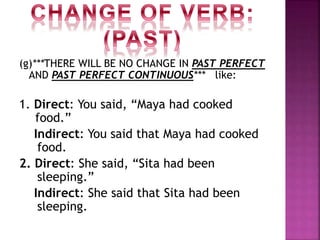
(g)***THERE WILL BE NO CHANGE IN PAST PERFECT
AND PAST PERFECT CONTINUOUS*** like:
1. Direct: You said, “Maya had cooked
food.”
Indirect: You said that Maya had cooked
food.
2. Direct: She said, “Sita had been
sleeping.”
Indirect: She said that Sita had been
sleeping.
(h) In Future Tense: Shall/Will >>> Would
1. Direct: He said, “Deepak will play a match.”
Indirect: He said that Deepak would play a
match.
2. Direct: The boys said, “We shall go there.”
Indirect: The boys said that they would go
there.
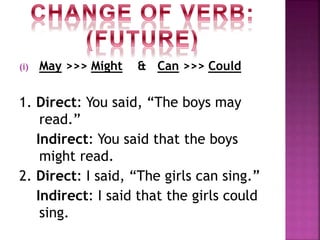
(i) May >>> Might & Can >>> Could
1. Direct: You said, “The boys may
read.”
Indirect: You said that the boys
might read.
2. Direct: I said, “The girls can sing.”
Indirect: I said that the girls could
sing.
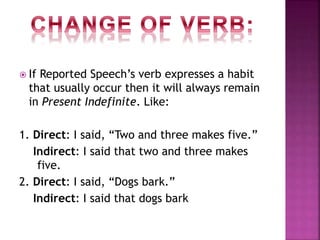
 If Reported Speech’s verb expresses a habit
that usually occur then it will always remain
in Present Indefinite. Like:
1. Direct: I said, “Two and three makes five.”
Indirect: I said that two and three makes
five.
2. Direct: I said, “Dogs bark.”
Indirect: I said that dogs bark
 It is the person that narrates the story or
speaks a sentence.
Examples: I, Me, etc.
1. Direct:
 It is the person that listens to the 1st person
or it is the person to whom the first person is
talking.
 It is the person about whom the 1st person is
talking about.

NARRATION (PRESENTATION)

  • 1.
  • 2.
    In English language,the act of reporting the words is called narration or reported speech. To express speaker’s statement we use the following two ways :
  • 3.
     DIRECT  Thereporting of words without making any changes and the statement said by the speaker should be under the Inverted Comma.  INDIRECT  The reporting of words with making changes and the statement said by the speaker should not be under the Inverted Comma.
  • 4.
     DIRECT: Reemasaid to me, “I shall go to the cinema today”.  INDIRECT: Reema told me that she would go to the cinema today.  The Verb used to begin speaker’s statement is called Reported Speech.  The repetition of the statement by the speaker is called Reported Speech.
  • 5.
     DIRECT: Reemasaid to me, “I shall go to the cinema today”.  INDIRECT: Reema told me that she would go to the cinema today.  Reema Said to me I shall go to the cinema today (Reporter) (Reporting Verb) (Reported Speech) HOW DIRECT NARRATION CHANGED TO INDIRECT NARRATION: 1. Reporting Verb ‘said to’ >>> ‘told’ 2. Inverted commas >>> Conjunction ‘that’ 3. ‘I’ >>> ‘she’ 4. shall go >>> would go
  • 6.
     If Reportingverb is in Present or in Future, Then there will be no change in reported speech’s tense. For example: 1. Direct: She says, “Ankush is a good boy.” Indirect: She says that Ankush is a good boy. 2. Direct: He will say. “Ankush is reading.” Indirect: He will say that Ankush is reading.
  • 7.
     If ReportingVerb is in past tense then reported speech’s tense will change into the following: (a) Simple present >>> Simple Past 1. Direct: Meena said to me, “Ayushi is a good girl.” Indirect: Meena told me that Ayushi was a good girl.
  • 8.
    (b) Present Continuous>>> Past Continuous 1. Direct: He said, “Chintan is telling a lie.” Indirect: He said that Chintan was telling a lie. 2. Direct: Gita said, “The girls are reading.” Indirect: Gita said that the girls are reading. 3. Direct: Ram said, “I am going to school.” Indirect: Ram said that he was going to school.
  • 9.
    (c) Present Perfect>>> Past Perfect 1. Direct: Raj said, “Rajeev has gone home.” Indirect: Raj said that Rajeev had gone home. 2. Direct: The teacher said , “The girls have sung a song.” Indirect: The teacher said that the girls had sung a song.
  • 10.
    (d) Present PerfectCont. >>> Past Perfect Cont. 1. Direct: She said, “The boys have been playing.” Indirect: She said that the boys had been playing. 2. Direct: He said, “My brother has been coming” Indirect: He said that his brother had been coming.
  • 11.
    (e) Simple Past>>> Past Perfect 1. Direct: You said to him, “You went to Pathankot yesterday.” Indirect: You told him that he had gone to Pathankot yesterday. 2. Direct: He said to us, “You did not help.” Indirect: He told us that we did not helped him.
  • 12.
    (f) Past Continuous>>> Past Perfect Cont. 1. Direct: He said to me, “Rajesh was weeping.” Indirect: He told me that Rajesh had been weeping. 2. Direct: I said, “Manoj was going home.” Indirect: I said that Manoj had been going home. ***THERE WILL BE NO CHANGE IN PAST PERFECT AND PASTPERFECT CONTINUOUS
  • 13.
    (g)***THERE WILL BENO CHANGE IN PAST PERFECT AND PAST PERFECT CONTINUOUS*** like: 1. Direct: You said, “Maya had cooked food.” Indirect: You said that Maya had cooked food. 2. Direct: She said, “Sita had been sleeping.” Indirect: She said that Sita had been sleeping.
  • 14.
    (h) In FutureTense: Shall/Will >>> Would 1. Direct: He said, “Deepak will play a match.” Indirect: He said that Deepak would play a match. 2. Direct: The boys said, “We shall go there.” Indirect: The boys said that they would go there.
  • 15.
    (i) May >>>Might & Can >>> Could 1. Direct: You said, “The boys may read.” Indirect: You said that the boys might read. 2. Direct: I said, “The girls can sing.” Indirect: I said that the girls could sing.
  • 16.
     If ReportedSpeech’s verb expresses a habit that usually occur then it will always remain in Present Indefinite. Like: 1. Direct: I said, “Two and three makes five.” Indirect: I said that two and three makes five. 2. Direct: I said, “Dogs bark.” Indirect: I said that dogs bark
  • 17.
     It isthe person that narrates the story or speaks a sentence. Examples: I, Me, etc. 1. Direct:
  • 18.
     It isthe person that listens to the 1st person or it is the person to whom the first person is talking.
  • 19.
     It isthe person about whom the 1st person is talking about.