DIRECT AND INDIRECT
SPEECH
Name : Hassan Ali
Registration Number : EE133009
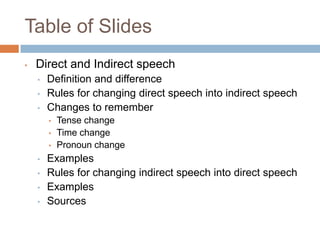
Table of Slides
•

Direct and Indirect speech
•
•
•

Definition and difference
Rules for changing direct speech into indirect speech
Changes to remember
•
•
•

•
•
•
•

Tense change
Time change
Pronoun change

Examples
Rules for changing indirect speech into direct speech
Examples
Sources
Definition and Difference








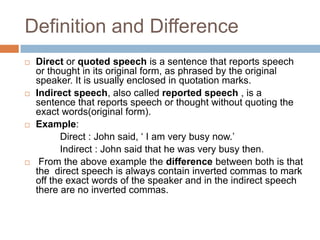
Direct or quoted speech is a sentence that reports speech
or thought in its original form, as phrased by the original
speaker. It is usually enclosed in quotation marks.
Indirect speech, also called reported speech , is a
sentence that reports speech or thought without quoting the
exact words(original form).
Example:
Direct : John said, ‘ I am very busy now.’
Indirect : John said that he was very busy then.
From the above example the difference between both is that
the direct speech is always contain inverted commas to mark
off the exact words of the speaker and in the indirect speech
there are no inverted commas.
Rules for changing direct speech
into indirect.


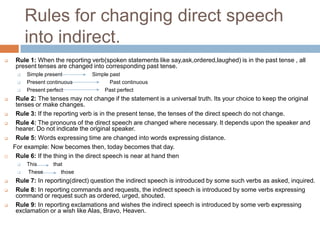
Rule 1: When the reporting verb(spoken statements like say,ask,ordered,laughed) is in the past tense , all
present tenses are changed into corresponding past tense.



















Simple past
Past continuous
Past perfect

Rule 2: The tenses may not change if the statement is a universal truth. Its your choice to keep the original
tenses or make changes.
Rule 3: If the reporting verb is in the present tense, the tenses of the direct speech do not change.
Rule 4: The pronouns of the direct speech are changed where necessary. It depends upon the speaker and
hearer. Do not indicate the original speaker.
Rule 5: Words expressing time are changed into words expressing distance.
For example: Now becomes then, today becomes that day.
Rule 6: If the thing in the direct speech is near at hand then




Simple present
Present continuous
Present perfect

This
These

that
those

Rule 7: In reporting(direct) question the indirect speech is introduced by some such verbs as asked, inquired.
Rule 8: In reporting commands and requests, the indirect speech is introduced by some verbs expressing
command or request such as ordered, urged, shouted.
Rule 9: In reporting exclamations and wishes the indirect speech is introduced by some verb expressing
exclamation or a wish like Alas, Bravo, Heaven.
Changes to remember
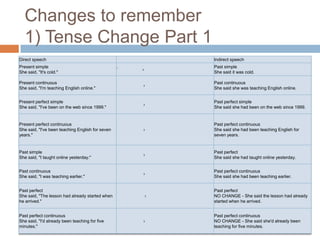
1) Tense Change Part 1
Direct speech
Present simple
She said, "It's cold."

Indirect speech
›

Past simple
She said it was cold.

Present continuous
She said, "I'm teaching English online."

›

Past continuous
She said she was teaching English online.

Present perfect simple
She said, "I've been on the web since 1999."

›

Past perfect simple
She said she had been on the web since 1999.

Present perfect continuous
She said, "I've been teaching English for seven
years."

›

Past perfect continuous
She said she had been teaching English for
seven years.

Past simple
She said, "I taught online yesterday."

›

Past perfect
She said she had taught online yesterday.

Past continuous
She said, "I was teaching earlier."

›

Past perfect continuous
She said she had been teaching earlier.

Past perfect
She said, "The lesson had already started when
he arrived."

›

Past perfect
NO CHANGE - She said the lesson had already
started when he arrived.

Past perfect continuous
She said, "I'd already been teaching for five
minutes."

›

Past perfect continuous
NO CHANGE - She said she'd already been
teaching for five minutes.

`
Changes to remember
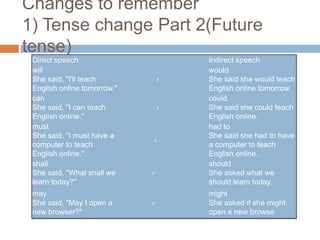
1) Tense change Part 2(Future
tense)
Direct speech
will
She said, "I'll teach
English online tomorrow."
can
She said, "I can teach
English online."
must
She said, "I must have a
computer to teach
English online."
shall
She said, "What shall we
learn today?"
may
She said, "May I open a
new browser?"

›

›

›

›

›

Indirect speech
would
She said she would teach
English online tomorrow.
could
She said she could teach
English online.
had to
She said she had to have
a computer to teach
English online.
should
She asked what we
should learn today.
might
She asked if she might
open a new browse
Changes to remember
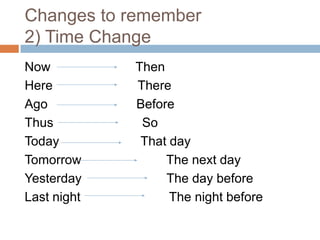
2) Time Change
Now
Here
Ago
Thus
Today
Tomorrow
Yesterday
Last night

Then
There
Before
So
That day
The next day
The day before
The night before
Changes to remember
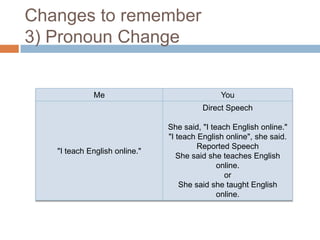
3) Pronoun Change

Me

You
Direct Speech

"I teach English online."

She said, "I teach English online."
"I teach English online", she said.
Reported Speech
She said she teaches English
online.
or
She said she taught English
online.
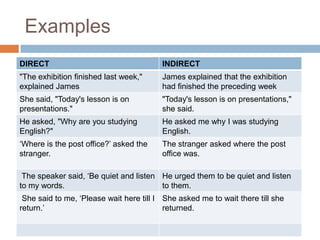
Examples
DIRECT

INDIRECT

"The exhibition finished last week,"
explained James

James explained that the exhibition
had finished the preceding week

She said, "Today's lesson is on
presentations."

"Today's lesson is on presentations,"
she said.

He asked, "Why are you studying
English?"

He asked me why I was studying
English.

‘Where is the post office?’ asked the
stranger.

The stranger asked where the post
office was.

The speaker said, ‘Be quiet and listen He urged them to be quiet and listen
to my words.
to them.
She said to me, ‘Please wait here till I She asked me to wait there till she
return.’
returned.
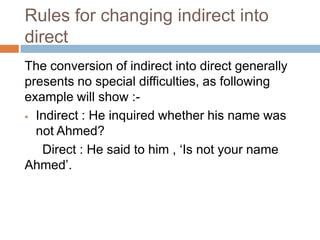
Rules for changing indirect into
direct
The conversion of indirect into direct generally
presents no special difficulties, as following
example will show : Indirect : He inquired whether his name was
not Ahmed?
Direct : He said to him , ‘Is not your name
Ahmed’.
Sources
English book by wren & Martin

Direct and indirect speech

  • 1.
    DIRECT AND INDIRECT SPEECH Name: Hassan Ali Registration Number : EE133009
  • 2.
    Table of Slides • Directand Indirect speech • • • Definition and difference Rules for changing direct speech into indirect speech Changes to remember • • • • • • • Tense change Time change Pronoun change Examples Rules for changing indirect speech into direct speech Examples Sources
  • 3.
    Definition and Difference     Director quoted speech is a sentence that reports speech or thought in its original form, as phrased by the original speaker. It is usually enclosed in quotation marks. Indirect speech, also called reported speech , is a sentence that reports speech or thought without quoting the exact words(original form). Example: Direct : John said, ‘ I am very busy now.’ Indirect : John said that he was very busy then. From the above example the difference between both is that the direct speech is always contain inverted commas to mark off the exact words of the speaker and in the indirect speech there are no inverted commas.
  • 4.
    Rules for changingdirect speech into indirect.  Rule 1: When the reporting verb(spoken statements like say,ask,ordered,laughed) is in the past tense , all present tenses are changed into corresponding past tense.            Simple past Past continuous Past perfect Rule 2: The tenses may not change if the statement is a universal truth. Its your choice to keep the original tenses or make changes. Rule 3: If the reporting verb is in the present tense, the tenses of the direct speech do not change. Rule 4: The pronouns of the direct speech are changed where necessary. It depends upon the speaker and hearer. Do not indicate the original speaker. Rule 5: Words expressing time are changed into words expressing distance. For example: Now becomes then, today becomes that day. Rule 6: If the thing in the direct speech is near at hand then   Simple present Present continuous Present perfect This These that those Rule 7: In reporting(direct) question the indirect speech is introduced by some such verbs as asked, inquired. Rule 8: In reporting commands and requests, the indirect speech is introduced by some verbs expressing command or request such as ordered, urged, shouted. Rule 9: In reporting exclamations and wishes the indirect speech is introduced by some verb expressing exclamation or a wish like Alas, Bravo, Heaven.
  • 5.
    Changes to remember 1)Tense Change Part 1 Direct speech Present simple She said, "It's cold." Indirect speech › Past simple She said it was cold. Present continuous She said, "I'm teaching English online." › Past continuous She said she was teaching English online. Present perfect simple She said, "I've been on the web since 1999." › Past perfect simple She said she had been on the web since 1999. Present perfect continuous She said, "I've been teaching English for seven years." › Past perfect continuous She said she had been teaching English for seven years. Past simple She said, "I taught online yesterday." › Past perfect She said she had taught online yesterday. Past continuous She said, "I was teaching earlier." › Past perfect continuous She said she had been teaching earlier. Past perfect She said, "The lesson had already started when he arrived." › Past perfect NO CHANGE - She said the lesson had already started when he arrived. Past perfect continuous She said, "I'd already been teaching for five minutes." › Past perfect continuous NO CHANGE - She said she'd already been teaching for five minutes. `
  • 6.
    Changes to remember 1)Tense change Part 2(Future tense) Direct speech will She said, "I'll teach English online tomorrow." can She said, "I can teach English online." must She said, "I must have a computer to teach English online." shall She said, "What shall we learn today?" may She said, "May I open a new browser?" › › › › › Indirect speech would She said she would teach English online tomorrow. could She said she could teach English online. had to She said she had to have a computer to teach English online. should She asked what we should learn today. might She asked if she might open a new browse
  • 7.
    Changes to remember 2)Time Change Now Here Ago Thus Today Tomorrow Yesterday Last night Then There Before So That day The next day The day before The night before
  • 8.
    Changes to remember 3)Pronoun Change Me You Direct Speech "I teach English online." She said, "I teach English online." "I teach English online", she said. Reported Speech She said she teaches English online. or She said she taught English online.
  • 9.
    Examples DIRECT INDIRECT "The exhibition finishedlast week," explained James James explained that the exhibition had finished the preceding week She said, "Today's lesson is on presentations." "Today's lesson is on presentations," she said. He asked, "Why are you studying English?" He asked me why I was studying English. ‘Where is the post office?’ asked the stranger. The stranger asked where the post office was. The speaker said, ‘Be quiet and listen He urged them to be quiet and listen to my words. to them. She said to me, ‘Please wait here till I She asked me to wait there till she return.’ returned.
  • 10.
    Rules for changingindirect into direct The conversion of indirect into direct generally presents no special difficulties, as following example will show : Indirect : He inquired whether his name was not Ahmed? Direct : He said to him , ‘Is not your name Ahmed’.
  • 11.