By Mariángeles Salazar
   Speech Act is a functional unit in
    communication. (Austin’s theory 1962)

   Furthermore, to communicate is to
    express a certain attitude, and the type
    of speech act being performed
    corresponds to the type of attitude
    being expressed. (Bach 1994)
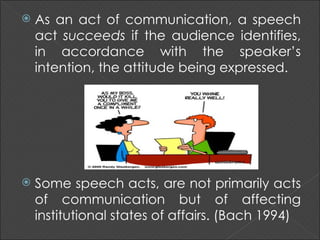
   As an act of communication, a speech
    act succeeds if the audience identifies,
    in accordance with the speaker’s
    intention, the attitude being expressed.


   Some speech acts, are not primarily acts
    of communication but of affecting
    institutional states of affairs. (Bach 1994)
 1. Locutionary: Meaning, namely, the
  literal meaning of the utterance.
 2. Illocutionary: Is related to the social
  function that the utterance or the written
  text has.
 3. Perlocutionary: Is the result or effect
  that is produced by the utterance in the
  given context.
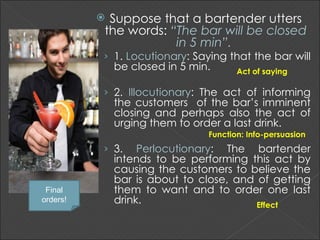
Suppose that a bartender utters
          the words: “The bar will be closed
                      in 5 min”.
          › 1. Locutionary: Saying that the bar will
              be closed in 5 min.      Act of saying

          › 2. Illocutionary: The act of informing
              the customers of the bar’s imminent
              closing and perhaps also the act of
              urging them to order a last drink.
                                Function: Info-persuasion
          › 3.     Perlocutionary: The bartender
              intends to be performing this act by
              causing the customers to believe the
              bar is about to close, and of getting
 Final        them to want and to order one last
orders!       drink.                     Effect
c   t
Spe ech A
According to Olshtain and
Cohen (1983), speech act sets
are set of strategies used by
native speakers of the target
language     uttered  in  the
appropriate context.

It is also paramount to notice
that     as  stated  by   SLA
researchers, the lack or even
partial mastery of speech act
sets may hinder breakdowns in
communication.
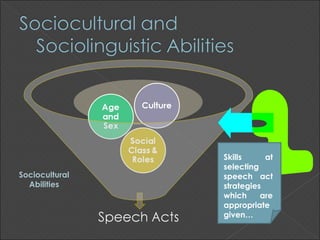
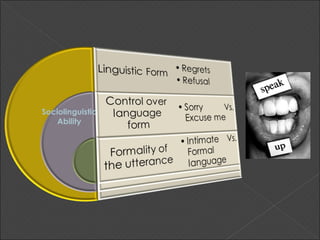
Skills     at
                selecting
Sociocultural   speech act
  Abilities     strategies
                which     are
                appropriate
                given…
Sociolinguistic
    Ability
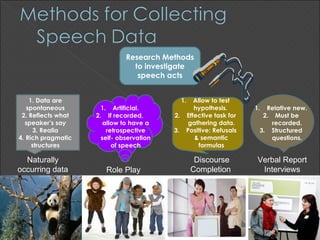
Research Methods
                                to investigate
                                 speech acts


    1. Data are                                1.  Allow to test
   spontaneous        1. Artificial.               hypothesis.       1. Relative new.
 2. Reflects what   2. If recorded,       2.    Effective task for     2. Must be
  speaker’s say        allow to have a          gathering data.           recorded.
      3. Realia         retrospective     3.    Positive: Refusals    3. Structured
4. Rich pragmatic     self- observation            & semantic             questions.
     structures           of speech                  formulas

  Naturally                                          Discourse        Verbal Report
occurring data         Role Play                    Completion         Interviews
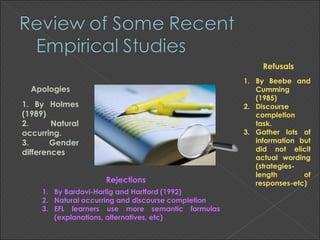
Refusals
                                                     1. By Beebe and
  Apologies                                             Cumming
                                                        (1985)
1. By Holmes                                         2. Discourse
(1989)                                                  completion
2.      Natural                                         task.
occurring.                                           3. Gather lots of
3.      Gender                                          information but
differences                                             did not elicit
                                                        actual wording
                                                        (strategies-
                                                        length       of
                     Rejections                         responses-etc)
     1. By Bardovi-Harlig and Hartford (1992)
     2. Natural occurring and discourse completion
     3. EFL learners use more semantic formulas
        (explanations, alternatives, etc)
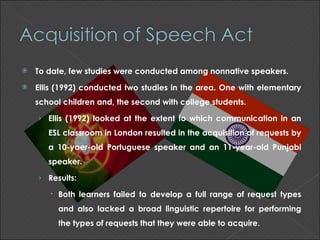
   To date, few studies were conducted among nonnative speakers.
   Ellis (1992) conducted two studies in the area. One with elementary
    school children and, the second with college students.

    › Ellis (1992) looked at the extent to which communication in an
       ESL classroom in London resulted in the acquisition of requests by
       a 10-yaer-old Portuguese speaker and an 11-year-old Punjabi
       speaker.

    › Results:

        Both learners failed to develop a full range of request types
         and also lacked a broad linguistic repertoire for performing
         the types of requests that they were able to acquire.
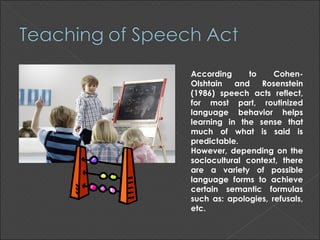
According      to    Cohen-
Olshtain   and    Rosenstein
(1986) speech acts reflect,
for most part, routinized
language behavior helps
learning in the sense that
much of what is said is
predictable.
However, depending on the
sociocultural context, there
are a variety of possible
language forms to achieve
certain semantic formulas
such as: apologies, refusals,
etc.
   The role of the teacher-researcher can be to
    obtain some information on how native speakers
    perform certain important speech acts, such as
    requesting, complaining, etc.

   Diagnostic assessments may help teachers to
    determine the student’s level of awareness of
    speech acts in general.

   Model dialogues are useful for students in order to
    practice real situation regardless the topic.
   The evaluation of a situation is a useful technique
    to further reinforce the learner’s awareness of the
    factors affecting the choice of semantic formula.
   Role play activities are suitable for practice as well.
   Feedback and discussion are useful so as to
    understand the perception and expectations of
    the students.
Speech acts

Speech acts

  • 1.
  • 2.
    Speech Act is a functional unit in communication. (Austin’s theory 1962)  Furthermore, to communicate is to express a certain attitude, and the type of speech act being performed corresponds to the type of attitude being expressed. (Bach 1994)
  • 3.
    As an act of communication, a speech act succeeds if the audience identifies, in accordance with the speaker’s intention, the attitude being expressed.  Some speech acts, are not primarily acts of communication but of affecting institutional states of affairs. (Bach 1994)
  • 4.
     1. Locutionary:Meaning, namely, the literal meaning of the utterance.  2. Illocutionary: Is related to the social function that the utterance or the written text has.  3. Perlocutionary: Is the result or effect that is produced by the utterance in the given context.
  • 5.
    Suppose that abartender utters the words: “The bar will be closed in 5 min”. › 1. Locutionary: Saying that the bar will be closed in 5 min. Act of saying › 2. Illocutionary: The act of informing the customers of the bar’s imminent closing and perhaps also the act of urging them to order a last drink. Function: Info-persuasion › 3. Perlocutionary: The bartender intends to be performing this act by causing the customers to believe the bar is about to close, and of getting Final them to want and to order one last orders! drink. Effect
  • 7.
    c t Spe ech A
  • 8.
    According to Olshtainand Cohen (1983), speech act sets are set of strategies used by native speakers of the target language uttered in the appropriate context. It is also paramount to notice that as stated by SLA researchers, the lack or even partial mastery of speech act sets may hinder breakdowns in communication.
  • 9.
    Skills at selecting Sociocultural speech act Abilities strategies which are appropriate given…
  • 10.
  • 11.
    Research Methods to investigate speech acts 1. Data are 1. Allow to test spontaneous 1. Artificial. hypothesis. 1. Relative new. 2. Reflects what 2. If recorded, 2. Effective task for 2. Must be speaker’s say allow to have a gathering data. recorded. 3. Realia retrospective 3. Positive: Refusals 3. Structured 4. Rich pragmatic self- observation & semantic questions. structures of speech formulas Naturally Discourse Verbal Report occurring data Role Play Completion Interviews
  • 12.
    Refusals 1. By Beebe and Apologies Cumming (1985) 1. By Holmes 2. Discourse (1989) completion 2. Natural task. occurring. 3. Gather lots of 3. Gender information but differences did not elicit actual wording (strategies- length of Rejections responses-etc) 1. By Bardovi-Harlig and Hartford (1992) 2. Natural occurring and discourse completion 3. EFL learners use more semantic formulas (explanations, alternatives, etc)
  • 13.
    To date, few studies were conducted among nonnative speakers.  Ellis (1992) conducted two studies in the area. One with elementary school children and, the second with college students. › Ellis (1992) looked at the extent to which communication in an ESL classroom in London resulted in the acquisition of requests by a 10-yaer-old Portuguese speaker and an 11-year-old Punjabi speaker. › Results:  Both learners failed to develop a full range of request types and also lacked a broad linguistic repertoire for performing the types of requests that they were able to acquire.
  • 14.
    According to Cohen- Olshtain and Rosenstein (1986) speech acts reflect, for most part, routinized language behavior helps learning in the sense that much of what is said is predictable. However, depending on the sociocultural context, there are a variety of possible language forms to achieve certain semantic formulas such as: apologies, refusals, etc.
  • 15.
    The role of the teacher-researcher can be to obtain some information on how native speakers perform certain important speech acts, such as requesting, complaining, etc.  Diagnostic assessments may help teachers to determine the student’s level of awareness of speech acts in general.  Model dialogues are useful for students in order to practice real situation regardless the topic.
  • 16.
    The evaluation of a situation is a useful technique to further reinforce the learner’s awareness of the factors affecting the choice of semantic formula.  Role play activities are suitable for practice as well.  Feedback and discussion are useful so as to understand the perception and expectations of the students.