Group 4:
Annisa Nur Fitria Riska Lestari
Dini Handayani Sofiyatul Inayah
SPEECH ACTS
(Pragmatics)
Class 4C English Department
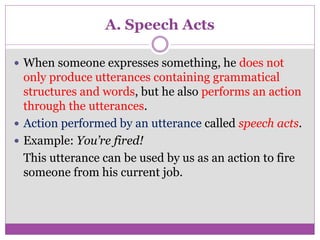
A. Speech Acts
 When someone expresses something, he does not
only produce utterances containing grammatical
structures and words, but he also performs an action
through the utterances.
 Action performed by an utterance called speech acts.
 Example: You’re fired!
This utterance can be used by us as an action to fire
someone from his current job.
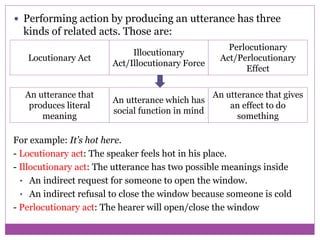
 Performing action by producing an utterance has three
kinds of related acts. Those are:
Locutionary Act
Illocutionary
Act/Illocutionary Force
Perlocutionary
Act/Perlocutionary
Effect
An utterance that
produces literal
meaning
An utterance which has
social function in mind
An utterance that gives
an effect to do
something
For example: It’s hot here.
- Locutionary act: The speaker feels hot in his place.
- Illocutionary act: The utterance has two possible meanings inside
• An indirect request for someone to open the window.
• An indirect refusal to close the window because someone is cold
- Perlocutionary act: The hearer will open/close the window
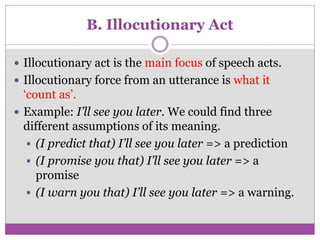
B. Illocutionary Act
 Illocutionary act is the main focus of speech acts.
 Illocutionary force from an utterance is what it
‘count as’.
 Example: I’ll see you later. We could find three
different assumptions of its meaning.
 (I predict that) I’ll see you later => a prediction
 (I promise you that) I’ll see you later => a
promise
 (I warn you that) I’ll see you later => a warning.
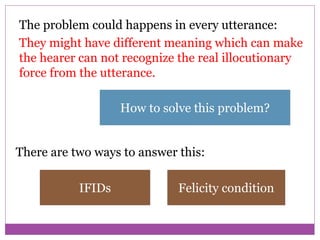
There are two ways to answer this:
How to solve this problem?
The problem could happens in every utterance:
They might have different meaning which can make
the hearer can not recognize the real illocutionary
force from the utterance.
IFIDs Felicity condition
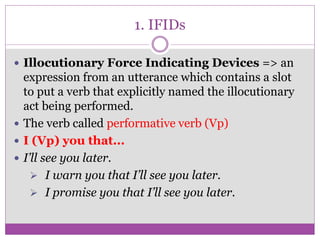
1. IFIDs
 Illocutionary Force Indicating Devices => an
expression from an utterance which contains a slot
to put a verb that explicitly named the illocutionary
act being performed.
 The verb called performative verb (Vp)
 I (Vp) you that...
 I’ll see you later.
 I warn you that I’ll see you later.
 I promise you that I’ll see you later.
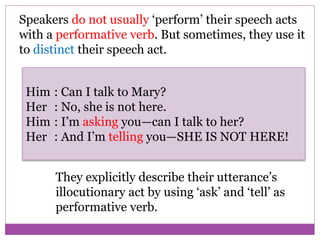
Speakers do not usually ‘perform’ their speech acts
with a performative verb. But sometimes, they use it
to distinct their speech act.
Him : Can I talk to Mary?
Her : No, she is not here.
Him : I’m asking you—can I talk to her?
Her : And I’m telling you—SHE IS NOT HERE!
They explicitly describe their utterance’s
illocutionary act by using ‘ask’ and ‘tell’ as
performative verb.
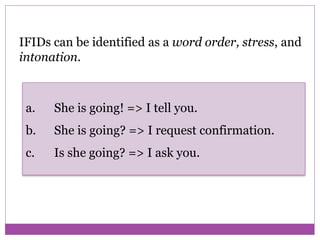
IFIDs can be identified as a word order, stress, and
intonation.
a. She is going! => I tell you.
b. She is going? => I request confirmation.
c. Is she going? => I ask you.
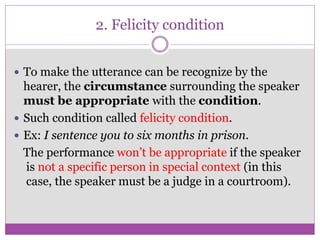
2. Felicity condition
 To make the utterance can be recognize by the
hearer, the circumstance surrounding the speaker
must be appropriate with the condition.
 Such condition called felicity condition.
 Ex: I sentence you to six months in prison.
The performance won’t be appropriate if the speaker
is not a specific person in special context (in this
case, the speaker must be a judge in a courtroom).
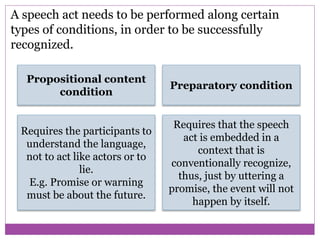
A speech act needs to be performed along certain
types of conditions, in order to be successfully
recognized.
Propositional content
condition
Preparatory condition
Requires the participants to
understand the language,
not to act like actors or to
lie.
E.g. Promise or warning
must be about the future.
Requires that the speech
act is embedded in a
context that is
conventionally recognize,
thus, just by uttering a
promise, the event will not
happen by itself.
A speech act needs to be performed along certain
types of conditions, in order to be successfully
recognized.
Sincerity condition Essential condition
Requires that the speaker is
sincere in uttering the
declaration.
E.g. Promise is only
effective when the speaker
really intends to carry it
out.
Requires that all parties
intend the result.
E.g. Changes state of
speaker from non-
obligation to obligation
(promise).
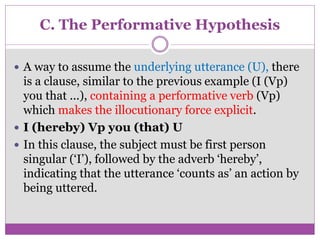
C. The Performative Hypothesis
 A way to assume the underlying utterance (U), there
is a clause, similar to the previous example (I (Vp)
you that ...), containing a performative verb (Vp)
which makes the illocutionary force explicit.
 I (hereby) Vp you (that) U
 In this clause, the subject must be first person
singular (‘I’), followed by the adverb ‘hereby’,
indicating that the utterance ‘counts as’ an action by
being uttered.
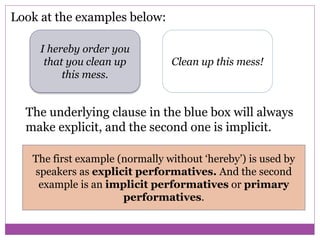
Look at the examples below:
I hereby order you
that you clean up
this mess.
Clean up this mess!
The underlying clause in the blue box will always
make explicit, and the second one is implicit.
The first example (normally without ‘hereby’) is used by
speakers as explicit performatives. And the second
example is an implicit performatives or primary
performatives.
The advantage of this analysis type:
It makes clear just what elements are involved in he
production and interpretation of utterances.
Do it yourself! (implicit)
The reflexive in ‘yourself’ is made possible by the
antecendent ‘you’ in explicit version.
I order you that you do it yourself. (explicit)
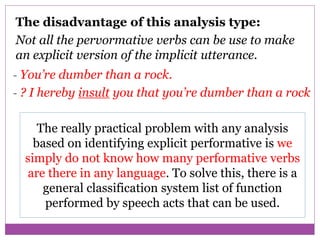
The disadvantage of this analysis type:
Not all the pervormative verbs can be use to make
an explicit version of the implicit utterance.
- You’re dumber than a rock.
- ? I hereby insult you that you’re dumber than a rock
The really practical problem with any analysis
based on identifying explicit performative is we
simply do not know how many performative verbs
are there in any language. To solve this, there is a
general classification system list of function
performed by speech acts that can be used.
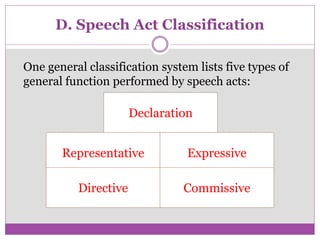
D. Speech Act Classification
One general classification system lists five types of
general function performed by speech acts:
Declaration
Representative Expressive
Directive Commissive
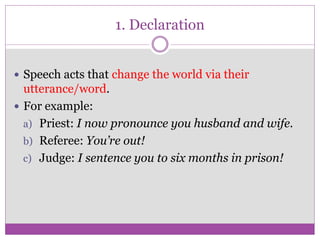
1. Declaration
 Speech acts that change the world via their
utterance/word.
 For example:
a) Priest: I now pronounce you husband and wife.
b) Referee: You’re out!
c) Judge: I sentence you to six months in prison!
2. Representative
 Speech acts that state what speaker believes to be the
case or not.
 Fact, assertions, conclusions, descriptions =>
representing the world as he believes it is.
 The speaker makes the words fit the world (of belief).
 For example:
a) The earth is flat.
b) Chomsky didn’t write about peanuts.
c) It was a warm sunny day.
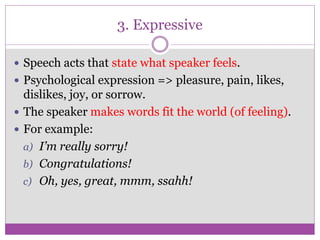
3. Expressive
 Speech acts that state what speaker feels.
 Psychological expression => pleasure, pain, likes,
dislikes, joy, or sorrow.
 The speaker makes words fit the world (of feeling).
 For example:
a) I’m really sorry!
b) Congratulations!
c) Oh, yes, great, mmm, ssahh!
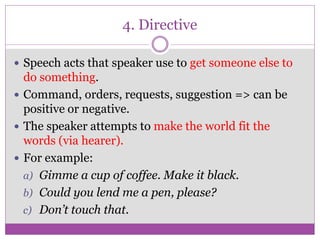
4. Directive
 Speech acts that speaker use to get someone else to
do something.
 Command, orders, requests, suggestion => can be
positive or negative.
 The speaker attempts to make the world fit the
words (via hearer).
 For example:
a) Gimme a cup of coffee. Make it black.
b) Could you lend me a pen, please?
c) Don’t touch that.
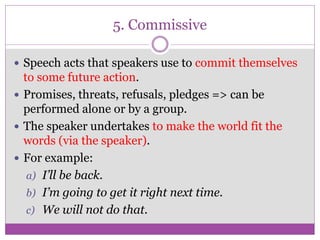
5. Commissive
 Speech acts that speakers use to commit themselves
to some future action.
 Promises, threats, refusals, pledges => can be
performed alone or by a group.
 The speaker undertakes to make the world fit the
words (via the speaker).
 For example:
a) I’ll be back.
b) I’m going to get it right next time.
c) We will not do that.
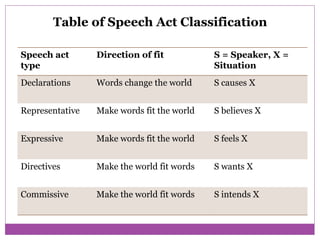
Speech act
type
Direction of fit S = Speaker, X =
Situation
Declarations Words change the world S causes X
Representative Make words fit the world S believes X
Expressive Make words fit the world S feels X
Directives Make the world fit words S wants X
Commissive Make the world fit words S intends X
Table of Speech Act Classification
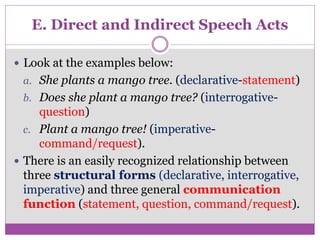
E. Direct and Indirect Speech Acts
 Look at the examples below:
a. She plants a mango tree. (declarative-statement)
b. Does she plant a mango tree? (interrogative-
question)
c. Plant a mango tree! (imperative-
command/request).
 There is an easily recognized relationship between
three structural forms (declarative, interrogative,
imperative) and three general communication
function (statement, question, command/request).
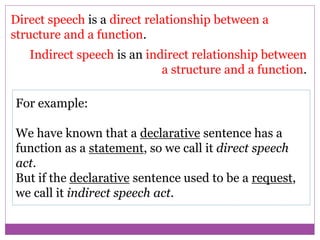
Direct speech is a direct relationship between a
structure and a function.
Indirect speech is an indirect relationship between
a structure and a function.
For example:
We have known that a declarative sentence has a
function as a statement, so we call it direct speech
act.
But if the declarative sentence used to be a request,
we call it indirect speech act.
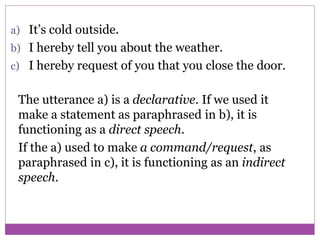
a) It’s cold outside.
b) I hereby tell you about the weather.
c) I hereby request of you that you close the door.
The utterance a) is a declarative. If we used it
make a statement as paraphrased in b), it is
functioning as a direct speech.
If the a) used to make a command/request, as
paraphrased in c), it is functioning as an indirect
speech.
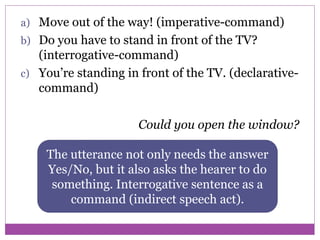
a) Move out of the way! (imperative-command)
b) Do you have to stand in front of the TV?
(interrogative-command)
c) You’re standing in front of the TV. (declarative-
command)
Could you open the window?
The utterance not only needs the answer
Yes/No, but it also asks the hearer to do
something. Interrogative sentence as a
command (indirect speech act).
F. Speech Event
 Speech act => one person trying to get another
person to do something without risking refusal or
causing offense.
 Speech event => the set of utterance produced in a
social situation involving participants who
necessarily have a social relationship and have
particular goals.
 The activity in which participants interact via
language in some conventional way to arrive at some
outcome.
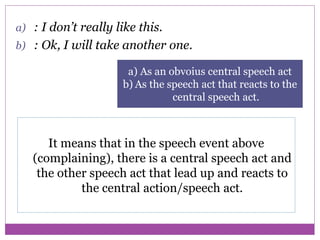
a) : I don’t really like this.
b) : Ok, I will take another one.
a) As an obvoius central speech act
b) As the speech act that reacts to the
central speech act.
It means that in the speech event above
(complaining), there is a central speech act and
the other speech act that lead up and reacts to
the central action/speech act.
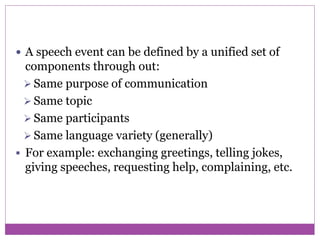
 A speech event can be defined by a unified set of
components through out:
 Same purpose of communication
 Same topic
 Same participants
 Same language variety (generally)
 For example: exchanging greetings, telling jokes,
giving speeches, requesting help, complaining, etc.
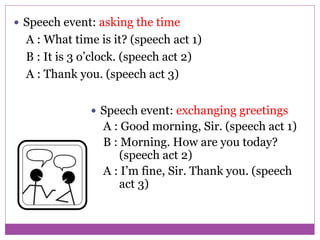
 Speech event: exchanging greetings
A : Good morning, Sir. (speech act 1)
B : Morning. How are you today?
(speech act 2)
A : I’m fine, Sir. Thank you. (speech
act 3)
 Speech event: asking the time
A : What time is it? (speech act 1)
B : It is 3 o’clock. (speech act 2)
A : Thank you. (speech act 3)
Speech acts

Speech acts

  • 1.
    Group 4: Annisa NurFitria Riska Lestari Dini Handayani Sofiyatul Inayah SPEECH ACTS (Pragmatics) Class 4C English Department
  • 2.
    A. Speech Acts When someone expresses something, he does not only produce utterances containing grammatical structures and words, but he also performs an action through the utterances.  Action performed by an utterance called speech acts.  Example: You’re fired! This utterance can be used by us as an action to fire someone from his current job.
  • 3.
     Performing actionby producing an utterance has three kinds of related acts. Those are: Locutionary Act Illocutionary Act/Illocutionary Force Perlocutionary Act/Perlocutionary Effect An utterance that produces literal meaning An utterance which has social function in mind An utterance that gives an effect to do something For example: It’s hot here. - Locutionary act: The speaker feels hot in his place. - Illocutionary act: The utterance has two possible meanings inside • An indirect request for someone to open the window. • An indirect refusal to close the window because someone is cold - Perlocutionary act: The hearer will open/close the window
  • 4.
    B. Illocutionary Act Illocutionary act is the main focus of speech acts.  Illocutionary force from an utterance is what it ‘count as’.  Example: I’ll see you later. We could find three different assumptions of its meaning.  (I predict that) I’ll see you later => a prediction  (I promise you that) I’ll see you later => a promise  (I warn you that) I’ll see you later => a warning.
  • 5.
    There are twoways to answer this: How to solve this problem? The problem could happens in every utterance: They might have different meaning which can make the hearer can not recognize the real illocutionary force from the utterance. IFIDs Felicity condition
  • 6.
    1. IFIDs  IllocutionaryForce Indicating Devices => an expression from an utterance which contains a slot to put a verb that explicitly named the illocutionary act being performed.  The verb called performative verb (Vp)  I (Vp) you that...  I’ll see you later.  I warn you that I’ll see you later.  I promise you that I’ll see you later.
  • 7.
    Speakers do notusually ‘perform’ their speech acts with a performative verb. But sometimes, they use it to distinct their speech act. Him : Can I talk to Mary? Her : No, she is not here. Him : I’m asking you—can I talk to her? Her : And I’m telling you—SHE IS NOT HERE! They explicitly describe their utterance’s illocutionary act by using ‘ask’ and ‘tell’ as performative verb.
  • 8.
    IFIDs can beidentified as a word order, stress, and intonation. a. She is going! => I tell you. b. She is going? => I request confirmation. c. Is she going? => I ask you.
  • 9.
    2. Felicity condition To make the utterance can be recognize by the hearer, the circumstance surrounding the speaker must be appropriate with the condition.  Such condition called felicity condition.  Ex: I sentence you to six months in prison. The performance won’t be appropriate if the speaker is not a specific person in special context (in this case, the speaker must be a judge in a courtroom).
  • 10.
    A speech actneeds to be performed along certain types of conditions, in order to be successfully recognized. Propositional content condition Preparatory condition Requires the participants to understand the language, not to act like actors or to lie. E.g. Promise or warning must be about the future. Requires that the speech act is embedded in a context that is conventionally recognize, thus, just by uttering a promise, the event will not happen by itself.
  • 11.
    A speech actneeds to be performed along certain types of conditions, in order to be successfully recognized. Sincerity condition Essential condition Requires that the speaker is sincere in uttering the declaration. E.g. Promise is only effective when the speaker really intends to carry it out. Requires that all parties intend the result. E.g. Changes state of speaker from non- obligation to obligation (promise).
  • 12.
    C. The PerformativeHypothesis  A way to assume the underlying utterance (U), there is a clause, similar to the previous example (I (Vp) you that ...), containing a performative verb (Vp) which makes the illocutionary force explicit.  I (hereby) Vp you (that) U  In this clause, the subject must be first person singular (‘I’), followed by the adverb ‘hereby’, indicating that the utterance ‘counts as’ an action by being uttered.
  • 13.
    Look at theexamples below: I hereby order you that you clean up this mess. Clean up this mess! The underlying clause in the blue box will always make explicit, and the second one is implicit. The first example (normally without ‘hereby’) is used by speakers as explicit performatives. And the second example is an implicit performatives or primary performatives.
  • 14.
    The advantage ofthis analysis type: It makes clear just what elements are involved in he production and interpretation of utterances. Do it yourself! (implicit) The reflexive in ‘yourself’ is made possible by the antecendent ‘you’ in explicit version. I order you that you do it yourself. (explicit)
  • 15.
    The disadvantage ofthis analysis type: Not all the pervormative verbs can be use to make an explicit version of the implicit utterance. - You’re dumber than a rock. - ? I hereby insult you that you’re dumber than a rock The really practical problem with any analysis based on identifying explicit performative is we simply do not know how many performative verbs are there in any language. To solve this, there is a general classification system list of function performed by speech acts that can be used.
  • 16.
    D. Speech ActClassification One general classification system lists five types of general function performed by speech acts: Declaration Representative Expressive Directive Commissive
  • 17.
    1. Declaration  Speechacts that change the world via their utterance/word.  For example: a) Priest: I now pronounce you husband and wife. b) Referee: You’re out! c) Judge: I sentence you to six months in prison!
  • 18.
    2. Representative  Speechacts that state what speaker believes to be the case or not.  Fact, assertions, conclusions, descriptions => representing the world as he believes it is.  The speaker makes the words fit the world (of belief).  For example: a) The earth is flat. b) Chomsky didn’t write about peanuts. c) It was a warm sunny day.
  • 19.
    3. Expressive  Speechacts that state what speaker feels.  Psychological expression => pleasure, pain, likes, dislikes, joy, or sorrow.  The speaker makes words fit the world (of feeling).  For example: a) I’m really sorry! b) Congratulations! c) Oh, yes, great, mmm, ssahh!
  • 20.
    4. Directive  Speechacts that speaker use to get someone else to do something.  Command, orders, requests, suggestion => can be positive or negative.  The speaker attempts to make the world fit the words (via hearer).  For example: a) Gimme a cup of coffee. Make it black. b) Could you lend me a pen, please? c) Don’t touch that.
  • 21.
    5. Commissive  Speechacts that speakers use to commit themselves to some future action.  Promises, threats, refusals, pledges => can be performed alone or by a group.  The speaker undertakes to make the world fit the words (via the speaker).  For example: a) I’ll be back. b) I’m going to get it right next time. c) We will not do that.
  • 22.
    Speech act type Direction offit S = Speaker, X = Situation Declarations Words change the world S causes X Representative Make words fit the world S believes X Expressive Make words fit the world S feels X Directives Make the world fit words S wants X Commissive Make the world fit words S intends X Table of Speech Act Classification
  • 23.
    E. Direct andIndirect Speech Acts  Look at the examples below: a. She plants a mango tree. (declarative-statement) b. Does she plant a mango tree? (interrogative- question) c. Plant a mango tree! (imperative- command/request).  There is an easily recognized relationship between three structural forms (declarative, interrogative, imperative) and three general communication function (statement, question, command/request).
  • 24.
    Direct speech isa direct relationship between a structure and a function. Indirect speech is an indirect relationship between a structure and a function. For example: We have known that a declarative sentence has a function as a statement, so we call it direct speech act. But if the declarative sentence used to be a request, we call it indirect speech act.
  • 25.
    a) It’s coldoutside. b) I hereby tell you about the weather. c) I hereby request of you that you close the door. The utterance a) is a declarative. If we used it make a statement as paraphrased in b), it is functioning as a direct speech. If the a) used to make a command/request, as paraphrased in c), it is functioning as an indirect speech.
  • 26.
    a) Move outof the way! (imperative-command) b) Do you have to stand in front of the TV? (interrogative-command) c) You’re standing in front of the TV. (declarative- command) Could you open the window? The utterance not only needs the answer Yes/No, but it also asks the hearer to do something. Interrogative sentence as a command (indirect speech act).
  • 27.
    F. Speech Event Speech act => one person trying to get another person to do something without risking refusal or causing offense.  Speech event => the set of utterance produced in a social situation involving participants who necessarily have a social relationship and have particular goals.  The activity in which participants interact via language in some conventional way to arrive at some outcome.
  • 28.
    a) : Idon’t really like this. b) : Ok, I will take another one. a) As an obvoius central speech act b) As the speech act that reacts to the central speech act. It means that in the speech event above (complaining), there is a central speech act and the other speech act that lead up and reacts to the central action/speech act.
  • 29.
     A speechevent can be defined by a unified set of components through out:  Same purpose of communication  Same topic  Same participants  Same language variety (generally)  For example: exchanging greetings, telling jokes, giving speeches, requesting help, complaining, etc.
  • 30.
     Speech event:exchanging greetings A : Good morning, Sir. (speech act 1) B : Morning. How are you today? (speech act 2) A : I’m fine, Sir. Thank you. (speech act 3)  Speech event: asking the time A : What time is it? (speech act 1) B : It is 3 o’clock. (speech act 2) A : Thank you. (speech act 3)