Presented By-
Abhinav Somani
XI-A
1
Direct Speech
 Direct speech is a report of the exact words used by a
speaker or writer.
 Direct speech is usually placed inside quotation
marks and accompanied by a reporting verb, signal
phrase, or quotative frame.
 Example:- He said, ‘I am playing.’
Indirect Speech
 Indirect speech is a report on what someone else
said or wrote without using that person's exact
words.
 Indirect speech is not usually placed inside
quotation marks.
 Example:- He said that he was playing.
What are the Changes When We
are Using Speech
• Omission of commas
• Use of ‘that’
• Change of pronoun
• Change of tense
• Change of adverb
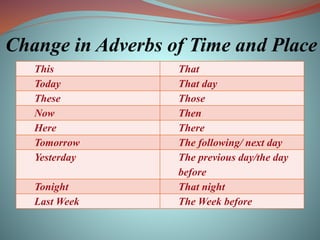
Change in Adverbs of Time and Place
This That
Today That day
These Those
Now Then
Here There
Tomorrow The following/ next day
Yesterday The previous day/the day
before
Tonight That night
Last Week The Week before
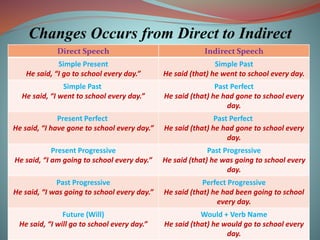
Changes Occurs from Direct to Indirect
Direct Speech Indirect Speech
Simple Present
He said, “I go to school every day.”
Simple Past
He said (that) he went to school every day.
Simple Past
He said, “I went to school every day.”
Past Perfect
He said (that) he had gone to school every
day.
Present Perfect
He said, “I have gone to school every day.”
Past Perfect
He said (that) he had gone to school every
day.
Present Progressive
He said, “I am going to school every day.”
Past Progressive
He said (that) he was going to school every
day.
Past Progressive
He said, “I was going to school every day.”
Perfect Progressive
He said (that) he had been going to school
every day.
Future (Will)
He said, “I will go to school every day.”
Would + Verb Name
He said (that) he would go to school every
day.
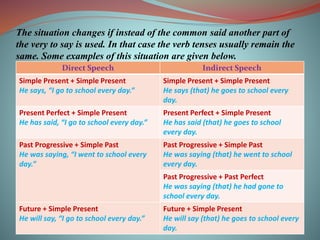
The situation changes if instead of the common said another part of
the very to say is used. In that case the verb tenses usually remain the
same. Some examples of this situation are given below.
Direct Speech Indirect Speech
Simple Present + Simple Present
He says, “I go to school every day.”
Simple Present + Simple Present
He says (that) he goes to school every
day.
Present Perfect + Simple Present
He has said, “I go to school every day.”
Present Perfect + Simple Present
He has said (that) he goes to school
every day.
Past Progressive + Simple Past
He was saying, “I went to school every
day.”
Past Progressive + Simple Past
He was saying (that) he went to school
every day.
Past Progressive + Past Perfect
He was saying (that) he had gone to
school every day.
Future + Simple Present
He will say, “I go to school every day.”
Future + Simple Present
He will say (that) he goes to school every
day.
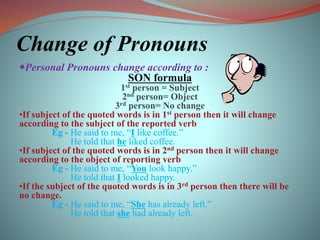
Change of Pronouns
Personal Pronouns change according to :
SON formula
1st person = Subject
2nd person= Object
3rd person= No change
•If subject of the quoted words is in 1st person then it will change
according to the subject of the reported verb
Eg - He said to me, “I like coffee.”
He told that he liked coffee.
•If subject of the quoted words is in 2nd person then it will change
according to the object of reporting verb
Eg - He said to me, “You look happy.”
He told that I looked happy.
•If the subject of the quoted words is in 3rd person then there will be
no change.
Eg - He said to me, “She has already left.”
He told that she had already left.
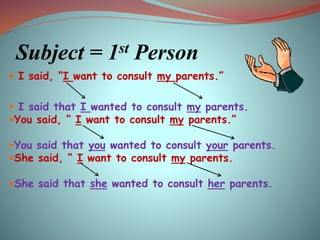
Subject = 1st Person
 I said, “I want to consult my parents.”
 I said that I wanted to consult my parents.
You said, “ I want to consult my parents.”
You said that you wanted to consult your parents.
She said, “ I want to consult my parents.
She said that she wanted to consult her parents.
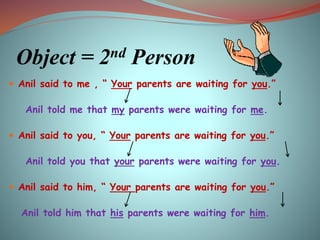
Object = 2nd Person
 Anil said to me , “ Your parents are waiting for you.”
Anil told me that my parents were waiting for me.
 Anil said to you, “ Your parents are waiting for you.”
Anil told you that your parents were waiting for you.
 Anil said to him, “ Your parents are waiting for you.”
Anil told him that his parents were waiting for him.
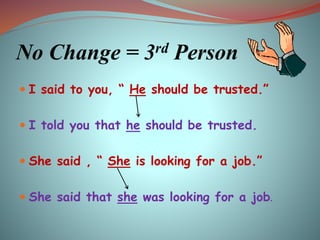
No Change = 3rd Person
 I said to you, “ He should be trusted.”
 I told you that he should be trusted.
 She said , “ She is looking for a job.”
 She said that she was looking for a job.
Direct And Indirect Speech

Direct And Indirect Speech

  • 1.
  • 2.
    Direct Speech  Directspeech is a report of the exact words used by a speaker or writer.  Direct speech is usually placed inside quotation marks and accompanied by a reporting verb, signal phrase, or quotative frame.  Example:- He said, ‘I am playing.’
  • 3.
    Indirect Speech  Indirectspeech is a report on what someone else said or wrote without using that person's exact words.  Indirect speech is not usually placed inside quotation marks.  Example:- He said that he was playing.
  • 4.
    What are theChanges When We are Using Speech • Omission of commas • Use of ‘that’ • Change of pronoun • Change of tense • Change of adverb
  • 5.
    Change in Adverbsof Time and Place This That Today That day These Those Now Then Here There Tomorrow The following/ next day Yesterday The previous day/the day before Tonight That night Last Week The Week before
  • 6.
    Changes Occurs fromDirect to Indirect Direct Speech Indirect Speech Simple Present He said, “I go to school every day.” Simple Past He said (that) he went to school every day. Simple Past He said, “I went to school every day.” Past Perfect He said (that) he had gone to school every day. Present Perfect He said, “I have gone to school every day.” Past Perfect He said (that) he had gone to school every day. Present Progressive He said, “I am going to school every day.” Past Progressive He said (that) he was going to school every day. Past Progressive He said, “I was going to school every day.” Perfect Progressive He said (that) he had been going to school every day. Future (Will) He said, “I will go to school every day.” Would + Verb Name He said (that) he would go to school every day.
  • 7.
    The situation changesif instead of the common said another part of the very to say is used. In that case the verb tenses usually remain the same. Some examples of this situation are given below. Direct Speech Indirect Speech Simple Present + Simple Present He says, “I go to school every day.” Simple Present + Simple Present He says (that) he goes to school every day. Present Perfect + Simple Present He has said, “I go to school every day.” Present Perfect + Simple Present He has said (that) he goes to school every day. Past Progressive + Simple Past He was saying, “I went to school every day.” Past Progressive + Simple Past He was saying (that) he went to school every day. Past Progressive + Past Perfect He was saying (that) he had gone to school every day. Future + Simple Present He will say, “I go to school every day.” Future + Simple Present He will say (that) he goes to school every day.
  • 8.
    Change of Pronouns PersonalPronouns change according to : SON formula 1st person = Subject 2nd person= Object 3rd person= No change •If subject of the quoted words is in 1st person then it will change according to the subject of the reported verb Eg - He said to me, “I like coffee.” He told that he liked coffee. •If subject of the quoted words is in 2nd person then it will change according to the object of reporting verb Eg - He said to me, “You look happy.” He told that I looked happy. •If the subject of the quoted words is in 3rd person then there will be no change. Eg - He said to me, “She has already left.” He told that she had already left.
  • 9.
    Subject = 1stPerson  I said, “I want to consult my parents.”  I said that I wanted to consult my parents. You said, “ I want to consult my parents.” You said that you wanted to consult your parents. She said, “ I want to consult my parents. She said that she wanted to consult her parents.
  • 10.
    Object = 2ndPerson  Anil said to me , “ Your parents are waiting for you.” Anil told me that my parents were waiting for me.  Anil said to you, “ Your parents are waiting for you.” Anil told you that your parents were waiting for you.  Anil said to him, “ Your parents are waiting for you.” Anil told him that his parents were waiting for him.
  • 11.
    No Change =3rd Person  I said to you, “ He should be trusted.”  I told you that he should be trusted.  She said , “ She is looking for a job.”  She said that she was looking for a job.