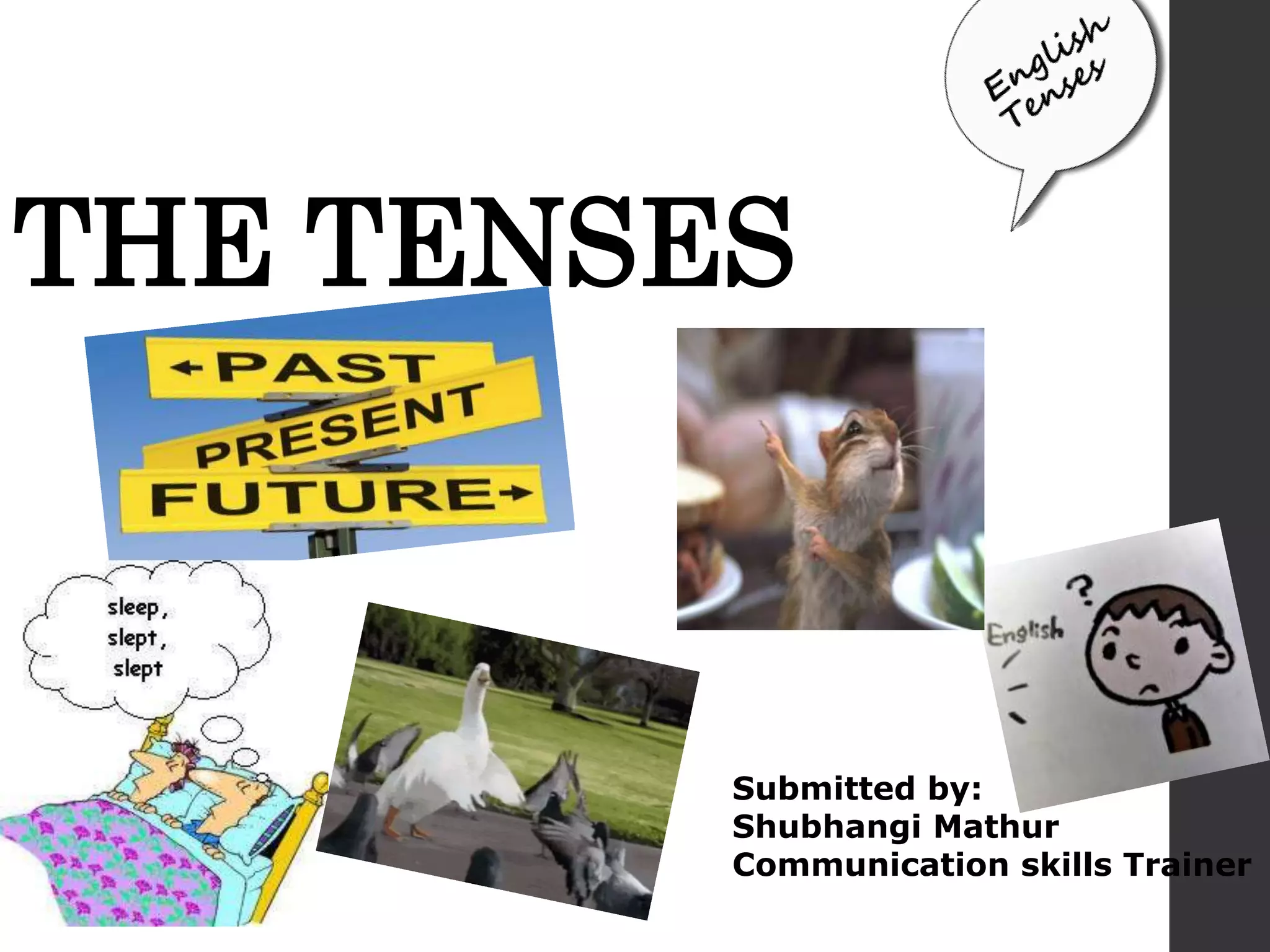
THE TENSES
Submitted by:
Shubhangi Mathur
Communication skills Trainer
•The correct use of tenses will help to speak with people clearly and effectively, it
enables us to raise the level of readability of the business writings and on the
other it allows the readers to comprehend accurately what we have written using
English tenses.
•Since there are many ways in which we express the time of action, we use
tenses. It must be borne in mind that in a given situation or in accordance with
the time, one should use an appropriate tense so as to maintain effective
communication. In this way, it is necessary to determine various aspects in
terms of English verbs, such as, the state of being, continuing action or action
completed. In doing so, you need to know how to conjugate verbs properly by
focusing on the structures of tenses and modal tenses, so that you can create
clear and effective sentences.
•The concept of English verb tenses is very important in establishing effective
communication. Hence, if you want to maintain both ways of communication
better, that is, speaking and writing. You need to gain mastery over English
tenses, because a command of twelve basic tenses of English language will aid
you immensely in gaining effective communication skills.
Expected Outcome
After the completion of this topic,
students will be :
• Be able to express themselves more
confidently and correctly.
• Be able to form complex sentences.
• This will also help in other grammar
units- active and passive voice, direct
and indirect speech, form of verbs etc.
• This will help in better understanding
of views of a particular person while
conversing.
CONTENTS
• Introduction
• Classification based on Time Frame
• Classification based on Aspect
• Block diagram of Tenses
• List of Rules
• Present Tense
• Past Tense
• Future Tense
• List of Examples
INTRODUCTION
The word Tense is
derived from Latin word
“tempus” which means
time. A verb indicates the
time of an action, event
or condition by changing
its form.
Based on Time frame
The verb tenses may
be categorized according
to the time frame:
Present Tense
Past Tense
Future Tense
Present Tense :---
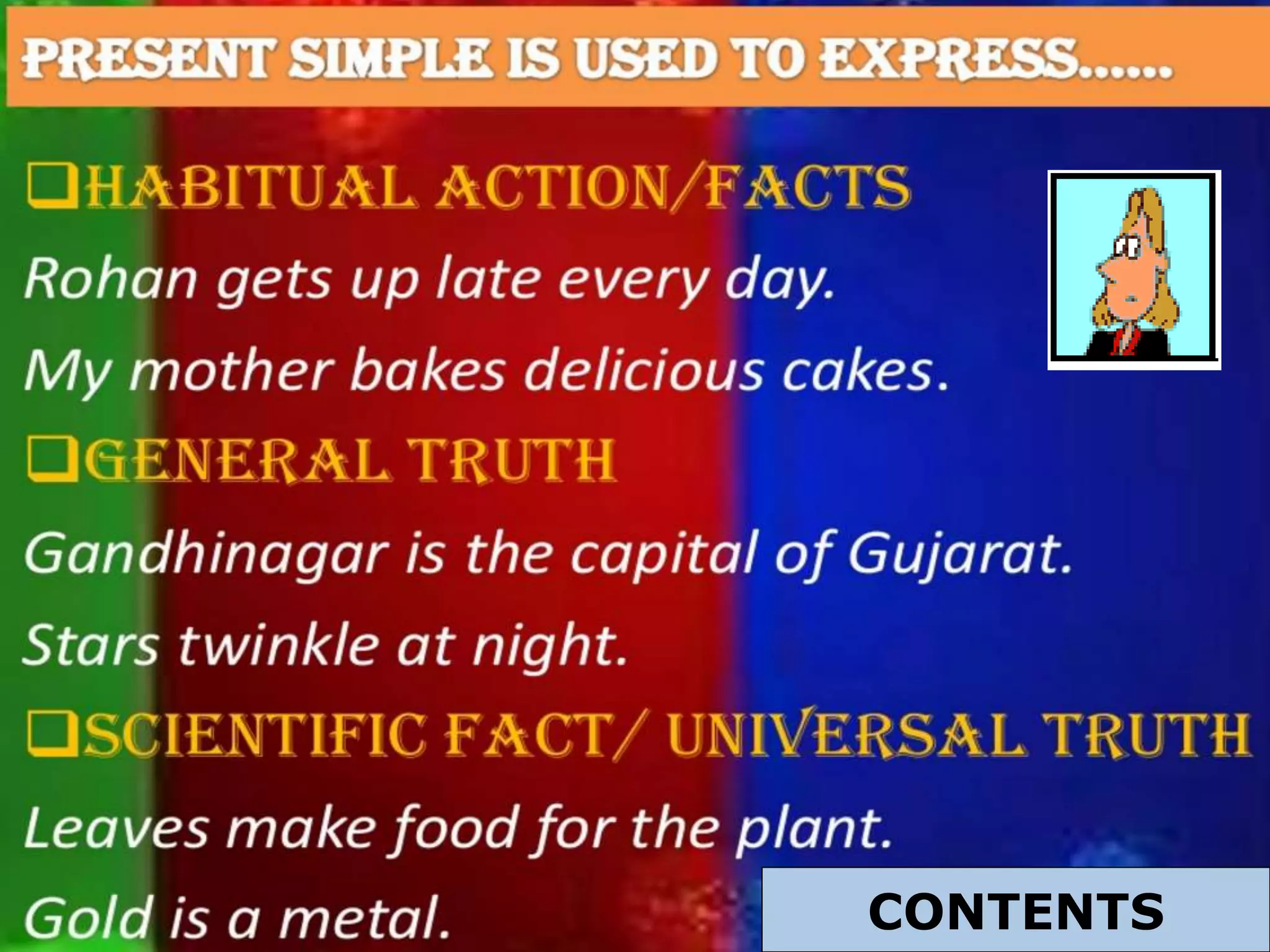
Present tense expresses an unchanging,
repeated, or reoccurring action or situation that
exists only now. It can also represent a widespread
truth.
Past Tense :---
Past tense expresses an action or
situation that was started and finished in the past.
Future Tense :---
Future tense expresses an action or
situation that will occur in the future.
CONTENTS
Based on Aspect
Verb tenses may also be categorized
according to aspect. Aspect refers to
the nature of the action described by
the verb. There are four aspects:
Indefinite or Simple
Continuous or Progressive
Perfect or Complete
Perfect Continuous
Indefinite Tense
The three indefinite tenses, or simple tenses, describe an action but do not state
whether the action is finished.
Continuous Tense
The three continuous tenses, incomplete tenses, or progressive tenses, describe an
unfinished action.
Perfect Tense
The three complete tenses, or perfect tenses, describe a finished action.
Perfect Continuous Tense
To combine the complete tenses and the incomplete tenses, to describe an action which
was in progress and then finished
CONTENTS
There are twelve possible verb
tenses.
Verb Tenses
Present
Present Indefinite
Present Continuous
Present Perfect
Present Perfect Cont.
Past
Past Indefinite
Past Continuous
Past Perfect
Past Perfect Cont.
Future
Future Indefinite
Future Continuous
Future Perfect
Future Perfect Cont.
Here is a list of rules of these
tenses:
Simple
Forms
Progressive
Forms
Perfect
Forms
Perfect
Progressiv
e Forms
Present
Ist form
+ s / es
am/is/are +
Ist form +
ing
have/ha
s +
IIIrd
form
have/has
been + Ist
form + ing
Past IInd form
was/were +
Ist form +
ing
had +
IIIrd
form
had been +
Ist form +
ing
Future
will/shall
+ Ist
form
will be + Ist
form + ing
will
have +
IIIrd
form
will have
been + Ist
form + ing
Present Tense
Present
Present
Indefinite
Tense
Present
Continuous
Tense
Present Perfect
Tense
Present Perfect
Cont.Tense
Present Indefinite Tense
The simple present is used to describe an
action, an event, or condition that is occurring in the
present, at the moment of speaking or writing.
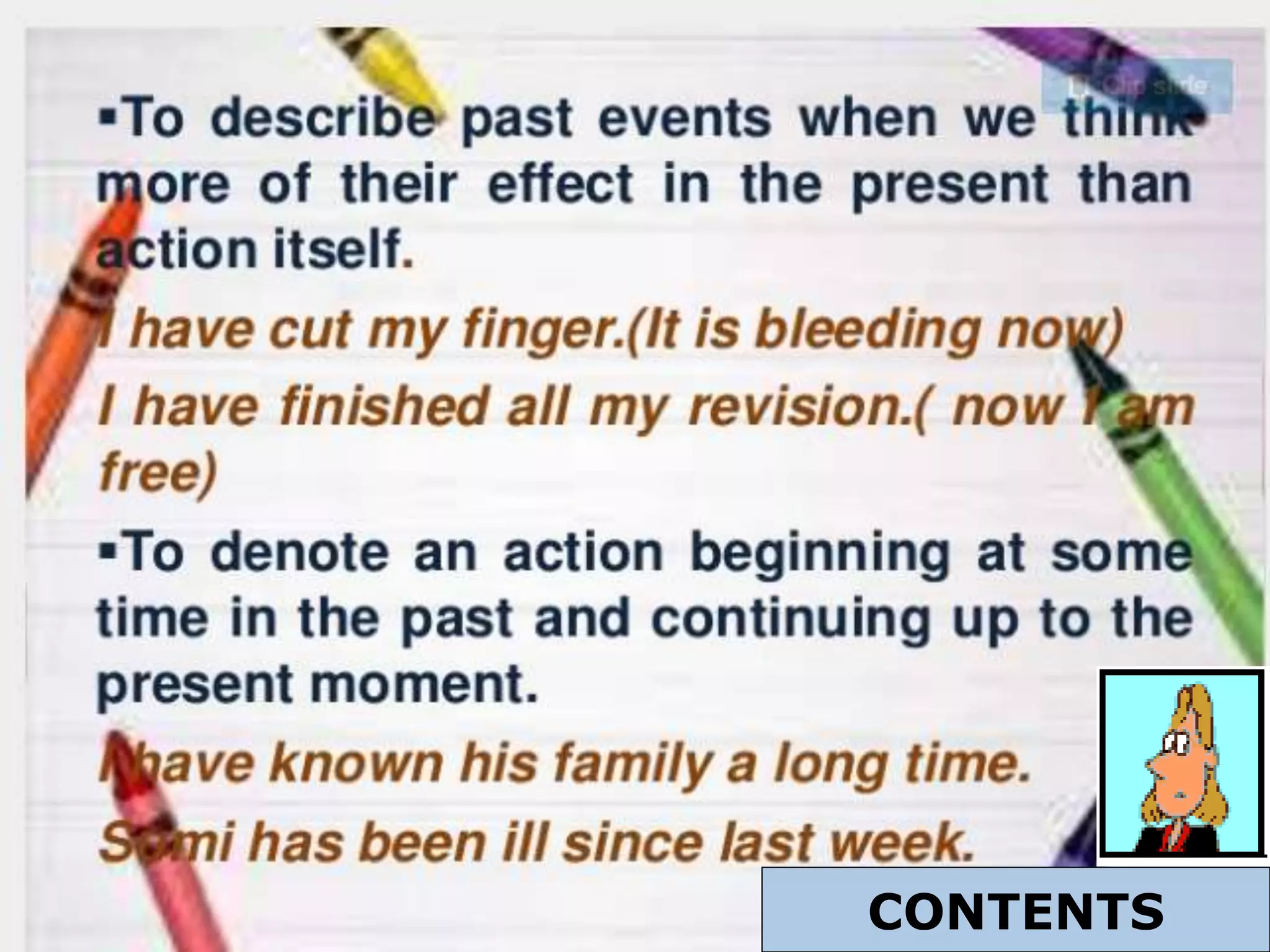
For Example—
I play.
He / She plays.
Present Continuous Tense
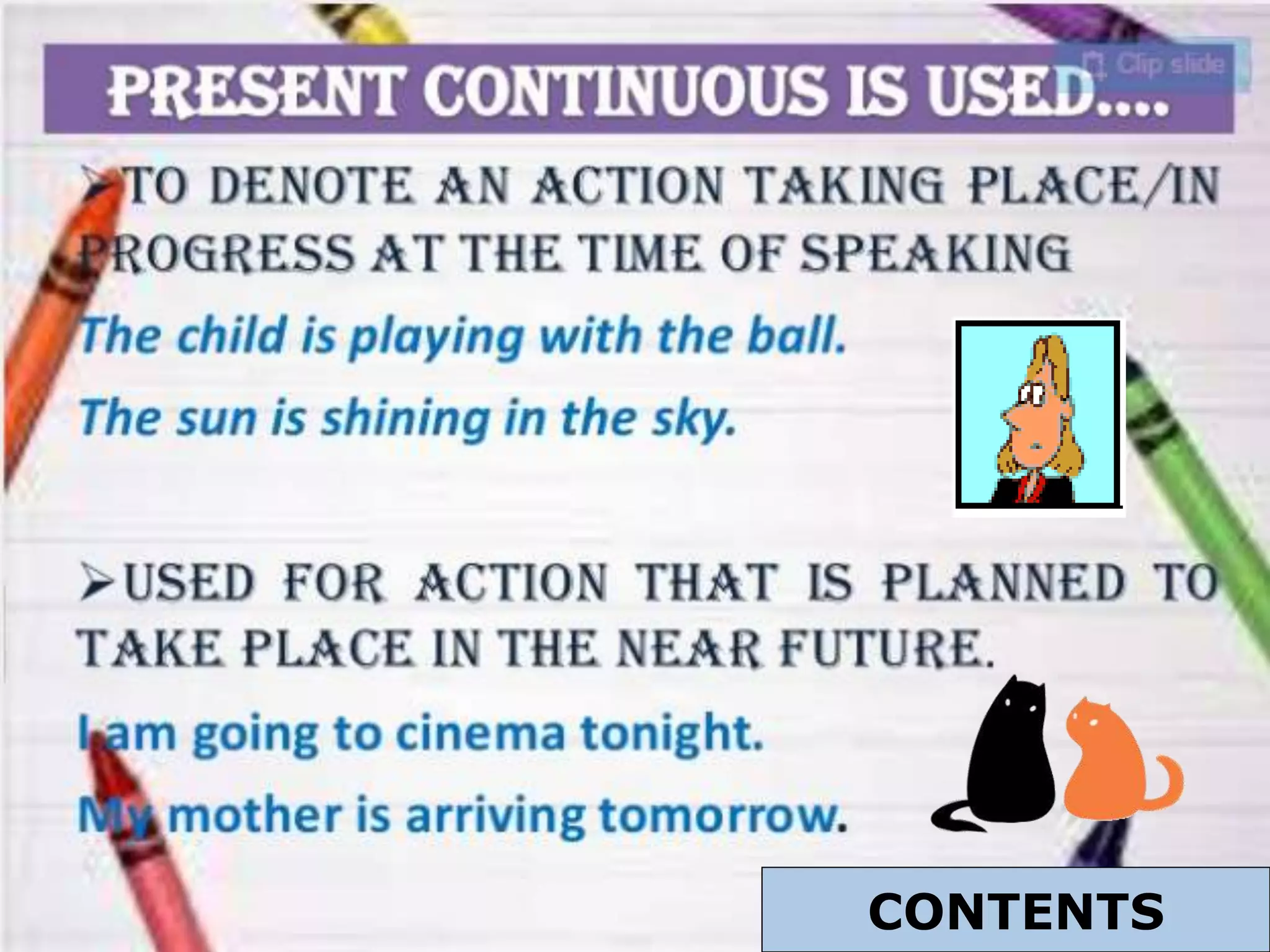
The present continuous emphasizes the
continuing nature of an act, event, or condition.
For Example—
I am playing.
He / She is playing.
They are playing.
Present Perfect Tense
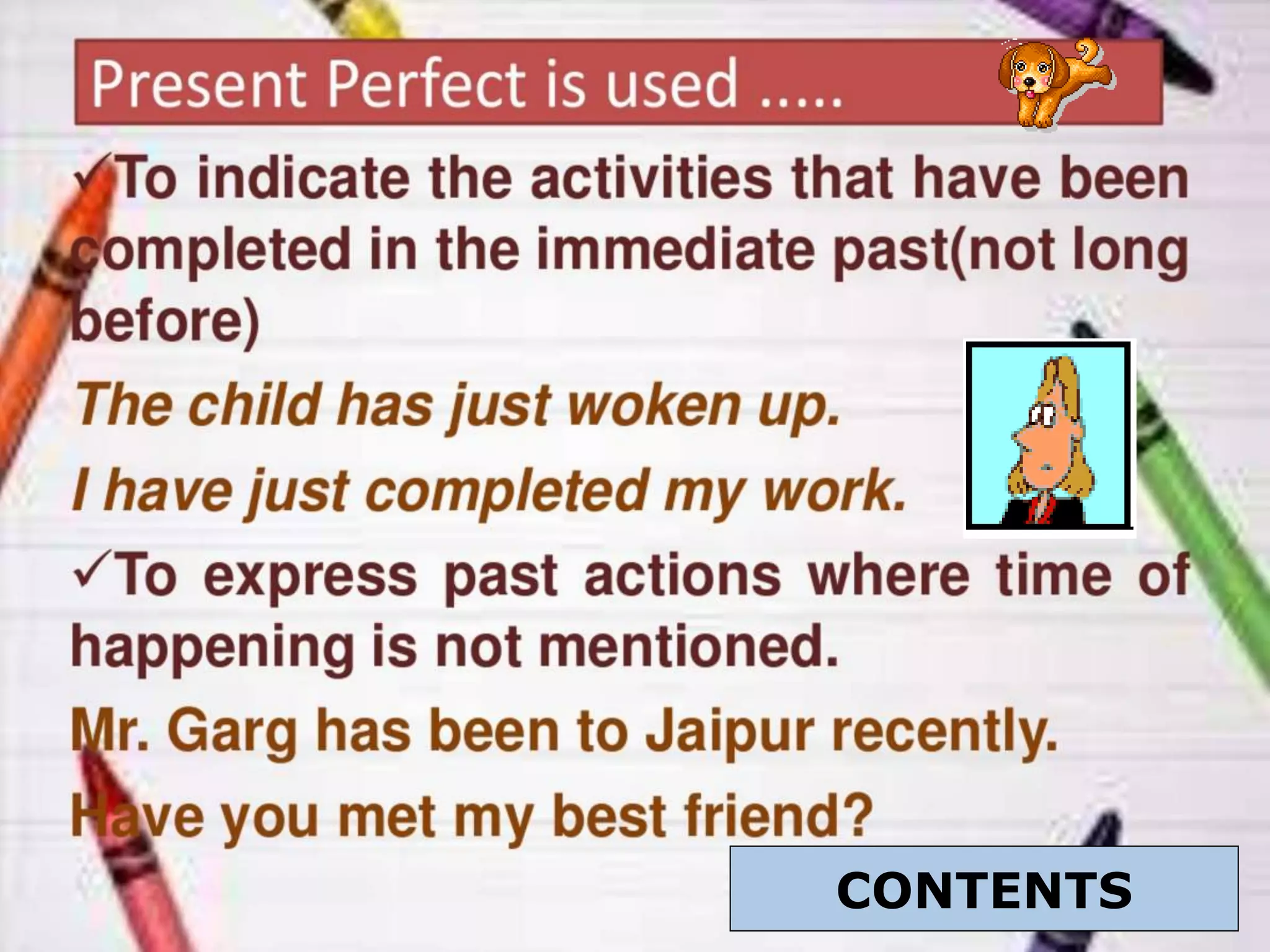
The present perfect tense is used to
describe action that began in the past and continues into
the present or has just been completed.
For Example—
I have played.
He / She has played.
Present Perfect Cont.Tense
The present perfect continuous is used to
describe an action, event, or condition that has begun in
the past and continues into the present.
For Example—
I / You have been playing.
He / She has been playing.
CONTENTS
Past Tense
Past
Past Indefinite
Tense
Past
Continuous
Tense
Past Perfect
Tense
Past Perfect
Cont.Tense
Past Indefinite Tense
The simple past is used to describe an
action, an event, or condition that occurred in the past.
For Example—
I played.
He / She played.
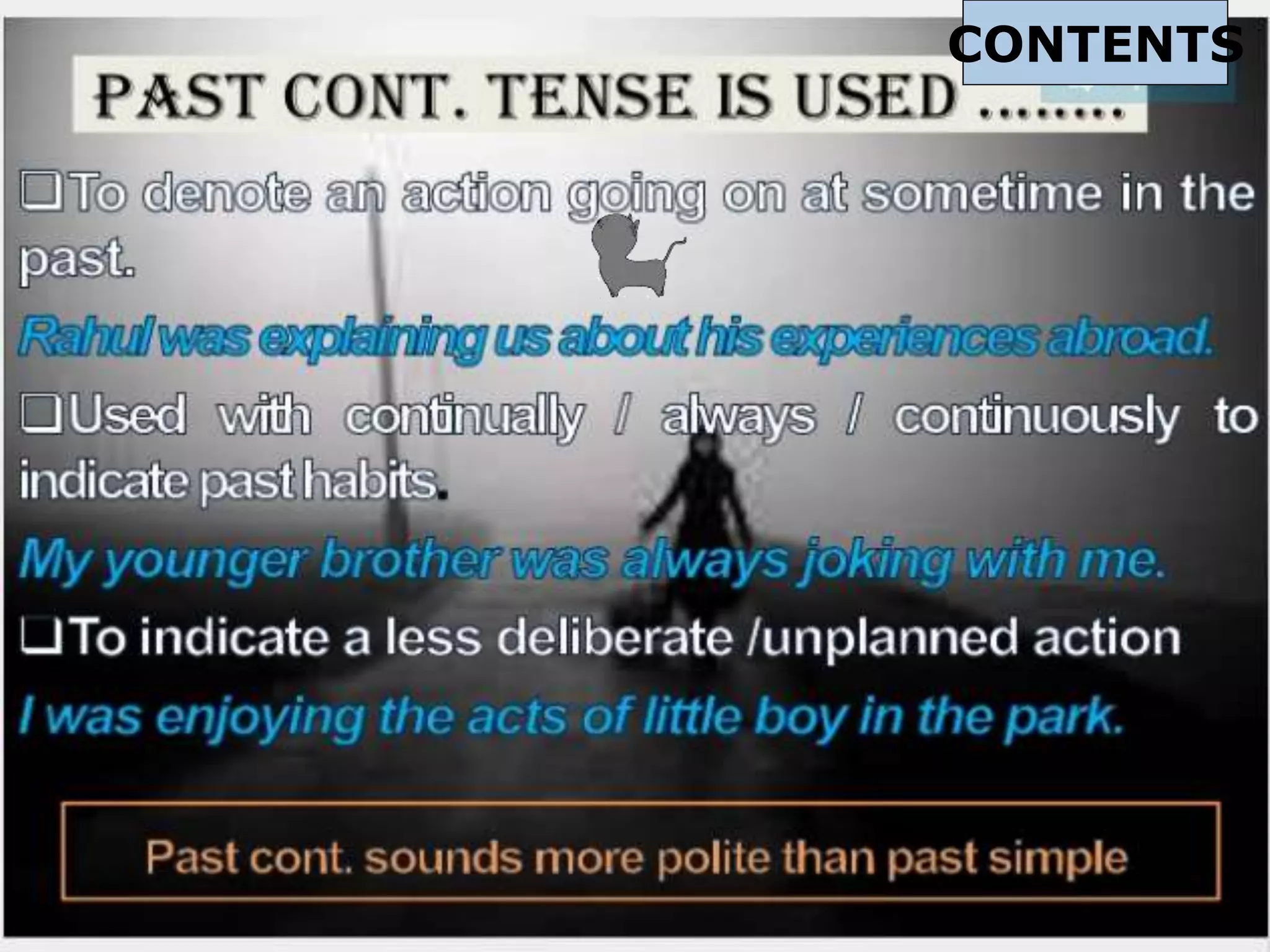
Past Continuous Tense
The past continuous tense is
used to described actions ongoing in
the past.
For Example—
I was playing.
He / She was playing.
You were playing.
Past Perfect Tense
The past perfect tense is used to refer to
actions that took place and were completed in the past.
For Example—
I had played.
He / She had played.
Past Perfect Cont.Tense
The past perfect continuous is used to
indicate that a continuing action in the past began
before another past action began or interrupted the first
action.
For Example—
I had been playing.
He / She had been playing.
CONTENTS
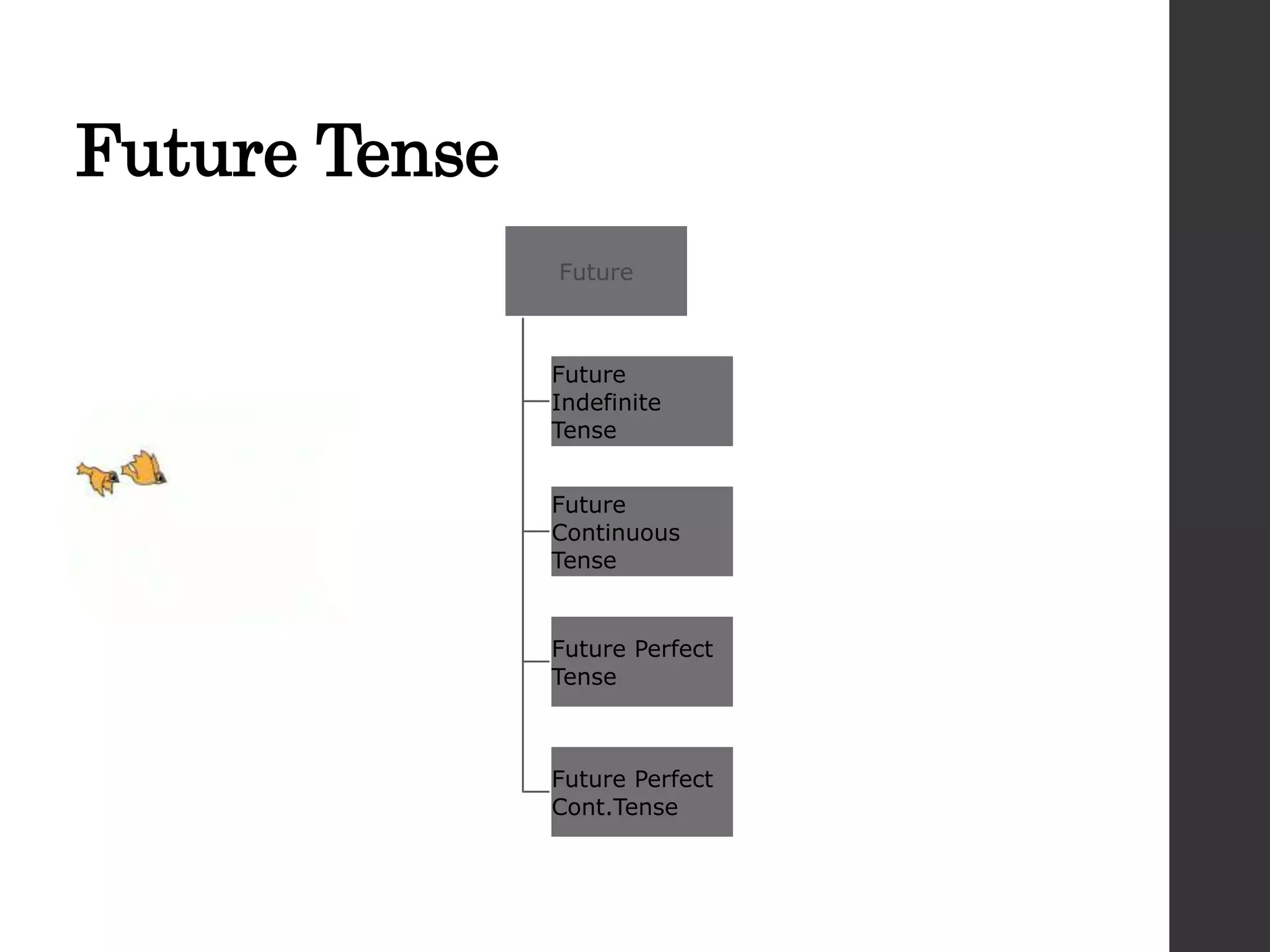
Future Tense
Future
Future
Indefinite
Tense
Future
Continuous
Tense
Future Perfect
Tense
Future Perfect
Cont.Tense
Future Indefinite Tense
The simple future is used to refer to
actions that will take place after the act of speaking or
writing.
For Example—
I shall play.
He / She will play.
Future Continuous Tense
The future continuous tense is used to
describe actions ongoing in the future. The future
progressive is used to refer to continuing action that will
occur in the future.
For Example—
I shall be playing.
He / She will be playing.
Future Perfect Tense
The future perfect is used to refer to an
action that will be completed sometime in the future
before another action takes place.
For Example—
I shall have played.
He / She will have played.
Future Perfect Continuous
Tense
The future perfect
continuous tense is used to indicate a
continuing action that will be
completed at some specified time in the
future.
For Example—
I shall have been playing.
He / She will have been playing.
CONTENTS
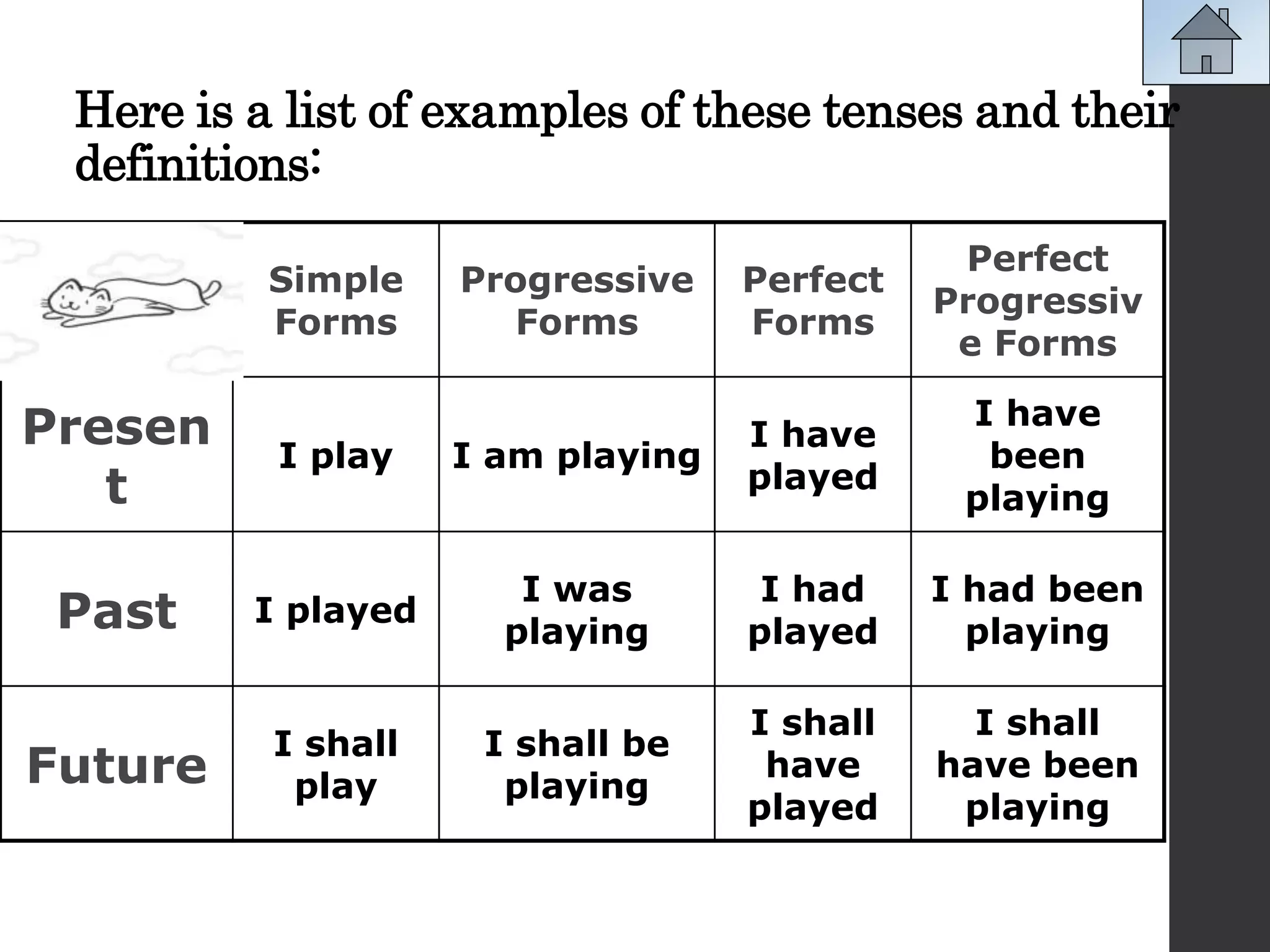
Here is a list of examples of these tenses and their
definitions:
Simple
Forms
Progressive
Forms
Perfect
Forms
Perfect
Progressiv
e Forms
Presen
t
I play I am playing
I have
played
I have
been
playing
Past I played
I was
playing
I had
played
I had been
playing
Future
I shall
play
I shall be
playing
I shall
have
played
I shall
have been
playing
CONTENTS
CONTENTS
CONTENTS
CONTENTS
CONTENTS
CONTENTS
CONTENTS
CONTENTS
CONTENTS
CONTENTS
CONTENTS
CONTENTS
CONTENTS
CONTENTS
Finally, Test
Multiple Choice Questions1. Although the police ______ every precaution, the robber managed
to escape.
(A)take (B)takes (C)has taken (D)had taken
2. The boys ______ television every night unless they have
homework.
(A)watch (B)watches (C)watched (D)watching
3. Maria ______ an appointment to see the doctor. It is at 10.00 am.
tomorrow.
(A)make (B)makes (C)made (D)has made
4. They ______ when they are ready.
(A)come (B)came (C)will come (D)have come
5. Judy ______ watching horror films although she has nightmares
afterwards.
(A)like (B)likes (C)liked (D)will like
6. It ______ every afternoon for the past week. The weather forecast
predicts rain for next week too.
(A)is raining (B)was raining (C)has been raining
(D)had been raining
7. I ______ the door before I realized that the keys were inside the
house.
(A)lock (B)locked (C)has locked (D)had locked
8. When Sally ______ her first pay, she bought presents for her
parents.
(A)receive (B)received (C)has received (D)had received
9. It's lovely to wake up in the morning and ______ birds singing.
(A)hear (B)hears (C)heard (D)hearing
10. Aaron ______ $80.00 for that bag.
(A)pay (B)paid (C)pays (D)paying
11. When I went back to my hometown three years ago, I found that a lot
of changes ______.
(A)are taken place (B)were taken place (C)have taken place (D)had
taken place
12. Lo ok ! A hamster ______ by a cat.
(A)is chased (B)is being chased(C)was being chased (D)has been chased
13. I'm sorry the house is not available any longer. It ______ to a timber
tycoon.
(A)is sold (B)was being sold (C)has been sold
(D)will be sold
14. Ai Ling ______ to Manhattan is 1997.
(A)is transferred (B)was transferred (C)has been transferred (D)should
be transferred
15. Passengers ______ to smoke in the train.
(A)are not allowed (B)was not allowed (C)had not allowed (D)will not
allow
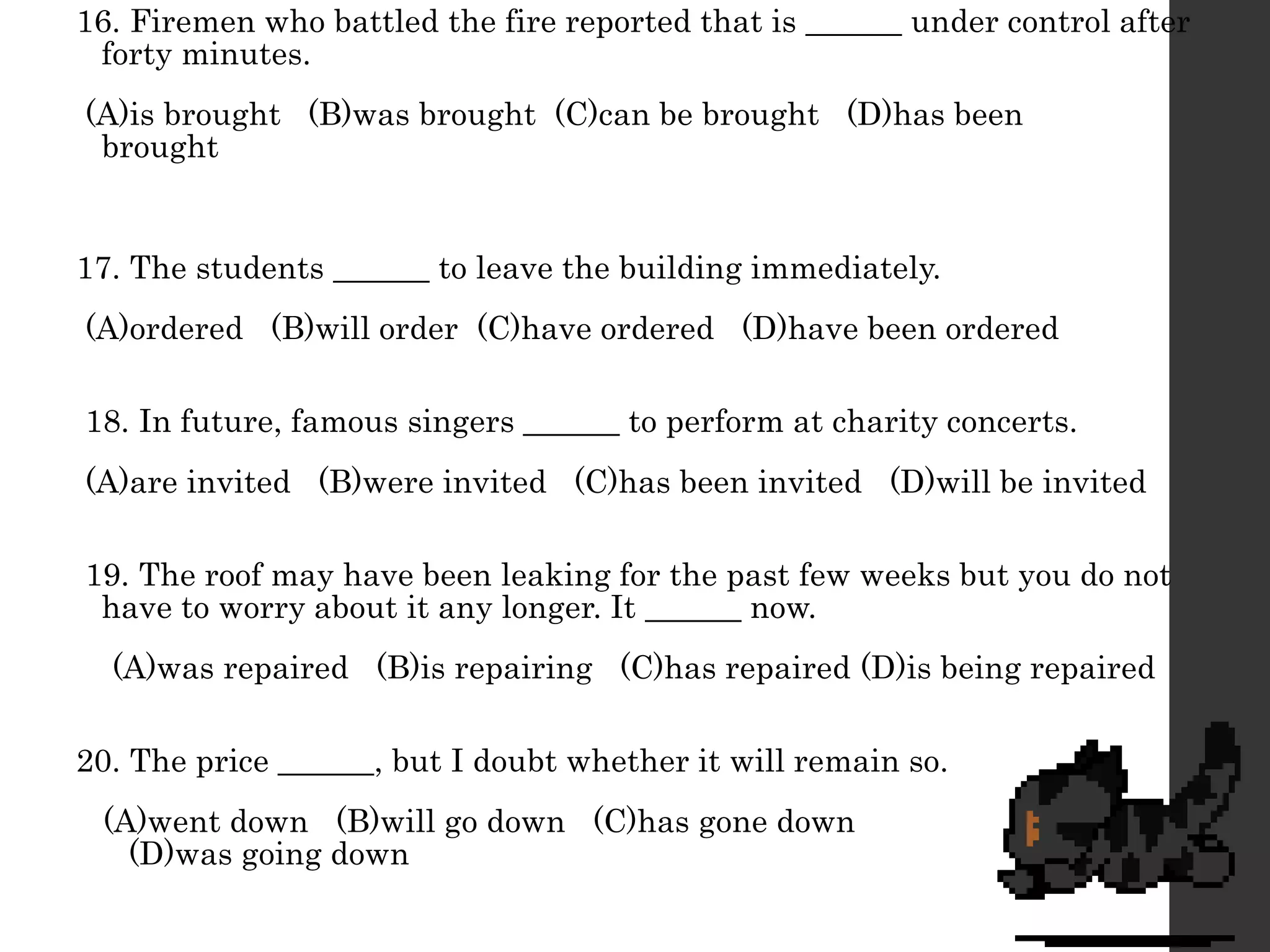
16. Firemen who battled the fire reported that is ______ under control after
forty minutes.
(A)is brought (B)was brought (C)can be brought (D)has been
brought
17. The students ______ to leave the building immediately.
(A)ordered (B)will order (C)have ordered (D)have been ordered
18. In future, famous singers ______ to perform at charity concerts.
(A)are invited (B)were invited (C)has been invited (D)will be invited
19. The roof may have been leaking for the past few weeks but you do not
have to worry about it any longer. It ______ now.
(A)was repaired (B)is repairing (C)has repaired (D)is being repaired
20. The price ______, but I doubt whether it will remain so.
(A)went down (B)will go down (C)has gone down
(D)was going down
Identify the verb and state the tense:
1. I have been working on my computer for six hours.
(…………………………………………….)
2. She has lived in this street for ten years. (…………………………………………….)
3. I finished the project yesterday. (…………………………………………….)
4. What are you doing there? (…………………………………………….)
5. She had not realized that. (…………………………………………….)
6. Susan will be joining us. (…………………………………………….)
7. Have you ever been to Australia? (…………………………………………….)
8. This house had been destroyed by the fire. (…………………………………………….)
9. The boys were severely reprimanded by their teacher.
(…………………………………………….)
10. I had been working in the garden. (…………………………………………….)
A few more:
Which tense is used in each of these senten
1. Why do you live in France?
2. You are visiting englishclub.com.
3. I haven't had breakfast yet.
4. Were you working at 9 o'clock?
5. Did Tara phone you yesterday?
6. We'll have finished by 6pm.
7. Will he still be travelling this evening?
8. The train had already left.
9. Will you be in Bangkok tomorrow?
10. Yes, I did take the TOEFL exam.
References
• High school grammar- Wren and Martin
• www.slideshare.com
• www.englishdaily.com
• www.thegrammartree.com
The Tenses and their Application

The Tenses and their Application

  • 1.
    THE TENSES Submitted by: ShubhangiMathur Communication skills Trainer
  • 2.
    •The correct useof tenses will help to speak with people clearly and effectively, it enables us to raise the level of readability of the business writings and on the other it allows the readers to comprehend accurately what we have written using English tenses. •Since there are many ways in which we express the time of action, we use tenses. It must be borne in mind that in a given situation or in accordance with the time, one should use an appropriate tense so as to maintain effective communication. In this way, it is necessary to determine various aspects in terms of English verbs, such as, the state of being, continuing action or action completed. In doing so, you need to know how to conjugate verbs properly by focusing on the structures of tenses and modal tenses, so that you can create clear and effective sentences. •The concept of English verb tenses is very important in establishing effective communication. Hence, if you want to maintain both ways of communication better, that is, speaking and writing. You need to gain mastery over English tenses, because a command of twelve basic tenses of English language will aid you immensely in gaining effective communication skills.
  • 3.
    Expected Outcome After thecompletion of this topic, students will be : • Be able to express themselves more confidently and correctly. • Be able to form complex sentences. • This will also help in other grammar units- active and passive voice, direct and indirect speech, form of verbs etc. • This will help in better understanding of views of a particular person while conversing.
  • 5.
    CONTENTS • Introduction • Classificationbased on Time Frame • Classification based on Aspect • Block diagram of Tenses • List of Rules • Present Tense • Past Tense • Future Tense • List of Examples
  • 6.
    INTRODUCTION The word Tenseis derived from Latin word “tempus” which means time. A verb indicates the time of an action, event or condition by changing its form.
  • 7.
    Based on Timeframe The verb tenses may be categorized according to the time frame: Present Tense Past Tense Future Tense
  • 8.
    Present Tense :--- Presenttense expresses an unchanging, repeated, or reoccurring action or situation that exists only now. It can also represent a widespread truth. Past Tense :--- Past tense expresses an action or situation that was started and finished in the past. Future Tense :--- Future tense expresses an action or situation that will occur in the future. CONTENTS
  • 9.
    Based on Aspect Verbtenses may also be categorized according to aspect. Aspect refers to the nature of the action described by the verb. There are four aspects: Indefinite or Simple Continuous or Progressive Perfect or Complete Perfect Continuous
  • 10.
    Indefinite Tense The threeindefinite tenses, or simple tenses, describe an action but do not state whether the action is finished. Continuous Tense The three continuous tenses, incomplete tenses, or progressive tenses, describe an unfinished action. Perfect Tense The three complete tenses, or perfect tenses, describe a finished action. Perfect Continuous Tense To combine the complete tenses and the incomplete tenses, to describe an action which was in progress and then finished CONTENTS
  • 11.
    There are twelvepossible verb tenses. Verb Tenses Present Present Indefinite Present Continuous Present Perfect Present Perfect Cont. Past Past Indefinite Past Continuous Past Perfect Past Perfect Cont. Future Future Indefinite Future Continuous Future Perfect Future Perfect Cont.
  • 12.
    Here is alist of rules of these tenses: Simple Forms Progressive Forms Perfect Forms Perfect Progressiv e Forms Present Ist form + s / es am/is/are + Ist form + ing have/ha s + IIIrd form have/has been + Ist form + ing Past IInd form was/were + Ist form + ing had + IIIrd form had been + Ist form + ing Future will/shall + Ist form will be + Ist form + ing will have + IIIrd form will have been + Ist form + ing
  • 13.
  • 14.
    Present Indefinite Tense Thesimple present is used to describe an action, an event, or condition that is occurring in the present, at the moment of speaking or writing. For Example— I play. He / She plays.
  • 15.
    Present Continuous Tense Thepresent continuous emphasizes the continuing nature of an act, event, or condition. For Example— I am playing. He / She is playing. They are playing.
  • 16.
    Present Perfect Tense Thepresent perfect tense is used to describe action that began in the past and continues into the present or has just been completed. For Example— I have played. He / She has played.
  • 17.
    Present Perfect Cont.Tense Thepresent perfect continuous is used to describe an action, event, or condition that has begun in the past and continues into the present. For Example— I / You have been playing. He / She has been playing. CONTENTS
  • 18.
  • 19.
    Past Indefinite Tense Thesimple past is used to describe an action, an event, or condition that occurred in the past. For Example— I played. He / She played.
  • 20.
    Past Continuous Tense Thepast continuous tense is used to described actions ongoing in the past. For Example— I was playing. He / She was playing. You were playing.
  • 21.
    Past Perfect Tense Thepast perfect tense is used to refer to actions that took place and were completed in the past. For Example— I had played. He / She had played.
  • 22.
    Past Perfect Cont.Tense Thepast perfect continuous is used to indicate that a continuing action in the past began before another past action began or interrupted the first action. For Example— I had been playing. He / She had been playing. CONTENTS
  • 23.
  • 24.
    Future Indefinite Tense Thesimple future is used to refer to actions that will take place after the act of speaking or writing. For Example— I shall play. He / She will play.
  • 25.
    Future Continuous Tense Thefuture continuous tense is used to describe actions ongoing in the future. The future progressive is used to refer to continuing action that will occur in the future. For Example— I shall be playing. He / She will be playing.
  • 26.
    Future Perfect Tense Thefuture perfect is used to refer to an action that will be completed sometime in the future before another action takes place. For Example— I shall have played. He / She will have played.
  • 27.
    Future Perfect Continuous Tense Thefuture perfect continuous tense is used to indicate a continuing action that will be completed at some specified time in the future. For Example— I shall have been playing. He / She will have been playing. CONTENTS
  • 28.
    Here is alist of examples of these tenses and their definitions: Simple Forms Progressive Forms Perfect Forms Perfect Progressiv e Forms Presen t I play I am playing I have played I have been playing Past I played I was playing I had played I had been playing Future I shall play I shall be playing I shall have played I shall have been playing
  • 30.
  • 31.
  • 32.
  • 33.
  • 34.
  • 35.
  • 36.
  • 37.
  • 38.
  • 39.
  • 40.
  • 41.
  • 42.
  • 43.
  • 44.
  • 45.
    Multiple Choice Questions1.Although the police ______ every precaution, the robber managed to escape. (A)take (B)takes (C)has taken (D)had taken 2. The boys ______ television every night unless they have homework. (A)watch (B)watches (C)watched (D)watching 3. Maria ______ an appointment to see the doctor. It is at 10.00 am. tomorrow. (A)make (B)makes (C)made (D)has made 4. They ______ when they are ready. (A)come (B)came (C)will come (D)have come 5. Judy ______ watching horror films although she has nightmares afterwards. (A)like (B)likes (C)liked (D)will like
  • 46.
    6. It ______every afternoon for the past week. The weather forecast predicts rain for next week too. (A)is raining (B)was raining (C)has been raining (D)had been raining 7. I ______ the door before I realized that the keys were inside the house. (A)lock (B)locked (C)has locked (D)had locked 8. When Sally ______ her first pay, she bought presents for her parents. (A)receive (B)received (C)has received (D)had received 9. It's lovely to wake up in the morning and ______ birds singing. (A)hear (B)hears (C)heard (D)hearing 10. Aaron ______ $80.00 for that bag. (A)pay (B)paid (C)pays (D)paying
  • 47.
    11. When Iwent back to my hometown three years ago, I found that a lot of changes ______. (A)are taken place (B)were taken place (C)have taken place (D)had taken place 12. Lo ok ! A hamster ______ by a cat. (A)is chased (B)is being chased(C)was being chased (D)has been chased 13. I'm sorry the house is not available any longer. It ______ to a timber tycoon. (A)is sold (B)was being sold (C)has been sold (D)will be sold 14. Ai Ling ______ to Manhattan is 1997. (A)is transferred (B)was transferred (C)has been transferred (D)should be transferred 15. Passengers ______ to smoke in the train. (A)are not allowed (B)was not allowed (C)had not allowed (D)will not allow
  • 48.
    16. Firemen whobattled the fire reported that is ______ under control after forty minutes. (A)is brought (B)was brought (C)can be brought (D)has been brought 17. The students ______ to leave the building immediately. (A)ordered (B)will order (C)have ordered (D)have been ordered 18. In future, famous singers ______ to perform at charity concerts. (A)are invited (B)were invited (C)has been invited (D)will be invited 19. The roof may have been leaking for the past few weeks but you do not have to worry about it any longer. It ______ now. (A)was repaired (B)is repairing (C)has repaired (D)is being repaired 20. The price ______, but I doubt whether it will remain so. (A)went down (B)will go down (C)has gone down (D)was going down
  • 49.
    Identify the verband state the tense: 1. I have been working on my computer for six hours. (…………………………………………….) 2. She has lived in this street for ten years. (…………………………………………….) 3. I finished the project yesterday. (…………………………………………….) 4. What are you doing there? (…………………………………………….) 5. She had not realized that. (…………………………………………….) 6. Susan will be joining us. (…………………………………………….) 7. Have you ever been to Australia? (…………………………………………….) 8. This house had been destroyed by the fire. (…………………………………………….) 9. The boys were severely reprimanded by their teacher. (…………………………………………….) 10. I had been working in the garden. (…………………………………………….)
  • 50.
    A few more: Whichtense is used in each of these senten 1. Why do you live in France? 2. You are visiting englishclub.com. 3. I haven't had breakfast yet. 4. Were you working at 9 o'clock? 5. Did Tara phone you yesterday? 6. We'll have finished by 6pm. 7. Will he still be travelling this evening? 8. The train had already left. 9. Will you be in Bangkok tomorrow? 10. Yes, I did take the TOEFL exam.
  • 51.
    References • High schoolgrammar- Wren and Martin • www.slideshare.com • www.englishdaily.com • www.thegrammartree.com