Direct and Indirect
      Speech
By the end of the lesson I will:
• Understand the difference between direct
  and indirect speech.
• Be able to apply this knowledge in my
  writing.
• Accurately punctuate direct and indirect
  speech
• Know when and how to change pronouns
  and verb tenses in indirect speech.
Direct speech
When we use direct speech in our writing:
• The exact words spoken must be put inside
  speech marks. “ ”
• The first spoken word must have a capital
  letter.
• When a new speaker begins, we must start
  a new line.
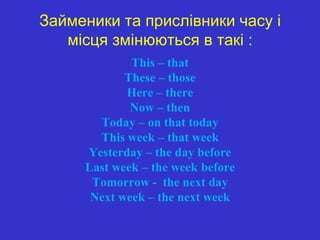
Займеники та прислівники часу і
   місця змінюються в такі :
             This – that
            These – those
            Here – there
             Now – then
       Today – on that today
       This week – that week
     Yesterday – the day before
     Last week – the week before
      Tomorrow - the next day
      Next week – the next week
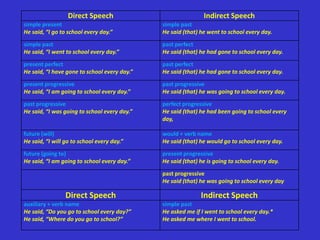
Direct Speech                               Indirect Speech
simple present                                simple past
He said, “I go to school every day.”          He said (that) he went to school every day.
simple past                                   past perfect
He said, “I went to school every day.”        He said (that) he had gone to school every day.
present perfect                               past perfect
He said, “I have gone to school every day.”   He said (that) he had gone to school every day.
present progressive                           past progressive
He said, “I am going to school every day.”    He said (that) he was going to school every day.
past progressive                              perfect progressive
He said, “I was going to school every day.”   He said (that) he had been going to school every
                                              day,

future (will)                                 would + verb name
He said, “I will go to school every day.”     He said (that) he would go to school every day.
future (going to)                             present progressive
He said, “I am going to school every day.”    He said (that) he is going to school every day.
                                              past progressive
                                              He said (that) he was going to school every day

                 Direct Speech                               Indirect Speech
auxiliary + verb name                         simple past
He said, “Do you go to school every day?”     He asked me if I went to school every day.*
He said, “Where do you go to school?”         He asked me where I went to school.
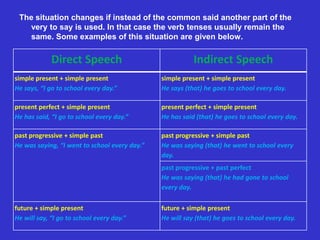
The situation changes if instead of the common said another part of the
   very to say is used. In that case the verb tenses usually remain the
   same. Some examples of this situation are given below.

             Direct Speech                                Indirect Speech
simple present + simple present                simple present + simple present
He says, “I go to school every day.”           He says (that) he goes to school every day.

present perfect + simple present               present perfect + simple present
He has said, “I go to school every day.”       He has said (that) he goes to school every day.

past progressive + simple past                 past progressive + simple past
He was saying, “I went to school every day.”   He was saying (that) he went to school every
                                               day.
                                               past progressive + past perfect
                                               He was saying (that) he had gone to school
                                               every day.

future + simple present                        future + simple present
He will say, “I go to school every day.”       He will say (that) he goes to school every day.
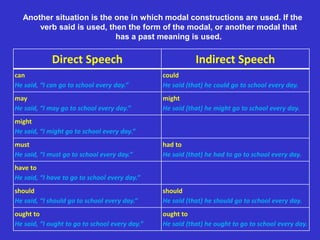
Another situation is the one in which modal constructions are used. If the
      verb said is used, then the form of the modal, or another modal that
                           has a past meaning is used.

             Direct Speech                                 Indirect Speech
can                                             could
He said, “I can go to school every day.”        He said (that) he could go to school every day.
may                                             might
He said, “I may go to school every day.”        He said (that) he might go to school every day.
might
He said, “I might go to school every day.”
must                                            had to
He said, “I must go to school every day.”       He said (that) he had to go to school every day.
have to
He said, “I have to go to school every day.”
should                                          should
He said, “I should go to school every day.”     He said (that) he should go to school every day.
ought to                                        ought to
He said, “I ought to go to school every day.”   He said (that) he ought to go to school every day.
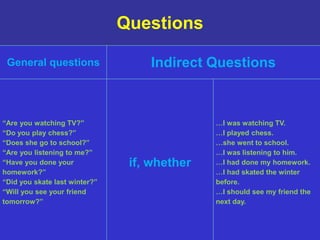
Questions

 General questions                 Indirect Questions


“Are you watching TV?”                        …I was watching TV.
“Do you play chess?”                          …I played chess.
“Does she go to school?”                      …she went to school.
“Are you listening to me?”                    …I was listening to him.
“Have you done your             if, whether   …I had done my homework.
homework?”                                    …I had skated the winter
“Did you skate last winter?”                  before.
“Will you see your friend                     …I should see my friend the
tomorrow?”                                    next day.
Direct speech

Here are some examples
    of direct speech.
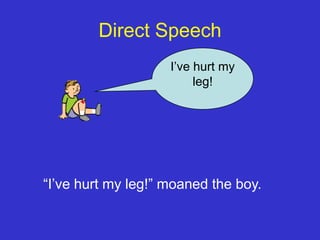
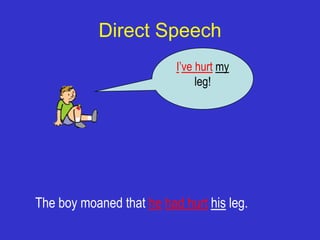
Direct Speech
                    I’ve hurt my
                         leg!


“I’ve hurt my leg!” moaned the boy.
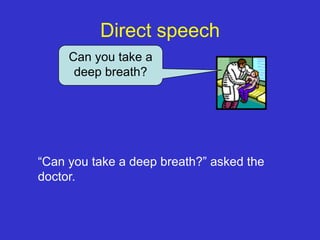
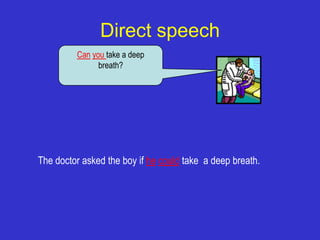
Direct speech
     Can you take a
      deep breath?


“Can you take a deep breath?” asked the
doctor.
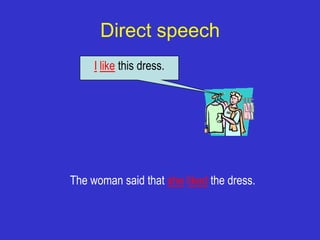
Direct speech
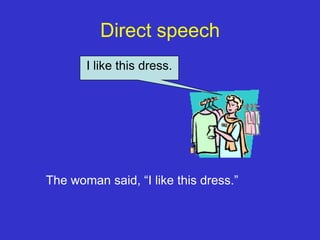
       I like this dress.


The woman said, “I like this dress.”
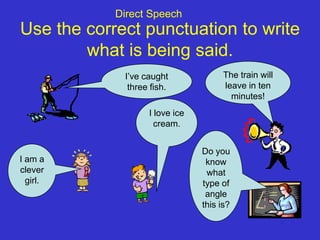
Direct Speech
Use the correct punctuation to write
        what is being said.
             I’ve caught              The train will
              three fish.             leave in ten
                                        minutes!
                   I love ice
                     cream.


                                Do you
I am a                           know
clever                           what
  girl.                         type of
                                 angle
                                this is?
Indirect speech
This is sometimes called REPORTED SPEECH.
When we use indirect speech in our writing:
• We don’t use speech marks.
• We usually have to change pronouns and verb
  tenses.
• We don’t have to start a new line when we
  report a new speaker’s words.
Indirect speech
Here are some examples
   of indirect speech.
Direct Speech
                          I’ve hurt my
                               leg!


The boy moaned that he had hurt his leg.
Direct speech
         Can you take a deep
               breath?


The doctor asked the boy if he could take a deep breath.
Direct speech
     I like this dress.


The woman said that she liked the dress.
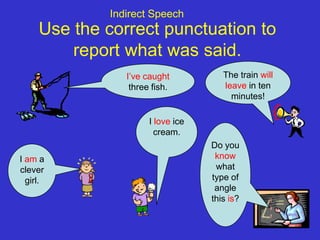
Indirect Speech
     Use the correct punctuation to
         report what was said.
                I’ve caught           The train will
                 three fish.          leave in ten
                                        minutes!

                      I love ice
                        cream.
                                   Do you
I am a                              know
clever                              what
  girl.                            type of
                                    angle
                                   this is?
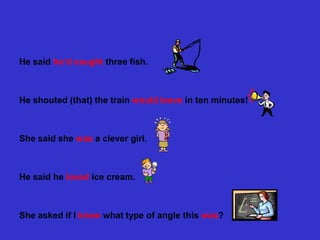
He said he’d caught three fish.


Не shouted (that) the train would leave in ten minutes!


She said she was a clever girl.


He said he loved ice cream.


She asked if I knew what type of angle this was?
QUESTIONS

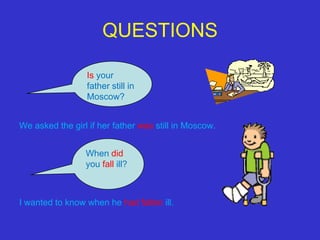
                 Is your
                 father still in
                 Moscow?


We asked the girl if her father was still in Moscow.


                 When did
                 you fall ill?


I wanted to know when he had fallen ill.
By the end of the lesson I will look for evidence to
  show that you will:
• Understand the difference between direct and
  indirect speech.
• Be able to apply this knowledge in your writing.
• Accurately punctuate direct and indirect speech
• Know when and how to change pronouns and
  verb tenses in indirect speech.

Direct and indirect speech

  • 1.
  • 2.
    By the endof the lesson I will: • Understand the difference between direct and indirect speech. • Be able to apply this knowledge in my writing. • Accurately punctuate direct and indirect speech • Know when and how to change pronouns and verb tenses in indirect speech.
  • 3.
    Direct speech When weuse direct speech in our writing: • The exact words spoken must be put inside speech marks. “ ” • The first spoken word must have a capital letter. • When a new speaker begins, we must start a new line.
  • 4.
    Займеники та прислівникичасу і місця змінюються в такі : This – that These – those Here – there Now – then Today – on that today This week – that week Yesterday – the day before Last week – the week before Tomorrow - the next day Next week – the next week
  • 5.
    Direct Speech Indirect Speech simple present simple past He said, “I go to school every day.” He said (that) he went to school every day. simple past past perfect He said, “I went to school every day.” He said (that) he had gone to school every day. present perfect past perfect He said, “I have gone to school every day.” He said (that) he had gone to school every day. present progressive past progressive He said, “I am going to school every day.” He said (that) he was going to school every day. past progressive perfect progressive He said, “I was going to school every day.” He said (that) he had been going to school every day, future (will) would + verb name He said, “I will go to school every day.” He said (that) he would go to school every day. future (going to) present progressive He said, “I am going to school every day.” He said (that) he is going to school every day. past progressive He said (that) he was going to school every day Direct Speech Indirect Speech auxiliary + verb name simple past He said, “Do you go to school every day?” He asked me if I went to school every day.* He said, “Where do you go to school?” He asked me where I went to school.
  • 6.
    The situation changesif instead of the common said another part of the very to say is used. In that case the verb tenses usually remain the same. Some examples of this situation are given below. Direct Speech Indirect Speech simple present + simple present simple present + simple present He says, “I go to school every day.” He says (that) he goes to school every day. present perfect + simple present present perfect + simple present He has said, “I go to school every day.” He has said (that) he goes to school every day. past progressive + simple past past progressive + simple past He was saying, “I went to school every day.” He was saying (that) he went to school every day. past progressive + past perfect He was saying (that) he had gone to school every day. future + simple present future + simple present He will say, “I go to school every day.” He will say (that) he goes to school every day.
  • 7.
    Another situation isthe one in which modal constructions are used. If the verb said is used, then the form of the modal, or another modal that has a past meaning is used. Direct Speech Indirect Speech can could He said, “I can go to school every day.” He said (that) he could go to school every day. may might He said, “I may go to school every day.” He said (that) he might go to school every day. might He said, “I might go to school every day.” must had to He said, “I must go to school every day.” He said (that) he had to go to school every day. have to He said, “I have to go to school every day.” should should He said, “I should go to school every day.” He said (that) he should go to school every day. ought to ought to He said, “I ought to go to school every day.” He said (that) he ought to go to school every day.
  • 8.
    Questions General questions Indirect Questions “Are you watching TV?” …I was watching TV. “Do you play chess?” …I played chess. “Does she go to school?” …she went to school. “Are you listening to me?” …I was listening to him. “Have you done your if, whether …I had done my homework. homework?” …I had skated the winter “Did you skate last winter?” before. “Will you see your friend …I should see my friend the tomorrow?” next day.
  • 9.
    Direct speech Here aresome examples of direct speech.
  • 10.
    Direct Speech I’ve hurt my leg! “I’ve hurt my leg!” moaned the boy.
  • 11.
    Direct speech Can you take a deep breath? “Can you take a deep breath?” asked the doctor.
  • 12.
    Direct speech I like this dress. The woman said, “I like this dress.”
  • 13.
    Direct Speech Use thecorrect punctuation to write what is being said. I’ve caught The train will three fish. leave in ten minutes! I love ice cream. Do you I am a know clever what girl. type of angle this is?
  • 14.
    Indirect speech This issometimes called REPORTED SPEECH. When we use indirect speech in our writing: • We don’t use speech marks. • We usually have to change pronouns and verb tenses. • We don’t have to start a new line when we report a new speaker’s words.
  • 15.
    Indirect speech Here aresome examples of indirect speech.
  • 16.
    Direct Speech I’ve hurt my leg! The boy moaned that he had hurt his leg.
  • 17.
    Direct speech Can you take a deep breath? The doctor asked the boy if he could take a deep breath.
  • 18.
    Direct speech I like this dress. The woman said that she liked the dress.
  • 19.
    Indirect Speech Use the correct punctuation to report what was said. I’ve caught The train will three fish. leave in ten minutes! I love ice cream. Do you I am a know clever what girl. type of angle this is?
  • 20.
    He said he’dcaught three fish. Не shouted (that) the train would leave in ten minutes! She said she was a clever girl. He said he loved ice cream. She asked if I knew what type of angle this was?
  • 21.
    QUESTIONS Is your father still in Moscow? We asked the girl if her father was still in Moscow. When did you fall ill? I wanted to know when he had fallen ill.
  • 22.
    By the endof the lesson I will look for evidence to show that you will: • Understand the difference between direct and indirect speech. • Be able to apply this knowledge in your writing. • Accurately punctuate direct and indirect speech • Know when and how to change pronouns and verb tenses in indirect speech.