Topic
NARRATION
Rules
To Change Direct
Speech Into Indirect
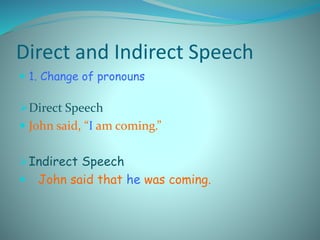
Direct and Indirect Speech
 1. Change of pronouns
Direct Speech
 John said, “I am coming.”
Indirect Speech
 John said that he was coming.
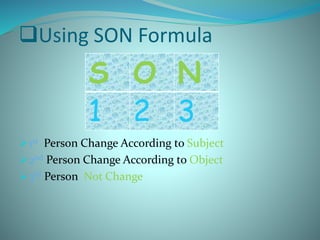
Using SON Formula
1st Person Change According to Subject
2nd Person Change According to Object
3rd Person Not Change
S O N
1 2 3
Direct and Indirect Speech
2. Change of tenses
Direct Speech
 John said, “I am coming.”
Indirect Speech
 John said that he was coming.
TENSE CHANGE INTO
Simple Present Simple Past
Present Continuous Past Continuous
Present Perfect Past Perfect
Present Perfect Continuous Past Perfect Continuous
Simple Past Past Perfect
Past Continuous Past Perfect Continuous
Past Perfect No Change
Past Perfect Continuous No Change
Simple Future No Change
Future Continuous No Change
Future Perfect No Change
Future Perfect continuous No Change
Change Of Tense
3. Change of situations
Direct Speech
John said, “I did this exercise last
night.”
Indirect Speech
John said that he had done that
exercise the previous night.
•'this' becomes 'that'
•'last night' becomes 'the previous night'
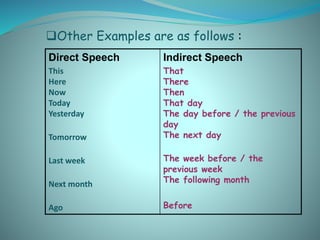
Other Examples are as follows :
Direct Speech
This
Here
Now
Today
Yesterday
Tomorrow
Last week
Next month
Ago
Indirect Speech
That
There
Then
That day
The day before / the previous
day
The next day
The week before / the
previous week
The following month
Before
4. Questions and answers
Direct Speech
1 John asked her, “Are you coming?” (yes/no
question)
2 John asked, “Where is Mary?” (wh-question)
Indirect Speech
1 John asked if / whether she was coming.
2 John asked where Mary was.
•yes/no questions - use if/whether
•wh-questions - use the wh-word
5. Actions : promises, orders, requests,
advice etc.
Direct Speech
John ordered Bill, “Clean my boots.”
Indirect Speech
John ordered Bill to clean his boots. (object + to +
infinitive)
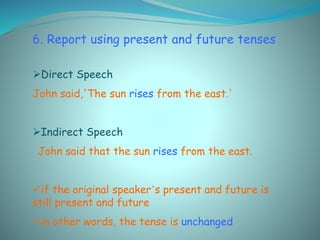
6. Report using present and future tenses
Direct Speech
John said,'The sun rises from the east.'
Indirect Speech
John said that the sun rises from the east.
if the original speaker’s present and future is
still present and future
in other words, the tense is unchanged
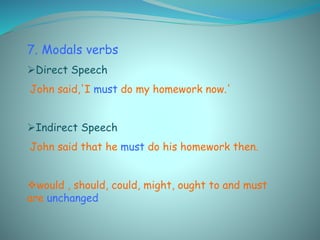
7. Modals verbs
Direct Speech
John said,'I must do my homework now.'
Indirect Speech
John said that he must do his homework then.
would , should, could, might, ought to and must
are unchanged
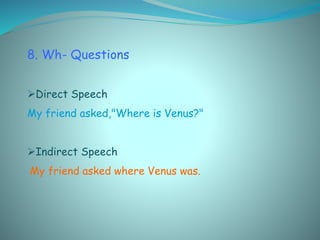
8. Wh- Questions
Direct Speech
My friend asked,"Where is Venus?"
Indirect Speech
My friend asked where Venus was.
Other Examples of WH-questions:
Direct Speech
My friend asked "How are you?"
Indirect Speech
My friend asked how I was.
TRANSFORMATION PROCESS:
1) Put the subject before the verb.
2) Join the clauses using the how,
who, whom, where, when, why
3) Adjust the 2nd verb to
the time frame of the 1st verb.
EXAMPLES of WH-questions
 My friend said, "Where are you going?"
 My friend asked where I was going.
 My friend said, " Whom did you call?"
 My friend asked whom I had called.
 He asked me, "How many times have you seen that
movie?"
 He asked me how many times I had seen that movie.
EXAMPLES of WH-questions
 He asked me, "What did she say?"
 He asked me what she had said.
 He asked me, "When are you leaving?"
 He asked me when I was leaving.
 He asked me, "Who is coming for dinner?"
• He asked me who was coming for dinner.
Thanks'T
o
t
a
k
e
K
n
o
w
l
e
d
g
e

Narration

  • 1.
  • 2.
    Direct and IndirectSpeech  1. Change of pronouns Direct Speech  John said, “I am coming.” Indirect Speech  John said that he was coming.
  • 3.
    Using SON Formula 1stPerson Change According to Subject 2nd Person Change According to Object 3rd Person Not Change S O N 1 2 3
  • 4.
    Direct and IndirectSpeech 2. Change of tenses Direct Speech  John said, “I am coming.” Indirect Speech  John said that he was coming.
  • 5.
    TENSE CHANGE INTO SimplePresent Simple Past Present Continuous Past Continuous Present Perfect Past Perfect Present Perfect Continuous Past Perfect Continuous Simple Past Past Perfect Past Continuous Past Perfect Continuous Past Perfect No Change Past Perfect Continuous No Change Simple Future No Change Future Continuous No Change Future Perfect No Change Future Perfect continuous No Change Change Of Tense
  • 6.
    3. Change ofsituations Direct Speech John said, “I did this exercise last night.” Indirect Speech John said that he had done that exercise the previous night. •'this' becomes 'that' •'last night' becomes 'the previous night'
  • 7.
    Other Examples areas follows : Direct Speech This Here Now Today Yesterday Tomorrow Last week Next month Ago Indirect Speech That There Then That day The day before / the previous day The next day The week before / the previous week The following month Before
  • 8.
    4. Questions andanswers Direct Speech 1 John asked her, “Are you coming?” (yes/no question) 2 John asked, “Where is Mary?” (wh-question) Indirect Speech 1 John asked if / whether she was coming. 2 John asked where Mary was. •yes/no questions - use if/whether •wh-questions - use the wh-word
  • 9.
    5. Actions :promises, orders, requests, advice etc. Direct Speech John ordered Bill, “Clean my boots.” Indirect Speech John ordered Bill to clean his boots. (object + to + infinitive)
  • 10.
    6. Report usingpresent and future tenses Direct Speech John said,'The sun rises from the east.' Indirect Speech John said that the sun rises from the east. if the original speaker’s present and future is still present and future in other words, the tense is unchanged
  • 11.
    7. Modals verbs DirectSpeech John said,'I must do my homework now.' Indirect Speech John said that he must do his homework then. would , should, could, might, ought to and must are unchanged
  • 12.
    8. Wh- Questions DirectSpeech My friend asked,"Where is Venus?" Indirect Speech My friend asked where Venus was.
  • 13.
    Other Examples ofWH-questions: Direct Speech My friend asked "How are you?" Indirect Speech My friend asked how I was. TRANSFORMATION PROCESS: 1) Put the subject before the verb. 2) Join the clauses using the how, who, whom, where, when, why 3) Adjust the 2nd verb to the time frame of the 1st verb.
  • 14.
    EXAMPLES of WH-questions My friend said, "Where are you going?"  My friend asked where I was going.  My friend said, " Whom did you call?"  My friend asked whom I had called.  He asked me, "How many times have you seen that movie?"  He asked me how many times I had seen that movie.
  • 15.
    EXAMPLES of WH-questions He asked me, "What did she say?"  He asked me what she had said.  He asked me, "When are you leaving?"  He asked me when I was leaving.  He asked me, "Who is coming for dinner?" • He asked me who was coming for dinner.
  • 16.