Presentation on Direct and Indirect Narration IMRAN of Swat ID#9714 [email_address]
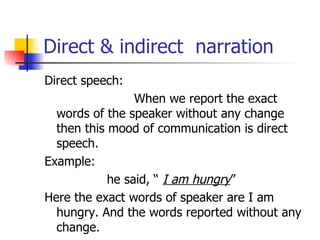
Direct & indirect  narration Direct speech: When we report the exact words of the speaker without any change then this mood of communication is direct speech. Example: he said, “  I am hungry ” Here the exact words of speaker are I am hungry. And the words reported without any change.
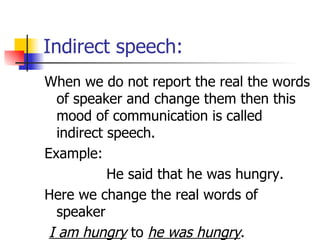
Indirect speech:  When we do not report the real the words of speaker and change them then this mood of communication is called indirect speech. Example: He said that he was hungry. Here we change the real words of speaker I am hungry  to  he was hungry .
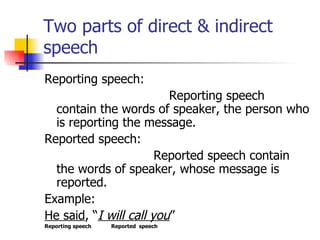
Two parts of direct & indirect speech Reporting speech: Reporting speech  contain the words of speaker, the person who is reporting the message. Reported speech: Reported speech contain the words of speaker, whose message is reported.  Example: He said , “ I will call you ” Reporting speech   Reported  speech
Rules and steps for change in speech TENSES Present indefinite  Present continuous  Present perfect Present perfect continuous Past indefinite  Past continuous  Past perfect Past perfect continuous In all future tenses “will" CHANGES TO Past indefinite  Past continuous Past perfect Past perfect continuous  Past perfect  Past perfect continuous Past perfect  Past perfect continuous Changes into “would”
Other changes Direct  Today  Yesterday Tomorrow  Is, am Was , were Did  Will, shall  Can  Must Ago  This  These  Last Are May  Now  Today It  next In direct That day  The day before  Following day Was Had been  Had Would Could  Had to  Before  That  Those  The previous  Were  Might  Then  That day  That  The following
Change in pronoun  All first person pronoun (I, my, mine ,myself) (we, our, us, ours, ourselves) are  changed according to the subject of reporting speech. Example: She said, “ I  sold  my  car  myself ” She said that  she  sold  her  car  herself .
2 nd  person pronouns  All second person pronoun (you, your, yours, yourself) are changed according to the object of reporting speech. Example: She said to me , “you waste your precious time yourself” She told me that I wasted my precious time myself.
3 rd  person pronouns  All third person pronoun will remain unchanged. Example: He said, “ she  is busy with  her  toy” He said that she was busy with her toy.
Change of interrogative sentences Yes no Question The  word said is usually changes into asked or inquired. Full stop or period (.) replaces sign of interrogative or question mark. Example: She said , “ Do you know me?” She asked if I knew her.
Information questions  Information question are those questions, which begin with W/H. Do , does and did are omitted  and other auxiliary change position and used after subject noun or pronoun. If or whether is not used . Question mark is omitted. Example: When does she come here, “said Faraz” Faraz asked when she came there.
Change of imperative Sentences Imperative sentences are those which expresses order, command and advice. The word said changes into tell, request, suggestion, permit , asked, advice, warn, remind, force, according to the sense of sentences. Example: She said, “get out of my way” She told me to get out of his way.
Reinforcement:  Examples: The teacher said to the  students, “Don't waste your time” The teacher advised the student no to waste time. She said to me , “Please come with me” She requested me to come with her.
Change of exclamatory sentences Exclamatory sentences are which express joy, sorrow, admiration, surprise or other such feelings . Interjection such as Oh! Ah! Alas! Hurrah! Etc. The word said changes into exclaimed with, after which expressed feeling as joy, sorrow, surprise, delight, happily, admiration, disgust and  horror are used.
Continue  Example: The leader said , “ Alas! I lost election” The leader exclaimed with sorrow that he had lost the election. He said , “what a lovely sight!” He exclaimed with admiration that it was a lovely sight.
Change of appetitive sentences Appetitive  sentences show wish, desire, hope and prayer. The word said changes into prayed and may change into might. Example: My mother said to me, “May you live long” My mother prayed that I might live long.
Mixed type sentences ‘What about’ often introduces  suggestion and is then reported by suggest : Examples: “Could you sign this application, please” he said. He asked me to sign that application.
THE END THANKS

Direct & Indirect Narration

  • 1.
    Presentation on Directand Indirect Narration IMRAN of Swat ID#9714 [email_address]
  • 2.
    Direct & indirect narration Direct speech: When we report the exact words of the speaker without any change then this mood of communication is direct speech. Example: he said, “ I am hungry ” Here the exact words of speaker are I am hungry. And the words reported without any change.
  • 3.
    Indirect speech: When we do not report the real the words of speaker and change them then this mood of communication is called indirect speech. Example: He said that he was hungry. Here we change the real words of speaker I am hungry to he was hungry .
  • 4.
    Two parts ofdirect & indirect speech Reporting speech: Reporting speech contain the words of speaker, the person who is reporting the message. Reported speech: Reported speech contain the words of speaker, whose message is reported. Example: He said , “ I will call you ” Reporting speech Reported speech
  • 5.
    Rules and stepsfor change in speech TENSES Present indefinite Present continuous Present perfect Present perfect continuous Past indefinite Past continuous Past perfect Past perfect continuous In all future tenses “will" CHANGES TO Past indefinite Past continuous Past perfect Past perfect continuous Past perfect Past perfect continuous Past perfect Past perfect continuous Changes into “would”
  • 6.
    Other changes Direct Today Yesterday Tomorrow Is, am Was , were Did Will, shall Can Must Ago This These Last Are May Now Today It next In direct That day The day before Following day Was Had been Had Would Could Had to Before That Those The previous Were Might Then That day That The following
  • 7.
    Change in pronoun All first person pronoun (I, my, mine ,myself) (we, our, us, ours, ourselves) are changed according to the subject of reporting speech. Example: She said, “ I sold my car myself ” She said that she sold her car herself .
  • 8.
    2 nd person pronouns All second person pronoun (you, your, yours, yourself) are changed according to the object of reporting speech. Example: She said to me , “you waste your precious time yourself” She told me that I wasted my precious time myself.
  • 9.
    3 rd person pronouns All third person pronoun will remain unchanged. Example: He said, “ she is busy with her toy” He said that she was busy with her toy.
  • 10.
    Change of interrogativesentences Yes no Question The word said is usually changes into asked or inquired. Full stop or period (.) replaces sign of interrogative or question mark. Example: She said , “ Do you know me?” She asked if I knew her.
  • 11.
    Information questions Information question are those questions, which begin with W/H. Do , does and did are omitted and other auxiliary change position and used after subject noun or pronoun. If or whether is not used . Question mark is omitted. Example: When does she come here, “said Faraz” Faraz asked when she came there.
  • 12.
    Change of imperativeSentences Imperative sentences are those which expresses order, command and advice. The word said changes into tell, request, suggestion, permit , asked, advice, warn, remind, force, according to the sense of sentences. Example: She said, “get out of my way” She told me to get out of his way.
  • 13.
    Reinforcement: Examples:The teacher said to the students, “Don't waste your time” The teacher advised the student no to waste time. She said to me , “Please come with me” She requested me to come with her.
  • 14.
    Change of exclamatorysentences Exclamatory sentences are which express joy, sorrow, admiration, surprise or other such feelings . Interjection such as Oh! Ah! Alas! Hurrah! Etc. The word said changes into exclaimed with, after which expressed feeling as joy, sorrow, surprise, delight, happily, admiration, disgust and horror are used.
  • 15.
    Continue Example:The leader said , “ Alas! I lost election” The leader exclaimed with sorrow that he had lost the election. He said , “what a lovely sight!” He exclaimed with admiration that it was a lovely sight.
  • 16.
    Change of appetitivesentences Appetitive sentences show wish, desire, hope and prayer. The word said changes into prayed and may change into might. Example: My mother said to me, “May you live long” My mother prayed that I might live long.
  • 17.
    Mixed type sentences‘What about’ often introduces suggestion and is then reported by suggest : Examples: “Could you sign this application, please” he said. He asked me to sign that application.
  • 18.