



PresentationPresentation
onon
PHASEPHASE
EQUILIBRIUMEQUILIBRIUM
CreatedCreated
By:By:
Md. Kamruzzaman Siam
EquilibriumEquilibrium
EquilibriumEquilibrium is a state in which there are nois a state in which there are no
observable changes as time goes by.observable changes as time goes by.
Chemical equilibriumChemical equilibrium is achieved when:is achieved when:
1.) the rates of the forward and reverse1.) the rates of the forward and reverse
reactions are equal andreactions are equal and
2.) the concentrations of the reactants2.) the concentrations of the reactants
and products remain constantand products remain constant
EquilibriumEquilibrium
 There are two types of equilibrium:There are two types of equilibrium:
Physical and Chemical.Physical and Chemical.
 Physical Equilibrium:Physical Equilibrium: Equilibrium between twoEquilibrium between two
phases of the same substance. Changes that occur arephases of the same substance. Changes that occur are
physical.physical.
 Chemical Equilibrium:Chemical Equilibrium: Chemical equilibrium isChemical equilibrium is
the point at which the rate of the forward reaction isthe point at which the rate of the forward reaction is
equal to the rate of the reverse reaction.equal to the rate of the reverse reaction.
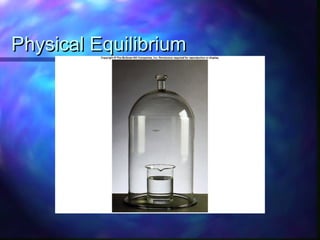
Physical EquilibriumPhysical Equilibrium
Chemical EquilibriumChemical Equilibrium
Definition of phase:
 Any part of a system which is physically separatedAny part of a system which is physically separated
from other parts of the system by afrom other parts of the system by a distinctdistinct boundaryboundary..
 A phase can be a solid, liquid, vapour (gas) or aqueousA phase can be a solid, liquid, vapour (gas) or aqueous
solution which issolution which is uniform in bothuniform in both chemical constitutionchemical constitution
and physical stateand physical state..
Phase Equilibrium:Phase Equilibrium:
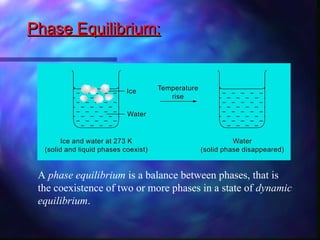
A phase equilibrium is a balance between phases, that is
the coexistence of two or more phases in a state of dynamic
equilibrium.
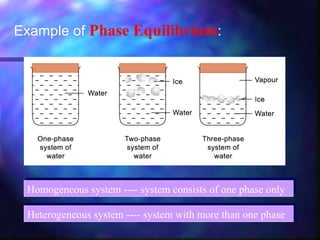
Heterogeneous system ---- system with more than one phaseHeterogeneous system ---- system with more than one phase
Homogeneous system ---- system consists of one phase onlyHomogeneous system ---- system consists of one phase only
Example of Phase Equilibrium:
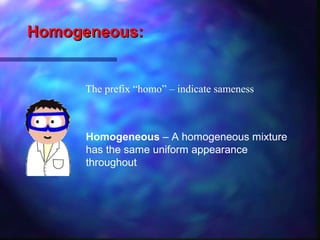
Homogeneous:Homogeneous:
The prefix “homo” – indicate sameness
Homogeneous – A homogeneous mixture
has the same uniform appearance
throughout
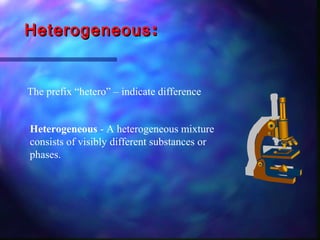
HeterogeneousHeterogeneous::
The prefix “hetero” – indicate difference
Heterogeneous - A heterogeneous mixture
consists of visibly different substances or
phases.
PHASE
system
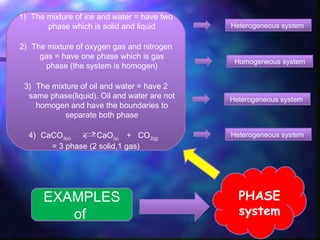
1) The mixture of ice and water = have two
phase which is solid and liquid
2) The mixture of oxygen gas and nitrogen
gas = have one phase which is gas
phase (the system is homogen)
3) The mixture of oil and water = have 2
same phase(liquid). Oil and water are not
homogen and have the boundaries to
separate both phase
4) CaCO3(s) CaO(s) + CO2(g)
= 3 phase (2 solid,1 gas)
Heterogeneous system
Homogeneous system
EXAMPLES
of
Phase equilibrium.siam (ppt file)

Phase equilibrium.siam (ppt file)

  • 3.
  • 4.
  • 5.
    EquilibriumEquilibrium EquilibriumEquilibrium is astate in which there are nois a state in which there are no observable changes as time goes by.observable changes as time goes by. Chemical equilibriumChemical equilibrium is achieved when:is achieved when: 1.) the rates of the forward and reverse1.) the rates of the forward and reverse reactions are equal andreactions are equal and 2.) the concentrations of the reactants2.) the concentrations of the reactants and products remain constantand products remain constant
  • 6.
    EquilibriumEquilibrium  There aretwo types of equilibrium:There are two types of equilibrium: Physical and Chemical.Physical and Chemical.  Physical Equilibrium:Physical Equilibrium: Equilibrium between twoEquilibrium between two phases of the same substance. Changes that occur arephases of the same substance. Changes that occur are physical.physical.  Chemical Equilibrium:Chemical Equilibrium: Chemical equilibrium isChemical equilibrium is the point at which the rate of the forward reaction isthe point at which the rate of the forward reaction is equal to the rate of the reverse reaction.equal to the rate of the reverse reaction.
  • 7.
  • 8.
  • 9.
    Definition of phase: Any part of a system which is physically separatedAny part of a system which is physically separated from other parts of the system by afrom other parts of the system by a distinctdistinct boundaryboundary..  A phase can be a solid, liquid, vapour (gas) or aqueousA phase can be a solid, liquid, vapour (gas) or aqueous solution which issolution which is uniform in bothuniform in both chemical constitutionchemical constitution and physical stateand physical state..
  • 10.
    Phase Equilibrium:Phase Equilibrium: Aphase equilibrium is a balance between phases, that is the coexistence of two or more phases in a state of dynamic equilibrium.
  • 11.
    Heterogeneous system ----system with more than one phaseHeterogeneous system ---- system with more than one phase Homogeneous system ---- system consists of one phase onlyHomogeneous system ---- system consists of one phase only Example of Phase Equilibrium:
  • 12.
    Homogeneous:Homogeneous: The prefix “homo”– indicate sameness Homogeneous – A homogeneous mixture has the same uniform appearance throughout
  • 13.
    HeterogeneousHeterogeneous:: The prefix “hetero”– indicate difference Heterogeneous - A heterogeneous mixture consists of visibly different substances or phases.
  • 14.
    PHASE system 1) The mixtureof ice and water = have two phase which is solid and liquid 2) The mixture of oxygen gas and nitrogen gas = have one phase which is gas phase (the system is homogen) 3) The mixture of oil and water = have 2 same phase(liquid). Oil and water are not homogen and have the boundaries to separate both phase 4) CaCO3(s) CaO(s) + CO2(g) = 3 phase (2 solid,1 gas) Heterogeneous system Heterogeneous system Heterogeneous system Homogeneous system EXAMPLES of

Editor's Notes

  • #6 In equilibrium, the concentration on reactants and products remains constant. Constant transfer. Although it seems like there are no more reactions taking place, r to p and p to r formation is continuously occurring. There are several types of equilibrium reactions that can occur and we will discuss all of them. In this chapter we will be looking at the types of equilibrium reactions, the equilibrium constant and its relationship to the rate constant and factors that can disrupt a system at equilibrium. Most reactions are reversible. As soon as p forms, r begins to reform. R then forms more p.
  • #7 Physical- equilibrium between two phases of the same substance. Changes that occur are physical. Chemical- Chemical equilibrium is the point at which the rate of the forward reaction is equal to the rate of the reverse reaction.
  • #8 Liquid water in equilibrium with its vapor. The number of water molecules leaving the liquid is equivalent to those returning to the liquid.
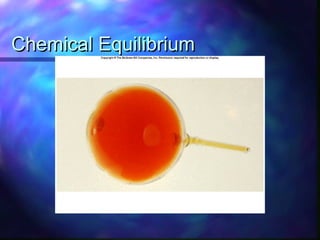
  • #9 Reversible reaction between nitrogen dioxide and dinitrogen tetroxide forms an orange colored product. Nit. Di. Is colorless and dinit. Tet. Is brown. Brown forms immediately, followed by the color lightnening due to reverse reaction occurring.