Metallurgy & Material ScienceDr.S.JoseDept of Mechanical Engg.,TKM College of Engineering, Kollamdrsjose@gmail.com
2Module IIDiffusion in crystals
Theory of Alloys
Equilibrium Diagrams
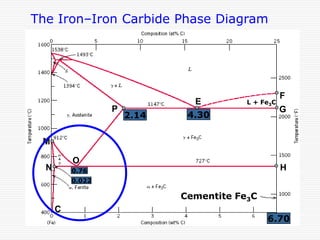
Iron Carbon Phase diagram
TTT Diagram
Heat Treatment
Recovery, Recrystallisation & Grain GrowthHeat Treatment of SteelMost heat treating operations begin with heating the alloy into the austenitic phase field to dissolve the carbide in the ironSteel heat treating practice rarely involves the use of temperatures above 1040°CClassificationHeating and rapid cooling (quenching)Heating and slow cooling
Purpose of heat treatment:Improvement in ductilityRelieving internal stressesGrain size refinementIncrease of strength and hardnessImprovement in machinability and toughness
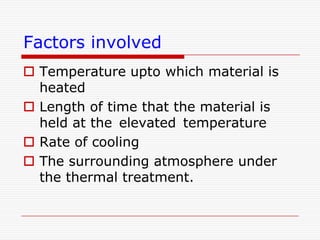
Factors involvedTemperature upto which material is heatedLength of time that the material is held at the	elevated	temperatureRate of coolingThe surrounding atmosphere under the thermal treatment.
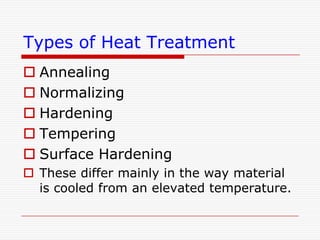
Types of Heat TreatmentAnnealingNormalizingHardening TemperingSurface HardeningThese differ mainly in the way material is cooled from an elevated temperature.
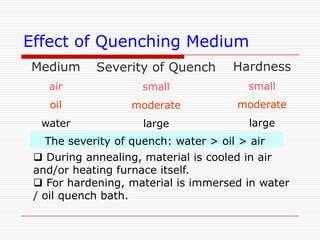
HardnesssmallmoderatelargeMediumairoilwaterSeverity of QuenchsmallmoderatelargeEffect of Quenching MediumThe severity of quench: water > oil > air	 During annealing, material is cooled in air and/or heating furnace itself.
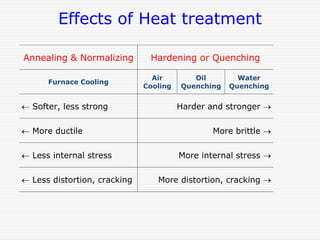
 For hardening, material is immersed in water / oil quench bath.Effects of Heat treatment
FEL + Fe3CPG4.302.14MONH0.760.022Cementite Fe3CC6.70The Iron–Iron Carbide Phase Diagram
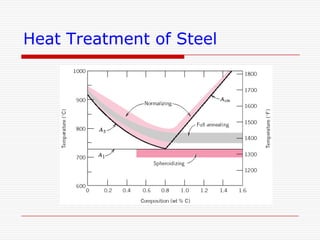
Heat Treatment of Steel
Annealing ProcessMaterial is exposed to an elevated temperature for an extended time period and then slowly cooled, allowing phase changes.Utilized for low- and medium-carbon steels. Full AnnealingProcess Annealing 	or Stress Relief AnnealingSpheroidising
Three stages of annealingHeating to the desired temperature : The material is austenitized by heating to 15 to 40C above the A3 or A1 lines until equilibrium is achieved (i.e., the alloy changes to austenite), Soaking or holding time: The material is held for 1h at the annealing temperature for every inch of thickness (a rule of thumb)Cooling to room temperature: cooling rate of 100°F/hr is typical for full annealing. Done in furnace itself.Purposes of AnnealingRelieve Internal StressesInternal stresses can build up in metal as a result of processing.
such as welding, cold working, casting, forging, or machining.
If internal stresses are allowed to remain in a metal, the part may eventually distort or crack.
Annealing helps relieve internal stresses and reduce the chances for distortion and cracking.Purposes of Annealing Increasing Softness, Machinability, and FormabilityA softer and more ductile material is easier to machine in the machine shop.
An annealed part will respond better to forming operations.Refinement of Grain StructuresAfter some types of metalworking (particularly cold working), the crystal structures are elongated.
Annealing can change the shape of the grains back to the desired form.AnnealingHeat to above Upper Critical Temperature, at which point the structure is all AusteniteCool very slowly in the furnace.Structure will now be large-grained pearlite.Used to improve the properties of cast and forged steels prior to machining.
Process Annealing (Intermediate Annealing)A heat treatment used to negate the effects of cold work, i.e., to soften and increase the ductility of a previously strain-hardened metalIn process annealing, parts are not as completely softened as they are in full annealing, but the time required is considerably lessened.Process annealing or stress-relief annealing is frequently used as an intermediate heat-treating step during the manufacture of a part.Recovery and recrystallization processes occur during the process.
Stress Relief AnnealingInternal residual stresses may develop in metal pieces due to:Plastic deformation processes (machining and grinding)Non-uniform cooling of a piece that was processed or fabricated at an elevated temperature (welding or casting)Distortion and warpage may result if these residual stresses are not removed.
Stress Relief AnnealingThe material is heated to the recommended temperature, held long enough to attain a uniform temperature, and finally cooled to room temperature slowly
The annealing temperature is ordinarily a relatively low one such that effects resulting from cold work and other heat treatments are not affectedProcess AnnealingHeat to below Upper Critical Temperature to cause recrystallisationCool very slowly in the furnace.Structure will now be equi-axed pearlite.Used to maximise the ductility of low carbon steels and other materials after cold working.
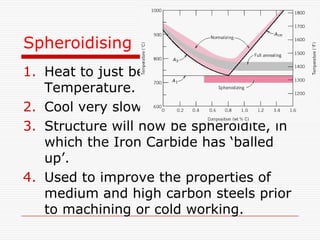
SpheroidisingHeat to just below Lower Critical Temperature. (about 650-700 deg C)Cool very slowly in the furnace.Structure will now be spheroidite, in which the Iron Carbide has ‘balled up’.Used to improve the properties of medium and high carbon steels prior to machining or cold working.
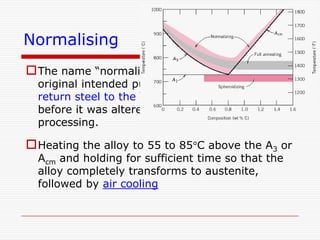
NormalisingThe name “normalising” comes from the original intended purpose of the process — to return steel to the “normal” conditionit was in before it was altered by cold working or other processing.Heating the alloy to 55 to 85C above the A3 or Acm and holding for sufficient time so that the alloy completely transforms to austenite, followed by air cooling
NormalisingTo refine the grains and produce a more uniform and desirable size distribution for steels that have been plastically deformedNormalising does not soften the material as much as full annealing does.  The cooling process does not leave the material as ductile or as internally stress-free.A normalised part will usually be a little stronger, harder, and more brittle than a full-annealed part.
NormalisingHeat to Upper Critical Temperature, at which point the structure is all AusteniteCool slowly in air.Structure will now be fine equi-axed pearlite.Used to restore the ductility of cold or hot worked materials whilst retaining other properties.
AnnealingHeat to above Upper Critical Temperature, at which point the structure is all AusteniteCool very slowly in the furnace.Structure will now be large-grained pearlite.Used to improve the properties of cast and forged steels prior to machining.
Process AnnealingHeat to below Upper Critical Temperature to cause recrystallisationCool very slowly in the furnace.Structure will now be equi-axed pearlite.Used to maximise the ductility of low carbon steels and other materials after cold working.
SpheroidisingHeat to just below Lower Critical Temperature. (about 650-700 deg C)Cool very slowly in the furnace.Structure will now be spheroidite, in which the Iron Carbide has ‘balled up’.Used to improve the properties of medium and high carbon steels prior to machining or cold working.
HardeningHardening of steels done to increase the strength and wear resistanceHeated to 30-50 °C above the upper critical temperature and then quenchedThe quicker the steel is cooled, the harder it would be
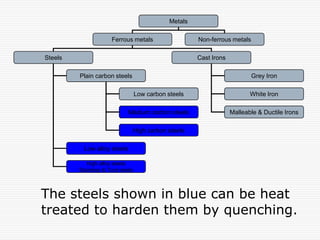
	The steels shown in blue can be heat treated to harden them by quenching.
Hardening TemperaturesThe temperatures for hardening depend on the carbon content. Plain carbon steels below 0.4% will not harden by heat treatment.The temperature decreases from approx 820 °C to 780 °C as carbon content increases from 0.4% up to 0.8%.  Above 0.8% the temperature remains constant at 780 °C.Hardening temperature same as that for normalising
Quenching MediaFour commonly used quenching media:Brine – the fastest cooling rateWater – moderate cooling rateOil – slowest cooling rateGas – used in automatic furnaces, usually liquid nitrogen, can be very fast cooling.	Too rapid cooling can cause cracking in complex and heavy sections.
HardenabilityThe hardenability of a steel is broadly defined as the property which determines the depth and distribution of hardness induced by quenching.This is dependent upon the chemical composition of the steel alloy.The addition of Nickel, Chromium and Molybdenum will slow the transformation to other phases and allow more martensite to form.Most heat treatable steels are alloys rather than plain carbon steels.
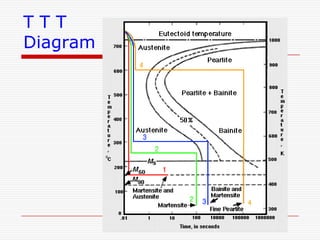
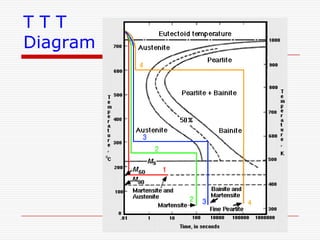
T T T Diagram
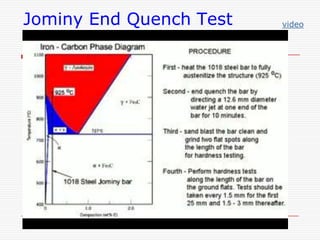
Test for Hardenability Jominy End Quench test - An austenitized steel bar is quenched at one end only, thus producing a range of cooling rates along the bar.Hardenability curves - Graphs showing the effect of the cooling rate on the hardness of as-quenched steel.Jominy distance - The distance from the quenched end of a Jominy bar. The Jominy distance is related to the cooling rate.Jominy End Quench Test video
Jominy End Quench Testvideo
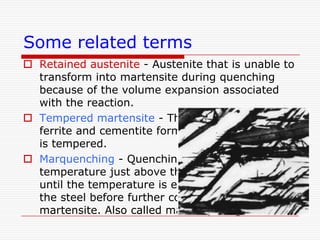
Some related termsRetained austenite - Austenite that is unable to transform into martensite during quenching because of the volume expansion associated with the reaction.Tempered martensite - The microconstituent of ferrite and cementite formed when martensite is tempered.Marquenching - Quenching austenite to a temperature just above the MS and holding until the temperature is equalized throughout the steel before further cooling to produce martensite. Also called martempering.
T T T Diagram
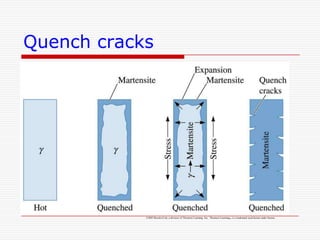
Quench cracksCracks that form at the surface of a steel during quenching due to tensile residual stresses that are produced because of the volume change that accompanies the austenite-to-martensite transformation.©2003 Brooks/Cole, a division of Thomson Learning, Inc.  Thomson Learning™ is a trademark used herein under license.
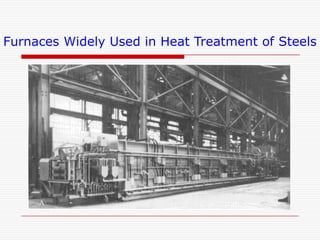
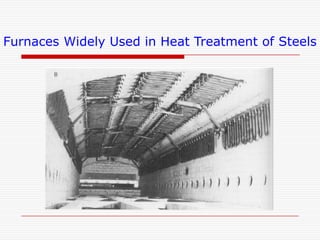
Furnaces Widely Used in Heat Treatment of Steels
VideosTraditional Heat treatmentOil quenching
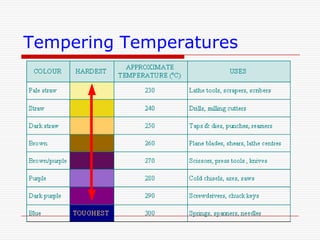
TemperingThe brittleness of martensite makes hardened steels unsuitable for most applications.Different cooling rates between edge and core of components result in internal stresses.This requires the steel to be tempered by re-heating to a lower temperature to reduce the hardness and improve the toughness.  This treatment converts some of the martensite to bainite.
Tempering Temperatures
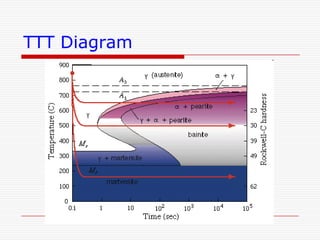
Isothermal Heat TreatmentsAustempering - The isothermal heat treatment by which austenite transforms to bainite.Isothermal annealing - Heat treatment of a steel by austenitizing, cooling rapidly to a temperature between the A1 and the nose of the TTT curve, and holding until the austenite transforms to pearlite.
TTT Diagram
Surface HardeningSelectively Heating the Surface - Rapidly heat the surface of a medium-carbon steel above the A3 temperature and then quench.
Case depth - The depth below the surface of a steel at which hardening occurs by surface hardening and carburizing processes.
Case Hardening : Carburizing
Cyaniding , Carbonitriding
Flame Hardening, Case HardeningThe primary purpose of case hardening is to produce a surface which is resistant to wear while maintaining the overall toughness and strength of the steel core.  Normally used on a steel with a low carbon content and introduces carbon by diffusion (carburising) into the local surfaces requiring treatment. Heating steel in the presence of a solid, liquid or gas rich in carbon.
CyanidingHardening the surface of steel with carbon and nitrogen obtained from a bath of liquid cyanide solution.Steel is heated in molten cyanide at about 850 °C followed by quenching.Carbon and nitrogen are absorbed by steel.
Carbonitriding Hardening the surface of steel with carbon and nitrogen Steel is heated in a gaseous mixture of ammonia and hydrocarons
NitridingAnother process called Nitriding consists of the diffusion of nitrogen.Nitrogen is introduced into steel by passing ammonia gas through a muffle furnace containing the steel to be nitrided.Temperature used is below the lower critical temperatureGreater resistance to wear and corrosion, greater surface hardness.
Flame HardeningHeating the surface being hardened above the upper critical temperature with an oxy acetylene flame before quenching it in a spray of water. This is a surface hardening process resulting in a hard surface layer of about 2mm to 6mm deep. The main difference between this process and other surface hardening processes is that the composition of the steel being hardened is not changed.
Flame HardeningThe steel must itself have sufficient hardenability . Limits this process to steels having carbon contents of above 0.35%. Steels with carbon contents of 0.4%-0.7% are most suitable for this process. Steels with higher C content and high alloy steels may not be suitable as they a liable to cracking.  Result similar to the conventional hardening process but with less hardness penetration.
Induction HardeningSurface to be hardened is heated using inductive heating.Depth of hardness can be closely monitored by controlling current. Time required for the process is less.Used for producing hard surfaces on crankshafts, axles, gears etc.
Recovery, Recrystallization and Grain GrowthThe phenomena intimately associated with the annealing of a plastically deformed crystalline material	Plastic deformation increases the density of point imperfections in crystalline materials.This leads to an increase in internal strain energyOn annealing, the material tends to lose the extra strain energy and revert to the original condition.This is achieved by the processes of recovery and recrystallisation.
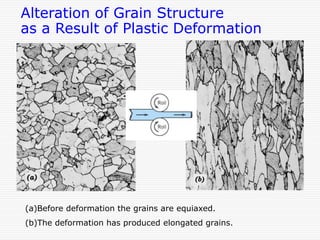
Alteration of Grain Structure as a Result of Plastic DeformationBefore deformation the grains are equiaxed. The deformation has produced elongated grains.
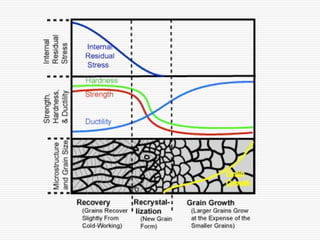
RecoveryTakes place at low temperatures of annealingThe point imperfections created during plastic deformations are absorbed at grain boundariesDislocations of opposite sign come together and mutually annihilate each other. Some of the stored internal strain energy is relieved by virtue of dislocation motion, as a result of enhanced atomic diffusion at the elevated temperature. 
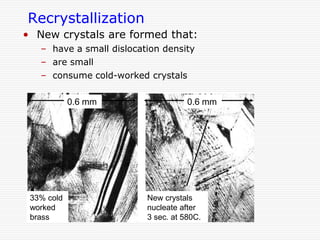
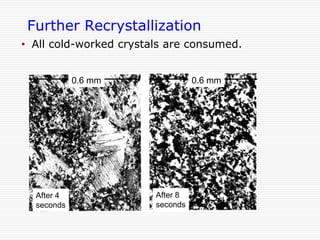
RecrystallizationThe process of nucleation and growth of new strain free crystals, which replace the deformed crystalsNo change in crystal structure 	These equiaxed grains will have low dislocation densities and have characteristics of the pre cold-worked condition.
Grain GrowthIncrease in the average grain size on further annealing after all the cold worked material has recrystallised.Larger grains grow at the expense of smaller grainsAs the grains grow larger, rate of grain growth decreases.Larger grains will reduce the strength and toughness of the material.
RecrystallizationNew crystals are formed that: