Metallurgy &Metallurgy &
Materials ScienceMaterials Science
Dr.S.Jose
Dept of Mechanical Engg.,
TKM College of Engineering, Kollam
drsjose@gmail.com
2
Module IV
 Ferrous Materials
 Non – ferrous alloys
 Composite Materials
 Metal matrix composites
 Smart Materials.
 Nano materials
 Bio materials
 Bioplastics.
 Copper and alloys
 Aluminium and alloys
 Magnesium and alloys
 Titanium and alloys
Non – ferrous alloys
4
Most extensively used among non ferrous materials
Important properties are excellent electrical conductivity
and corrosion resistance
It occupies the second place among engineering
materials.
It is also having very good thermal conductivity, and
also it can be easily machined, welded, brazed and
soldered.
But, it lacks sufficient strength which makes it
Copper
5
Over 50% of the copper produced is used for electrical
purposes like wires, switches and other articles which
carry electric current
Another chunk of copper goes into applications which
require higher thermal conductivity
These applications include, automotive radiators, water
heaters, refrigerators, heat exchangers, condensers etc
Due to the excellent corrosion resistance, copper and its
alloys find widespread usage in corrosive environments
Copper
6
Strength of copper can be increased by different
methods like strain hardening, solid solution
strengthening and precipitation hardening.
Among these, most effective method is the second
one which is achieved by alloying of copper by
addition of elements like zinc, tin, aluminium etc.
to form solid solutions.
The solid solution alloys of copper are brasses,
Copper
7
Brass is an alloy of copper and zinc with the zinc
content varying from 5 to 54%.
Small amounts of lead, tin or aluminium also are
added to impart specific properties to brass
The important properties of brass are
• Good strength, ductility and formability
• Good machinability
• Good electrical and thermal conductivity
Brass
Copper-Zinc Phase diagram
9
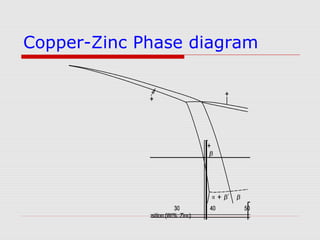
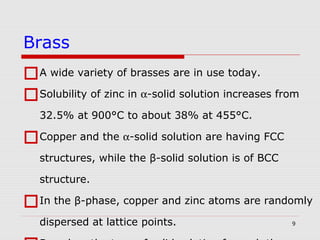
A wide variety of brasses are in use today.
Solubility of zinc in α-solid solution increases from
32.5% at 900°C to about 38% at 455°C.
Copper and the α-solid solution are having FCC
structures, while the β-solid solution is of BCC
structure.
In the β-phase, copper and zinc atoms are randomly
dispersed at lattice points.
Brass
10
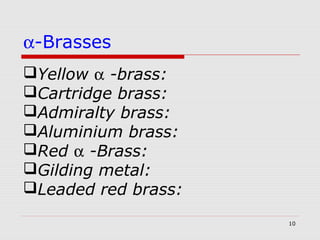
Yellow α -brass:
Cartridge brass:
Admiralty brass:
Aluminium brass:
Red α -Brass:
Gilding metal:
Leaded red brass:
α-Brasses
11
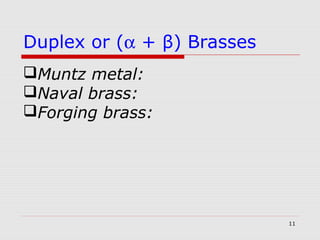
Muntz metal:
Naval brass:
Forging brass:
Duplex or (α + β) Brasses
12
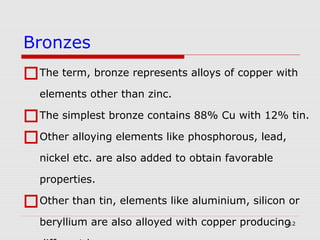
The term, bronze represents alloys of copper with
elements other than zinc.
The simplest bronze contains 88% Cu with 12% tin.
Other alloying elements like phosphorous, lead,
nickel etc. are also added to obtain favorable
properties.
Other than tin, elements like aluminium, silicon or
beryllium are also alloyed with copper producing
Bronzes
13
Bronzes are softer and weaker than steel.
 Corrosion resistance, heat and electric conductivity are
also better than steel, while the cost is higher than
steels.
Compared to brasses, these are having lower coefficient
of friction, higher strength, toughness, corrosion
resistance and also higher cost.
Bronze is having good castability and anti-friction or
Bronzes
14
Tin Bronze:
Gun metal:
Aluminium bronze:
Silicon bronze:
Beryllium bronze:
Bronzes
15
 Aluminium occupies the third place
among commercially used engineering
materials.
 It has low density, low melting point
and high electrical and thermal
conductivities.
 It has low strength and hardness, but
high ductility and malleability.
Aluminium
16
 On exposure to atmosphere, it forms a strong
film of aluminium oxide on its surface, which
prevents further oxidation and corrosion.
 It is employed for lightly loaded structures and
for electrical cables and similar items.
 Aluminium has good machinability, formability,
workability and castability.
 It is non-magnetic, non-toxic, easily available
and less expensive.
 The main drawback is its low strength and
hardness.
Aluminium
17
The poor tensile strength of aluminium can be
increased by many methods like strain hardening,
solid solution hardening, age hardening and fiber
reinforcement.
By cold working, tensile strength of aluminium can be
increased by two times due to strain hardening.
Addition of alloying elements like copper,
manganese, magnesium, silicon etc. can increase the
Aluminium alloys
Aluminium- Copper phase diagram
19
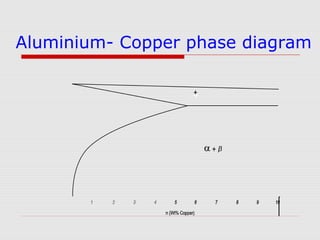
 Maximum solubility of copper in aluminium
is 5.65% at 550O
C and it reduces to 0.45%
at 300O
C.
 Alloys containing between 2.5 and 5%
copper will respond to heat treatment by
age hardening.
 Due to the increased strength, aluminium
alloys are widely used in commercial
applications.
 Two main groups of aluminium alloys are
wrought alloys and casting alloys.
Aluminium alloys
20
 Wrought alloys : Al-Mn and Al-Mg alloys
form homogenous solid solutions and are
characterized by comparatively lower
strength and high ductility. Other examples
are avial (Al-Mg-Si) and duralumin (Al-Cu-
Mg).
 Casting alloys: The best known casting
alloy is the silumin alloys. Alloys of Al and
Cu also are suitable for casting. Many of the
casting alloys are heat treatable.
Aluminium alloys
21
 Duralumin: A typical composition is 94% Al,
4% Cu and 0.5% each of Mg, Mn, Si and Fe.
 High tensile strength and electrical conductivity.
 Widely used for aeroplanes, surgical and
orthopedic equipments.
 Y-alloy: Composition of this alloy is 92.5%
Al, 4% Cu, 2% Ni and 1.5% Mg.
 High strength and hardness even at high
temperature such as 200o
C.
 Used for cylinder heads and crank cases of
engines.
Aluminium alloys
22
 Magnelium: The major alloying elements in
this alloy are magnesium and copper with Ni,
Sn, Fe, Mn and Si in small amounts.
 Better tensile strength and machinability, but it is
brittle.
 Used by aircraft and automobile industries.
 Silumin alloys: Alloys based on Al-Si
system are known as silumin alloys.
 A typical silumin is the eutectic alloy with 88% Al
and 12% Si.
 Having good castability, corrosion resistance,
high ductility and low density.
Aluminium alloys
23
 Titanium has two allotropic forms: upto
880O
C, it exists as α-titanium (HCP)and at
higher temperatures as β-titanium (BCC)
 It is a strong, ductile and light weight metal,
density of pure Ti is 60% of steel.
 High corrosion resistance and high strength
at elevated temperatures and widely used as
a structural material.
 Suitable for cold and hot working and has
good weldability.
 Machinability is much inferior to steel.
Titanium
24
 The most important alloying elements for
titanium are Al, Cr, Mn, V, Fe, Mo and Sn
which considerably increase the mechanical
strength.
 Higher creep resistance, higher fatigue
strength, highest specific strength and good
corrosion resistance.
 Responds to heat treatment by precipitation
hardening.
 Ti-6Al-4V is the most widely used alloy,
accounting for about 45% of total titanium
production.
Titanium Alloys
25
 Used for aerospace structures and turbines
due to the high specific strength, corrosion
resistance and strength at elevated
temperature.
 Titanium is used in the construction of
leaching and purification plants for cobalt
production.
 Due to the higher corrosion resistance,
titanium is also used in various chemical
processing equipments, valves and tanks.
Uses of Titanium Alloys
26
 Magnesium has the HCP crystal structure.
 It is lighter and less ductile than aluminium.
 It is having poor modulus of elasticity, poor
resistance to wear, fatigue and creep.
 Its response to strengthening mechanisms
also is relatively poor.
 Solubility of aluminium in magnesium
increases with temperature
 This alloy responds well to age hardening
also
Magnesium
27
 Addition of aluminium to magnesium increases
strength, hardness and castability.
 Addition of manganese to magnesium has very
little effect on the mechanical properties, but it
improves the corrosion resistance.
 Magnesium-aluminium-zinc alloys have higher
mechanical properties and good corrosion
resistance.
 In general, magnesium alloys have poor
ductility and formability, but poor fatigue and
stress corrosion resistance.
Magnesium Alloys
28
 Magnesium alloys are used in the areas of
aerospace, high speed machinery,
transportation and material handling
equipments.
 Magnesium-manganese alloys are used for
sheet forming processes.
 Magnesium-aluminium-zinc alloys are
suitable for sand and die casting, extrusion
and forging processes.
Magnesium Alloys
Thank you
Non ferrous alloys

Non ferrous alloys

  • 1.
    Metallurgy &Metallurgy & MaterialsScienceMaterials Science Dr.S.Jose Dept of Mechanical Engg., TKM College of Engineering, Kollam drsjose@gmail.com
  • 2.
    2 Module IV  FerrousMaterials  Non – ferrous alloys  Composite Materials  Metal matrix composites  Smart Materials.  Nano materials  Bio materials  Bioplastics.
  • 3.
     Copper andalloys  Aluminium and alloys  Magnesium and alloys  Titanium and alloys Non – ferrous alloys
  • 4.
    4 Most extensively usedamong non ferrous materials Important properties are excellent electrical conductivity and corrosion resistance It occupies the second place among engineering materials. It is also having very good thermal conductivity, and also it can be easily machined, welded, brazed and soldered. But, it lacks sufficient strength which makes it Copper
  • 5.
    5 Over 50% ofthe copper produced is used for electrical purposes like wires, switches and other articles which carry electric current Another chunk of copper goes into applications which require higher thermal conductivity These applications include, automotive radiators, water heaters, refrigerators, heat exchangers, condensers etc Due to the excellent corrosion resistance, copper and its alloys find widespread usage in corrosive environments Copper
  • 6.
    6 Strength of coppercan be increased by different methods like strain hardening, solid solution strengthening and precipitation hardening. Among these, most effective method is the second one which is achieved by alloying of copper by addition of elements like zinc, tin, aluminium etc. to form solid solutions. The solid solution alloys of copper are brasses, Copper
  • 7.
    7 Brass is analloy of copper and zinc with the zinc content varying from 5 to 54%. Small amounts of lead, tin or aluminium also are added to impart specific properties to brass The important properties of brass are • Good strength, ductility and formability • Good machinability • Good electrical and thermal conductivity Brass
  • 8.
  • 9.
    9 A wide varietyof brasses are in use today. Solubility of zinc in α-solid solution increases from 32.5% at 900°C to about 38% at 455°C. Copper and the α-solid solution are having FCC structures, while the β-solid solution is of BCC structure. In the β-phase, copper and zinc atoms are randomly dispersed at lattice points. Brass
  • 10.
    10 Yellow α -brass: Cartridgebrass: Admiralty brass: Aluminium brass: Red α -Brass: Gilding metal: Leaded red brass: α-Brasses
  • 11.
    11 Muntz metal: Naval brass: Forgingbrass: Duplex or (α + β) Brasses
  • 12.
    12 The term, bronzerepresents alloys of copper with elements other than zinc. The simplest bronze contains 88% Cu with 12% tin. Other alloying elements like phosphorous, lead, nickel etc. are also added to obtain favorable properties. Other than tin, elements like aluminium, silicon or beryllium are also alloyed with copper producing Bronzes
  • 13.
    13 Bronzes are softerand weaker than steel.  Corrosion resistance, heat and electric conductivity are also better than steel, while the cost is higher than steels. Compared to brasses, these are having lower coefficient of friction, higher strength, toughness, corrosion resistance and also higher cost. Bronze is having good castability and anti-friction or Bronzes
  • 14.
    14 Tin Bronze: Gun metal: Aluminiumbronze: Silicon bronze: Beryllium bronze: Bronzes
  • 15.
    15  Aluminium occupiesthe third place among commercially used engineering materials.  It has low density, low melting point and high electrical and thermal conductivities.  It has low strength and hardness, but high ductility and malleability. Aluminium
  • 16.
    16  On exposureto atmosphere, it forms a strong film of aluminium oxide on its surface, which prevents further oxidation and corrosion.  It is employed for lightly loaded structures and for electrical cables and similar items.  Aluminium has good machinability, formability, workability and castability.  It is non-magnetic, non-toxic, easily available and less expensive.  The main drawback is its low strength and hardness. Aluminium
  • 17.
    17 The poor tensilestrength of aluminium can be increased by many methods like strain hardening, solid solution hardening, age hardening and fiber reinforcement. By cold working, tensile strength of aluminium can be increased by two times due to strain hardening. Addition of alloying elements like copper, manganese, magnesium, silicon etc. can increase the Aluminium alloys
  • 18.
  • 19.
    19  Maximum solubilityof copper in aluminium is 5.65% at 550O C and it reduces to 0.45% at 300O C.  Alloys containing between 2.5 and 5% copper will respond to heat treatment by age hardening.  Due to the increased strength, aluminium alloys are widely used in commercial applications.  Two main groups of aluminium alloys are wrought alloys and casting alloys. Aluminium alloys
  • 20.
    20  Wrought alloys: Al-Mn and Al-Mg alloys form homogenous solid solutions and are characterized by comparatively lower strength and high ductility. Other examples are avial (Al-Mg-Si) and duralumin (Al-Cu- Mg).  Casting alloys: The best known casting alloy is the silumin alloys. Alloys of Al and Cu also are suitable for casting. Many of the casting alloys are heat treatable. Aluminium alloys
  • 21.
    21  Duralumin: Atypical composition is 94% Al, 4% Cu and 0.5% each of Mg, Mn, Si and Fe.  High tensile strength and electrical conductivity.  Widely used for aeroplanes, surgical and orthopedic equipments.  Y-alloy: Composition of this alloy is 92.5% Al, 4% Cu, 2% Ni and 1.5% Mg.  High strength and hardness even at high temperature such as 200o C.  Used for cylinder heads and crank cases of engines. Aluminium alloys
  • 22.
    22  Magnelium: Themajor alloying elements in this alloy are magnesium and copper with Ni, Sn, Fe, Mn and Si in small amounts.  Better tensile strength and machinability, but it is brittle.  Used by aircraft and automobile industries.  Silumin alloys: Alloys based on Al-Si system are known as silumin alloys.  A typical silumin is the eutectic alloy with 88% Al and 12% Si.  Having good castability, corrosion resistance, high ductility and low density. Aluminium alloys
  • 23.
    23  Titanium hastwo allotropic forms: upto 880O C, it exists as α-titanium (HCP)and at higher temperatures as β-titanium (BCC)  It is a strong, ductile and light weight metal, density of pure Ti is 60% of steel.  High corrosion resistance and high strength at elevated temperatures and widely used as a structural material.  Suitable for cold and hot working and has good weldability.  Machinability is much inferior to steel. Titanium
  • 24.
    24  The mostimportant alloying elements for titanium are Al, Cr, Mn, V, Fe, Mo and Sn which considerably increase the mechanical strength.  Higher creep resistance, higher fatigue strength, highest specific strength and good corrosion resistance.  Responds to heat treatment by precipitation hardening.  Ti-6Al-4V is the most widely used alloy, accounting for about 45% of total titanium production. Titanium Alloys
  • 25.
    25  Used foraerospace structures and turbines due to the high specific strength, corrosion resistance and strength at elevated temperature.  Titanium is used in the construction of leaching and purification plants for cobalt production.  Due to the higher corrosion resistance, titanium is also used in various chemical processing equipments, valves and tanks. Uses of Titanium Alloys
  • 26.
    26  Magnesium hasthe HCP crystal structure.  It is lighter and less ductile than aluminium.  It is having poor modulus of elasticity, poor resistance to wear, fatigue and creep.  Its response to strengthening mechanisms also is relatively poor.  Solubility of aluminium in magnesium increases with temperature  This alloy responds well to age hardening also Magnesium
  • 27.
    27  Addition ofaluminium to magnesium increases strength, hardness and castability.  Addition of manganese to magnesium has very little effect on the mechanical properties, but it improves the corrosion resistance.  Magnesium-aluminium-zinc alloys have higher mechanical properties and good corrosion resistance.  In general, magnesium alloys have poor ductility and formability, but poor fatigue and stress corrosion resistance. Magnesium Alloys
  • 28.
    28  Magnesium alloysare used in the areas of aerospace, high speed machinery, transportation and material handling equipments.  Magnesium-manganese alloys are used for sheet forming processes.  Magnesium-aluminium-zinc alloys are suitable for sand and die casting, extrusion and forging processes. Magnesium Alloys
  • 29.