Sintering
Outlines
 Introduction
 Types of Sintering
 Parameters in Sintering
 Driving Force for Sintering
 Stages of Sintering
 Mechanisms of Sintering
 Advantages of Sintering
Introduction
Sintering is defined as
The thermal treatment of a powder or
compact at a temperature below the
melting point of the main constituent, for
the purpose of increasing its strength by
bonding together of the particles.
Types of Sintering
1. Solid state sintering
Only solid phases are present at
the sinter temperature
2. Liquid phase sintering
Small amounts of liquid phase are
present during sintering
3. Reactive sintering
Particles react with each other to
new product phases
Important Parameters in
Sintering
We can divide these parameters into
four broad categories
Powder preparation:
-- Particle size
-- Shape
-- Size distribution
Important Parameters in
Sintering
Distribution of:
-- Dopants
-- Second phases
Powder Consolidation:
-- Density
-- Pore size distribution
Important Parameters in
Sintering
Firing:
-- Heating rate
-- Temperature
-- Applied pressure
-- Atmosphere
Important Parameters in
Sintering
 Some parameters, such as the sintering
temperature, applied pressure, average
particle size and atmosphere can be
controlled with sufficient accuracy
 Others, such as the powder
characteristics and particle packing are
more difficult to control but have a
significant effect on sintering
What Happens During
Sintering?
 Atomic diffusion takes place and the
welded areas formed during compaction
grow until eventually they may be lost
completely
 Recrystallisation and grain growth may
follow, and the pores tend to become
rounded and the total porosity, as a
percentage of the whole volume tends to
decrease
What Happens During Sintering?
 In the pressing operation the powder
particles are brought together and
deformed at the points of contact
 At elevated temperature - the sintering
temperature - the atoms can move more
easily and quickly migrate along the
particle surfaces (the technical term is
Diffusion)
What Happens During Sintering?
Metals consist of crystallites
 At the sintering temperature new
crystallites form at the points of contact so
that the original inter-particle boundaries
disappear, or become recognizable merely
as grain boundaries (This process is called
Recrystallisation)
What Happens During Sintering?
 The total internal surface
area of the pressed body
is reduced by sintering
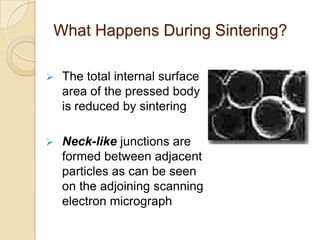
 Neck-like junctions are
formed between adjacent
particles as can be seen
on the adjoining scanning
electron micrograph
Driving Force for Sintering
As with all processes, sintering is
accompanied by an increase in the free
energy of the system. The sources that give
rise to the amount of free energy are
commonly referred to as the driving forces
for sintering. The main possible driving
forces are
The curvature of the particle surfaces
An externally applied pressure
A chemical reaction
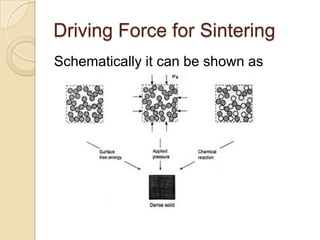
Driving Force for Sintering
Schematically it can be shown as
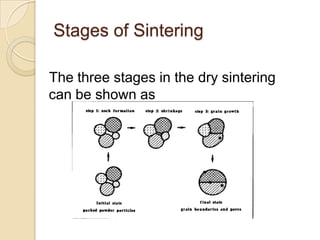
Stages of Sintering
Three stages are distinguished in sintering
 First Stage
After burn out of any organic additives,
two things happen to the powder
particles when the mobility of the
surface atoms has become high
enough; initially rough surface of the
particles is smoothed and neck
formation occurs
Stages of Sintering
 Second Stage
Densification and pore shrinkage. If grain
boundaries are formed after the first stage,
these are new source of atoms for filling up
the concave areas which diminishes the
outer surface of the particle
 Third Stage
Grain growth takes place, the pores break
up and form closed spherical bubbles
Stages of Sintering
The three stages in the dry sintering
can be shown as
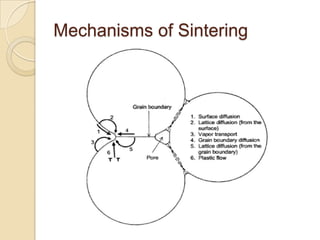
Mechanisms of Sintering
Six mechanisms can contribute to the
sintering of a consolidated mass of
crystalline particles
1. Surface diffusion
2. Lattice diffusion from the surface
3. Vapor transport
4. Grain boundary diffusion
5. Lattice diffusion from the grain boundary
6. Plastic flow
Mechanisms of Sintering
Advantages of Sintering
Particular advantages of this
powder technology include:
1. the possibility of very high purity for
the starting materials and their
great uniformity
2. preservation of purity due to the
restricted nature of subsequent
fabrication steps
Advantages of Sintering
3. stabilization of the details of
repetitive operations by control of
grain size in the input stages
4. absence of segregated particles
and inclusions (as often occurs in
melt processes)
5. no requirement for deformation to
produce directional elongation of
grains
Sintering

Sintering

  • 1.
  • 2.
    Outlines  Introduction  Typesof Sintering  Parameters in Sintering  Driving Force for Sintering  Stages of Sintering  Mechanisms of Sintering  Advantages of Sintering
  • 3.
    Introduction Sintering is definedas The thermal treatment of a powder or compact at a temperature below the melting point of the main constituent, for the purpose of increasing its strength by bonding together of the particles.
  • 4.
    Types of Sintering 1.Solid state sintering Only solid phases are present at the sinter temperature 2. Liquid phase sintering Small amounts of liquid phase are present during sintering 3. Reactive sintering Particles react with each other to new product phases
  • 5.
    Important Parameters in Sintering Wecan divide these parameters into four broad categories Powder preparation: -- Particle size -- Shape -- Size distribution
  • 6.
    Important Parameters in Sintering Distributionof: -- Dopants -- Second phases Powder Consolidation: -- Density -- Pore size distribution
  • 7.
    Important Parameters in Sintering Firing: --Heating rate -- Temperature -- Applied pressure -- Atmosphere
  • 8.
    Important Parameters in Sintering Some parameters, such as the sintering temperature, applied pressure, average particle size and atmosphere can be controlled with sufficient accuracy  Others, such as the powder characteristics and particle packing are more difficult to control but have a significant effect on sintering
  • 9.
    What Happens During Sintering? Atomic diffusion takes place and the welded areas formed during compaction grow until eventually they may be lost completely  Recrystallisation and grain growth may follow, and the pores tend to become rounded and the total porosity, as a percentage of the whole volume tends to decrease
  • 10.
    What Happens DuringSintering?  In the pressing operation the powder particles are brought together and deformed at the points of contact  At elevated temperature - the sintering temperature - the atoms can move more easily and quickly migrate along the particle surfaces (the technical term is Diffusion)
  • 11.
    What Happens DuringSintering? Metals consist of crystallites  At the sintering temperature new crystallites form at the points of contact so that the original inter-particle boundaries disappear, or become recognizable merely as grain boundaries (This process is called Recrystallisation)
  • 12.
    What Happens DuringSintering?  The total internal surface area of the pressed body is reduced by sintering  Neck-like junctions are formed between adjacent particles as can be seen on the adjoining scanning electron micrograph
  • 13.
    Driving Force forSintering As with all processes, sintering is accompanied by an increase in the free energy of the system. The sources that give rise to the amount of free energy are commonly referred to as the driving forces for sintering. The main possible driving forces are The curvature of the particle surfaces An externally applied pressure A chemical reaction
  • 14.
    Driving Force forSintering Schematically it can be shown as
  • 15.
    Stages of Sintering Threestages are distinguished in sintering  First Stage After burn out of any organic additives, two things happen to the powder particles when the mobility of the surface atoms has become high enough; initially rough surface of the particles is smoothed and neck formation occurs
  • 16.
    Stages of Sintering Second Stage Densification and pore shrinkage. If grain boundaries are formed after the first stage, these are new source of atoms for filling up the concave areas which diminishes the outer surface of the particle  Third Stage Grain growth takes place, the pores break up and form closed spherical bubbles
  • 17.
    Stages of Sintering Thethree stages in the dry sintering can be shown as
  • 18.
    Mechanisms of Sintering Sixmechanisms can contribute to the sintering of a consolidated mass of crystalline particles 1. Surface diffusion 2. Lattice diffusion from the surface 3. Vapor transport 4. Grain boundary diffusion 5. Lattice diffusion from the grain boundary 6. Plastic flow
  • 19.
  • 20.
    Advantages of Sintering Particularadvantages of this powder technology include: 1. the possibility of very high purity for the starting materials and their great uniformity 2. preservation of purity due to the restricted nature of subsequent fabrication steps
  • 21.
    Advantages of Sintering 3.stabilization of the details of repetitive operations by control of grain size in the input stages 4. absence of segregated particles and inclusions (as often occurs in melt processes) 5. no requirement for deformation to produce directional elongation of grains