Metallurgy &Metallurgy &
Materials ScienceMaterials Science
Dr.S.Jose
Dept of Mechanical Engg.,
TKM College of Engineering, Kollam
drsjose@gmail.com
2
 Ferrous Materials
 Non – ferrous alloys
 Composite Materials
 Metal matrix composites
 Smart Materials.
 Nano materials
 Bio materials
 Bioplastics.
Module IV
A composite can be defined as a multiphase
material that is artificially made with chemically
dissimilar constituent phases which are separated by a
distinct interface.
Many composite materials consist of only two
phases.
The properties of composites are dependent on the
Composite Materials
The matrix phase, which is present in larger amounts, is
continuous and surrounds the other one called as dispersed
phase or reinforcing phase.
The matrix phase may be metal, polymer or ceramic.
When some ductility is desirable, metals and polymers
are used, to which the reinforcing particles or fibres
incorporate fracture toughness.
The matrix phase binds the reinforcement together and
Composite Materials
Particle Reinforced Composites
Fibre-Reinforced Composites
Metal Matrix Composites
Ceramic Matrix Composites
Carbon-Carbon Composites
Laminated Composites
Composite Materials
The matrix is reinforced by hard particles of three
dimensional shapes.
Here the matrix and dispersed particles share the load.
Typical examples are cemented carbides, tungsten
reinforced copper, concrete, cermets etc.
For effective reinforcement, the particles should be small
and evenly distributed throughout the matrix.
Particle Reinforced Composites
When the dispersed phase is in the form of fibres, the most
important type of composite is obtained.
 The matrix phase is usually metal, ceramic or plastic
materials.
This type of composites has unique combination of
properties like high stiffness, high strength and fracture
toughness.
Fibre Reinforced Composites
Glass fibre reinforced polymer (GFRP) composites are
popularly known as fibre glass.
This is a composite consisting of continuous or discontinuous
glass fibres embedded in a polymer matrix.
It is having high strength, stiffness and rigidity, but is not
suitable for structural applications at higher temperatures.
Fibre glass is used for automotive bodies, storage
Fibre Reinforced Composites
Carbon fibre reinforced polymer (CFRP) composites are
among the advanced composite materials used for aircraft and
aerospace applications.
Carbon fibres used for this purpose are having diameters
between 4 to 10 microns.
These fibres exhibit a diversity of physical and mechanical
properties.
Fibre Reinforced Composites
A ductile metal is used as the matrix material.
Alloys of aluminium, copper, titanium and magnesium are
used as matrix materials.
Reinforcement materials are silicon carbide, aluminium
oxide, boron carbide, graphite etc. in the form of fibers,
whiskers or particles.
The reinforcement may improve specific strength, abrasion
Metal Matrix Composites
Particulates, fibres or whiskers of one ceramic material is
embedded into a matrix of another ceramic material
Fracture toughness of these composites are significantly
higher than that of ceramics.
Silicon carbide whisker reinforced alumina are used as
cutting tool inserts for machining hard metal alloys.
Ceramic Matrix Composites
Carbon fibre reinforced carbon matrix composite is an
advanced engineering material.
This material is having high tensile strength, which is
retained even at temperature above 2000C.
In addition, higher creep resistance and fracture toughness
also are the features of these materials.
Due to the complexity of processing techniques used, the
Carbon Carbon Composites
Laminated composite is composed of thin sheets or layers
that have a high strength direction oriented along the direction
of fibres.
The layers are stacked and cemented together to form a
laminated composite. Eg. plywood
Laminated composite is one among the structural
composites, the properties of which are dependent on the
constituent materials as well as on the geometrical design of
Laminated Composites
Homogenous distribution of the reinforcement phase is the
key challenge.
The primary processes can be grouped under two broad
categories.
Liquid state processes like stir casting, squeeze casting
and spray casting
Solid state processes include powder blending (powder
Fabrication of
Metal Matrix Composites
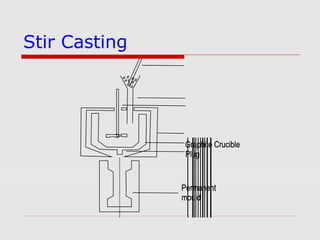
Stir casting is done by introducing fibres of particles into
molten or partially solidified metal/alloy followed by casting in
moulds.
The main advantages are the simplicity, flexibility and cost
efficiency.
The stir casting process begins with preparation of a melt of
the selected metallic matrix material followed by cooling it to a
semi solid state.
Stir Casting
Stir Casting
The slurry is again heated to convert the matrix phase to
liquid state.
During the process the melt is agitated (stirred) vigourously
to obtain uniform dispersion of the reinforcement phase.
The resultant melt is immediately used for die casting,
permanent mould casting or sand casting.
Stir Casting
Powder processing methods are used to fabricate particulate
or short fibre reinforced composites.
Powdered metal and discontinuous reinforcement are
blended to produce a homogeneous distribution and then
bonded through a process of compaction, degassing and
thermo-mechanical treatment.
The composite ingot is subsequently used to fabricate
structural components using secondary fabrication processes.
Powder Metallurgy
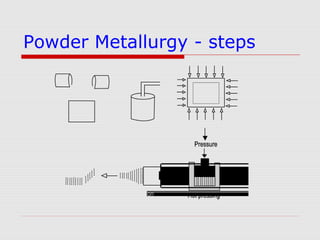
Powder Production
Mixing or Blending
Powder Degassing
Powder Compaction
Sintering
Hot Isostatic Pressing
Powder Metallurgy -steps
Almost all metals and their alloys can be
converted into powder form.
The major methods are
 Electrolytic deposition
 Chemical reaction and decomposition
 Atomisation
 Mechanical processing
A number of metals can be precipitated on
the cathode of an electrolytic cell as powder.
Powder Production
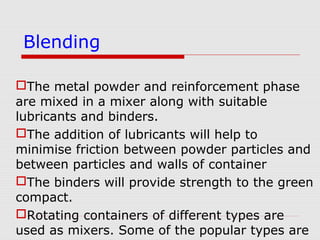
The metal powder and reinforcement phase
are mixed in a mixer along with suitable
lubricants and binders.
The addition of lubricants will help to
minimise friction between powder particles and
between particles and walls of container
The binders will provide strength to the green
compact.
Rotating containers of different types are
used as mixers. Some of the popular types are
Blending
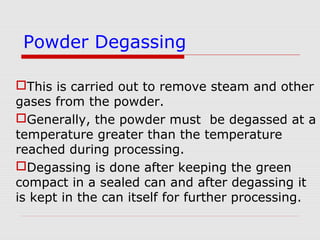
This is carried out to remove steam and other
gases from the powder.
Generally, the powder must be degassed at a
temperature greater than the temperature
reached during processing.
Degassing is done after keeping the green
compact in a sealed can and after degassing it
is kept in the can itself for further processing.
Powder Degassing
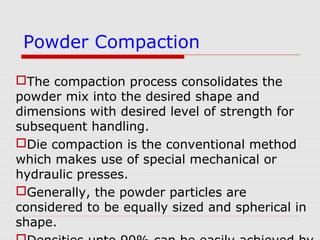
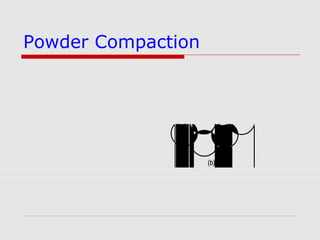
The compaction process consolidates the
powder mix into the desired shape and
dimensions with desired level of strength for
subsequent handling.
Die compaction is the conventional method
which makes use of special mechanical or
hydraulic presses.
Generally, the powder particles are
considered to be equally sized and spherical in
shape.
Powder Compaction
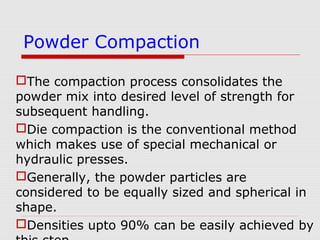
The compaction process consolidates the
powder mix into desired level of strength for
subsequent handling.
Die compaction is the conventional method
which makes use of special mechanical or
hydraulic presses.
Generally, the powder particles are
considered to be equally sized and spherical in
shape.
Densities upto 90% can be easily achieved by
Powder Compaction
Powder Compaction
This is a thermal process for consolidating
powder particles into a coherent structure by
mass transport on the atomic scale.
Before sintering, the lubricant and binder are
removed from the green compact by heating it
in vacuum or in controlled atmosphere.
Sintering is done inside sintering furnaces, at
temperatures around 75% of the melting
temperature of the metals.
The high temperatures stimulate atomic
Sintering
Here the pressing and sintering are combined
to a single step.
This process is used to impart density
consolidation, which is necessary to provide
sufficient strength to the powder processed
material.
An inert gas is used as the pressure medium
and heat is applied with the help of a furnace
The pressure is applied uniformly from all
sides and this provides uniform grain structure
Hot Isostatic Pressing
Powder Metallurgy - steps
The filament winding process is employed for fabrication of a
continuous fibre reinforced composite structures having an axis
of revolution.
Common examples of such structures are tubes, pipes,
cylindrical tanks, pressure vessels, rocket motor cases, etc.
Continuous fibre strands or rovings are first coated with
resin in a resin bath and then fed through rollers to squeeze out
excess resin and finally wound, under constant tension, around
Filament Winding
The outer diameter of the mandrel corresponds to the inner
diameter of the part to be fabricated. The mandrel is usually
made of steel, plastic or rubber.
The mandrel is positioned, either horizontally (for helical
winding) or vertically (for polar winding), on a carriage that
moved back and forth along the direction parallel to the
rotational axis.
In addition to the translational (axial) motion induced by the
Filament Winding
In the helical winding a constant angle φ (known as helical
angle) is maintained by controlling the rotational and axial
motions of the mandrel.
Structural components having circular cylindrical shapes like
tubes, pipes and cylinders are normally fabricated with
alternating helical angles of+φ and -φ
When the filaments are wound at an angle φ = 90, the
winding is called hoop winding. Similarly, when φ =0, it is
Filament Winding
Filament Winding
Filament Winding
Biomaterials
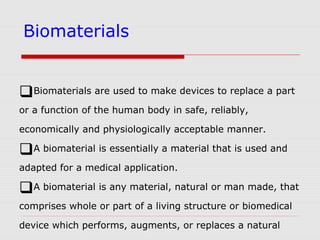
Biomaterials are used to make devices to replace a part
or a function of the human body in safe, reliably,
economically and physiologically acceptable manner.
A biomaterial is essentially a material that is used and
adapted for a medical application.
A biomaterial is any material, natural or man made, that
comprises whole or part of a living structure or biomedical
device which performs, augments, or replaces a natural
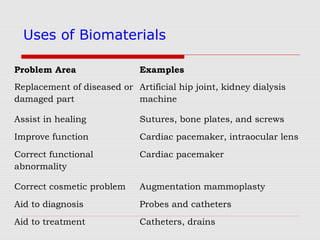
Problem Area Examples
Replacement of diseased or
damaged part
Artificial hip joint, kidney dialysis
machine
Assist in healing Sutures, bone plates, and screws
Improve function Cardiac pacemaker, intraocular lens
Correct functional
abnormality
Cardiac pacemaker
Correct cosmetic problem Augmentation mammoplasty
Aid to diagnosis Probes and catheters
Aid to treatment Catheters, drains
Uses of Biomaterials
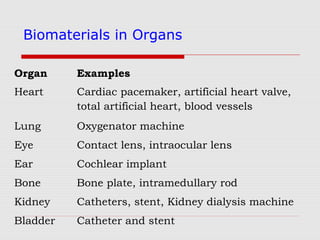
Organ Examples
Heart Cardiac pacemaker, artificial heart valve,
total artificial heart, blood vessels
Lung Oxygenator machine
Eye Contact lens, intraocular lens
Ear Cochlear implant
Bone Bone plate, intramedullary rod
Kidney Catheters, stent, Kidney dialysis machine
Bladder Catheter and stent
Biomaterials in Organs
Biomaterials
The most common classes of materials used as
biomedical materials are polymers, metals, ceramics and
composites.
 These classes are used singly and in combination to
form most of the implantation devices available today.
There are a large number of polymeric materials that have
been used as implants or part of implant systems.
The polymeric systems include acrylics, polyamides,
polyesters, polyethylene, polyurethane and a number of
reprocessed biological materials.
Applications include artificial heart, kidney, liver, pancreas,
bladder, bone cement, catheters, contact lenses, cornea and
eye-lens replacements, external and internal ear repairs, heart
Polymeric Biomaterials
Metals are used as biomaterial due to their excellent
electrical and thermal conductivity and mechanical properties.
Some metallic parts are used as passive substitutes for hard
tissue replacement such as:
Total hip
Knee joints
Bone plates and screws
Spinal fixation devices
Metallic Biomaterials
The first metal alloy developed specifically for use as
biomaterial is the vanadium steel which was used to
manufacture bone fracture plates and screws.
 The biocompatibility of the metallic implant is of
considerable concern because these implants can corrode in
prolonged usage.
Stainless Steels
CoCr Alloys
Metallic Biomaterials
The most important properties for a biomaterial like, non-
toxic, non-carcinogenic, non-allergic, non-inflammatory,
biocompatible and biofunctional for its lifetime in the host are
all satisfied by certain ceramic materials.
Ceramics such as alumina, zirconia, silicone nitrides, and
carbons are inert bioceramics.
Certain glass ceramics are semi-inert (bioreactive), and
calcium phosphates and calcium aluminates are resorbable
Ceramic Biomaterials
By definition, composites contain two or more distinct
constituent materials.
In biomaterials, it is important that each constituent of the
composite be biocompatible.
Moreover, the interface between constituents should not be
degraded by the biological environment.
 Some applications are: dental filling composites, reinforced
methyl methacrylate bone cement and ultra-high-molecular-
Composite Biomaterials
Bioplastics are not just one single substance, they comprise
of a whole family of materials with differing properties and
applications.
 A plastic material is defined as a bioplastic if it is either
biobased, biodegradable, or having features of both.
Bioplastics are plastics in which all carbon is derived from
renewable feedstocks including corn, potatoes, rice, tapioca,
palm fiber, wood cellulose, wheat fiber etc.
Bioplastics
The term “biobased” means that the material or product is
(partly) derived from biomass of plants like corn, sugarcane, or
cellulose. Biobased does not equal biodegradable.
Biodegradation is a chemical process during which micro-
organisms that are available in the environment convert
materials into natural substances such as water, carbon
dioxide, and compost.
Bioplastics
Smart or intelligent materials have one or more properties
that can be significantly changed in a controlled fashion by
external stimuli, such as stress, temperature, moisture, pH,
electric or magnetic fields.
A smart material should consist of a sensor (that detects an
input signal) and an actuator (that performs a responsive and
adaptive function).
In simple words, “smart material responds to a stimulus with
Smart Materials
Normal materials have limited responses, while smart
materials have appropriate responses, but response is the same
every time.
Some simple examples are
photo chromatic glass that darkens in bright light;
low melting point wax in a fire sprinkler which blocks the
nozzle until it gets hot;
Smart Materials
♦ No moving parts.
♦ High reliability.
♦ Low power requirements.
♦ Provide new capabilities that are presently not possible.
Applications
♦ Active control inceptors using smart material motion
control.
Smart Materials -Advantages
These are materials which produce a voltage when stress is
applied.
Since this effect also applies in the reverse manner, a
voltage across the sample will produce stress within the
sample.
Suitably designed structures made from these materials can
therefore be made.
Used as sensors and actuators
Piezoelectric Materials
Shape memory alloys (SMA) and shape memory polymers
are materials in which large deformation can be induced and
recovered through temperature changes or stress changes.
The large deformation results due to martensitic phase
change.
A shape memory alloy is an alloy that “remembers” its
original, cold-forged shape: returning the pre-deformed shape
by heating.
Shape memory alloys
Thank you
Contact :
drsjose@gmail.com
0091-9446812425

Modern materials

  • 1.
    Metallurgy &Metallurgy & MaterialsScienceMaterials Science Dr.S.Jose Dept of Mechanical Engg., TKM College of Engineering, Kollam drsjose@gmail.com
  • 2.
    2  Ferrous Materials Non – ferrous alloys  Composite Materials  Metal matrix composites  Smart Materials.  Nano materials  Bio materials  Bioplastics. Module IV
  • 3.
    A composite canbe defined as a multiphase material that is artificially made with chemically dissimilar constituent phases which are separated by a distinct interface. Many composite materials consist of only two phases. The properties of composites are dependent on the Composite Materials
  • 4.
    The matrix phase,which is present in larger amounts, is continuous and surrounds the other one called as dispersed phase or reinforcing phase. The matrix phase may be metal, polymer or ceramic. When some ductility is desirable, metals and polymers are used, to which the reinforcing particles or fibres incorporate fracture toughness. The matrix phase binds the reinforcement together and Composite Materials
  • 5.
    Particle Reinforced Composites Fibre-ReinforcedComposites Metal Matrix Composites Ceramic Matrix Composites Carbon-Carbon Composites Laminated Composites Composite Materials
  • 6.
    The matrix isreinforced by hard particles of three dimensional shapes. Here the matrix and dispersed particles share the load. Typical examples are cemented carbides, tungsten reinforced copper, concrete, cermets etc. For effective reinforcement, the particles should be small and evenly distributed throughout the matrix. Particle Reinforced Composites
  • 7.
    When the dispersedphase is in the form of fibres, the most important type of composite is obtained.  The matrix phase is usually metal, ceramic or plastic materials. This type of composites has unique combination of properties like high stiffness, high strength and fracture toughness. Fibre Reinforced Composites
  • 8.
    Glass fibre reinforcedpolymer (GFRP) composites are popularly known as fibre glass. This is a composite consisting of continuous or discontinuous glass fibres embedded in a polymer matrix. It is having high strength, stiffness and rigidity, but is not suitable for structural applications at higher temperatures. Fibre glass is used for automotive bodies, storage Fibre Reinforced Composites
  • 9.
    Carbon fibre reinforcedpolymer (CFRP) composites are among the advanced composite materials used for aircraft and aerospace applications. Carbon fibres used for this purpose are having diameters between 4 to 10 microns. These fibres exhibit a diversity of physical and mechanical properties. Fibre Reinforced Composites
  • 10.
    A ductile metalis used as the matrix material. Alloys of aluminium, copper, titanium and magnesium are used as matrix materials. Reinforcement materials are silicon carbide, aluminium oxide, boron carbide, graphite etc. in the form of fibers, whiskers or particles. The reinforcement may improve specific strength, abrasion Metal Matrix Composites
  • 11.
    Particulates, fibres orwhiskers of one ceramic material is embedded into a matrix of another ceramic material Fracture toughness of these composites are significantly higher than that of ceramics. Silicon carbide whisker reinforced alumina are used as cutting tool inserts for machining hard metal alloys. Ceramic Matrix Composites
  • 12.
    Carbon fibre reinforcedcarbon matrix composite is an advanced engineering material. This material is having high tensile strength, which is retained even at temperature above 2000C. In addition, higher creep resistance and fracture toughness also are the features of these materials. Due to the complexity of processing techniques used, the Carbon Carbon Composites
  • 13.
    Laminated composite iscomposed of thin sheets or layers that have a high strength direction oriented along the direction of fibres. The layers are stacked and cemented together to form a laminated composite. Eg. plywood Laminated composite is one among the structural composites, the properties of which are dependent on the constituent materials as well as on the geometrical design of Laminated Composites
  • 14.
    Homogenous distribution ofthe reinforcement phase is the key challenge. The primary processes can be grouped under two broad categories. Liquid state processes like stir casting, squeeze casting and spray casting Solid state processes include powder blending (powder Fabrication of Metal Matrix Composites
  • 15.
    Stir casting isdone by introducing fibres of particles into molten or partially solidified metal/alloy followed by casting in moulds. The main advantages are the simplicity, flexibility and cost efficiency. The stir casting process begins with preparation of a melt of the selected metallic matrix material followed by cooling it to a semi solid state. Stir Casting
  • 16.
  • 17.
    The slurry isagain heated to convert the matrix phase to liquid state. During the process the melt is agitated (stirred) vigourously to obtain uniform dispersion of the reinforcement phase. The resultant melt is immediately used for die casting, permanent mould casting or sand casting. Stir Casting
  • 18.
    Powder processing methodsare used to fabricate particulate or short fibre reinforced composites. Powdered metal and discontinuous reinforcement are blended to produce a homogeneous distribution and then bonded through a process of compaction, degassing and thermo-mechanical treatment. The composite ingot is subsequently used to fabricate structural components using secondary fabrication processes. Powder Metallurgy
  • 19.
    Powder Production Mixing orBlending Powder Degassing Powder Compaction Sintering Hot Isostatic Pressing Powder Metallurgy -steps
  • 20.
    Almost all metalsand their alloys can be converted into powder form. The major methods are  Electrolytic deposition  Chemical reaction and decomposition  Atomisation  Mechanical processing A number of metals can be precipitated on the cathode of an electrolytic cell as powder. Powder Production
  • 21.
    The metal powderand reinforcement phase are mixed in a mixer along with suitable lubricants and binders. The addition of lubricants will help to minimise friction between powder particles and between particles and walls of container The binders will provide strength to the green compact. Rotating containers of different types are used as mixers. Some of the popular types are Blending
  • 22.
    This is carriedout to remove steam and other gases from the powder. Generally, the powder must be degassed at a temperature greater than the temperature reached during processing. Degassing is done after keeping the green compact in a sealed can and after degassing it is kept in the can itself for further processing. Powder Degassing
  • 23.
    The compaction processconsolidates the powder mix into the desired shape and dimensions with desired level of strength for subsequent handling. Die compaction is the conventional method which makes use of special mechanical or hydraulic presses. Generally, the powder particles are considered to be equally sized and spherical in shape. Powder Compaction
  • 24.
    The compaction processconsolidates the powder mix into desired level of strength for subsequent handling. Die compaction is the conventional method which makes use of special mechanical or hydraulic presses. Generally, the powder particles are considered to be equally sized and spherical in shape. Densities upto 90% can be easily achieved by Powder Compaction
  • 25.
  • 26.
    This is athermal process for consolidating powder particles into a coherent structure by mass transport on the atomic scale. Before sintering, the lubricant and binder are removed from the green compact by heating it in vacuum or in controlled atmosphere. Sintering is done inside sintering furnaces, at temperatures around 75% of the melting temperature of the metals. The high temperatures stimulate atomic Sintering
  • 27.
    Here the pressingand sintering are combined to a single step. This process is used to impart density consolidation, which is necessary to provide sufficient strength to the powder processed material. An inert gas is used as the pressure medium and heat is applied with the help of a furnace The pressure is applied uniformly from all sides and this provides uniform grain structure Hot Isostatic Pressing
  • 28.
  • 29.
    The filament windingprocess is employed for fabrication of a continuous fibre reinforced composite structures having an axis of revolution. Common examples of such structures are tubes, pipes, cylindrical tanks, pressure vessels, rocket motor cases, etc. Continuous fibre strands or rovings are first coated with resin in a resin bath and then fed through rollers to squeeze out excess resin and finally wound, under constant tension, around Filament Winding
  • 30.
    The outer diameterof the mandrel corresponds to the inner diameter of the part to be fabricated. The mandrel is usually made of steel, plastic or rubber. The mandrel is positioned, either horizontally (for helical winding) or vertically (for polar winding), on a carriage that moved back and forth along the direction parallel to the rotational axis. In addition to the translational (axial) motion induced by the Filament Winding
  • 31.
    In the helicalwinding a constant angle φ (known as helical angle) is maintained by controlling the rotational and axial motions of the mandrel. Structural components having circular cylindrical shapes like tubes, pipes and cylinders are normally fabricated with alternating helical angles of+φ and -φ When the filaments are wound at an angle φ = 90, the winding is called hoop winding. Similarly, when φ =0, it is Filament Winding
  • 32.
  • 33.
  • 34.
    Biomaterials Biomaterials are usedto make devices to replace a part or a function of the human body in safe, reliably, economically and physiologically acceptable manner. A biomaterial is essentially a material that is used and adapted for a medical application. A biomaterial is any material, natural or man made, that comprises whole or part of a living structure or biomedical device which performs, augments, or replaces a natural
  • 35.
    Problem Area Examples Replacementof diseased or damaged part Artificial hip joint, kidney dialysis machine Assist in healing Sutures, bone plates, and screws Improve function Cardiac pacemaker, intraocular lens Correct functional abnormality Cardiac pacemaker Correct cosmetic problem Augmentation mammoplasty Aid to diagnosis Probes and catheters Aid to treatment Catheters, drains Uses of Biomaterials
  • 36.
    Organ Examples Heart Cardiacpacemaker, artificial heart valve, total artificial heart, blood vessels Lung Oxygenator machine Eye Contact lens, intraocular lens Ear Cochlear implant Bone Bone plate, intramedullary rod Kidney Catheters, stent, Kidney dialysis machine Bladder Catheter and stent Biomaterials in Organs
  • 37.
    Biomaterials The most commonclasses of materials used as biomedical materials are polymers, metals, ceramics and composites.  These classes are used singly and in combination to form most of the implantation devices available today.
  • 38.
    There are alarge number of polymeric materials that have been used as implants or part of implant systems. The polymeric systems include acrylics, polyamides, polyesters, polyethylene, polyurethane and a number of reprocessed biological materials. Applications include artificial heart, kidney, liver, pancreas, bladder, bone cement, catheters, contact lenses, cornea and eye-lens replacements, external and internal ear repairs, heart Polymeric Biomaterials
  • 39.
    Metals are usedas biomaterial due to their excellent electrical and thermal conductivity and mechanical properties. Some metallic parts are used as passive substitutes for hard tissue replacement such as: Total hip Knee joints Bone plates and screws Spinal fixation devices Metallic Biomaterials
  • 40.
    The first metalalloy developed specifically for use as biomaterial is the vanadium steel which was used to manufacture bone fracture plates and screws.  The biocompatibility of the metallic implant is of considerable concern because these implants can corrode in prolonged usage. Stainless Steels CoCr Alloys Metallic Biomaterials
  • 41.
    The most importantproperties for a biomaterial like, non- toxic, non-carcinogenic, non-allergic, non-inflammatory, biocompatible and biofunctional for its lifetime in the host are all satisfied by certain ceramic materials. Ceramics such as alumina, zirconia, silicone nitrides, and carbons are inert bioceramics. Certain glass ceramics are semi-inert (bioreactive), and calcium phosphates and calcium aluminates are resorbable Ceramic Biomaterials
  • 42.
    By definition, compositescontain two or more distinct constituent materials. In biomaterials, it is important that each constituent of the composite be biocompatible. Moreover, the interface between constituents should not be degraded by the biological environment.  Some applications are: dental filling composites, reinforced methyl methacrylate bone cement and ultra-high-molecular- Composite Biomaterials
  • 43.
    Bioplastics are notjust one single substance, they comprise of a whole family of materials with differing properties and applications.  A plastic material is defined as a bioplastic if it is either biobased, biodegradable, or having features of both. Bioplastics are plastics in which all carbon is derived from renewable feedstocks including corn, potatoes, rice, tapioca, palm fiber, wood cellulose, wheat fiber etc. Bioplastics
  • 44.
    The term “biobased”means that the material or product is (partly) derived from biomass of plants like corn, sugarcane, or cellulose. Biobased does not equal biodegradable. Biodegradation is a chemical process during which micro- organisms that are available in the environment convert materials into natural substances such as water, carbon dioxide, and compost. Bioplastics
  • 45.
    Smart or intelligentmaterials have one or more properties that can be significantly changed in a controlled fashion by external stimuli, such as stress, temperature, moisture, pH, electric or magnetic fields. A smart material should consist of a sensor (that detects an input signal) and an actuator (that performs a responsive and adaptive function). In simple words, “smart material responds to a stimulus with Smart Materials
  • 46.
    Normal materials havelimited responses, while smart materials have appropriate responses, but response is the same every time. Some simple examples are photo chromatic glass that darkens in bright light; low melting point wax in a fire sprinkler which blocks the nozzle until it gets hot; Smart Materials
  • 47.
    ♦ No movingparts. ♦ High reliability. ♦ Low power requirements. ♦ Provide new capabilities that are presently not possible. Applications ♦ Active control inceptors using smart material motion control. Smart Materials -Advantages
  • 48.
    These are materialswhich produce a voltage when stress is applied. Since this effect also applies in the reverse manner, a voltage across the sample will produce stress within the sample. Suitably designed structures made from these materials can therefore be made. Used as sensors and actuators Piezoelectric Materials
  • 49.
    Shape memory alloys(SMA) and shape memory polymers are materials in which large deformation can be induced and recovered through temperature changes or stress changes. The large deformation results due to martensitic phase change. A shape memory alloy is an alloy that “remembers” its original, cold-forged shape: returning the pre-deformed shape by heating. Shape memory alloys
  • 50.