PRESENTATION
                     ON

     DISPERSION STRENGHTHENING OF
              COMPOSITES


            By: Sanjeev Kumar Verma
                M. Tech. 1st year (12307EN045)
               Department of Metallurgical
                Engg. IIT (BHU),Varanasi


4/12/2013
CONTENT
• Introduction
•Classification of composites materials
• Definition of dispersion strengthening
• Mechanism
• Influence of the strengthening
• Precipitation Vs dispersion strengthening
• Summary
• References


4/12/2013                                     1
Introduction:
    The strength and hardness in some metal alloys may be
   enhanced by the presence of extremely small and uniformly
   dispersed particles within the original phase matrix.
    Whether introduced as insoluble particles in powder
   compaction (dispersion strengthening).
    Second phase particles are generally the most potent
   strengthening agent in practical high strength engineering
   materials.
    The size, shape, and amount of second phase particles
   controls the mechanical properties of the alloy.
                                                                2
4/12/2013
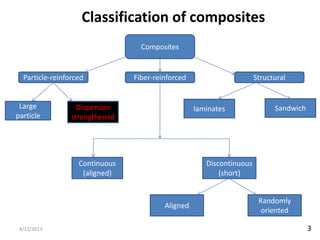
Classification of composites
                                  Composites


  Particle-reinforced           Fiber-reinforced                      Structural


 Large             Dispersion                      laminates                Sandwich
particle         strengthened


                   Continuous                         Discontinuous
                    (aligned)                             (short)


                                                                       Randomly
                                         Aligned
                                                                        oriented

 4/12/2013                                                                             3
Dispersion Strengthening
       The process which produces dislocation pining sites due to
       the presence of second phase particles in the matrix of the
       first phase.
       Normally Hard particles size rang .1nm up to 1μm

                              Hard                              Composite
              Ductile                     Powder
                             particles                           materials
              Matrix                     metallurgy


Examples:
14%Al2O3 in Al- “SAP” Composite
1-2%ThO2 in Ni-20%Cr-TD nickel
WC in CO- Cemented Carbide cutting tools
                                                      fig: 1 Powder metallurgy processes

  4/12/2013                                                                                4
Mechanism
        Orownan Model
      Dislocation Bypass by the Orowan Bowing
      Mechanism:
             The shear stress required to bow a two
            particles separated by 
                ~ Gb / 
                                                       fig: 2 Stages in passage of a dislocation
             Straight dislocation line approaching
            two particles.
             Initially line to bend.
             Reached to critical curvature.
             Leaving a dislocation loop around each
            particle.
                                                                                                   5
4/12/2013
Factors influencing second-phase particle
                  strengthening

 Interparticle spacing  

 Average particle diameterD                 Strength
 Volume fraction V f                       Ductility
 Distribution
(interspacing distance)
     If the contributions of each phase are independent, the properties
    of the multiple phase alloy is the summation of a weighted average
    of individual phases.

     For example:  avgV 1 1V 2 2       V n n
                                                             Where V= volume fraction
               avgV 1 1V 2 2     V n n           V=V1+V2+----Vn

  4/12/2013                                                                             6
Dispersion Hardening big and Small particles


                                                Strengthening
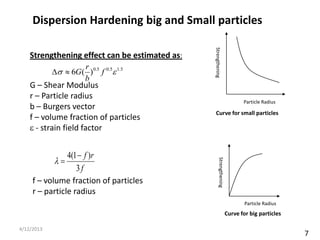
    Strengthening effect can be estimated as:
                     r
              6G ( ) 0.5 f 0.5 1.5
                     b
    G – Shear Modulus
    r – Particle radius
                                                                              Particle Radius
    b – Burgers vector
                                                  Curve for small particles
    f – volume fraction of particles
     - strain field factor


                4(1  f )r
            


                                                       Strengthening
                   3f
     f – volume fraction of particles
     r – particle radius
                                                                               Particle Radius
                                                                       Curve for big particles

4/12/2013
                                                                                                 7
Difference between precipitation and
Dispersion Strengthening
   Coherency occur in PS but No
   coherency presence in DS.
   DS stable at all temperatures but PS is
   not stables.
                                              fig:3 Coherency PS   fig:4 No coherency DS
   Time factor not important for DS but
   PS time factor important.
    Any alloy can be made in case DS.
    In DS chemical stability is increase
   than PS.
    PS-isotropic and DS- Anisotropic
4/12/2013                                                                           8
Advantage And Disadvantages
 Advantages:
  Higher creep resistance

  Higher temperature sustain

  Automotives industries

  Aerospace areas

  Sporting goods industries
  Disadvantages:
   Not use for only higher strength purpose.
   Uniform distribution of the particles


4/12/2013                                       9
Summary of dispersion strengthening
 Very       favorable for high-temperature strengthening since

dispersoids can not dissolve.

 Due to incoherency particle cutting can not occur.

 Main problem: distribute fine particles homogeneously and at

high particle number density.


 4/12/2013                                                        10
References


      George E.Dieter,Mechanical Metallurgy SI Metric Edition, McGraw-

     Hill Science in Materials and Engineering,

      William D.Callister , Jr.Materials Science and Engineering-In

     Introduction six ediation,Joh Wiley& Sons’2007

      Luker Fischer, “Nano-Dispersion Particulate Strengthened Metal

     Matrix Composites”,2004,P4-10


4/12/2013                                                                 11
4/12/2013   12