LUNG TRANSPLANTATION
INDICATIONS AND OUTCOMES
DR ANUSHA CM
• Lung transplantation involves removal of one or both diseased lungs
from patient and replacement of healthy lungs from donor.
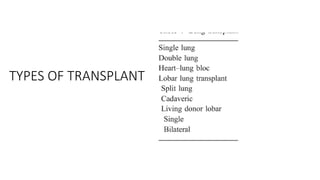
• Can be single lung transplant, double or heart lung transplant.
• Common accepted modality for end stage lung diseases failing
medical therapy.
• In 1963, Hardy performed the first lung transplant in a 58-year-old
male patient consisting of a left single-lung transplant performed for a
carcinoma of the left lung that involved the hilum who died of
nephrotoxicity.
• Since then, significant advancements have occurred regarding organ
preservation, extracorporeal support of both donor organs and
recipients, surgical techniques, immunosuppressive therapeutic
agents, and allograft surveillance, along with the advent of
multidisciplinary, collaborative medical and surgical teams to provide
care to patients after transplantation .
Recent trends in lung transplant numbers
• The International Society for Heart and Lung Transplantation (ISHLT)
Registry provides detailed annual information on patients who have
undergone Lung transplant.
• The most recent report in 2013 summarized data from 43,428 adult
lung and 3,703 adult heart-lung transplant recipients and their donors
through June 30, 2012.
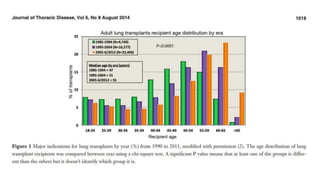
• Coinciding with the increase in total lung transplants, patients who
are older than 65 years undergoing Lung transplant are also on the
rise
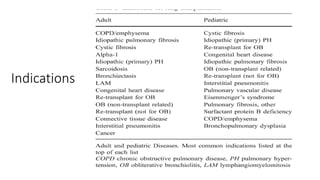
Indications
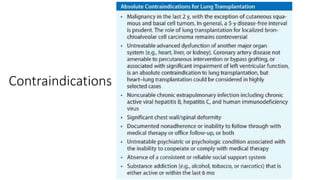
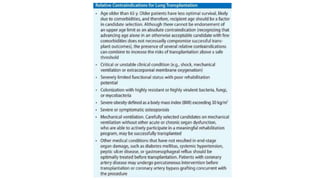
Contraindications
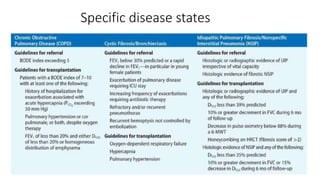
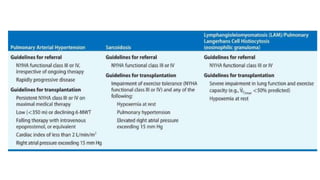
Specific disease states
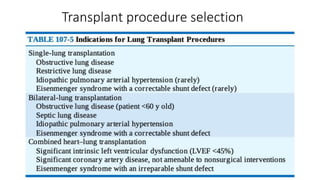
Transplant procedure selection
TYPES OF TRANSPLANT
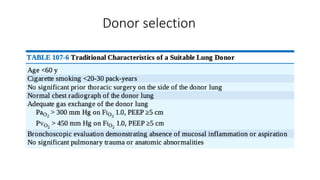
Donor selection
COMPLICATIONS
1. SURGICAL COMPLICATIONS
2. INFECTIOUS COMPLICATIONS
3. REJECTION
4. NEOPLASTIC COMPLICATIONS
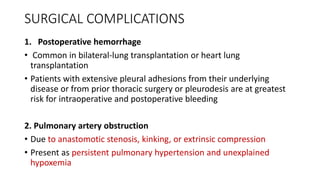
SURGICAL COMPLICATIONS
1. Postoperative hemorrhage
• Common in bilateral-lung transplantation or heart lung
transplantation
• Patients with extensive pleural adhesions from their underlying
disease or from prior thoracic surgery or pleurodesis are at greatest
risk for intraoperative and postoperative bleeding
2. Pulmonary artery obstruction
• Due to anastomotic stenosis, kinking, or extrinsic compression
• Present as persistent pulmonary hypertension and unexplained
hypoxemia
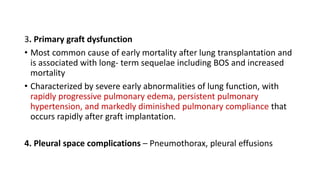
3. Primary graft dysfunction
• Most common cause of early mortality after lung transplantation and
is associated with long- term sequelae including BOS and increased
mortality
• Characterized by severe early abnormalities of lung function, with
rapidly progressive pulmonary edema, persistent pulmonary
hypertension, and markedly diminished pulmonary compliance that
occurs rapidly after graft implantation.
4. Pleural space complications – Pneumothorax, pleural effusions
5. Bronchial ischemia
• Lung transplantation do not provide direct revascularization of the
bronchial arterial circulation, and the donor bronchus must rely
entirely on collateral perfusion from the pulmonary circulation in the
initial post implantation period.
• Reduced incidence owing to better surgical methods
6. Atrial dysrhythmias
7. Hepatobiliary and pancreatic complications
INFECTIOUS COMPLICATIONS
• Bacterial pneumonia
• Chronic sinusitis: common in cystic fibrosis
• Gastroesophageal reflux (GERD) : lead to recurrent aspiration
pneumonia
• Viral infections : CMV (most dreaded ), HSV , RSV, Parainfluenza 1,2,3 ,
metapneumovirus
Rejection
1.Acute rejection
• Lymphocytic infiltration about pulmonary vessels.
• Manifest dyspnea, low-grade fever, hypoxemia, and pulmonary
infiltrates on chest radiograph.
2. Antibody mediated rejection
• Four diagnostic pillars : neutrophilic capillaritis, C4d immunostaining
involving 50% or greater interstitial capillaries, the presence of
circulating donor-specific antibodies, and allograft dysfunction
3. Chronic rejection
• Affect either the pulmonary vasculature or the airway
• Accelerated sclerosis of the pulmonary arteries and veins
• Histologically : obliterative bronchiolitis and consists of dense
eosinophilic scarring of the membranous and respiratory bronchioles
• Physiologically : evidence of airflow obstruction as assessed by simple
spirometry.
• Clinically : progressive dyspnea occurs, although a gradual decline in
FEV1 or in expiratory flow rates often precedes symptoms
NEOPLASTIC COMPLICATIONS
• Post transplant lymphoproliferative disorder - most common
• Colon cancer - more common in cystic fibrosis
OUTCOMES
SURVIVAL
• According to the 2016 report of International Society for Heart and
Lung Transplantation (ISHLT) registry, patients who underwent
primary LT between January 1990 and June 2014 had a median
survival of 5.8 years
• With unadjusted survival rates of 89% at 3 months, 80% at 1-year,
65% at 3 years, 54% at 5 years and 32% at 10 years.
• Posttransplant survival has improved over time with a median survival
of 4.2 years in the 1990–1998 era compared to 6.1 years in the 1999–
2008 era
J Thorac Dis 2017;9(8):2684-2691
1. Main determinants : underlying disease.
• A median survival of 8.9 years for cystic fibrosis (CF) patients, 6.7
years for chronic obstructive pulmonary disease (COPD) with alpha-1
antitrypsin deficiency (AATD), 5.6 years for COPD without A ATD, 4.8
years for idiopathic interstitial pneumonia and 2.8 years for re-
transplantation
• Due to differences in patients’ characteristics at the time of LT than to
the underlying disease by itself
2. Type of transplant
• Unadjusted survival rates are in favor of BLT with a median survival of
7.3 years compared to 4.6 years for single LT (SLT) recipients
according to the ISHLT registry.
• SLT is in general proposed to older and more frail patients and hence
lower survival
QUALITY OF LIFE
• In a prospective cohort study involving 326 patients in whom HRQoL
has been measured pre and post transplantation, average
improvements in SGRQ was 47 points
• These changes greatly exceed those seen with other treatments for
advances lung disease.
• This improvement persisted even when the worst possible values
were imputed to patients who died after LT
PULMONARY FUNCTION TESTS
• First few weeks after LT, pulmonary function is hampered by various
factors including pain and early graft dysfunction, and the peak in
pulmonary function is in general observed between 3 to 12 months
following LT.
• The average function declines thereafter because of CLAD ( Chronic
lung allograft dysfunction) that develops in 50% of patients at 5 years.
Second factor: type of transplant
• Patients who receive a BLT typically achieve normal pulmonary
function tests (FEV1, FVC, TLC) as well a gas exchange whatever the
indication for LT
• Lower PFTs are achieved following SLT and depend on the indication.
• Almost normal FEV1 can be expected in patients with PAH, whereas
IPF patients have typically FEV1 between 60 and 80 percent of
predicted value
• COPD patients achieve typically FEV1 in the 50–60% range
To conclude ,
• LT allows for major improvements in lung function and exercise
tolerance that translates into dramatic improvement in HRQoL that
far exceeds the effects of other treatments of end-stage lung
diseases.
• Although recent studies suggest that LT improves survival in most
cases, post-transplantation survival remains hampered by the
frequent development of CLAD.
• A better understanding of the mechanisms implicated in CLAD
development could allow to match the outcomes after other solid
organ transplantations
THANK YOU
• The introduction of the Lung Allocation Score (LAS) within the United
States has been an attempt to provide potential lung transplant
recipients with a uniform lung donor allocation system designed to
achieve at least the first of these broad goals
Reduced the waiting period

Lung transplantation

  • 1.
  • 2.
    • Lung transplantationinvolves removal of one or both diseased lungs from patient and replacement of healthy lungs from donor. • Can be single lung transplant, double or heart lung transplant. • Common accepted modality for end stage lung diseases failing medical therapy.
  • 3.
    • In 1963,Hardy performed the first lung transplant in a 58-year-old male patient consisting of a left single-lung transplant performed for a carcinoma of the left lung that involved the hilum who died of nephrotoxicity. • Since then, significant advancements have occurred regarding organ preservation, extracorporeal support of both donor organs and recipients, surgical techniques, immunosuppressive therapeutic agents, and allograft surveillance, along with the advent of multidisciplinary, collaborative medical and surgical teams to provide care to patients after transplantation .
  • 4.
    Recent trends inlung transplant numbers • The International Society for Heart and Lung Transplantation (ISHLT) Registry provides detailed annual information on patients who have undergone Lung transplant. • The most recent report in 2013 summarized data from 43,428 adult lung and 3,703 adult heart-lung transplant recipients and their donors through June 30, 2012. • Coinciding with the increase in total lung transplants, patients who are older than 65 years undergoing Lung transplant are also on the rise
  • 6.
  • 7.
  • 9.
  • 11.
  • 12.
  • 13.
  • 14.
    COMPLICATIONS 1. SURGICAL COMPLICATIONS 2.INFECTIOUS COMPLICATIONS 3. REJECTION 4. NEOPLASTIC COMPLICATIONS
  • 15.
    SURGICAL COMPLICATIONS 1. Postoperativehemorrhage • Common in bilateral-lung transplantation or heart lung transplantation • Patients with extensive pleural adhesions from their underlying disease or from prior thoracic surgery or pleurodesis are at greatest risk for intraoperative and postoperative bleeding 2. Pulmonary artery obstruction • Due to anastomotic stenosis, kinking, or extrinsic compression • Present as persistent pulmonary hypertension and unexplained hypoxemia
  • 16.
    3. Primary graftdysfunction • Most common cause of early mortality after lung transplantation and is associated with long- term sequelae including BOS and increased mortality • Characterized by severe early abnormalities of lung function, with rapidly progressive pulmonary edema, persistent pulmonary hypertension, and markedly diminished pulmonary compliance that occurs rapidly after graft implantation. 4. Pleural space complications – Pneumothorax, pleural effusions
  • 17.
    5. Bronchial ischemia •Lung transplantation do not provide direct revascularization of the bronchial arterial circulation, and the donor bronchus must rely entirely on collateral perfusion from the pulmonary circulation in the initial post implantation period. • Reduced incidence owing to better surgical methods 6. Atrial dysrhythmias 7. Hepatobiliary and pancreatic complications
  • 18.
    INFECTIOUS COMPLICATIONS • Bacterialpneumonia • Chronic sinusitis: common in cystic fibrosis • Gastroesophageal reflux (GERD) : lead to recurrent aspiration pneumonia • Viral infections : CMV (most dreaded ), HSV , RSV, Parainfluenza 1,2,3 , metapneumovirus
  • 19.
    Rejection 1.Acute rejection • Lymphocyticinfiltration about pulmonary vessels. • Manifest dyspnea, low-grade fever, hypoxemia, and pulmonary infiltrates on chest radiograph. 2. Antibody mediated rejection • Four diagnostic pillars : neutrophilic capillaritis, C4d immunostaining involving 50% or greater interstitial capillaries, the presence of circulating donor-specific antibodies, and allograft dysfunction
  • 20.
    3. Chronic rejection •Affect either the pulmonary vasculature or the airway • Accelerated sclerosis of the pulmonary arteries and veins • Histologically : obliterative bronchiolitis and consists of dense eosinophilic scarring of the membranous and respiratory bronchioles • Physiologically : evidence of airflow obstruction as assessed by simple spirometry. • Clinically : progressive dyspnea occurs, although a gradual decline in FEV1 or in expiratory flow rates often precedes symptoms
  • 21.
    NEOPLASTIC COMPLICATIONS • Posttransplant lymphoproliferative disorder - most common • Colon cancer - more common in cystic fibrosis
  • 22.
    OUTCOMES SURVIVAL • According tothe 2016 report of International Society for Heart and Lung Transplantation (ISHLT) registry, patients who underwent primary LT between January 1990 and June 2014 had a median survival of 5.8 years • With unadjusted survival rates of 89% at 3 months, 80% at 1-year, 65% at 3 years, 54% at 5 years and 32% at 10 years. • Posttransplant survival has improved over time with a median survival of 4.2 years in the 1990–1998 era compared to 6.1 years in the 1999– 2008 era J Thorac Dis 2017;9(8):2684-2691
  • 23.
    1. Main determinants: underlying disease. • A median survival of 8.9 years for cystic fibrosis (CF) patients, 6.7 years for chronic obstructive pulmonary disease (COPD) with alpha-1 antitrypsin deficiency (AATD), 5.6 years for COPD without A ATD, 4.8 years for idiopathic interstitial pneumonia and 2.8 years for re- transplantation • Due to differences in patients’ characteristics at the time of LT than to the underlying disease by itself
  • 24.
    2. Type oftransplant • Unadjusted survival rates are in favor of BLT with a median survival of 7.3 years compared to 4.6 years for single LT (SLT) recipients according to the ISHLT registry. • SLT is in general proposed to older and more frail patients and hence lower survival
  • 25.
    QUALITY OF LIFE •In a prospective cohort study involving 326 patients in whom HRQoL has been measured pre and post transplantation, average improvements in SGRQ was 47 points • These changes greatly exceed those seen with other treatments for advances lung disease. • This improvement persisted even when the worst possible values were imputed to patients who died after LT
  • 26.
    PULMONARY FUNCTION TESTS •First few weeks after LT, pulmonary function is hampered by various factors including pain and early graft dysfunction, and the peak in pulmonary function is in general observed between 3 to 12 months following LT. • The average function declines thereafter because of CLAD ( Chronic lung allograft dysfunction) that develops in 50% of patients at 5 years.
  • 27.
    Second factor: typeof transplant • Patients who receive a BLT typically achieve normal pulmonary function tests (FEV1, FVC, TLC) as well a gas exchange whatever the indication for LT • Lower PFTs are achieved following SLT and depend on the indication. • Almost normal FEV1 can be expected in patients with PAH, whereas IPF patients have typically FEV1 between 60 and 80 percent of predicted value • COPD patients achieve typically FEV1 in the 50–60% range
  • 28.
    To conclude , •LT allows for major improvements in lung function and exercise tolerance that translates into dramatic improvement in HRQoL that far exceeds the effects of other treatments of end-stage lung diseases. • Although recent studies suggest that LT improves survival in most cases, post-transplantation survival remains hampered by the frequent development of CLAD. • A better understanding of the mechanisms implicated in CLAD development could allow to match the outcomes after other solid organ transplantations
  • 29.
  • 31.
    • The introductionof the Lung Allocation Score (LAS) within the United States has been an attempt to provide potential lung transplant recipients with a uniform lung donor allocation system designed to achieve at least the first of these broad goals Reduced the waiting period