DLCO Date :09/06/15
Presentation on DLCO
Dr. ANU K.N
DLCO Date :09/06/15
DLCO
Diffusion capacity of lung for CO
A Test to determine the extent to which O2 can pass from
alveoli to blood across the alveolar-capillary membrane
DLCO Date :09/06/15
DIFFUSING CAPACITY(DL)
Volume of gas diffusing through the resp membrane per min
per mm Hg difference in partial pressure of gas on the 2 sides
of the membrane
Directly prop to-Surface area of resp membrane & solubility of
the gas
Indirectly to thickness of membrane & molecular wt. Of the
gas
DLCO Date :09/06/15
Measurement of diffusion capacity
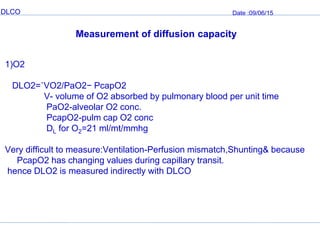
1)O2
DLO2=˙VO2/PaO2− PcapO2
V- volume of O2 absorbed by pulmonary blood per unit time
PaO2-alveolar O2 conc.
PcapO2-pulm cap O2 conc
DL for O2=21 ml/mt/mmhg
Very difficult to measure:Ventilation-Perfusion mismatch,Shunting& because
PcapO2 has changing values during capillary transit.
hence DLO2 is measured indirectly with DLCO
DLCO Date :09/06/15
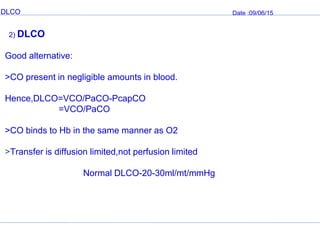
2) DLCO
Good alternative:
>CO present in negligible amounts in blood.
Hence,DLCO=VCO/PaCO-PcapCO
=VCO/PaCO
>CO binds to Hb in the same manner as O2
>Transfer is diffusion limited,not perfusion limited
Normal DLCO-20-30ml/mt/mmHg
DLCO Date :09/06/15
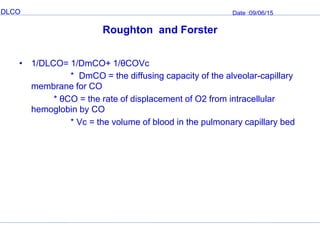
Roughton and Forster
• 1/DLCO= 1/DmCO+ 1/θCOVc
* DmCO = the diffusing capacity of the alveolar-capillary
membrane for CO
* θCO = the rate of displacement of O2 from intracellular
hemoglobin by CO
* Vc = the volume of blood in the pulmonary capillary bed
DLCO Date :09/06/15
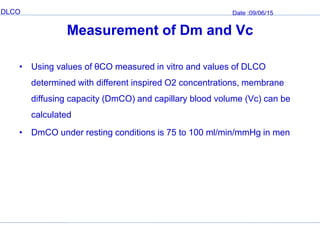
Measurement of Dm and Vc
• Using values of θCO measured in vitro and values of DLCO
determined with different inspired O2 concentrations, membrane
diffusing capacity (DmCO) and capillary blood volume (Vc) can be
calculated
• DmCO under resting conditions is 75 to 100 ml/min/mmHg in men
DLCO Date :09/06/15
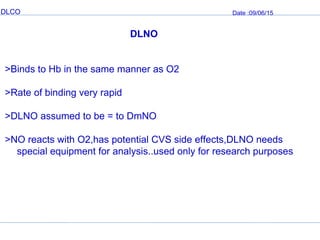
DLNO
>Binds to Hb in the same manner as O2
>Rate of binding very rapid
>DLNO assumed to be = to DmNO
>NO reacts with O2,has potential CVS side effects,DLNO needs
special equipment for analysis..used only for research purposes
DLCO Date :09/06/15
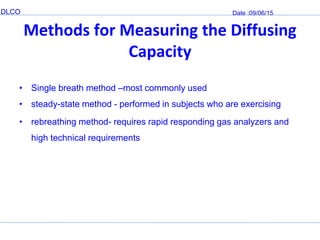
Methods for Measuring the Diffusing
Capacity
• Single breath method –most commonly used
• steady-state method - performed in subjects who are exercising
• rebreathing method- requires rapid responding gas analyzers and
high technical requirements
DLCO Date :09/06/15
SINGLE BREATH METHOD- 5 Steps
• 12 hours of abstinence from smoking is advisable
> Tidal breathing (no deep breaths)
> Unforced exhalation to Residual Volume (RV)
> Rapid Inhalation (< 4 seconds)from a gas mixture.
– 0.3% CO
– 10% He (tracer gas)
– 21% O2
– Balance Nitrogen
> Breath-hold period (9-12 seconds)
> Smooth, unforced, without hesitation
exhalation (< 4 seconds )
DLCO Date :09/06/15
• Discard volume 0.75 – 1 L (dead space)
• Sample volume 0.5 – 1 L (alveolar)
• Sample collection time<3sec
• Sample is analysed for tracer gas conc & fraction of CO, Change in
He concentration reflects dilution by gas in lungs at RV,This change
is used to determine the initial CO concentration
• Test repeated after 4 mins
DLCO Date :09/06/15
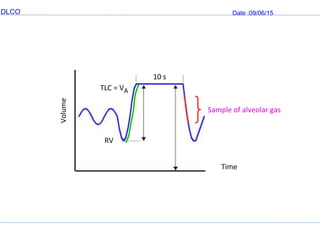
Time
10 s
Volume
RV
TLC = VA
Sample of alveolar gas
DLCO Date :09/06/15
• Perform at least 2 tests but not more than 5 tests (5 tests will
increase COHb by ~ 3.5% which will decrease the measured DLCO
~ by 3 - 3.5%)
• Testing is complete when two measurements agree within 3.0
ml/min/mmHg or within 10 percent of the higher measured value
• DLCO is reported as average of at least two acceptable tests
DLCO Date :09/06/15
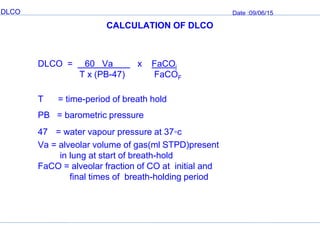
CALCULATION OF DLCO
DLCO = 60 Va x FaCOi
T x (PB-47) FaCOF
T = time-period of breath hold
PB = barometric pressure
47 = water vapour pressure at 37◦c
Va = alveolar volume of gas(ml STPD)present
in lung at start of breath-hold
FaCO = alveolar fraction of CO at initial and
final times of breath-holding period
DLCO Date :09/06/15
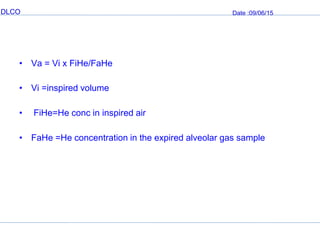
• Va = Vi x FiHe/FaHe
• Vi =inspired volume
• FiHe=He conc in inspired air
• FaHe =He concentration in the expired alveolar gas sample
DLCO Date :09/06/15
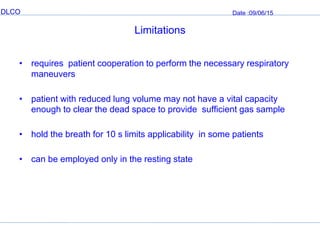
Limitations
• requires patient cooperation to perform the necessary respiratory
maneuvers
• patient with reduced lung volume may not have a vital capacity
enough to clear the dead space to provide sufficient gas sample
• hold the breath for 10 s limits applicability in some patients
• can be employed only in the resting state
DLCO Date :09/06/15
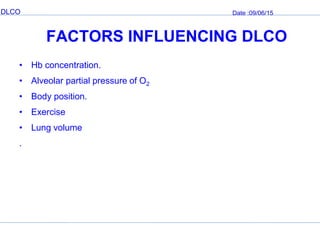
FACTORS INFLUENCING DLCO
• Hb concentration.
• Alveolar partial pressure of O2
• Body position.
• Exercise
• Lung volume
.
DLCO Date :09/06/15
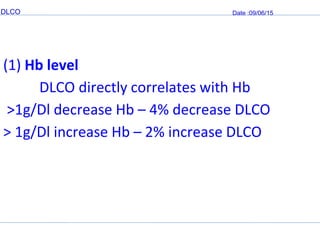
(1) Hb level
DLCO directly correlates with Hb
>1g/Dl decrease Hb – 4% decrease DLCO
> 1g/Dl increase Hb – 2% increase DLCO
DLCO Date :09/06/15
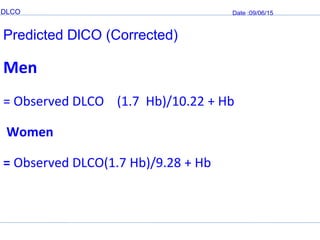
Predicted DlCO (Corrected)
Men
= Observed DLCO (1.7 Hb)/10.22 + Hb
Women
= Observed DLCO(1.7 Hb)/9.28 + Hb
DLCO Date :09/06/15
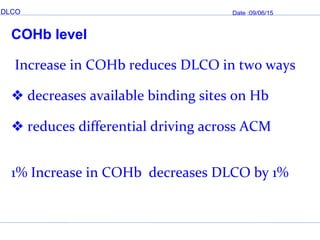
COHb level
Increase in COHb reduces DLCO in two ways
❖ decreases available binding sites on Hb
❖ reduces differential driving across ACM
1% Increase in COHb decreases DLCO by 1%
DLCO Date :09/06/15
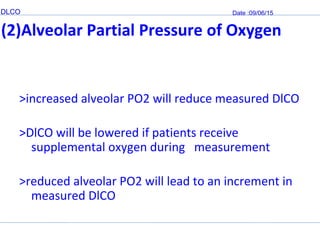
(2)Alveolar Partial Pressure of Oxygen
>increased alveolar PO2 will reduce measured DlCO
>DlCO will be lowered if patients receive
supplemental oxygen during measurement
>reduced alveolar PO2 will lead to an increment in
measured DlCO
DLCO Date :09/06/15
(3)Body Position
DlCO is 5 to 15 percent greater in supine
position than in the erect position
• Blood volume shifts from the lower trunk and
legs to the lungs in the supine position,leads
to increase in Vc
• there is minimal increase in DmCO in the
supine position
• effect of posture on DlCO decreases with age
DLCO Date :09/06/15
(4)Exercise
• DlCO can increase twofold during exercise
• Both alveolar-capillary surface area(Dm) and
capillary volume(Vc) are recruited by the
increase in cardiac output that accompanies
exercise
DLCO Date :09/06/15
(5)Alveolar volume:
DLCO decreases with decrease in alveolar
volume
DLCO Date :09/06/15
Uses
• DlCO provides a mean of assessing overall oxygen transport but does not
indicate specific defects in gas exchange
DLCO Date :09/06/15
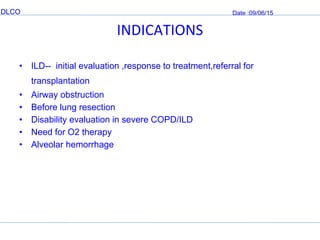
INDICATIONS
• ILD-- initial evaluation ,response to treatment,referral for
transplantation
• Airway obstruction
• Before lung resection
• Disability evaluation in severe COPD/ILD
• Need for O2 therapy
• Alveolar hemorrhage
DLCO Date :09/06/15
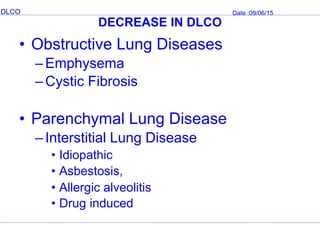
DECREASE IN DLCO
• Obstructive Lung Diseases
–Emphysema
–Cystic Fibrosis
• Parenchymal Lung Disease
–Interstitial Lung Disease
• Idiopathic
• Asbestosis,
• Allergic alveolitis
• Drug induced
DLCO Date :09/06/15
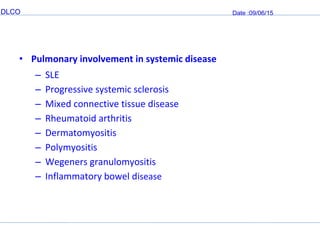
• Pulmonary involvement in systemic disease
– SLE
– Progressive systemic sclerosis
– Mixed connective tissue disease
– Rheumatoid arthritis
– Dermatomyositis
– Polymyositis
– Wegeners granulomyositis
– Inflammatory bowel disease
DLCO Date :09/06/15
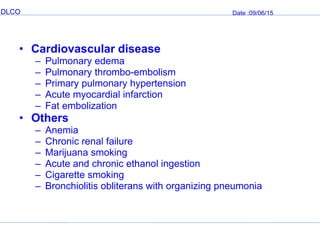
• Cardiovascular disease
– Pulmonary edema
– Pulmonary thrombo-embolism
– Primary pulmonary hypertension
– Acute myocardial infarction
– Fat embolization
• Others
– Anemia
– Chronic renal failure
– Marijuana smoking
– Acute and chronic ethanol ingestion
– Cigarette smoking
– Bronchiolitis obliterans with organizing pneumonia
DLCO Date :09/06/15
INCREASE IN DLCO
• Polycythemia
• Pulmonary hemorrhage
• Increased pulmonary blood flow
Left to right intracardiac shunts
• Exercise
• Pseudo increase-Br Asthma
DLCO Date :09/06/15
Obstruction and ↓DLCO
-> Cystic fibrosis
-> Alpha 1 antitrypsin deficiency
-> Bronciolitis obliterans
-> Lymphangiomyomatosis
DLCO Date :09/06/15
↓lung volume,↓DLCO
• Seen in Interstitial Lung Diseases
DLCO Date :09/06/15
↓DLCO,normal lung volumes
Seen in extrapulmonary restrictive lung disease
• Obesity
• Pleural effusion/thickening
• NM weakness
• Kyphoscoliosis
DLCO Date :09/06/15
↓DLCO,↓lung volume ,small airway
obstruction
• Miliary TB
• Sarcoidosis
• Asbestosis
• CCF
DLCO Date :09/06/15
Isolated fall in DLCO(normal spiro)
• Pulmonary vascular diseases
Eg. Chronic rec.pul. Emboli
Idiopathic PAH
Connective tissue
disorders/vasculitides
• ↑COHb level
• Early ILD
DLCO Date :09/06/15
Thank You

DLCO.pptx

  • 1.
  • 2.
    DLCO Date :09/06/15 DLCO Diffusioncapacity of lung for CO A Test to determine the extent to which O2 can pass from alveoli to blood across the alveolar-capillary membrane
  • 3.
    DLCO Date :09/06/15 DIFFUSINGCAPACITY(DL) Volume of gas diffusing through the resp membrane per min per mm Hg difference in partial pressure of gas on the 2 sides of the membrane Directly prop to-Surface area of resp membrane & solubility of the gas Indirectly to thickness of membrane & molecular wt. Of the gas
  • 4.
    DLCO Date :09/06/15 Measurementof diffusion capacity 1)O2 DLO2=˙VO2/PaO2− PcapO2 V- volume of O2 absorbed by pulmonary blood per unit time PaO2-alveolar O2 conc. PcapO2-pulm cap O2 conc DL for O2=21 ml/mt/mmhg Very difficult to measure:Ventilation-Perfusion mismatch,Shunting& because PcapO2 has changing values during capillary transit. hence DLO2 is measured indirectly with DLCO
  • 5.
    DLCO Date :09/06/15 2)DLCO Good alternative: >CO present in negligible amounts in blood. Hence,DLCO=VCO/PaCO-PcapCO =VCO/PaCO >CO binds to Hb in the same manner as O2 >Transfer is diffusion limited,not perfusion limited Normal DLCO-20-30ml/mt/mmHg
  • 6.
    DLCO Date :09/06/15 Roughtonand Forster • 1/DLCO= 1/DmCO+ 1/θCOVc * DmCO = the diffusing capacity of the alveolar-capillary membrane for CO * θCO = the rate of displacement of O2 from intracellular hemoglobin by CO * Vc = the volume of blood in the pulmonary capillary bed
  • 7.
    DLCO Date :09/06/15 Measurementof Dm and Vc • Using values of θCO measured in vitro and values of DLCO determined with different inspired O2 concentrations, membrane diffusing capacity (DmCO) and capillary blood volume (Vc) can be calculated • DmCO under resting conditions is 75 to 100 ml/min/mmHg in men
  • 8.
    DLCO Date :09/06/15 DLNO >Bindsto Hb in the same manner as O2 >Rate of binding very rapid >DLNO assumed to be = to DmNO >NO reacts with O2,has potential CVS side effects,DLNO needs special equipment for analysis..used only for research purposes
  • 9.
    DLCO Date :09/06/15 Methodsfor Measuring the Diffusing Capacity • Single breath method –most commonly used • steady-state method - performed in subjects who are exercising • rebreathing method- requires rapid responding gas analyzers and high technical requirements
  • 10.
    DLCO Date :09/06/15 SINGLEBREATH METHOD- 5 Steps • 12 hours of abstinence from smoking is advisable > Tidal breathing (no deep breaths) > Unforced exhalation to Residual Volume (RV) > Rapid Inhalation (< 4 seconds)from a gas mixture. – 0.3% CO – 10% He (tracer gas) – 21% O2 – Balance Nitrogen > Breath-hold period (9-12 seconds) > Smooth, unforced, without hesitation exhalation (< 4 seconds )
  • 11.
    DLCO Date :09/06/15 •Discard volume 0.75 – 1 L (dead space) • Sample volume 0.5 – 1 L (alveolar) • Sample collection time<3sec • Sample is analysed for tracer gas conc & fraction of CO, Change in He concentration reflects dilution by gas in lungs at RV,This change is used to determine the initial CO concentration • Test repeated after 4 mins
  • 12.
    DLCO Date :09/06/15 Time 10s Volume RV TLC = VA Sample of alveolar gas
  • 13.
    DLCO Date :09/06/15 •Perform at least 2 tests but not more than 5 tests (5 tests will increase COHb by ~ 3.5% which will decrease the measured DLCO ~ by 3 - 3.5%) • Testing is complete when two measurements agree within 3.0 ml/min/mmHg or within 10 percent of the higher measured value • DLCO is reported as average of at least two acceptable tests
  • 14.
    DLCO Date :09/06/15 CALCULATIONOF DLCO DLCO = 60 Va x FaCOi T x (PB-47) FaCOF T = time-period of breath hold PB = barometric pressure 47 = water vapour pressure at 37◦c Va = alveolar volume of gas(ml STPD)present in lung at start of breath-hold FaCO = alveolar fraction of CO at initial and final times of breath-holding period
  • 15.
    DLCO Date :09/06/15 •Va = Vi x FiHe/FaHe • Vi =inspired volume • FiHe=He conc in inspired air • FaHe =He concentration in the expired alveolar gas sample
  • 16.
    DLCO Date :09/06/15 Limitations •requires patient cooperation to perform the necessary respiratory maneuvers • patient with reduced lung volume may not have a vital capacity enough to clear the dead space to provide sufficient gas sample • hold the breath for 10 s limits applicability in some patients • can be employed only in the resting state
  • 17.
    DLCO Date :09/06/15 FACTORSINFLUENCING DLCO • Hb concentration. • Alveolar partial pressure of O2 • Body position. • Exercise • Lung volume .
  • 18.
    DLCO Date :09/06/15 (1)Hb level DLCO directly correlates with Hb >1g/Dl decrease Hb – 4% decrease DLCO > 1g/Dl increase Hb – 2% increase DLCO
  • 19.
    DLCO Date :09/06/15 PredictedDlCO (Corrected) Men = Observed DLCO (1.7 Hb)/10.22 + Hb Women = Observed DLCO(1.7 Hb)/9.28 + Hb
  • 20.
    DLCO Date :09/06/15 COHblevel Increase in COHb reduces DLCO in two ways ❖ decreases available binding sites on Hb ❖ reduces differential driving across ACM 1% Increase in COHb decreases DLCO by 1%
  • 21.
    DLCO Date :09/06/15 (2)AlveolarPartial Pressure of Oxygen >increased alveolar PO2 will reduce measured DlCO >DlCO will be lowered if patients receive supplemental oxygen during measurement >reduced alveolar PO2 will lead to an increment in measured DlCO
  • 22.
    DLCO Date :09/06/15 (3)BodyPosition DlCO is 5 to 15 percent greater in supine position than in the erect position • Blood volume shifts from the lower trunk and legs to the lungs in the supine position,leads to increase in Vc • there is minimal increase in DmCO in the supine position • effect of posture on DlCO decreases with age
  • 23.
    DLCO Date :09/06/15 (4)Exercise •DlCO can increase twofold during exercise • Both alveolar-capillary surface area(Dm) and capillary volume(Vc) are recruited by the increase in cardiac output that accompanies exercise
  • 24.
    DLCO Date :09/06/15 (5)Alveolarvolume: DLCO decreases with decrease in alveolar volume
  • 25.
    DLCO Date :09/06/15 Uses •DlCO provides a mean of assessing overall oxygen transport but does not indicate specific defects in gas exchange
  • 26.
    DLCO Date :09/06/15 INDICATIONS •ILD-- initial evaluation ,response to treatment,referral for transplantation • Airway obstruction • Before lung resection • Disability evaluation in severe COPD/ILD • Need for O2 therapy • Alveolar hemorrhage
  • 27.
    DLCO Date :09/06/15 DECREASEIN DLCO • Obstructive Lung Diseases –Emphysema –Cystic Fibrosis • Parenchymal Lung Disease –Interstitial Lung Disease • Idiopathic • Asbestosis, • Allergic alveolitis • Drug induced
  • 28.
    DLCO Date :09/06/15 •Pulmonary involvement in systemic disease – SLE – Progressive systemic sclerosis – Mixed connective tissue disease – Rheumatoid arthritis – Dermatomyositis – Polymyositis – Wegeners granulomyositis – Inflammatory bowel disease
  • 29.
    DLCO Date :09/06/15 •Cardiovascular disease – Pulmonary edema – Pulmonary thrombo-embolism – Primary pulmonary hypertension – Acute myocardial infarction – Fat embolization • Others – Anemia – Chronic renal failure – Marijuana smoking – Acute and chronic ethanol ingestion – Cigarette smoking – Bronchiolitis obliterans with organizing pneumonia
  • 30.
    DLCO Date :09/06/15 INCREASEIN DLCO • Polycythemia • Pulmonary hemorrhage • Increased pulmonary blood flow Left to right intracardiac shunts • Exercise • Pseudo increase-Br Asthma
  • 31.
    DLCO Date :09/06/15 Obstructionand ↓DLCO -> Cystic fibrosis -> Alpha 1 antitrypsin deficiency -> Bronciolitis obliterans -> Lymphangiomyomatosis
  • 32.
    DLCO Date :09/06/15 ↓lungvolume,↓DLCO • Seen in Interstitial Lung Diseases
  • 33.
    DLCO Date :09/06/15 ↓DLCO,normallung volumes Seen in extrapulmonary restrictive lung disease • Obesity • Pleural effusion/thickening • NM weakness • Kyphoscoliosis
  • 34.
    DLCO Date :09/06/15 ↓DLCO,↓lungvolume ,small airway obstruction • Miliary TB • Sarcoidosis • Asbestosis • CCF
  • 35.
    DLCO Date :09/06/15 Isolatedfall in DLCO(normal spiro) • Pulmonary vascular diseases Eg. Chronic rec.pul. Emboli Idiopathic PAH Connective tissue disorders/vasculitides • ↑COHb level • Early ILD
  • 36.