Introduction to
Pulmonary Function testing
Tacla Sfeir, MD , FCCP
Objectives
• Review the clinical indications of pulmonary function testing
• Recognize a good quality pulmonary function test.
• Recognize the distinct role of lung mechanics tests (spirometry and
lung volumes) and gas exchange tests (DLCO) in the evaluation of
pulmonary impairment.
• Recognize normal patterns of pulmonary function test and flow
volume loops and abnormal patterns of obstructive and restrictive
pulmonary diseases.
• Recognize hyperinflation and air trapping on lung volume testing
• Explain the metacholine challenge test ,its indication and
interpretation
• Explain the six minute walk test (6MWT)
Indications
• Evaluate a patient with a history of lung
disease
• Evaluate a patient at risk for lung disease
• Evaluate a patient with a symptom suggestive
of lung disease (dyspnea, cough,…)
• Assess and monitor a disease and assess the
effect of a therapeutic intervention
• Evaluate preoperative pulmonary risk
Pulmonary function testing
Aid in differentiating obstructive from
restrictive pulmonary disease
• Obstructive pulmonary diseases
• COPD
• Asthma
• Restrictive pulmonary diseases
• Parenchymal diseases or interstitium (such as pulmonary
fibrosis)
• Chest wall diseases or neuromuscular diseases
• Evaluation of Vascular diseases ( pulmonary
hypertension)
Pulmonary function testing
components
Lung mechanics tests
• Spirometry: pre and post bronchodilator
• Lung volumes
Gas exchange test
• DLCO
Methacholine challenge test
How to interpret PFT
• Reference values depend on age, height,
gender , and race
• Use appropriate reference values (obtained
from healthy individuals) with which the
patient’s results are compared
• Results are going to be % of predicted
• Normal range is 80-120% of predicted
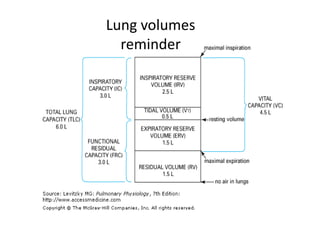
Lung volumes
reminder
Spirometry
• Measures the volume of air exhaled at specific
time points during a forceful and complete
exhalation after a maximal inhalation
• Measures all components of the VC
• Cannot measure RV
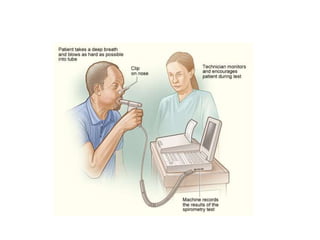
Procedure spirometry
• Patients are usually seated
• Nose is clipped
• Patient is hooked to a spirometer
• Normal tidal breathing
• The patient exhales completely
• Ask the patient to inspire maximally
• Ask the patient to exhale as hard and as
completely as he can
• Exhalation should last at least 6 seconds
Pulmonary function tests
• Results are going to be displayed as numbers
and graphs.
Spirometry
• Most commonly performed part of the full
PFT
• FVC (forced vital capacity)
• FEV1 (forced expiratory volume in one second)
• FEV1/FVC ratio
Spirometry
• The forced vital capacity (FVC) is the maximal
volume of air exhaled with a maximally forced
effort from a position of full inspiration and is
expressed in liters : normal >80% of predicted
• The forced expiratory volume in one second
(FEV1) is the maximal volume of air exhaled in
the first second of a forced exhalation that
follows a full inspiration, expressed in liters :
normal >80% of predicted
• Normally the FEV1 is 80% of the FVC: FEV1/FVC
ratio is > or = to 80%
Spiromerty
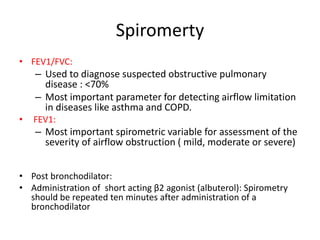
• FEV1/FVC:
– Used to diagnose suspected obstructive pulmonary
disease : <70%
– Most important parameter for detecting airflow limitation
in diseases like asthma and COPD.
• FEV1:
– Most important spirometric variable for assessment of the
severity of airflow obstruction ( mild, moderate or severe)
• Post bronchodilator:
• Administration of short acting β2 agonist (albuterol): Spirometry
should be repeated ten minutes after administration of a
bronchodilator
Spirometry
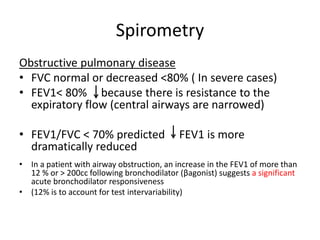
Obstructive pulmonary disease
• FVC normal or decreased <80% ( In severe cases)
• FEV1< 80% because there is resistance to the
expiratory flow (central airways are narrowed)
• FEV1/FVC < 70% predicted FEV1 is more
dramatically reduced
• In a patient with airway obstruction, an increase in the FEV1 of more than
12 % or > 200cc following bronchodilator (βagonist) suggests a significant
acute bronchodilator responsiveness
• (12% is to account for test intervariability)
Spirometry
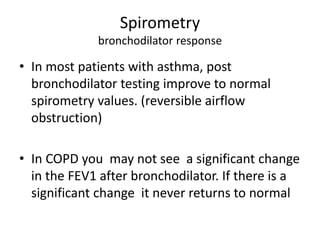
bronchodilator response
• In most patients with asthma, post
bronchodilator testing improve to normal
spirometry values. (reversible airflow
obstruction)
• In COPD you may not see a significant change
in the FEV1 after bronchodilator. If there is a
significant change it never returns to normal
Spirometry
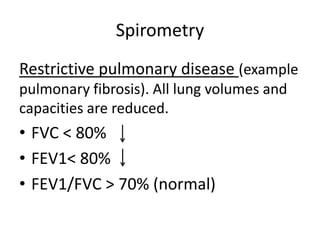
Restrictive pulmonary disease (example
pulmonary fibrosis). All lung volumes and
capacities are reduced.
• FVC < 80%
• FEV1< 80%
• FEV1/FVC > 70% (normal)
Spirometry
• Obstructive
FVC is normal or decreased
FEV1 is decreased
FEV1/FVC ratio is < 70%
• Restrictive
FVC is decreased
FEV1 is decreased
FEV1/FVC ratio is > 70%
PFT (spirometry)
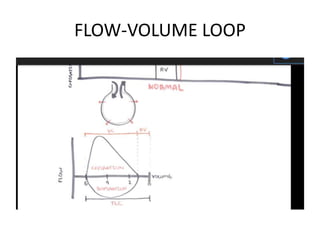
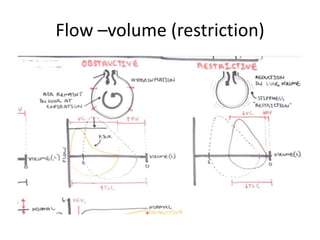
• The flow-volume loop is a plot of inspiratory
and expiratory flow (on the Y-axis) against
volume (on the X-axis) during the
performance of maximally forced inspiratory
and expiratory maneuvers
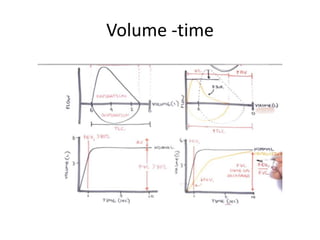
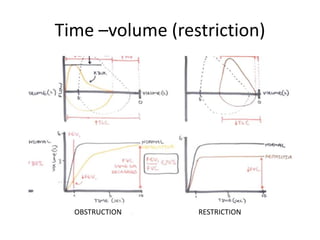
• volume-time spirogram
FLOW-VOLUME LOOP
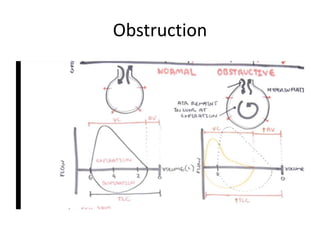
Obstruction
Volume -time
Flow –volume (restriction)
Time –volume (restriction)
OBSTRUCTION RESTRICTION
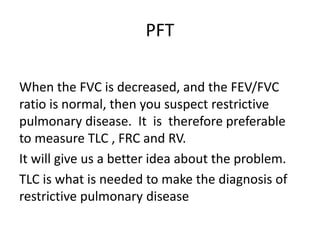
Recognize a good spirometry
• Inspection of the flow volume loop
– a sharp peak in the flow curve
– an expiratory duration greater than six seconds
A: early cough
B: poor effort
C: Cough during the
exhalation procedure
D: short exhalation
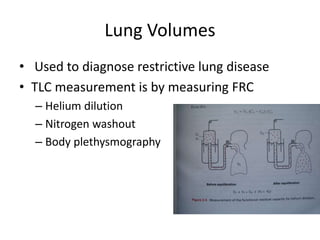
PFT
When the FVC is decreased, and the FEV/FVC
ratio is normal, then you suspect restrictive
pulmonary disease. It is therefore preferable
to measure TLC , FRC and RV.
It will give us a better idea about the problem.
TLC is what is needed to make the diagnosis of
restrictive pulmonary disease
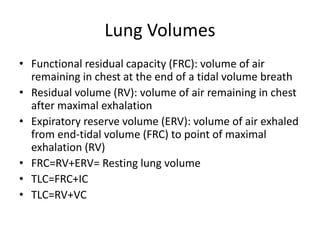
Lung Volumes
• Used to diagnose restrictive lung disease
• TLC measurement is by measuring FRC
– Helium dilution
– Nitrogen washout
– Body plethysmography
Lung Volumes
• Functional residual capacity (FRC): volume of air
remaining in chest at the end of a tidal volume breath
• Residual volume (RV): volume of air remaining in chest
after maximal exhalation
• Expiratory reserve volume (ERV): volume of air exhaled
from end-tidal volume (FRC) to point of maximal
exhalation (RV)
• FRC=RV+ERV= Resting lung volume
• TLC=FRC+IC
• TLC=RV+VC
Lung volumes in restrictive lung
diseases
TLC < 80%
RV :decreased
ERV: decreased
FRC : decreased
Lung volumes in obstructive lung
diseases
RV : may be increased in hyperinflation and air
trapping
RV/TLC ratio:
Increased (> 120% predicted) in airtrapping and
hyperinflation (emphysema)
FRC : may be increased
DLCO
• DLCO measures the ability of the lungs to
transfer gas from inhaled air to the red blood
cells in pulmonary capillaries
• Any problem at the alveolar side or the
vascular side is going to affect your DLCO
Physiology
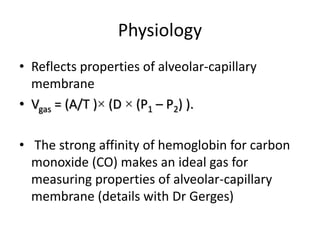
• Reflects properties of alveolar-capillary
membrane
• Vgas = (A/T )× (D × (P1 – P2) ).
• The strong affinity of hemoglobin for carbon
monoxide (CO) makes an ideal gas for
measuring properties of alveolar-capillary
membrane (details with Dr Gerges)
Method
• A single-breath method, in which the patient quickly
inhales a deep breath of 0.3 percent CO and 10 percent
helium, holds their breath for 10 seconds, and then exhales
quickly
• An alveolar sample of the exhaled gas is then analyzed for
calculation of the dilution of helium and the uptake of CO.
• The rate of disappearance of CO from the alveolar
gas during a 10-second breathhold is obtained by
measuring the inspired and expired [CO] with an
infrared analyzer.
• DLCO is the volume of CO transferred in milliliters per
minute per mm Hg of alveolar partial pressure.
• Normal DLCO: 25ml.min-1.mmHg-1
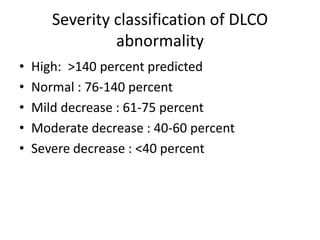
Severity classification of DLCO
abnormality
• High: >140 percent predicted
• Normal : 76-140 percent
• Mild decrease : 61-75 percent
• Moderate decrease : 40-60 percent
• Severe decrease : <40 percent
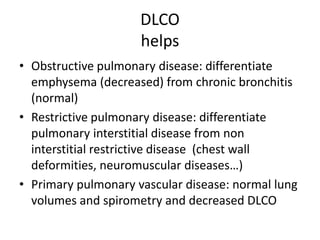
DLCO
helps
• Obstructive pulmonary disease: differentiate
emphysema (decreased) from chronic bronchitis
(normal)
• Restrictive pulmonary disease: differentiate
pulmonary interstitial disease from non
interstitial restrictive disease (chest wall
deformities, neuromuscular diseases…)
• Primary pulmonary vascular disease: normal lung
volumes and spirometry and decreased DLCO
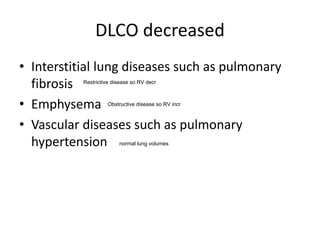
DLCO decreased
• Interstitial lung diseases such as pulmonary
fibrosis
• Emphysema
• Vascular diseases such as pulmonary
hypertension normal lung volumes
Restrictive disease so RV decr
Obstructive disease so RV incr
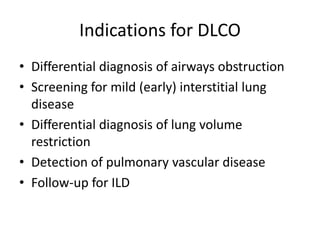
Indications for DLCO
• Differential diagnosis of airways obstruction
• Screening for mild (early) interstitial lung
disease
• Differential diagnosis of lung volume
restriction
• Detection of pulmonary vascular disease
• Follow-up for ILD
AGING
• Healthy never-smoking adults without exposure
to air pollution experience a gradual decline in
lung function.
• The forced expiratory volume in one second
(FEV1) falls approximately 30 mL per year.
• The vital capacity decreases while the residual
volume increases
• The total lung capacity intact.
• The diffusing capacity (DLCO) declines linearly
with age
Bronchoprovocation test
indications
• Accurate diagnosis of asthma
• The patient has symptoms consistent
with asthma but normal pulmonary
function test results and no response to a
bronchodilator
• (asthmatics have often normal PFT
between exacerbations)
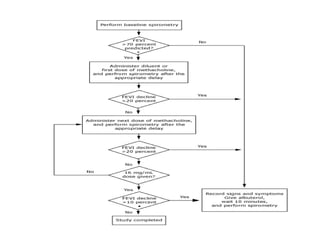
Methacholine challenge test
• Cholinergic (parasympathomimetic) synthetic analogue
of acetylcholine. The drug stimulates muscarinic,
postganglionic parasympathetic receptors, which
results in smooth muscle contraction of the airways
and increased tracheobronchial secretions.
• A series of methacholine chloride solutions are
prepared, ranging from approximately 0.03 mg/mL (the
most dilute) to 16 mg/mL (the most concentrated).
• Given by inhalation
• Contraindicated in patients with evidence wheezing
and a decreased FEV1< 60% predicted
PFT (wrap up)
FEV1 FVC FEV1/FVC
OBSTRUCTIVE Decreased Normal or
Decreased ~ or
Decreased < 70%
RESTRICTIVE Decreased Decreased >70%
Asthma: positive and significant airway responsiveness (>12%
increase in the FEV1 following bronchodilators and normalization
of FEV1)
COPD: fixed obstruction or sometimes 12% response but never
normalization of the FEV1
In obstructive pulmonary disease: RV, FRC and TLC may be
increased ( seen mostly with emphysema)
In emphysema : Hyperinflation because you start the next breath
before emptying the previous breath: increase in RV and
increased RV/TLC ratio >120% predicted
In restrictive pulmonary disease: Decreased TLC, FRC and RV
In Emphysema and interstitial lung disease : Decreased DLCO
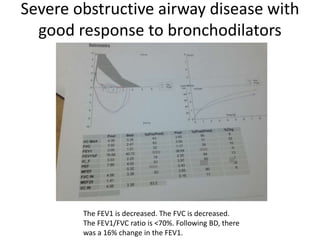
Severe obstructive airway disease with
good response to bronchodilators
The FEV1 is decreased. The FVC is decreased.
The FEV1/FVC ratio is <70%. Following BD, there
was a 16% change in the FEV1.
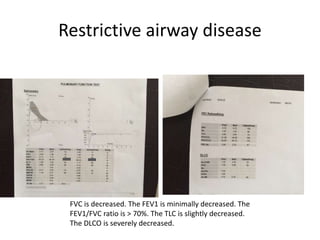
Restrictive airway disease
FVC is decreased. The FEV1 is minimally decreased. The
FEV1/FVC ratio is > 70%. The TLC is slightly decreased.
The DLCO is severely decreased.
Six-minute walk test
• 6MWT is a good index of physical function and
response to therapy in patients with COPD,
pulmonary fibrosis and pulmonary arterial
hypertension
• You ask the patient to WALK AS FAST AS
POSSIBLE for 6 minutes on a flat straight
corridor
• DON’T RUN or JOG
Six-minute walk test
• You record baseline oxygen and the heart rate
and at the end of the test
• you calculate the distance walked and you
record
• Healthy subject can typically walk 400 to 700
meters
Six-minute walk test
• The 6MWT is a test that has been used to
assess patients with COPD and pulmonary
hypertension and to follow patients after a
specific therapy.
• It has also been used as an endpoint in studies
evaluating rehabilitation in pulmonary
diseases
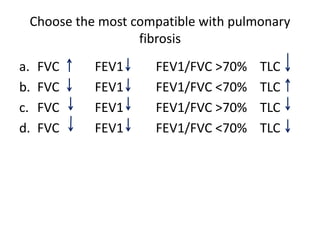
Choose the most compatible with pulmonary
fibrosis
a. FVC FEV1 FEV1/FVC >70% TLC
b. FVC FEV1 FEV1/FVC <70% TLC
c. FVC FEV1 FEV1/FVC >70% TLC
d. FVC FEV1 FEV1/FVC <70% TLC
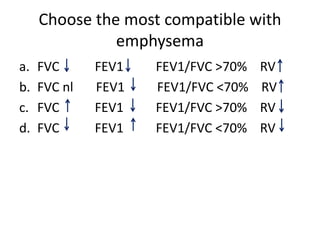
Choose the most compatible with
emphysema
a. FVC FEV1 FEV1/FVC >70% RV
b. FVC nl FEV1 FEV1/FVC <70% RV
c. FVC FEV1 FEV1/FVC >70% RV
d. FVC FEV1 FEV1/FVC <70% RV
Thank you

Pulmonary Function testing 2024 students.pdf

  • 1.
    Introduction to Pulmonary Functiontesting Tacla Sfeir, MD , FCCP
  • 2.
    Objectives • Review theclinical indications of pulmonary function testing • Recognize a good quality pulmonary function test. • Recognize the distinct role of lung mechanics tests (spirometry and lung volumes) and gas exchange tests (DLCO) in the evaluation of pulmonary impairment. • Recognize normal patterns of pulmonary function test and flow volume loops and abnormal patterns of obstructive and restrictive pulmonary diseases. • Recognize hyperinflation and air trapping on lung volume testing • Explain the metacholine challenge test ,its indication and interpretation • Explain the six minute walk test (6MWT)
  • 3.
    Indications • Evaluate apatient with a history of lung disease • Evaluate a patient at risk for lung disease • Evaluate a patient with a symptom suggestive of lung disease (dyspnea, cough,…) • Assess and monitor a disease and assess the effect of a therapeutic intervention • Evaluate preoperative pulmonary risk
  • 4.
    Pulmonary function testing Aidin differentiating obstructive from restrictive pulmonary disease • Obstructive pulmonary diseases • COPD • Asthma • Restrictive pulmonary diseases • Parenchymal diseases or interstitium (such as pulmonary fibrosis) • Chest wall diseases or neuromuscular diseases • Evaluation of Vascular diseases ( pulmonary hypertension)
  • 5.
    Pulmonary function testing components Lungmechanics tests • Spirometry: pre and post bronchodilator • Lung volumes Gas exchange test • DLCO Methacholine challenge test
  • 6.
    How to interpretPFT • Reference values depend on age, height, gender , and race • Use appropriate reference values (obtained from healthy individuals) with which the patient’s results are compared • Results are going to be % of predicted • Normal range is 80-120% of predicted
  • 7.
  • 8.
    Spirometry • Measures thevolume of air exhaled at specific time points during a forceful and complete exhalation after a maximal inhalation • Measures all components of the VC • Cannot measure RV
  • 9.
    Procedure spirometry • Patientsare usually seated • Nose is clipped • Patient is hooked to a spirometer • Normal tidal breathing • The patient exhales completely • Ask the patient to inspire maximally • Ask the patient to exhale as hard and as completely as he can • Exhalation should last at least 6 seconds
  • 11.
    Pulmonary function tests •Results are going to be displayed as numbers and graphs.
  • 12.
    Spirometry • Most commonlyperformed part of the full PFT • FVC (forced vital capacity) • FEV1 (forced expiratory volume in one second) • FEV1/FVC ratio
  • 13.
    Spirometry • The forcedvital capacity (FVC) is the maximal volume of air exhaled with a maximally forced effort from a position of full inspiration and is expressed in liters : normal >80% of predicted • The forced expiratory volume in one second (FEV1) is the maximal volume of air exhaled in the first second of a forced exhalation that follows a full inspiration, expressed in liters : normal >80% of predicted • Normally the FEV1 is 80% of the FVC: FEV1/FVC ratio is > or = to 80%
  • 14.
    Spiromerty • FEV1/FVC: – Usedto diagnose suspected obstructive pulmonary disease : <70% – Most important parameter for detecting airflow limitation in diseases like asthma and COPD. • FEV1: – Most important spirometric variable for assessment of the severity of airflow obstruction ( mild, moderate or severe) • Post bronchodilator: • Administration of short acting β2 agonist (albuterol): Spirometry should be repeated ten minutes after administration of a bronchodilator
  • 15.
    Spirometry Obstructive pulmonary disease •FVC normal or decreased <80% ( In severe cases) • FEV1< 80% because there is resistance to the expiratory flow (central airways are narrowed) • FEV1/FVC < 70% predicted FEV1 is more dramatically reduced • In a patient with airway obstruction, an increase in the FEV1 of more than 12 % or > 200cc following bronchodilator (βagonist) suggests a significant acute bronchodilator responsiveness • (12% is to account for test intervariability)
  • 16.
    Spirometry bronchodilator response • Inmost patients with asthma, post bronchodilator testing improve to normal spirometry values. (reversible airflow obstruction) • In COPD you may not see a significant change in the FEV1 after bronchodilator. If there is a significant change it never returns to normal
  • 17.
    Spirometry Restrictive pulmonary disease(example pulmonary fibrosis). All lung volumes and capacities are reduced. • FVC < 80% • FEV1< 80% • FEV1/FVC > 70% (normal)
  • 18.
    Spirometry • Obstructive FVC isnormal or decreased FEV1 is decreased FEV1/FVC ratio is < 70% • Restrictive FVC is decreased FEV1 is decreased FEV1/FVC ratio is > 70%
  • 19.
    PFT (spirometry) • Theflow-volume loop is a plot of inspiratory and expiratory flow (on the Y-axis) against volume (on the X-axis) during the performance of maximally forced inspiratory and expiratory maneuvers • volume-time spirogram
  • 20.
  • 21.
  • 22.
  • 23.
  • 24.
  • 25.
    Recognize a goodspirometry • Inspection of the flow volume loop – a sharp peak in the flow curve – an expiratory duration greater than six seconds
  • 26.
    A: early cough B:poor effort C: Cough during the exhalation procedure D: short exhalation
  • 27.
    PFT When the FVCis decreased, and the FEV/FVC ratio is normal, then you suspect restrictive pulmonary disease. It is therefore preferable to measure TLC , FRC and RV. It will give us a better idea about the problem. TLC is what is needed to make the diagnosis of restrictive pulmonary disease
  • 28.
    Lung Volumes • Usedto diagnose restrictive lung disease • TLC measurement is by measuring FRC – Helium dilution – Nitrogen washout – Body plethysmography
  • 29.
    Lung Volumes • Functionalresidual capacity (FRC): volume of air remaining in chest at the end of a tidal volume breath • Residual volume (RV): volume of air remaining in chest after maximal exhalation • Expiratory reserve volume (ERV): volume of air exhaled from end-tidal volume (FRC) to point of maximal exhalation (RV) • FRC=RV+ERV= Resting lung volume • TLC=FRC+IC • TLC=RV+VC
  • 30.
    Lung volumes inrestrictive lung diseases TLC < 80% RV :decreased ERV: decreased FRC : decreased
  • 31.
    Lung volumes inobstructive lung diseases RV : may be increased in hyperinflation and air trapping RV/TLC ratio: Increased (> 120% predicted) in airtrapping and hyperinflation (emphysema) FRC : may be increased
  • 32.
    DLCO • DLCO measuresthe ability of the lungs to transfer gas from inhaled air to the red blood cells in pulmonary capillaries • Any problem at the alveolar side or the vascular side is going to affect your DLCO
  • 33.
    Physiology • Reflects propertiesof alveolar-capillary membrane • Vgas = (A/T )× (D × (P1 – P2) ). • The strong affinity of hemoglobin for carbon monoxide (CO) makes an ideal gas for measuring properties of alveolar-capillary membrane (details with Dr Gerges)
  • 34.
    Method • A single-breathmethod, in which the patient quickly inhales a deep breath of 0.3 percent CO and 10 percent helium, holds their breath for 10 seconds, and then exhales quickly • An alveolar sample of the exhaled gas is then analyzed for calculation of the dilution of helium and the uptake of CO. • The rate of disappearance of CO from the alveolar gas during a 10-second breathhold is obtained by measuring the inspired and expired [CO] with an infrared analyzer. • DLCO is the volume of CO transferred in milliliters per minute per mm Hg of alveolar partial pressure. • Normal DLCO: 25ml.min-1.mmHg-1
  • 35.
    Severity classification ofDLCO abnormality • High: >140 percent predicted • Normal : 76-140 percent • Mild decrease : 61-75 percent • Moderate decrease : 40-60 percent • Severe decrease : <40 percent
  • 36.
    DLCO helps • Obstructive pulmonarydisease: differentiate emphysema (decreased) from chronic bronchitis (normal) • Restrictive pulmonary disease: differentiate pulmonary interstitial disease from non interstitial restrictive disease (chest wall deformities, neuromuscular diseases…) • Primary pulmonary vascular disease: normal lung volumes and spirometry and decreased DLCO
  • 37.
    DLCO decreased • Interstitiallung diseases such as pulmonary fibrosis • Emphysema • Vascular diseases such as pulmonary hypertension normal lung volumes Restrictive disease so RV decr Obstructive disease so RV incr
  • 38.
    Indications for DLCO •Differential diagnosis of airways obstruction • Screening for mild (early) interstitial lung disease • Differential diagnosis of lung volume restriction • Detection of pulmonary vascular disease • Follow-up for ILD
  • 39.
    AGING • Healthy never-smokingadults without exposure to air pollution experience a gradual decline in lung function. • The forced expiratory volume in one second (FEV1) falls approximately 30 mL per year. • The vital capacity decreases while the residual volume increases • The total lung capacity intact. • The diffusing capacity (DLCO) declines linearly with age
  • 40.
    Bronchoprovocation test indications • Accuratediagnosis of asthma • The patient has symptoms consistent with asthma but normal pulmonary function test results and no response to a bronchodilator • (asthmatics have often normal PFT between exacerbations)
  • 41.
    Methacholine challenge test •Cholinergic (parasympathomimetic) synthetic analogue of acetylcholine. The drug stimulates muscarinic, postganglionic parasympathetic receptors, which results in smooth muscle contraction of the airways and increased tracheobronchial secretions. • A series of methacholine chloride solutions are prepared, ranging from approximately 0.03 mg/mL (the most dilute) to 16 mg/mL (the most concentrated). • Given by inhalation • Contraindicated in patients with evidence wheezing and a decreased FEV1< 60% predicted
  • 43.
    PFT (wrap up) FEV1FVC FEV1/FVC OBSTRUCTIVE Decreased Normal or Decreased ~ or Decreased < 70% RESTRICTIVE Decreased Decreased >70% Asthma: positive and significant airway responsiveness (>12% increase in the FEV1 following bronchodilators and normalization of FEV1) COPD: fixed obstruction or sometimes 12% response but never normalization of the FEV1 In obstructive pulmonary disease: RV, FRC and TLC may be increased ( seen mostly with emphysema) In emphysema : Hyperinflation because you start the next breath before emptying the previous breath: increase in RV and increased RV/TLC ratio >120% predicted In restrictive pulmonary disease: Decreased TLC, FRC and RV In Emphysema and interstitial lung disease : Decreased DLCO
  • 45.
    Severe obstructive airwaydisease with good response to bronchodilators The FEV1 is decreased. The FVC is decreased. The FEV1/FVC ratio is <70%. Following BD, there was a 16% change in the FEV1.
  • 46.
    Restrictive airway disease FVCis decreased. The FEV1 is minimally decreased. The FEV1/FVC ratio is > 70%. The TLC is slightly decreased. The DLCO is severely decreased.
  • 48.
    Six-minute walk test •6MWT is a good index of physical function and response to therapy in patients with COPD, pulmonary fibrosis and pulmonary arterial hypertension • You ask the patient to WALK AS FAST AS POSSIBLE for 6 minutes on a flat straight corridor • DON’T RUN or JOG
  • 49.
    Six-minute walk test •You record baseline oxygen and the heart rate and at the end of the test • you calculate the distance walked and you record • Healthy subject can typically walk 400 to 700 meters
  • 50.
    Six-minute walk test •The 6MWT is a test that has been used to assess patients with COPD and pulmonary hypertension and to follow patients after a specific therapy. • It has also been used as an endpoint in studies evaluating rehabilitation in pulmonary diseases
  • 51.
    Choose the mostcompatible with pulmonary fibrosis a. FVC FEV1 FEV1/FVC >70% TLC b. FVC FEV1 FEV1/FVC <70% TLC c. FVC FEV1 FEV1/FVC >70% TLC d. FVC FEV1 FEV1/FVC <70% TLC
  • 52.
    Choose the mostcompatible with emphysema a. FVC FEV1 FEV1/FVC >70% RV b. FVC nl FEV1 FEV1/FVC <70% RV c. FVC FEV1 FEV1/FVC >70% RV d. FVC FEV1 FEV1/FVC <70% RV

  • 53.