Pulmonary
Function Testing
Goals
• Indications for PFTs
• Know types of studies that can be
ordered
• Understand how common tests are done
• Interpretation of the data
Indications
• Characterize known or suspected pulmonary
disease (COPD screening)
• Follow evolution of pulmonary disease
• Assess effectiveness of therapy
• Pre-op assessment of surgical risks
• Assess need for surgical interventions
• Assess impact of an occupational exposure
Pulmonary Function Tests
• Spirometry/flow-volume loop
• Lung volumes
• Diffusion capacity
• Arterial blood gas, shunt fraction measurement, dead
space
• Airway resistance
• Inspiratory/expiratory muscle pressures
• Airway reactivity (methacholine/exercise challenge)
• Cardiopulmonary exercise test
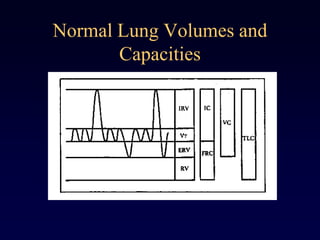
Normal Lung Volumes and
Capacities
Primary Lung Volumes
• VT: tidal volume - air inhaled during quiet
breathing
• IRV: inspiratory reserve volume - maximal
volume inhaled from quiet breathing
• ERV: expiratory reserve volume - maximal
volume exhaled from quiet breathing
• RV: residual volume - volume remaining after
maximal exhalation
Lung Capacities = Sum of
Primary Lung Volumes
• TLC: total lung capacity - sum of 4 primary
volumes
• VC: vital capacity - volume exhaled from
maximal inspiration to maximal expiration
• FRC: functional residual capacity – resting,
end-expiratory volume
• IC: maximal volume inhaled from FRC
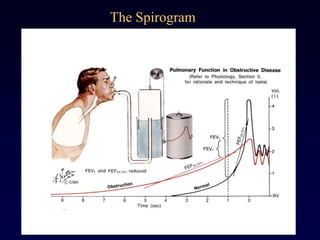
The Spirogram
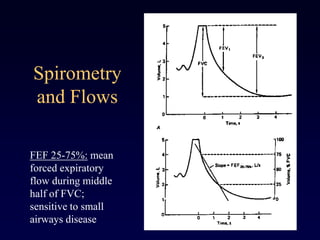
Spirometry
and Flows
FEF 25-75%: mean
forced expiratory
flow during middle
half of FVC;
sensitive to small
airways disease
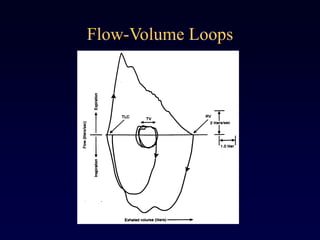
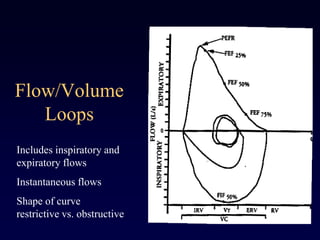
Flow/Volume
Loops
Includes inspiratory and
expiratory flows
Instantaneous flows
Shape of curve
restrictive vs. obstructive
Normal Reference
• Normal standards depend upon:
– Height
– Gender
– Age
– Race
• Reproducibility criteria (3 trials examined)
• Rate of decline: normal fall in FEV1 with
age = 20-30cc/year; in COPD = 50-
80cc/year
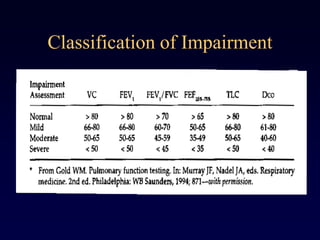
Classification of Impairment
Interpretation of Spirometry
• Step 1: obstruction or not?
– Low FEV1/FVC (<70%) = obstruction
• Step 2: Interpret severity (based upon FEV1)
• Restriction: FEV1 and FVC reduced in proportion
(i.e. normal FEV1/FVC ratio)
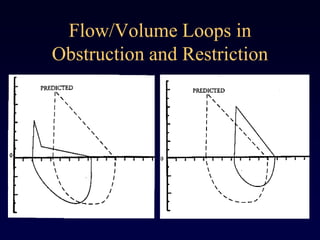
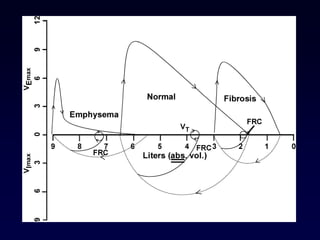
• Flow/Volume Loops
– Obstruction – concave, scooped appearing
– Restriction – decreased VC, normal shape
– Upper airway obstruction: cut-off insp and/or exp limbs
Bronchodilator Response:
• Response to inhaled bronchodilators:
– Typical in asthma; some patients with COPD
and CF have reversibility also
– “Real response”: consists of a change in FEV1
by at least 12% (and 200cc) after inhalation of
albuterol
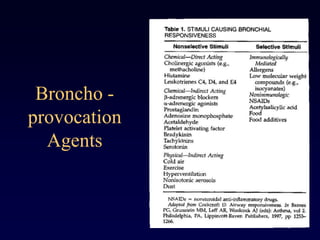
Broncho-provocation testing
• Reveals airway hyper-reactivity (asthma)
• Useful to assess non-specific hyperrresponsiveness in a
patient with symptoms c/w asthma, but without
obstruction or bronchodilator reversibility (cough
variant asthma, exercise-induced asthma)
• Methacholine – 75% asthmatics will react
• Histamine – 90-95% asthmatics will react
• Decline in FEV1 by 20% at concentration of 8mg/ml or
less (methacholine)
Flow-volume loops and upper
airway obstruction
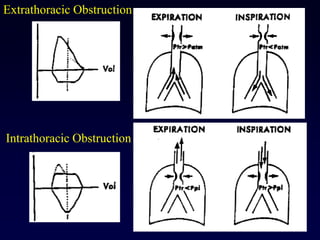
• Extrathoracic obstruction – vocal cord
dysfunction, goiter, cause flattening of
inspiratory limb of flow/volume loop
• Intrathoracic obstruction – bronchogenic cancer
in right mainstem bronchus, flattening of
expiratory limb of flow/volume loop
Intrathoracic Obstruction
Extrathoracic Obstruction
Lung Volumes
• Spirometry measures volume differences
between identifiable lung capacities (TLC, FRC,
RV), but cannot measure the absolute volume of
these key volumes
• Lung volumes measure FRC and use spirometry
to calculate TLC and RV
• FRC can be measured by following techniques:
– Closed circuit helium dilution
– Open circuit nitrogen washout
– Plethysmography or body box
Dilution Techniques
• Closed circuit helium dilution – starting at FRC, patient
breathes helium for 7 minutes (until equilibrium) from known
volume system with known He concentration; measure helium
concentration after maneuver
• Open nitrogen washout – starting at FRC, begin inspiring
100% O2 and collect/measure all nitrogen exhaled from the
lungs for 7 minutes (N2 essentially washed out). Given
known initial concentration of nitrogen in the lungs (81%),
use the measured concentration and volume of nitrogen in
collected air to calculate the starting lung volume (FRC) at
end of maneuver
• Both techniques underestimate actual FRC if ventilation isn’t
homogeneous (i.e. obstructive lung disease)
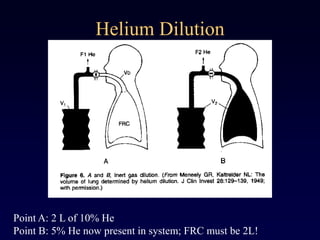
Helium Dilution
Point A: 2 L of 10% He
Point B: 5% He now present in system; FRC must be 2L!
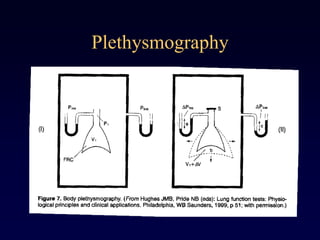
Plethysmography
Plethysmography
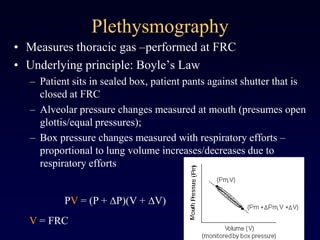
• Measures thoracic gas –performed at FRC
• Underlying principle: Boyle’s Law
– Patient sits in sealed box, patient pants against shutter that is
closed at FRC
– Alveolar pressure changes measured at mouth (presumes open
glottis/equal pressures);
– Box pressure changes measured with respiratory efforts –
proportional to lung volume increases/decreases due to
respiratory efforts
PV = (P + P)(V + V)
V = FRC
Lung Volume Determinants
• FRC:
– Lung and chest wall properties
• TLC:
– Lung and chest wall properties
– Inspiratory muscle strength
• RV:
– Lung and chest wall properties
– Expiratory muscle strength
– Airway Closure**
Lung Volume Patterns
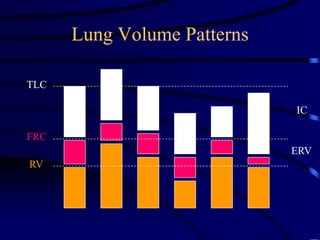
TLC
FRC
RV
ERV
IC
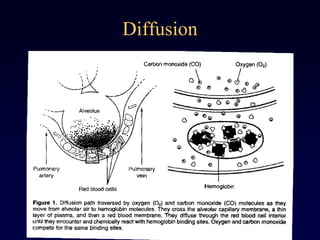
Diffusion
• Volume of gas transferred across
alveolar/capillary membrane/per minute/mmHg
of difference between the alveolar and capillary
blood
• Determined from CO uptake during 10 seconds
of breath-holding
• VCO = (Area/Thickness) x (Solubility/ MW) x
(PA-PC)
Diffusion – use of CO
• Rate of transfer of CO across respiratory membrane
relates to hemoglobin affinity (240 fold higher than for
O2)
• CO transfer rate decreases in anemia and increases in
polycythemia
• DLCO is artificially low in smokers (have baseline CO
in blood – i.e. concentration gradient working against
CO uptake)
• High altitude – increased transfer of CO
Diffusion
Loss of membrane surface area; increase in
thickness:
• pneumonectomy, emphysema, interstitial disease, CHF
Changes in Pulmonary Circulation
• Pulmonary vascular disease
Increases in DLCO
• pulmonary hemorrhage, left-to-right intracardiac
shunts, asthma
Pulmonary Gas Exchange
• Evaluating Hypoxemia:
• Hypoxemia with normal A-a gradient: hypoventilation
• Hypoxemia with increased A-a gradient: V/Q
mismatch, right-to-left shunt, diffusion impairment
• P(A-a)O2 = [PiO2 –(PaCO2/R)] – PaO2
• P(A-a)O2 = [0.21(PB-47) – (PaCO2/0.8)] –PaO2
• P(A-a)O2 = 150 – (PaCO2/0.8) – PaCO2
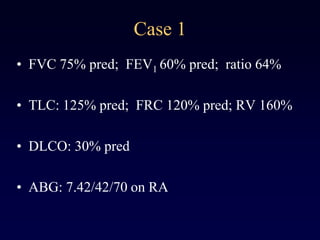
Case 1
• FVC 75% pred; FEV1 60% pred; ratio 64%
• TLC: 125% pred; FRC 120% pred; RV 160%
• DLCO: 30% pred
• ABG: 7.42/42/70 on RA
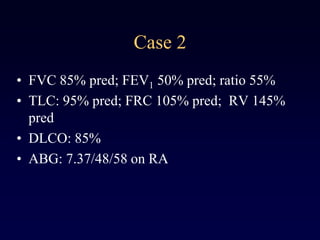
Case 2
• FVC 85% pred; FEV1 50% pred; ratio 55%
• TLC: 95% pred; FRC 105% pred; RV 145%
pred
• DLCO: 85%
• ABG: 7.37/48/58 on RA
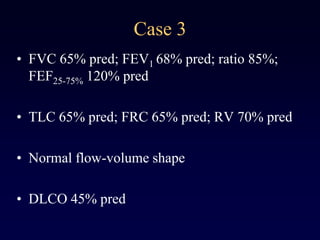
Case 3
• FVC 65% pred; FEV1 68% pred; ratio 85%;
FEF25-75% 120% pred
• TLC 65% pred; FRC 65% pred; RV 70% pred
• Normal flow-volume shape
• DLCO 45% pred
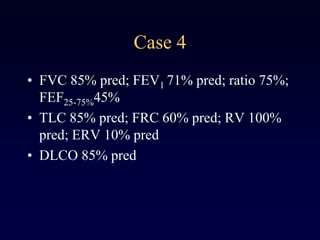
Case 4
• FVC 85% pred; FEV1 71% pred; ratio 75%;
FEF25-75%45%
• TLC 85% pred; FRC 60% pred; RV 100%
pred; ERV 10% pred
• DLCO 85% pred
Flow-Volume Loops
Flow/Volume Loops in
Obstruction and Restriction
Broncho -
provocation
Agents
Mechanics
• Neuromuscular disease with MIP, MEP
• Pressure/volume – elastic properties of lung
• Esophageal balloon to measure changes in
expiratory lung volume with changes in
transpulmonary pressure
• Transpulmonary pressure = alveolar
pressure measured at mouth and pleural
pressure measured by balloon
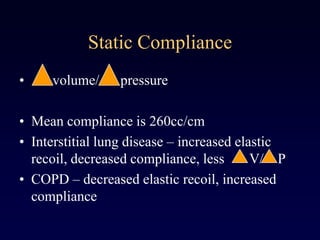
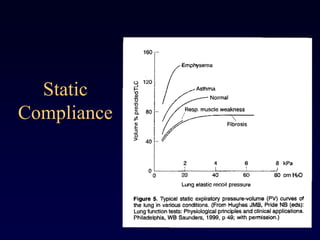
Static Compliance
• volume/ pressure
• Mean compliance is 260cc/cm
• Interstitial lung disease – increased elastic
recoil, decreased compliance, less V/ P
• COPD – decreased elastic recoil, increased
compliance
Static
Compliance
Diffusion

Pulmonary function exam

  • 1.
  • 2.
    Goals • Indications forPFTs • Know types of studies that can be ordered • Understand how common tests are done • Interpretation of the data
  • 3.
    Indications • Characterize knownor suspected pulmonary disease (COPD screening) • Follow evolution of pulmonary disease • Assess effectiveness of therapy • Pre-op assessment of surgical risks • Assess need for surgical interventions • Assess impact of an occupational exposure
  • 4.
    Pulmonary Function Tests •Spirometry/flow-volume loop • Lung volumes • Diffusion capacity • Arterial blood gas, shunt fraction measurement, dead space • Airway resistance • Inspiratory/expiratory muscle pressures • Airway reactivity (methacholine/exercise challenge) • Cardiopulmonary exercise test
  • 5.
    Normal Lung Volumesand Capacities
  • 6.
    Primary Lung Volumes •VT: tidal volume - air inhaled during quiet breathing • IRV: inspiratory reserve volume - maximal volume inhaled from quiet breathing • ERV: expiratory reserve volume - maximal volume exhaled from quiet breathing • RV: residual volume - volume remaining after maximal exhalation
  • 7.
    Lung Capacities =Sum of Primary Lung Volumes • TLC: total lung capacity - sum of 4 primary volumes • VC: vital capacity - volume exhaled from maximal inspiration to maximal expiration • FRC: functional residual capacity – resting, end-expiratory volume • IC: maximal volume inhaled from FRC
  • 8.
  • 9.
    Spirometry and Flows FEF 25-75%:mean forced expiratory flow during middle half of FVC; sensitive to small airways disease
  • 10.
    Flow/Volume Loops Includes inspiratory and expiratoryflows Instantaneous flows Shape of curve restrictive vs. obstructive
  • 12.
    Normal Reference • Normalstandards depend upon: – Height – Gender – Age – Race • Reproducibility criteria (3 trials examined) • Rate of decline: normal fall in FEV1 with age = 20-30cc/year; in COPD = 50- 80cc/year
  • 13.
  • 14.
    Interpretation of Spirometry •Step 1: obstruction or not? – Low FEV1/FVC (<70%) = obstruction • Step 2: Interpret severity (based upon FEV1) • Restriction: FEV1 and FVC reduced in proportion (i.e. normal FEV1/FVC ratio) • Flow/Volume Loops – Obstruction – concave, scooped appearing – Restriction – decreased VC, normal shape – Upper airway obstruction: cut-off insp and/or exp limbs
  • 15.
    Bronchodilator Response: • Responseto inhaled bronchodilators: – Typical in asthma; some patients with COPD and CF have reversibility also – “Real response”: consists of a change in FEV1 by at least 12% (and 200cc) after inhalation of albuterol
  • 16.
    Broncho-provocation testing • Revealsairway hyper-reactivity (asthma) • Useful to assess non-specific hyperrresponsiveness in a patient with symptoms c/w asthma, but without obstruction or bronchodilator reversibility (cough variant asthma, exercise-induced asthma) • Methacholine – 75% asthmatics will react • Histamine – 90-95% asthmatics will react • Decline in FEV1 by 20% at concentration of 8mg/ml or less (methacholine)
  • 17.
    Flow-volume loops andupper airway obstruction • Extrathoracic obstruction – vocal cord dysfunction, goiter, cause flattening of inspiratory limb of flow/volume loop • Intrathoracic obstruction – bronchogenic cancer in right mainstem bronchus, flattening of expiratory limb of flow/volume loop
  • 18.
  • 19.
    Lung Volumes • Spirometrymeasures volume differences between identifiable lung capacities (TLC, FRC, RV), but cannot measure the absolute volume of these key volumes • Lung volumes measure FRC and use spirometry to calculate TLC and RV • FRC can be measured by following techniques: – Closed circuit helium dilution – Open circuit nitrogen washout – Plethysmography or body box
  • 20.
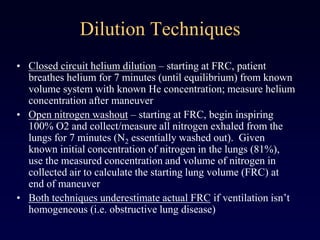
    Dilution Techniques • Closedcircuit helium dilution – starting at FRC, patient breathes helium for 7 minutes (until equilibrium) from known volume system with known He concentration; measure helium concentration after maneuver • Open nitrogen washout – starting at FRC, begin inspiring 100% O2 and collect/measure all nitrogen exhaled from the lungs for 7 minutes (N2 essentially washed out). Given known initial concentration of nitrogen in the lungs (81%), use the measured concentration and volume of nitrogen in collected air to calculate the starting lung volume (FRC) at end of maneuver • Both techniques underestimate actual FRC if ventilation isn’t homogeneous (i.e. obstructive lung disease)
  • 21.
    Helium Dilution Point A:2 L of 10% He Point B: 5% He now present in system; FRC must be 2L!
  • 22.
  • 23.
    Plethysmography • Measures thoracicgas –performed at FRC • Underlying principle: Boyle’s Law – Patient sits in sealed box, patient pants against shutter that is closed at FRC – Alveolar pressure changes measured at mouth (presumes open glottis/equal pressures); – Box pressure changes measured with respiratory efforts – proportional to lung volume increases/decreases due to respiratory efforts PV = (P + P)(V + V) V = FRC
  • 24.
    Lung Volume Determinants •FRC: – Lung and chest wall properties • TLC: – Lung and chest wall properties – Inspiratory muscle strength • RV: – Lung and chest wall properties – Expiratory muscle strength – Airway Closure**
  • 25.
  • 26.
    Diffusion • Volume ofgas transferred across alveolar/capillary membrane/per minute/mmHg of difference between the alveolar and capillary blood • Determined from CO uptake during 10 seconds of breath-holding • VCO = (Area/Thickness) x (Solubility/ MW) x (PA-PC)
  • 27.
    Diffusion – useof CO • Rate of transfer of CO across respiratory membrane relates to hemoglobin affinity (240 fold higher than for O2) • CO transfer rate decreases in anemia and increases in polycythemia • DLCO is artificially low in smokers (have baseline CO in blood – i.e. concentration gradient working against CO uptake) • High altitude – increased transfer of CO
  • 28.
    Diffusion Loss of membranesurface area; increase in thickness: • pneumonectomy, emphysema, interstitial disease, CHF Changes in Pulmonary Circulation • Pulmonary vascular disease Increases in DLCO • pulmonary hemorrhage, left-to-right intracardiac shunts, asthma
  • 29.
    Pulmonary Gas Exchange •Evaluating Hypoxemia: • Hypoxemia with normal A-a gradient: hypoventilation • Hypoxemia with increased A-a gradient: V/Q mismatch, right-to-left shunt, diffusion impairment • P(A-a)O2 = [PiO2 –(PaCO2/R)] – PaO2 • P(A-a)O2 = [0.21(PB-47) – (PaCO2/0.8)] –PaO2 • P(A-a)O2 = 150 – (PaCO2/0.8) – PaCO2
  • 30.
    Case 1 • FVC75% pred; FEV1 60% pred; ratio 64% • TLC: 125% pred; FRC 120% pred; RV 160% • DLCO: 30% pred • ABG: 7.42/42/70 on RA
  • 31.
    Case 2 • FVC85% pred; FEV1 50% pred; ratio 55% • TLC: 95% pred; FRC 105% pred; RV 145% pred • DLCO: 85% • ABG: 7.37/48/58 on RA
  • 32.
    Case 3 • FVC65% pred; FEV1 68% pred; ratio 85%; FEF25-75% 120% pred • TLC 65% pred; FRC 65% pred; RV 70% pred • Normal flow-volume shape • DLCO 45% pred
  • 33.
    Case 4 • FVC85% pred; FEV1 71% pred; ratio 75%; FEF25-75%45% • TLC 85% pred; FRC 60% pred; RV 100% pred; ERV 10% pred • DLCO 85% pred
  • 35.
  • 36.
  • 37.
  • 38.
    Mechanics • Neuromuscular diseasewith MIP, MEP • Pressure/volume – elastic properties of lung • Esophageal balloon to measure changes in expiratory lung volume with changes in transpulmonary pressure • Transpulmonary pressure = alveolar pressure measured at mouth and pleural pressure measured by balloon
  • 39.
    Static Compliance • volume/pressure • Mean compliance is 260cc/cm • Interstitial lung disease – increased elastic recoil, decreased compliance, less V/ P • COPD – decreased elastic recoil, increased compliance
  • 40.
  • 41.