Presented by
Ahmed Al Gahtani, BSRC, RRT
Associate Director Clinical Education
Chairman, RTS Advisory Committee
Dept. of Respiratory Therapy Program
Inaya Medical College, Riyadh
Saudi Society for Respiratory Care Executive Board of Directors, Member
CEO, SSRC
Airway Clearance Therapies
Optimizing Bronchial Hygiene Therapy
Bronchial Hygiene
Therapy Workshop
Ahmed Al Gahtani, BSRC, RRT
 Associate Director, Clinical Education & Instructor, RTS Program, IMC Respiratory Care Services.
 Member of Saudi Society for Respiratory Care Executive Board of Directors
 CEO, Saudi Society for Respiratory Care
 Previous Work Experience:
 Registered Respiratory Therapist King Faisal Specialist Hospital & Research Center, Riyadh, KSA.
 Principal Respiratory Therapist at Rashid Hospital, Dubai, UAE.
 Co-Founder, Instructor & Coordinator at DHA Mechanical Ventilation Training Center Dubai, UAE.
 Volunteer Work History:
 Haj-Missions, 2009, 2010, 2011 & 2015
 SSRC, Central & Northern Region Chapter, Outreach Program, MV course instructor 2011-2012
 SSRC, Central & Northern Region Chapter, Member 2015-2016
 SCCS, International Conference, 2015, RT track Scientific Committee Chair and representative of SSRC.
 SCCS, International Conference, 2016, RT track Scientific Committee Co-Chair and representative of
SSRC.
 SCCS, International Conference, 2017, Conference Scientific Committee member, RT track chair and
representative of SSRC.
Bronchial Hygiene
Therapy Workshop
• The current research and clinical trials are not conclusive, and have number
of limitations regarding study design, sample number, reported positive
outcomes. (LACK OF EVIDENCE VERSUS LACK OF BENEFIT)
• The physician needs the assistance and expertise of trained and motivated
respiratory therapists.
• Bronchial Hygiene Therapy is an interactive process.
• No single method of airway clearance is better than another.
• The therapist needs to work for and with the patient to find the methods
most suitable.
• Variety helps, it is useful to be proficient in several methods of airway
clearance.
• Measure 1:
▫ Therapist-Driven Protocol Program
• Measure 2:
▫ Patient involvement and selection of BHT technique.
• Measure 3:
▫ Therapeutic & Clinical Objective
• Measure 4:
▫ Combination & Variety of techniques
Optimizing Bronchial Hygiene Therapy
Measures to wards the right direction
• Deliver individualized diagnostic and therapeutic respiratory care to
patients
• Assist the physician with evaluating patients’ respiratory care needs and
to optimize the allocation of respiratory care services
• Determine the indications for respiratory therapy and the appropriate
modalities for providing high- quality, cost-effective care that improves
patient outcomes and decreases length of stay
• Empower respiratory care practitioners to allocate care using sign- and
symptom-based algorithms for respiratory treatment
Therapist-Driven Protocol Program
Copyright © 2016 CLINICAL MANIFESTATIONS AND ASSESSMENT OF RESPIRATORY DISEASE, SEVENTH EDITION
• Give practitioner authority to:
▫ Gather clinical information related to the patient’s respiratory status
▫ Make an assessment of the clinical data collected
▫ Start, increase, decrease, or discontinue certain respiratory therapies on a
moment-to-moment basis
• The Innate Beauty of Respiratory TDPs Is That:
▫ The physician is always in the “information loop” regarding patient care
▫ Therapy can be quickly modified in response to the specific and immediate
needs of the patient
Therapist-Driven Protocol Program
Copyright © 2016 CLINICAL MANIFESTATIONS AND ASSESSMENT OF RESPIRATORY DISEASE, SEVENTH EDITION
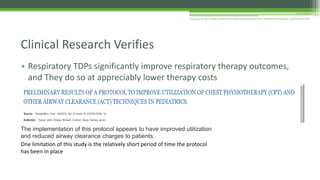
• Respiratory TDPs significantly improve respiratory therapy outcomes,
and They do so at appreciably lower therapy costs
Clinical Research Verifies
The implementation of this protocol appears to have improved utilization
and reduced airway clearance charges to patients.
One limitation of this study is the relatively short period of time the protocol
has been in place
Copyright © 2016 CLINICAL MANIFESTATIONS AND ASSESSMENT OF RESPIRATORY DISEASE, SEVENTH EDITION
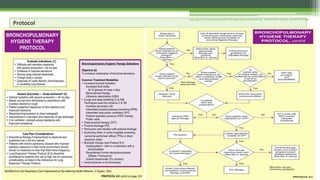
Protocol
Copyright © 2016 CLINICAL MANIFESTATIONS AND ASSESSMENT OF RESPIRATORY DISEASE, SEVENTH EDITION
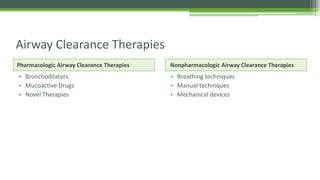
• Breathing techniques
• Manual techniques
• Mechanical devices
Nonpharmacologic Airway Clearance Therapies
• Bronchodilators
• Mucoactive Drugs
• Novel Therapies
Pharmacologic Airway Clearance Therapies
Airway Clearance Therapies
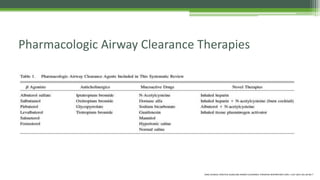
Pharmacologic Airway Clearance Therapies
AARC CLINICAL PRACTICE GUIDELINE:AIRWAY CLEARANCE THERAPIES RESPIRATORY CARE • JULY 2015 VOL 60 NO 7
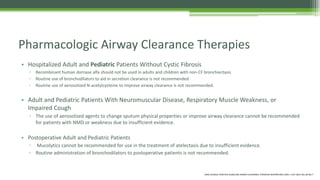
• Hospitalized Adult and Pediatric Patients Without Cystic Fibrosis
▫ Recombinant human dornase alfa should not be used in adults and children with non-CF bronchiectasis
▫ Routine use of bronchodilators to aid in secretion clearance is not recommended.
▫ Routine use of aerosolized N-acetylcysteine to improve airway clearance is not recommended.
• Adult and Pediatric Patients With Neuromuscular Disease, Respiratory Muscle Weakness, or
Impaired Cough
▫ The use of aerosolized agents to change sputum physical properties or improve airway clearance cannot be recommended
for patients with NMD or weakness due to insufficient evidence.
• Postoperative Adult and Pediatric Patients
▫ Mucolytics cannot be recommended for use in the treatment of atelectasis due to insufficient evidence.
▫ Routine administration of bronchodilators to postoperative patients is not recommended.
Pharmacologic Airway Clearance Therapies
AARC CLINICAL PRACTICE GUIDELINE:AIRWAY CLEARANCE THERAPIES RESPIRATORY CARE • JULY 2015 VOL 60 NO 7
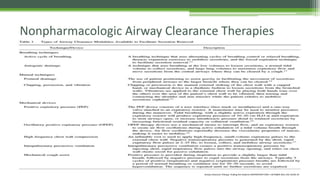
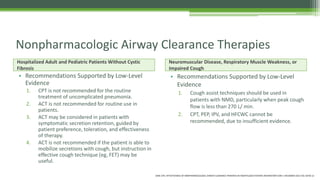
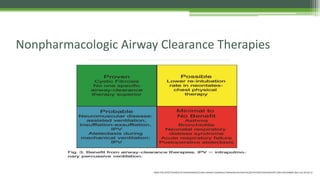
Nonpharmacologic Airway Clearance Therapies
Airway Clearance Therapy: Finding the Evidence RESPIRATORY CARE • OCTOBER 2013 VOL 58 NO 10
• Recommendations Supported by Low-Level
Evidence
1. Cough assist techniques should be used in
patients with NMD, particularly when peak cough
flow is less than 270 L/ min.
2. CPT, PEP, IPV, and HFCWC cannot be
recommended, due to insufficient evidence.
Neuromuscular Disease, Respiratory Muscle Weakness, or
Impaired Cough
• Recommendations Supported by Low-Level
Evidence
1. CPT is not recommended for the routine
treatment of uncomplicated pneumonia.
2. ACT is not recommended for routine use in
patients.
3. ACT may be considered in patients with
symptomatic secretion retention, guided by
patient preference, toleration, and effectiveness
of therapy.
4. ACT is not recommended if the patient is able to
mobilize secretions with cough, but instruction in
effective cough technique (eg, FET) may be
useful.
Hospitalized Adult and Pediatric Patients Without Cystic
Fibrosis
Nonpharmacologic Airway Clearance Therapies
AARC CPG: EFFECTIVENESS OF NONPHARMACOLOGIC AIRWAY CLEARANCE THERAPIES IN HOSPITALIZED PATIENTS RESPIRATORY CARE • DECEMBER 2013 VOL 58 NO 12
• Recommendations Supported by Low-Level
Evidence
1. Incentive spirometry is not recommended for
routine, prophylactic use in postoperative
patients.
2. Early mobility and ambulation is
recommended to reduce postoperative
complications and promote airway clearance.
3. ACT is not recommended for routine
postoperative care
Postoperative Adult and Pediatric Patients
Nonpharmacologic Airway Clearance Therapies
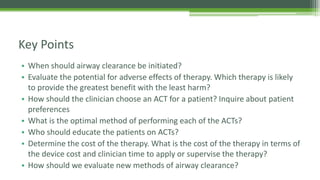
• When should airway clearance be initiated?
• Evaluate the potential for adverse effects of therapy. Which therapy is likely
to provide the greatest benefit with the least harm?
• How should the clinician choose an ACT for a patient? Inquire about patient
preferences
• What is the optimal method of performing each of the ACTs?
• Who should educate the patients on ACTs?
• Determine the cost of the therapy. What is the cost of the therapy in terms of
the device cost and clinician time to apply or supervise the therapy?
• How should we evaluate new methods of airway clearance?
Key Points
Copyright © 2016 CLINICAL
MANIFESTATIONS AND ASSESSMENT
OF RESPIRATORY DISEASE, SEVENTH
EDITION
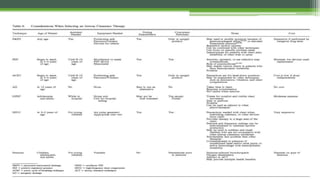
Traditional Airway Clearance
Techniques
• Postural drainage
• Percussion
• Postural drainage and percussion
• Vibration of the chest wall
Airway Clearance Therapy (ACT)
• Adverse consequences
• Cough
• Forced expiration technique (FET)
• Coughing and FET
• Positive expiratory pressure (PEP) therapy
• Cough assist
• Autogenic drainage (AD)
• PEP + AD
• High-frequency chest compression
• Effectiveness of techniques
Complications of ACT
• Hypoxemia
• Airway obstruction and respiratory arrest
• Intracranial complications
• Rib fractures and bruising
• Airway trauma
Selection of Patients for ACT
• Conditions in which airway clearance therapy may
not be beneficial
• Conditions in which airway clearance therapy may be
beneficial
▫ Acute lobar atelectasis
▫ Cystic fibrosis
▫ Neuromuscular disease or injury
▫ Lung abscess
Contraindications
• Frank hemoptysis
• Empyema
• Foreign body aspiration
• Untreated pneumothorax
Length and Frequency of Therapy
• CF and bronchiectasis: 30 to 45 minutes
• Most ACTs, 15 to 20 minutes
• Rarely needed more than every 4 hours
• Evaluated every 48 hours
Therapy Modification
• Medical or surgical procedures
• Implanted devices
• Brittle bones
• Trendelenburg
▫ Gastroesophageal reflux
▫ Intracranial trauma or surgery
▫ Increased intracranial pressure
▫ Abdominal distention
▫ Cardiopulmonary failure
Monitoring During Therapy
• SaO2
• Heart rate
• Respiratory rate
• Breathing pattern
• Skin color
• Breath sounds
Evaluation of Therapy
• Amount of secretions expectorated
• Hydration status
• Changes in sputum production
• Breath sounds
• Vital signs
• Chest x-ray
• Blood gases
• Lung mechanics
Documentation of Therapy
• Technique used
• Lobes treated
• Position of the patient
• Suctioning
• Pretreatment and post-treatment breath sounds
• Vital signs
• Amount and quality of the sputum
Airway Clearance Therapies

Airway Clearance Therapies

  • 1.
    Presented by Ahmed AlGahtani, BSRC, RRT Associate Director Clinical Education Chairman, RTS Advisory Committee Dept. of Respiratory Therapy Program Inaya Medical College, Riyadh Saudi Society for Respiratory Care Executive Board of Directors, Member CEO, SSRC Airway Clearance Therapies Optimizing Bronchial Hygiene Therapy Bronchial Hygiene Therapy Workshop
  • 2.
    Ahmed Al Gahtani,BSRC, RRT  Associate Director, Clinical Education & Instructor, RTS Program, IMC Respiratory Care Services.  Member of Saudi Society for Respiratory Care Executive Board of Directors  CEO, Saudi Society for Respiratory Care  Previous Work Experience:  Registered Respiratory Therapist King Faisal Specialist Hospital & Research Center, Riyadh, KSA.  Principal Respiratory Therapist at Rashid Hospital, Dubai, UAE.  Co-Founder, Instructor & Coordinator at DHA Mechanical Ventilation Training Center Dubai, UAE.  Volunteer Work History:  Haj-Missions, 2009, 2010, 2011 & 2015  SSRC, Central & Northern Region Chapter, Outreach Program, MV course instructor 2011-2012  SSRC, Central & Northern Region Chapter, Member 2015-2016  SCCS, International Conference, 2015, RT track Scientific Committee Chair and representative of SSRC.  SCCS, International Conference, 2016, RT track Scientific Committee Co-Chair and representative of SSRC.  SCCS, International Conference, 2017, Conference Scientific Committee member, RT track chair and representative of SSRC. Bronchial Hygiene Therapy Workshop
  • 3.
    • The currentresearch and clinical trials are not conclusive, and have number of limitations regarding study design, sample number, reported positive outcomes. (LACK OF EVIDENCE VERSUS LACK OF BENEFIT) • The physician needs the assistance and expertise of trained and motivated respiratory therapists. • Bronchial Hygiene Therapy is an interactive process. • No single method of airway clearance is better than another. • The therapist needs to work for and with the patient to find the methods most suitable. • Variety helps, it is useful to be proficient in several methods of airway clearance.
  • 4.
    • Measure 1: ▫Therapist-Driven Protocol Program • Measure 2: ▫ Patient involvement and selection of BHT technique. • Measure 3: ▫ Therapeutic & Clinical Objective • Measure 4: ▫ Combination & Variety of techniques Optimizing Bronchial Hygiene Therapy Measures to wards the right direction
  • 5.
    • Deliver individualizeddiagnostic and therapeutic respiratory care to patients • Assist the physician with evaluating patients’ respiratory care needs and to optimize the allocation of respiratory care services • Determine the indications for respiratory therapy and the appropriate modalities for providing high- quality, cost-effective care that improves patient outcomes and decreases length of stay • Empower respiratory care practitioners to allocate care using sign- and symptom-based algorithms for respiratory treatment Therapist-Driven Protocol Program Copyright © 2016 CLINICAL MANIFESTATIONS AND ASSESSMENT OF RESPIRATORY DISEASE, SEVENTH EDITION
  • 6.
    • Give practitionerauthority to: ▫ Gather clinical information related to the patient’s respiratory status ▫ Make an assessment of the clinical data collected ▫ Start, increase, decrease, or discontinue certain respiratory therapies on a moment-to-moment basis • The Innate Beauty of Respiratory TDPs Is That: ▫ The physician is always in the “information loop” regarding patient care ▫ Therapy can be quickly modified in response to the specific and immediate needs of the patient Therapist-Driven Protocol Program Copyright © 2016 CLINICAL MANIFESTATIONS AND ASSESSMENT OF RESPIRATORY DISEASE, SEVENTH EDITION
  • 7.
    • Respiratory TDPssignificantly improve respiratory therapy outcomes, and They do so at appreciably lower therapy costs Clinical Research Verifies The implementation of this protocol appears to have improved utilization and reduced airway clearance charges to patients. One limitation of this study is the relatively short period of time the protocol has been in place Copyright © 2016 CLINICAL MANIFESTATIONS AND ASSESSMENT OF RESPIRATORY DISEASE, SEVENTH EDITION
  • 8.
    Protocol Copyright © 2016CLINICAL MANIFESTATIONS AND ASSESSMENT OF RESPIRATORY DISEASE, SEVENTH EDITION
  • 9.
    • Breathing techniques •Manual techniques • Mechanical devices Nonpharmacologic Airway Clearance Therapies • Bronchodilators • Mucoactive Drugs • Novel Therapies Pharmacologic Airway Clearance Therapies Airway Clearance Therapies
  • 10.
    Pharmacologic Airway ClearanceTherapies AARC CLINICAL PRACTICE GUIDELINE:AIRWAY CLEARANCE THERAPIES RESPIRATORY CARE • JULY 2015 VOL 60 NO 7
  • 11.
    • Hospitalized Adultand Pediatric Patients Without Cystic Fibrosis ▫ Recombinant human dornase alfa should not be used in adults and children with non-CF bronchiectasis ▫ Routine use of bronchodilators to aid in secretion clearance is not recommended. ▫ Routine use of aerosolized N-acetylcysteine to improve airway clearance is not recommended. • Adult and Pediatric Patients With Neuromuscular Disease, Respiratory Muscle Weakness, or Impaired Cough ▫ The use of aerosolized agents to change sputum physical properties or improve airway clearance cannot be recommended for patients with NMD or weakness due to insufficient evidence. • Postoperative Adult and Pediatric Patients ▫ Mucolytics cannot be recommended for use in the treatment of atelectasis due to insufficient evidence. ▫ Routine administration of bronchodilators to postoperative patients is not recommended. Pharmacologic Airway Clearance Therapies AARC CLINICAL PRACTICE GUIDELINE:AIRWAY CLEARANCE THERAPIES RESPIRATORY CARE • JULY 2015 VOL 60 NO 7
  • 12.
    Nonpharmacologic Airway ClearanceTherapies Airway Clearance Therapy: Finding the Evidence RESPIRATORY CARE • OCTOBER 2013 VOL 58 NO 10
  • 13.
    • Recommendations Supportedby Low-Level Evidence 1. Cough assist techniques should be used in patients with NMD, particularly when peak cough flow is less than 270 L/ min. 2. CPT, PEP, IPV, and HFCWC cannot be recommended, due to insufficient evidence. Neuromuscular Disease, Respiratory Muscle Weakness, or Impaired Cough • Recommendations Supported by Low-Level Evidence 1. CPT is not recommended for the routine treatment of uncomplicated pneumonia. 2. ACT is not recommended for routine use in patients. 3. ACT may be considered in patients with symptomatic secretion retention, guided by patient preference, toleration, and effectiveness of therapy. 4. ACT is not recommended if the patient is able to mobilize secretions with cough, but instruction in effective cough technique (eg, FET) may be useful. Hospitalized Adult and Pediatric Patients Without Cystic Fibrosis Nonpharmacologic Airway Clearance Therapies AARC CPG: EFFECTIVENESS OF NONPHARMACOLOGIC AIRWAY CLEARANCE THERAPIES IN HOSPITALIZED PATIENTS RESPIRATORY CARE • DECEMBER 2013 VOL 58 NO 12
  • 14.
    • Recommendations Supportedby Low-Level Evidence 1. Incentive spirometry is not recommended for routine, prophylactic use in postoperative patients. 2. Early mobility and ambulation is recommended to reduce postoperative complications and promote airway clearance. 3. ACT is not recommended for routine postoperative care Postoperative Adult and Pediatric Patients Nonpharmacologic Airway Clearance Therapies
  • 15.
    • When shouldairway clearance be initiated? • Evaluate the potential for adverse effects of therapy. Which therapy is likely to provide the greatest benefit with the least harm? • How should the clinician choose an ACT for a patient? Inquire about patient preferences • What is the optimal method of performing each of the ACTs? • Who should educate the patients on ACTs? • Determine the cost of the therapy. What is the cost of the therapy in terms of the device cost and clinician time to apply or supervise the therapy? • How should we evaluate new methods of airway clearance? Key Points
  • 16.
    Copyright © 2016CLINICAL MANIFESTATIONS AND ASSESSMENT OF RESPIRATORY DISEASE, SEVENTH EDITION
  • 17.
    Traditional Airway Clearance Techniques •Postural drainage • Percussion • Postural drainage and percussion • Vibration of the chest wall
  • 18.
    Airway Clearance Therapy(ACT) • Adverse consequences • Cough • Forced expiration technique (FET) • Coughing and FET • Positive expiratory pressure (PEP) therapy • Cough assist • Autogenic drainage (AD) • PEP + AD • High-frequency chest compression • Effectiveness of techniques
  • 19.
    Complications of ACT •Hypoxemia • Airway obstruction and respiratory arrest • Intracranial complications • Rib fractures and bruising • Airway trauma
  • 20.
    Selection of Patientsfor ACT • Conditions in which airway clearance therapy may not be beneficial • Conditions in which airway clearance therapy may be beneficial ▫ Acute lobar atelectasis ▫ Cystic fibrosis ▫ Neuromuscular disease or injury ▫ Lung abscess
  • 21.
    Contraindications • Frank hemoptysis •Empyema • Foreign body aspiration • Untreated pneumothorax
  • 22.
    Length and Frequencyof Therapy • CF and bronchiectasis: 30 to 45 minutes • Most ACTs, 15 to 20 minutes • Rarely needed more than every 4 hours • Evaluated every 48 hours
  • 23.
    Therapy Modification • Medicalor surgical procedures • Implanted devices • Brittle bones • Trendelenburg ▫ Gastroesophageal reflux ▫ Intracranial trauma or surgery ▫ Increased intracranial pressure ▫ Abdominal distention ▫ Cardiopulmonary failure
  • 24.
    Monitoring During Therapy •SaO2 • Heart rate • Respiratory rate • Breathing pattern • Skin color • Breath sounds
  • 25.
    Evaluation of Therapy •Amount of secretions expectorated • Hydration status • Changes in sputum production • Breath sounds • Vital signs • Chest x-ray • Blood gases • Lung mechanics
  • 26.
    Documentation of Therapy •Technique used • Lobes treated • Position of the patient • Suctioning • Pretreatment and post-treatment breath sounds • Vital signs • Amount and quality of the sputum

Editor's Notes

  • #5 Lesson descriptions should be brief.
  • #6 Example objectives At the end of this lesson, you will be able to: Save files to the team Web server. Move files to different locations on the team Web server. Share files on the team Web server.