Diffraction
    • Interference with more than 2 beams
        – 3, 4, 5 beams
        – Large number of beams
    • Diffraction gratings
        – Equation
        – Uses
    • Diffraction by an aperture
        –   Huygen’s principle again, Fresnel zones, Arago’s spot
        –   Qualitative effects, changes with propagation distance
        –   Fresnel number again
        –   Imaging with an optical system, near and far field
        –   Fraunhofer diffraction of slits and circular apertures
        –   Resolution of optical systems
    • Diffraction of a laser beam
LASERS 51                                                            April 03
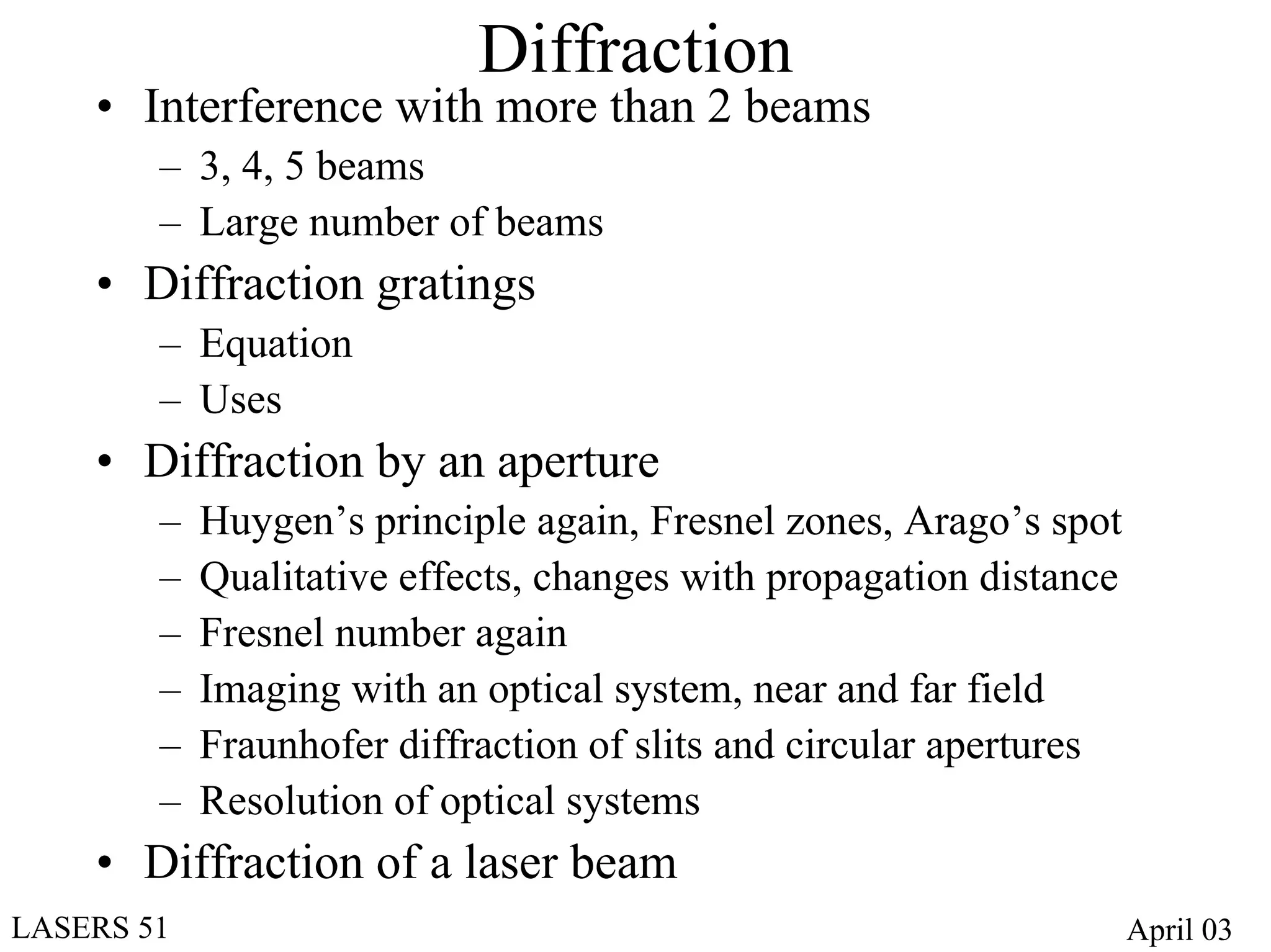
Interference from multiple apertures
                                 L
                                                    Bright fringes when OPD=nλ
                                                                    40

                                                x
                                                         nLλ
                                                      x=


                                                                     Intensity
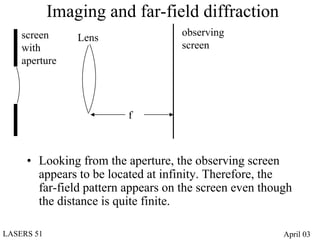
            d
source                     OPD
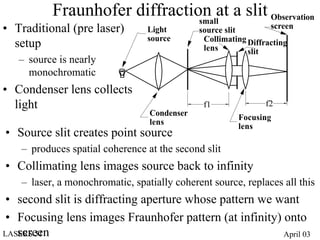
                                                          d
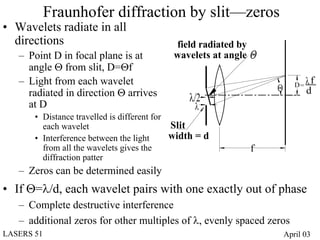
                    two slits                                                    position on screen

                                          screen Complete destructive interference halfway between

                                OPD 1            OPD 1=nλ, OPD 2=2nλ
                                  OPD 2          all three waves interfere constructively
                                                               40

                d


                                                                 Intensity
source
                       three                                                     position on screen
                       equally spaced
                       slits          screen
                                                    OPD 2=nλ, n odd
                                                    outer slits constructively interfere
                                                    middle slit gives secondary maxima
LASERS 51                                                                                             April 03
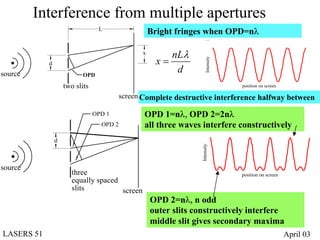
Diffraction from multiple apertures
• Fringes not sinusoidal for
  more than two slits                 2 slits
• Main peak gets narrower
   – Center location obeys same       3 slits
     equation
• Secondary maxima appear             4 slits
  between main peaks
   – The more slits, the more         5 slits
     secondary maxima
   – The more slits, the weaker the
     secondary maxima become
• Diffraction grating – many slits, very narrow spacing
   – Main peaks become narrow and widely spaced
   – Secondary peaks are too small to observe
LASERS 51                                                 April 03
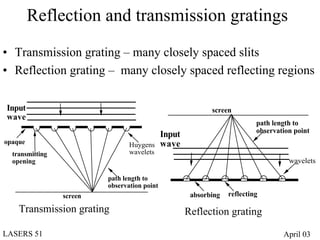
Reflection and transmission gratings
• Transmission grating – many closely spaced slits
• Reflection grating – many closely spaced reflecting regions

Input                                                        screen
wave
                                                                            path length to
                                                                            observation point
                                              Input
opaque                           Huygens      wave
  transmitting                   wavelets
  opening                                                                             wavelets

                          path length to
                          observation point
                 screen                                absorbing   reflecting

    Transmission grating                              Reflection grating

LASERS 51                                                                           April 03
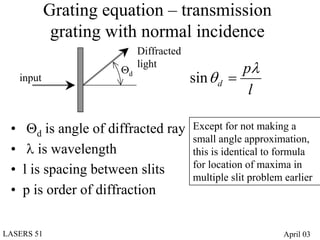
Grating equation – transmission
              grating with normal incidence
                            Diffracted
                       Θd
                            light
                                                   pλ
     input                               sin θ d =
                                                    l

 •    Θd is angle of diffracted ray      Except for not making a
                                         small angle approximation,
 •    λ is wavelength                    this is identical to formula
                                         for location of maxima in
 •   l is spacing between slits          multiple slit problem earlier
 •   p is order of diffraction

LASERS 51                                                      April 03
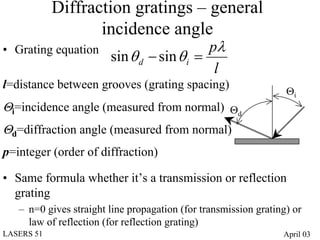
Diffraction gratings – general
                   incidence angle
• Grating equation                          pλ
                        sin θ d − sin θ i =
                                             l
l=distance between grooves (grating spacing)
                                                                  Θi
Θi=incidence angle (measured from normal) Θd
Θd=diffraction angle (measured from normal)
p=integer (order of diffraction)

• Same formula whether it’s a transmission or reflection
  grating
   – n=0 gives straight line propagation (for transmission grating) or
     law of reflection (for reflection grating)
LASERS 51                                                        April 03
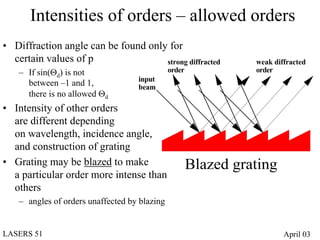
Intensities of orders – allowed orders
• Diffraction angle can be found only for
  certain values of p                strong diffracted          weak diffracted
   – If sin(Θd) is not                        order             order
                                   input
     between –1 and 1,             beam
     there is no allowed Θd
• Intensity of other orders
  are different depending
  on wavelength, incidence angle,
  and construction of grating
• Grating may be blazed to make                       Blazed grating
  a particular order more intense than
  others
   – angles of orders unaffected by blazing


LASERS 51                                                               April 03
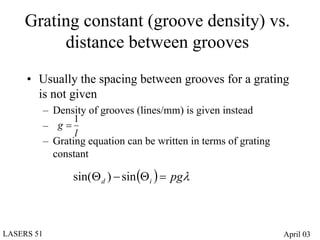
Grating constant (groove density) vs.
         distance between grooves
     • Usually the spacing between grooves for a grating
       is not given
            – Density of grooves (lines/mm) is given instead
                   1
            –  g=
                   l
            – Grating equation can be written in terms of grating
              constant

                   sin(Θ d ) − sin (Θ i ) = pgλ


LASERS 51                                                           April 03
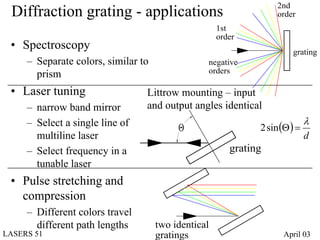
2nd
 Diffraction grating - applications                                order
                                                     1st
                                                     order
 • Spectroscopy                                                        grating
     – Separate colors, similar to               negative
       prism                                     orders

 • Laser tuning                  Littrow mounting – input
     – narrow band mirror        and output angles identical
     – Select a single line of                                               λ
                                          Θ                   2 sin (Θ ) =
       multiline laser                                                       d
     – Select frequency in a                            grating
       tunable laser
 • Pulse stretching and
   compression
     – Different colors travel
       different path lengths        two identical
LASERS 51                            gratings                       April 03
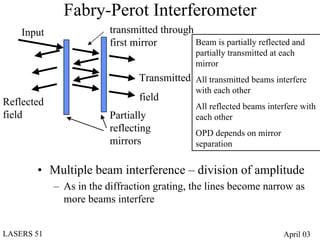
Fabry-Perot Interferometer
    Input                transmitted through
                         first mirror        Beam is partially reflected and
                                               partially transmitted at each
                                               mirror
                                Transmitted All transmitted beams interfere
                                               with each other
Reflected                       field
                                               All reflected beams interfere with
field                    Partially             each other
                         reflecting            OPD depends on mirror
                         mirrors               separation


       • Multiple beam interference – division of amplitude
            – As in the diffraction grating, the lines become narrow as
              more beams interfere


LASERS 51                                                               April 03
Fabry-Perot Interferometer
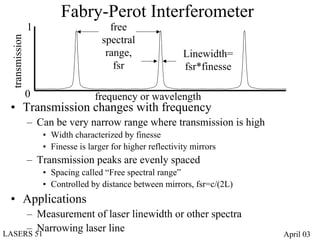
                1                      free
                                     spectral
 transmission


                                      range,                 Linewidth=
                                        fsr                  fsr*finesse

                0                  frequency or wavelength
 • Transmission changes with frequency
                – Can be very narrow range where transmission is high
                    • Width characterized by finesse
                    • Finesse is larger for higher reflectivity mirrors
                – Transmission peaks are evenly spaced
                    • Spacing called “Free spectral range”
                    • Controlled by distance between mirrors, fsr=c/(2L)
 • Applications
     – Measurement of laser linewidth or other spectra
     – Narrowing laser line
LASERS 51                                                                  April 03
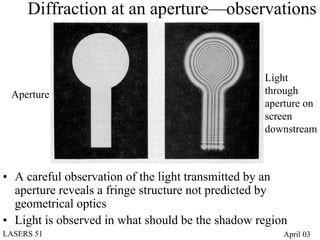
Diffraction at an aperture—observations


                                                  Light
 Aperture                                         through
                                                  aperture on
                                                  screen
                                                  downstream


• A careful observation of the light transmitted by an
  aperture reveals a fringe structure not predicted by
  geometrical optics
• Light is observed in what should be the shadow region
LASERS 51                                             April 03
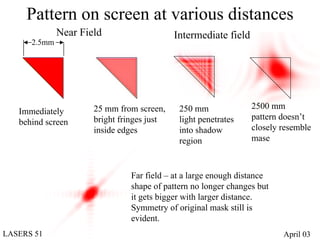
Pattern on screen at various distances
              Near Field                    Intermediate field
      2.5mm


                      25 mm from screen,     250 mm              2500 mm
   Immediately
                      bright fringes just    light penetrates    pattern doesn’t
   behind screen
                      inside edges           into shadow         closely resemble
                                             region              mase


                               Far field – at a large enough distance
                               shape of pattern no longer changes but
                               it gets bigger with larger distance.
                               Symmetry of original mask still is
                               evident.
LASERS 51                                                                April 03
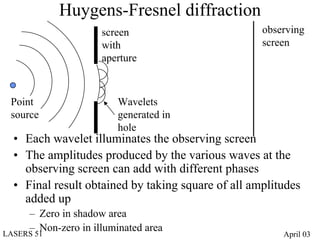
Huygens-Fresnel diffraction
                      screen                        observing
                      with                          screen
                      aperture


 Point                   Wavelets
 source                  generated in
                         hole
  • Each wavelet illuminates the observing screen
  • The amplitudes produced by the various waves at the
    observing screen can add with different phases
  • Final result obtained by taking square of all amplitudes
    added up
      – Zero in shadow area
      – Non-zero in illuminated area
LASERS 51                                               April 03
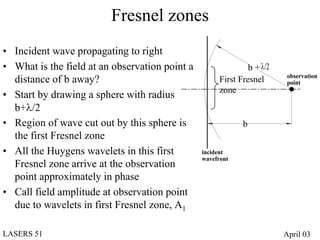
Fresnel zones
• Incident wave propagating to right
• What is the field at an observation point a                  b + λ/2
                                                                          observation
  distance of b away?                                 First Fresnel       point
                                                      zone
• Start by drawing a sphere with radius
  b+λ/2
• Region of wave cut out by this sphere is                   b
  the first Fresnel zone
• All the Huygens wavelets in this first        incident
                                                wavefront
  Fresnel zone arrive at the observation
  point approximately in phase
• Call field amplitude at observation point
  due to wavelets in first Fresnel zone, A1

LASERS 51                                                                April 03
Fresnel’s zones – continued
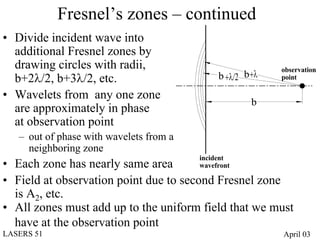
• Divide incident wave into
  additional Fresnel zones by
  drawing circles with radii,                               observation
  b+2λ/2, b+3λ/2, etc.                        b +λ/2 b +λ   point

• Wavelets from any one zone
                                                       b
  are approximately in phase
  at observation point
   – out of phase with wavelets from a
     neighboring zone
                                         incident
• Each zone has nearly same area         wavefront

• Field at observation point due to second Fresnel zone
  is A2, etc.
• All zones must add up to the uniform field that we must
  have at the observation point
LASERS 51                                                   April 03
Adding up contributions from Fresnel
                   zones
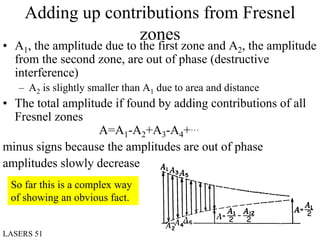
• A1, the amplitude due to the first zone and A2, the amplitude
  from the second zone, are out of phase (destructive
  interference)
   – A2 is slightly smaller than A1 due to area and distance
• The total amplitude if found by adding contributions of all
  Fresnel zones
                   A=A1-A2+A3-A4+…
minus signs because the amplitudes are out of phase
amplitudes slowly decrease
 So far this is a complex way
 of showing an obvious fact.


LASERS 51                                                      April 03
Diffraction from circular apertures
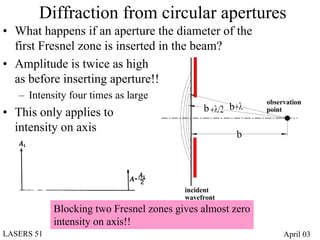
• What happens if an aperture the diameter of the
  first Fresnel zone is inserted in the beam?
• Amplitude is twice as high
  as before inserting aperture!!
   – Intensity four times as large
                                                            observation
• This only applies to                        b +λ/2 b +λ   point

  intensity on axis
                                                       b


                                         incident
                                         wavefront
            Blocking two Fresnel zones gives almost zero
            intensity on axis!!
LASERS 51                                                        April 03
Fresnel diffraction by a circular aperture
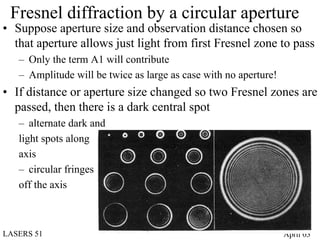
• Suppose aperture size and observation distance chosen so
  that aperture allows just light from first Fresnel zone to pass
   – Only the term A1 will contribute
   – Amplitude will be twice as large as case with no aperture!
• If distance or aperture size changed so two Fresnel zones are
  passed, then there is a dark central spot
   – alternate dark and
   light spots along
   axis
   – circular fringes
   off the axis


LASERS 51                                                         April 03
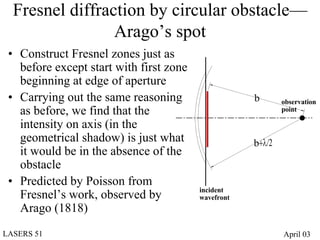
Fresnel diffraction by circular obstacle—
                 Arago’s spot
 • Construct Fresnel zones just as
   before except start with first zone
   beginning at edge of aperture
 • Carrying out the same reasoning                   b       observation
   as before, we find that the                               point

   intensity on axis (in the
   geometrical shadow) is just what                  b+λ/2
   it would be in the absence of the
   obstacle
 • Predicted by Poisson from
                                         incident
   Fresnel’s work, observed by           wavefront
   Arago (1818)
LASERS 51                                                    April 03
Character of diffraction for different
         locations of observation screen
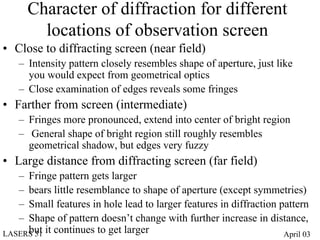
• Close to diffracting screen (near field)
   – Intensity pattern closely resembles shape of aperture, just like
     you would expect from geometrical optics
   – Close examination of edges reveals some fringes
• Farther from screen (intermediate)
   – Fringes more pronounced, extend into center of bright region
   – General shape of bright region still roughly resembles
     geometrical shadow, but edges very fuzzy
• Large distance from diffracting screen (far field)
   – Fringe pattern gets larger
   – bears little resemblance to shape of aperture (except symmetries)
   – Small features in hole lead to larger features in diffraction pattern
   – Shape of pattern doesn’t change with further increase in distance,
LASERS 51 it continues to get larger
     but                                                            April 03
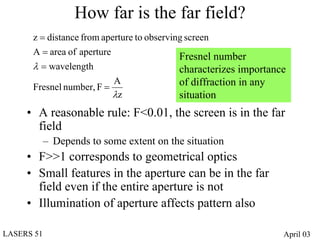
How far is the far field?
      z = distance from aperture to observing screen
      A = area of aperture                  Fresnel number
      λ = wavelength                        characterizes importance
                           A                of diffraction in any
      Fresnel number, F =
                           λz               situation
     • A reasonable rule: F<0.01, the screen is in the far
       field
            – Depends to some extent on the situation
     • F>>1 corresponds to geometrical optics
     • Small features in the aperture can be in the far
       field even if the entire aperture is not
     • Illumination of aperture affects pattern also

LASERS 51                                                          April 03
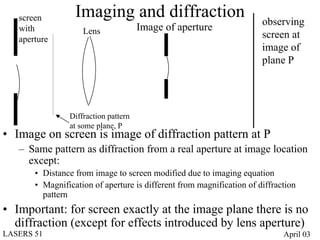
screen         Imaging and diffraction                              observing
   with             Lens              Image of aperture
   aperture                                                            screen at
                                                                       image of
                                                                       plane P


                Diffraction pattern
                at some plane, P
• Image on screen is image of diffraction pattern at P
   – Same pattern as diffraction from a real aperture at image location
     except:
       • Distance from image to screen modified due to imaging equation
       • Magnification of aperture is different from magnification of diffraction
         pattern
• Important: for screen exactly at the image plane there is no
  diffraction (except for effects introduced by lens aperture)
LASERS 51                                                                    April 03
Imaging and far-field diffraction
    screen      Lens                observing
    with                            screen
    aperture


                         f


     • Looking from the aperture, the observing screen
       appears to be located at infinity. Therefore, the
       far-field pattern appears on the screen even though
       the distance is quite finite.

LASERS 51                                               April 03
Fresnel and Fraunhofer diffraction
• Fraunhofer diffraction = infinite observation distance
   – In practice often at focal point of a lens
   – If a lens is not used the observation distance must be large
   – (Fresnel number small, <0.01)
• Fresnel diffraction must be used in all other cases
• The Fresnel and Fraunhofer regions are used as synonyms
  for near field and far field, respectively
   – In Fresnel region, geometric optics can be used for the most part;
     wave optics is manifest primarily near edges, see first viewgraph
   – In Fraunhofer region, light distribution bears no similarity to
     geometric optics (except for symmetry!)
   – Math in Fresnel region slightly more complicated
       • mathematical treatment in either region is beyond the scope of this course


LASERS 51                                                                   April 03
Fraunhofer diffraction at a slit Observation
                               small
• Traditional (pre laser)        Light       source slit        screen
                                 source       Collimating Diffracting
  setup                                       lens        slit
   – source is nearly
     monochromatic
• Condenser lens collects
  light                                       f1              f2
                                 Condenser
                                                       Focusing
                                 lens
                                                       lens
• Source slit creates point source
   – produces spatial coherence at the second slit
• Collimating lens images source back to infinity
   – laser, a monochromatic, spatially coherent source, replaces all this
 • second slit is diffracting aperture whose pattern we want
 • Focusing lens images Fraunhofer pattern (at infinity) onto
   screen
LASERS 51                                                April 03
Fraunhofer diffraction by slit—zeros
• Wavelets radiate in all
  directions                                field radiated by
   – Point D in focal plane is at           wavelets at angle Θ
     angle Θ from slit, D=Θf
                                                                         D= λ
   – Light from each wavelet                                                 f
     radiated in direction Θ arrives                              Θ         d
                                                λ/2
     at D                                         λ
       • Distance travelled is different for
         each wavelet                        Slit
       • Interference between the light      width = d
         from all the wavelets gives the                     f
         diffraction patter
   – Zeros can be determined easily
• If Θ=λ/d, each wavelet pairs with one exactly out of phase
   – Complete destructive interference
   – additional zeros for other multiples of λ, evenly spaced zeros
LASERS 51                                                             April 03
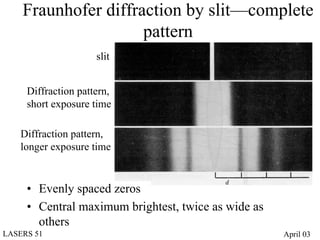
Fraunhofer diffraction by slit—complete
                     pattern
                     slit


     Diffraction pattern,
     short exposure time

    Diffraction pattern,
    longer exposure time


     • Evenly spaced zeros
     • Central maximum brightest, twice as wide as
       others
LASERS 51                                            April 03
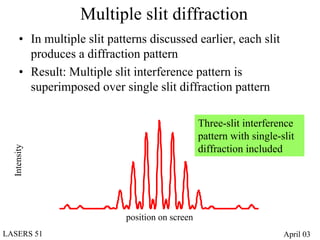
Multiple slit diffraction
       • In multiple slit patterns discussed earlier, each slit
         produces a diffraction pattern
       • Result: Multiple slit interference pattern is
         superimposed over single slit diffraction pattern

                                                   Three-slit interference
                                                   pattern with single-slit
                                                   diffraction included
  Intensity


                              position on screen
LASERS 51                                                               April 03
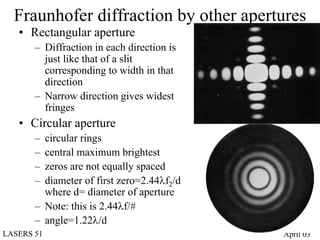
Fraunhofer diffraction by other apertures
   • Rectangular aperture
       – Diffraction in each direction is
         just like that of a slit
         corresponding to width in that
         direction
       – Narrow direction gives widest
         fringes
   • Circular aperture
       – circular rings
       – central maximum brightest
       – zeros are not equally spaced
       – diameter of first zero=2.44λf2/d
         where d= diameter of aperture
       – Note: this is 2.44λf/#
       – angle=1.22λ/d
LASERS 51                                   April 03
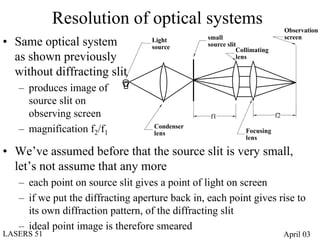
Resolution of optical systems                                      Observation
                                                 small                         screen
• Same optical system              Light
                                   source        source slit
                                                            Collimating
  as shown previously                                       lens

  without diffracting slit
   – produces image of
     source slit on
     observing screen                             f1                      f2
                                    Condenser
   – magnification f2/f1            lens                      Focusing
                                                              lens

• We’ve assumed before that the source slit is very small,
  let’s not assume that any more
   – each point on source slit gives a point of light on screen
   – if we put the diffracting aperture back in, each point gives rise to
     its own diffraction pattern, of the diffracting slit
   – ideal point image is therefore smeared
LASERS 51                                                                      April 03
Resolution of optical systems (cont.)
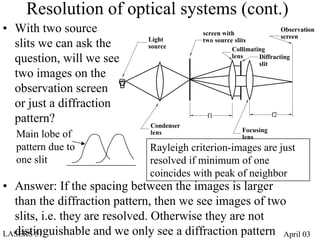
• With two source                         screen with
                                                                     Observation
                              Light                                  screen
  slits we can ask the        source
                                          two source slits
                                                    Collimating
  question, will we see                             lens     Diffracting
                                                             slit
  two images on the
  observation screen
  or just a diffraction
  pattern?                    Condenser
                                           f1                     f2

                                                       Focusing
  Main lobe of                lens
                                                       lens
  pattern due to              Rayleigh criterion-images are just
  one slit                    resolved if minimum of one
                              coincides with peak of neighbor
• Answer: If the spacing between the images is larger
  than the diffraction pattern, then we see images of two
  slits, i.e. they are resolved. Otherwise they are not
  distinguishable and we only see a diffraction pattern April 03
LASERS 51
Resolution of optical systems (cont.)
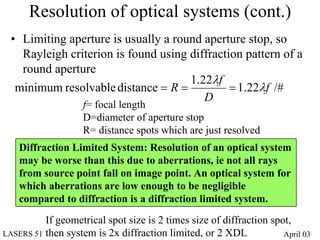
 • Limiting aperture is usually a round aperture stop, so
   Rayleigh criterion is found using diffraction pattern of a
   round aperture
                                     1.22λf
  minimum resolvable distance = R =           = 1.22λf /#
                                        D
                    f= focal length
                    D=diameter of aperture stop
                    R= distance spots which are just resolved
    Diffraction Limited System: Resolution of an optical system
    may be worse than this due to aberrations, ie not all rays
    from source point fall on image point. An optical system for
    which aberrations are low enough to be negligible
    compared to diffraction is a diffraction limited system.
          If geometrical spot size is 2 times size of diffraction spot,
LASERS 51 then system is 2x diffraction limited, or 2 XDL            April 03
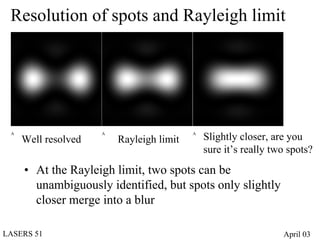
Resolution of spots and Rayleigh limit


 A
     Well resolved
                     A
                         Rayleigh limit
                                          A
                                              Slightly closer, are you
                                              sure it’s really two spots?
     • At the Rayleigh limit, two spots can be
       unambiguously identified, but spots only slightly
       closer merge into a blur

LASERS 51                                                        April 03
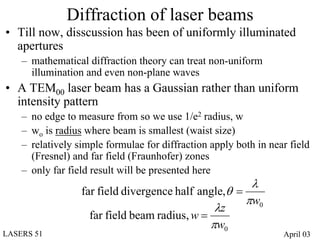
Diffraction of laser beams
• Till now, disscussion has been of uniformly illuminated
  apertures
    – mathematical diffraction theory can treat non-uniform
      illumination and even non-plane waves
• A TEM00 laser beam has a Gaussian rather than uniform
  intensity pattern
    – no edge to measure from so we use 1/e2 radius, w
    – wo is radius where beam is smallest (waist size)
    – relatively simple formulae for diffraction apply both in near field
      (Fresnel) and far field (Fraunhofer) zones
    – only far field result will be presented here
                                                       λ
                  far field divergence half angle,θ =
                                                      πw0
                                                λz
                    far field beam radius, w =
                                               πw0
LASERS 51                                                         April 03
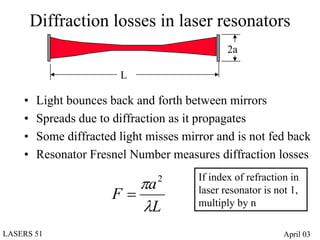
Diffraction losses in laser resonators
                                               2a

                        L

    •   Light bounces back and forth between mirrors
    •   Spreads due to diffraction as it propagates
    •   Some diffracted light misses mirror and is not fed back
    •   Resonator Fresnel Number measures diffraction losses
                                        If index of refraction in
                          πa    2
                       F=               laser resonator is not 1,
                          λL            multiply by n

LASERS 51                                                    April 03

Diffraction

  • 1.
    Diffraction • Interference with more than 2 beams – 3, 4, 5 beams – Large number of beams • Diffraction gratings – Equation – Uses • Diffraction by an aperture – Huygen’s principle again, Fresnel zones, Arago’s spot – Qualitative effects, changes with propagation distance – Fresnel number again – Imaging with an optical system, near and far field – Fraunhofer diffraction of slits and circular apertures – Resolution of optical systems • Diffraction of a laser beam LASERS 51 April 03
  • 2.
    Interference from multipleapertures L Bright fringes when OPD=nλ 40 x nLλ x= Intensity d source OPD d two slits position on screen screen Complete destructive interference halfway between OPD 1 OPD 1=nλ, OPD 2=2nλ OPD 2 all three waves interfere constructively 40 d Intensity source three position on screen equally spaced slits screen OPD 2=nλ, n odd outer slits constructively interfere middle slit gives secondary maxima LASERS 51 April 03
  • 3.
    Diffraction from multipleapertures • Fringes not sinusoidal for more than two slits 2 slits • Main peak gets narrower – Center location obeys same 3 slits equation • Secondary maxima appear 4 slits between main peaks – The more slits, the more 5 slits secondary maxima – The more slits, the weaker the secondary maxima become • Diffraction grating – many slits, very narrow spacing – Main peaks become narrow and widely spaced – Secondary peaks are too small to observe LASERS 51 April 03
  • 4.
    Reflection and transmissiongratings • Transmission grating – many closely spaced slits • Reflection grating – many closely spaced reflecting regions Input screen wave path length to observation point Input opaque Huygens wave transmitting wavelets opening wavelets path length to observation point screen absorbing reflecting Transmission grating Reflection grating LASERS 51 April 03
  • 5.
    Grating equation –transmission grating with normal incidence Diffracted Θd light pλ input sin θ d = l • Θd is angle of diffracted ray Except for not making a small angle approximation, • λ is wavelength this is identical to formula for location of maxima in • l is spacing between slits multiple slit problem earlier • p is order of diffraction LASERS 51 April 03
  • 6.
    Diffraction gratings –general incidence angle • Grating equation pλ sin θ d − sin θ i = l l=distance between grooves (grating spacing) Θi Θi=incidence angle (measured from normal) Θd Θd=diffraction angle (measured from normal) p=integer (order of diffraction) • Same formula whether it’s a transmission or reflection grating – n=0 gives straight line propagation (for transmission grating) or law of reflection (for reflection grating) LASERS 51 April 03
  • 7.
    Intensities of orders– allowed orders • Diffraction angle can be found only for certain values of p strong diffracted weak diffracted – If sin(Θd) is not order order input between –1 and 1, beam there is no allowed Θd • Intensity of other orders are different depending on wavelength, incidence angle, and construction of grating • Grating may be blazed to make Blazed grating a particular order more intense than others – angles of orders unaffected by blazing LASERS 51 April 03
  • 8.
    Grating constant (groovedensity) vs. distance between grooves • Usually the spacing between grooves for a grating is not given – Density of grooves (lines/mm) is given instead 1 – g= l – Grating equation can be written in terms of grating constant sin(Θ d ) − sin (Θ i ) = pgλ LASERS 51 April 03
  • 9.
    2nd Diffraction grating- applications order 1st order • Spectroscopy grating – Separate colors, similar to negative prism orders • Laser tuning Littrow mounting – input – narrow band mirror and output angles identical – Select a single line of λ Θ 2 sin (Θ ) = multiline laser d – Select frequency in a grating tunable laser • Pulse stretching and compression – Different colors travel different path lengths two identical LASERS 51 gratings April 03
  • 10.
    Fabry-Perot Interferometer Input transmitted through first mirror Beam is partially reflected and partially transmitted at each mirror Transmitted All transmitted beams interfere with each other Reflected field All reflected beams interfere with field Partially each other reflecting OPD depends on mirror mirrors separation • Multiple beam interference – division of amplitude – As in the diffraction grating, the lines become narrow as more beams interfere LASERS 51 April 03
  • 11.
    Fabry-Perot Interferometer 1 free spectral transmission range, Linewidth= fsr fsr*finesse 0 frequency or wavelength • Transmission changes with frequency – Can be very narrow range where transmission is high • Width characterized by finesse • Finesse is larger for higher reflectivity mirrors – Transmission peaks are evenly spaced • Spacing called “Free spectral range” • Controlled by distance between mirrors, fsr=c/(2L) • Applications – Measurement of laser linewidth or other spectra – Narrowing laser line LASERS 51 April 03
  • 12.
    Diffraction at anaperture—observations Light Aperture through aperture on screen downstream • A careful observation of the light transmitted by an aperture reveals a fringe structure not predicted by geometrical optics • Light is observed in what should be the shadow region LASERS 51 April 03
  • 13.
    Pattern on screenat various distances Near Field Intermediate field 2.5mm 25 mm from screen, 250 mm 2500 mm Immediately bright fringes just light penetrates pattern doesn’t behind screen inside edges into shadow closely resemble region mase Far field – at a large enough distance shape of pattern no longer changes but it gets bigger with larger distance. Symmetry of original mask still is evident. LASERS 51 April 03
  • 14.
    Huygens-Fresnel diffraction screen observing with screen aperture Point Wavelets source generated in hole • Each wavelet illuminates the observing screen • The amplitudes produced by the various waves at the observing screen can add with different phases • Final result obtained by taking square of all amplitudes added up – Zero in shadow area – Non-zero in illuminated area LASERS 51 April 03
  • 15.
    Fresnel zones • Incidentwave propagating to right • What is the field at an observation point a b + λ/2 observation distance of b away? First Fresnel point zone • Start by drawing a sphere with radius b+λ/2 • Region of wave cut out by this sphere is b the first Fresnel zone • All the Huygens wavelets in this first incident wavefront Fresnel zone arrive at the observation point approximately in phase • Call field amplitude at observation point due to wavelets in first Fresnel zone, A1 LASERS 51 April 03
  • 16.
    Fresnel’s zones –continued • Divide incident wave into additional Fresnel zones by drawing circles with radii, observation b+2λ/2, b+3λ/2, etc. b +λ/2 b +λ point • Wavelets from any one zone b are approximately in phase at observation point – out of phase with wavelets from a neighboring zone incident • Each zone has nearly same area wavefront • Field at observation point due to second Fresnel zone is A2, etc. • All zones must add up to the uniform field that we must have at the observation point LASERS 51 April 03
  • 17.
    Adding up contributionsfrom Fresnel zones • A1, the amplitude due to the first zone and A2, the amplitude from the second zone, are out of phase (destructive interference) – A2 is slightly smaller than A1 due to area and distance • The total amplitude if found by adding contributions of all Fresnel zones A=A1-A2+A3-A4+… minus signs because the amplitudes are out of phase amplitudes slowly decrease So far this is a complex way of showing an obvious fact. LASERS 51 April 03
  • 18.
    Diffraction from circularapertures • What happens if an aperture the diameter of the first Fresnel zone is inserted in the beam? • Amplitude is twice as high as before inserting aperture!! – Intensity four times as large observation • This only applies to b +λ/2 b +λ point intensity on axis b incident wavefront Blocking two Fresnel zones gives almost zero intensity on axis!! LASERS 51 April 03
  • 19.
    Fresnel diffraction bya circular aperture • Suppose aperture size and observation distance chosen so that aperture allows just light from first Fresnel zone to pass – Only the term A1 will contribute – Amplitude will be twice as large as case with no aperture! • If distance or aperture size changed so two Fresnel zones are passed, then there is a dark central spot – alternate dark and light spots along axis – circular fringes off the axis LASERS 51 April 03
  • 20.
    Fresnel diffraction bycircular obstacle— Arago’s spot • Construct Fresnel zones just as before except start with first zone beginning at edge of aperture • Carrying out the same reasoning b observation as before, we find that the point intensity on axis (in the geometrical shadow) is just what b+λ/2 it would be in the absence of the obstacle • Predicted by Poisson from incident Fresnel’s work, observed by wavefront Arago (1818) LASERS 51 April 03
  • 21.
    Character of diffractionfor different locations of observation screen • Close to diffracting screen (near field) – Intensity pattern closely resembles shape of aperture, just like you would expect from geometrical optics – Close examination of edges reveals some fringes • Farther from screen (intermediate) – Fringes more pronounced, extend into center of bright region – General shape of bright region still roughly resembles geometrical shadow, but edges very fuzzy • Large distance from diffracting screen (far field) – Fringe pattern gets larger – bears little resemblance to shape of aperture (except symmetries) – Small features in hole lead to larger features in diffraction pattern – Shape of pattern doesn’t change with further increase in distance, LASERS 51 it continues to get larger but April 03
  • 22.
    How far isthe far field? z = distance from aperture to observing screen A = area of aperture Fresnel number λ = wavelength characterizes importance A of diffraction in any Fresnel number, F = λz situation • A reasonable rule: F<0.01, the screen is in the far field – Depends to some extent on the situation • F>>1 corresponds to geometrical optics • Small features in the aperture can be in the far field even if the entire aperture is not • Illumination of aperture affects pattern also LASERS 51 April 03
  • 23.
    screen Imaging and diffraction observing with Lens Image of aperture aperture screen at image of plane P Diffraction pattern at some plane, P • Image on screen is image of diffraction pattern at P – Same pattern as diffraction from a real aperture at image location except: • Distance from image to screen modified due to imaging equation • Magnification of aperture is different from magnification of diffraction pattern • Important: for screen exactly at the image plane there is no diffraction (except for effects introduced by lens aperture) LASERS 51 April 03
  • 24.
    Imaging and far-fielddiffraction screen Lens observing with screen aperture f • Looking from the aperture, the observing screen appears to be located at infinity. Therefore, the far-field pattern appears on the screen even though the distance is quite finite. LASERS 51 April 03
  • 25.
    Fresnel and Fraunhoferdiffraction • Fraunhofer diffraction = infinite observation distance – In practice often at focal point of a lens – If a lens is not used the observation distance must be large – (Fresnel number small, <0.01) • Fresnel diffraction must be used in all other cases • The Fresnel and Fraunhofer regions are used as synonyms for near field and far field, respectively – In Fresnel region, geometric optics can be used for the most part; wave optics is manifest primarily near edges, see first viewgraph – In Fraunhofer region, light distribution bears no similarity to geometric optics (except for symmetry!) – Math in Fresnel region slightly more complicated • mathematical treatment in either region is beyond the scope of this course LASERS 51 April 03
  • 26.
    Fraunhofer diffraction ata slit Observation small • Traditional (pre laser) Light source slit screen source Collimating Diffracting setup lens slit – source is nearly monochromatic • Condenser lens collects light f1 f2 Condenser Focusing lens lens • Source slit creates point source – produces spatial coherence at the second slit • Collimating lens images source back to infinity – laser, a monochromatic, spatially coherent source, replaces all this • second slit is diffracting aperture whose pattern we want • Focusing lens images Fraunhofer pattern (at infinity) onto screen LASERS 51 April 03
  • 27.
    Fraunhofer diffraction byslit—zeros • Wavelets radiate in all directions field radiated by – Point D in focal plane is at wavelets at angle Θ angle Θ from slit, D=Θf D= λ – Light from each wavelet f radiated in direction Θ arrives Θ d λ/2 at D λ • Distance travelled is different for each wavelet Slit • Interference between the light width = d from all the wavelets gives the f diffraction patter – Zeros can be determined easily • If Θ=λ/d, each wavelet pairs with one exactly out of phase – Complete destructive interference – additional zeros for other multiples of λ, evenly spaced zeros LASERS 51 April 03
  • 28.
    Fraunhofer diffraction byslit—complete pattern slit Diffraction pattern, short exposure time Diffraction pattern, longer exposure time • Evenly spaced zeros • Central maximum brightest, twice as wide as others LASERS 51 April 03
  • 29.
    Multiple slit diffraction • In multiple slit patterns discussed earlier, each slit produces a diffraction pattern • Result: Multiple slit interference pattern is superimposed over single slit diffraction pattern Three-slit interference pattern with single-slit diffraction included Intensity position on screen LASERS 51 April 03
  • 30.
    Fraunhofer diffraction byother apertures • Rectangular aperture – Diffraction in each direction is just like that of a slit corresponding to width in that direction – Narrow direction gives widest fringes • Circular aperture – circular rings – central maximum brightest – zeros are not equally spaced – diameter of first zero=2.44λf2/d where d= diameter of aperture – Note: this is 2.44λf/# – angle=1.22λ/d LASERS 51 April 03
  • 31.
    Resolution of opticalsystems Observation small screen • Same optical system Light source source slit Collimating as shown previously lens without diffracting slit – produces image of source slit on observing screen f1 f2 Condenser – magnification f2/f1 lens Focusing lens • We’ve assumed before that the source slit is very small, let’s not assume that any more – each point on source slit gives a point of light on screen – if we put the diffracting aperture back in, each point gives rise to its own diffraction pattern, of the diffracting slit – ideal point image is therefore smeared LASERS 51 April 03
  • 32.
    Resolution of opticalsystems (cont.) • With two source screen with Observation Light screen slits we can ask the source two source slits Collimating question, will we see lens Diffracting slit two images on the observation screen or just a diffraction pattern? Condenser f1 f2 Focusing Main lobe of lens lens pattern due to Rayleigh criterion-images are just one slit resolved if minimum of one coincides with peak of neighbor • Answer: If the spacing between the images is larger than the diffraction pattern, then we see images of two slits, i.e. they are resolved. Otherwise they are not distinguishable and we only see a diffraction pattern April 03 LASERS 51
  • 33.
    Resolution of opticalsystems (cont.) • Limiting aperture is usually a round aperture stop, so Rayleigh criterion is found using diffraction pattern of a round aperture 1.22λf minimum resolvable distance = R = = 1.22λf /# D f= focal length D=diameter of aperture stop R= distance spots which are just resolved Diffraction Limited System: Resolution of an optical system may be worse than this due to aberrations, ie not all rays from source point fall on image point. An optical system for which aberrations are low enough to be negligible compared to diffraction is a diffraction limited system. If geometrical spot size is 2 times size of diffraction spot, LASERS 51 then system is 2x diffraction limited, or 2 XDL April 03
  • 34.
    Resolution of spotsand Rayleigh limit A Well resolved A Rayleigh limit A Slightly closer, are you sure it’s really two spots? • At the Rayleigh limit, two spots can be unambiguously identified, but spots only slightly closer merge into a blur LASERS 51 April 03
  • 35.
    Diffraction of laserbeams • Till now, disscussion has been of uniformly illuminated apertures – mathematical diffraction theory can treat non-uniform illumination and even non-plane waves • A TEM00 laser beam has a Gaussian rather than uniform intensity pattern – no edge to measure from so we use 1/e2 radius, w – wo is radius where beam is smallest (waist size) – relatively simple formulae for diffraction apply both in near field (Fresnel) and far field (Fraunhofer) zones – only far field result will be presented here λ far field divergence half angle,θ = πw0 λz far field beam radius, w = πw0 LASERS 51 April 03
  • 36.
    Diffraction losses inlaser resonators 2a L • Light bounces back and forth between mirrors • Spreads due to diffraction as it propagates • Some diffracted light misses mirror and is not fed back • Resonator Fresnel Number measures diffraction losses If index of refraction in πa 2 F= laser resonator is not 1, λL multiply by n LASERS 51 April 03