WAVE OPTICS
1. Electromagnetic Wave
2. Wave front
3. Huygens’ Principle
4. Reflection of Light based on Huygens’ Principle
5. Refraction of Light based on Huygens’ Principle
6. Behaviour of Wave front in a Mirror, Lens and Prism
7. Coherent Sources
8. Interference
9. Young’s Double Slit Experiment
10.Colours in Thin Films
11.Diffraction of light
0
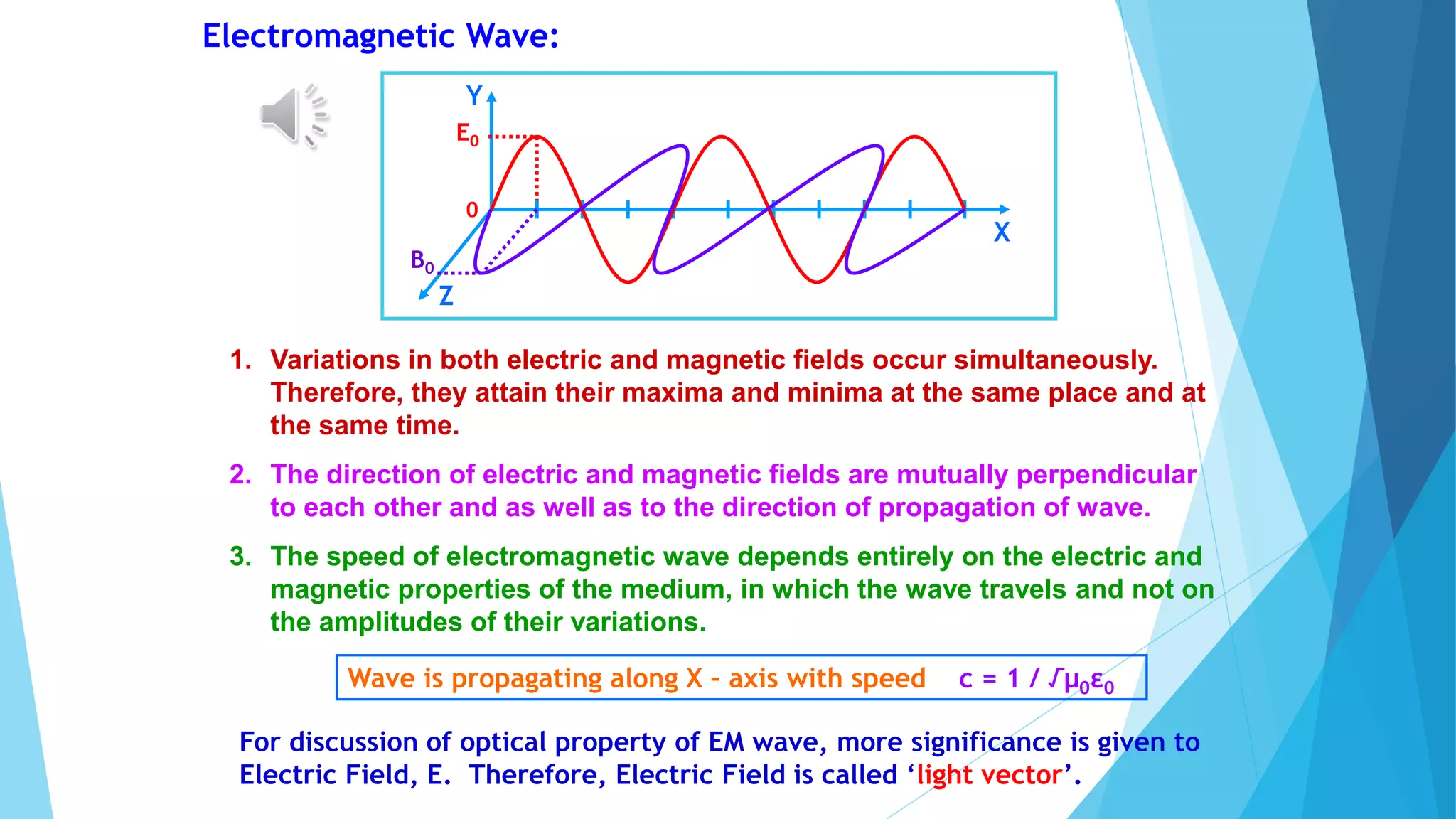
Electromagnetic Wave:
X
E0
B0
Y
Z
Wave is propagating along X – axis with speed c = 1 / √μ0ε0
For discussion of optical property of EM wave, more significance is given to
Electric Field, E. Therefore, Electric Field is called ‘light vector’.
1. Variations in both electric and magnetic fields occur simultaneously.
Therefore, they attain their maxima and minima at the same place and at
the same time.
2. The direction of electric and magnetic fields are mutually perpendicular
to each other and as well as to the direction of propagation of wave.
3. The speed of electromagnetic wave depends entirely on the electric and
magnetic properties of the medium, in which the wave travels and not on
the amplitudes of their variations.
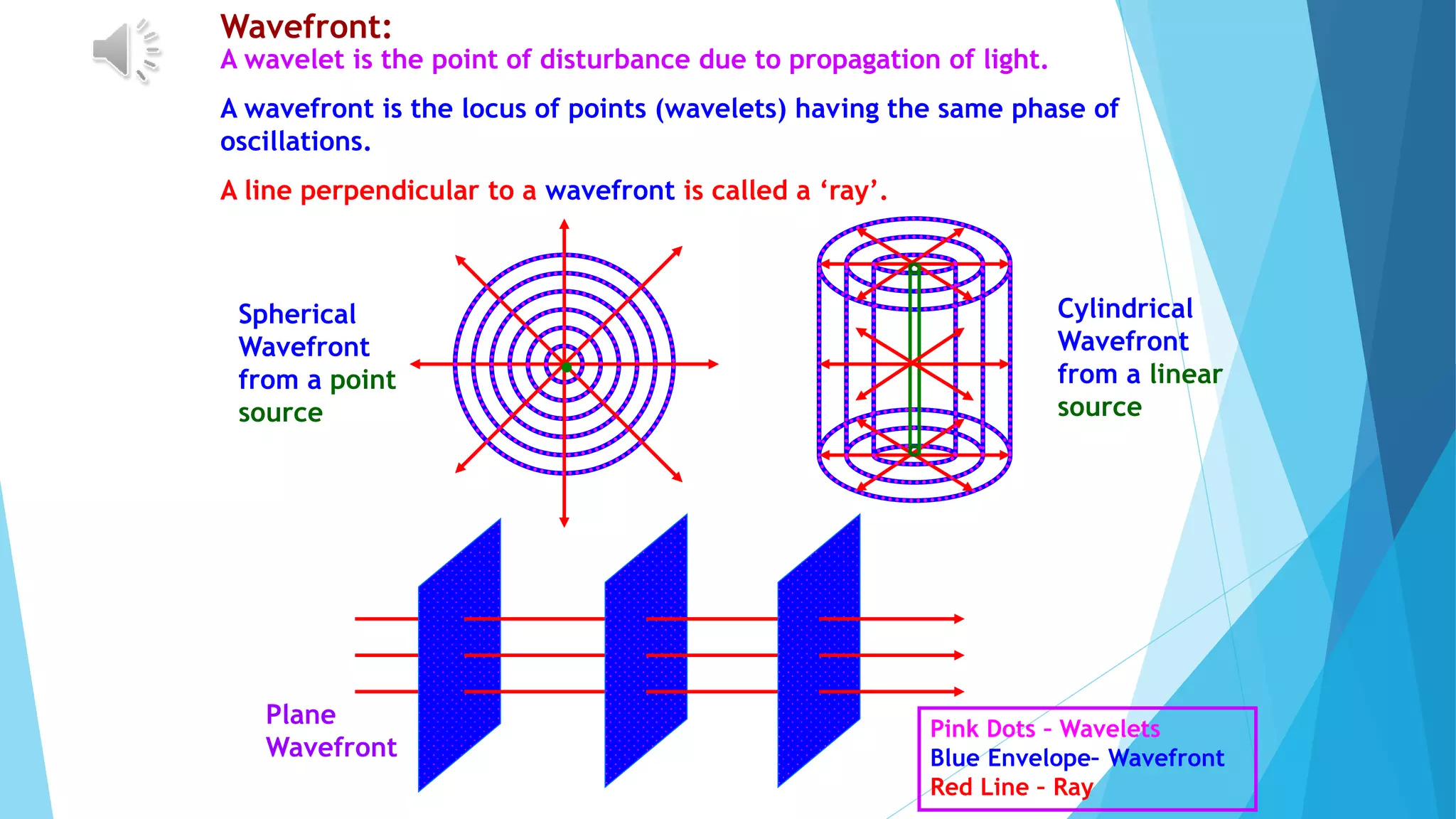
Wavefront:
A wavelet is the point of disturbance due to propagation of light.
A wavefront is the locus of points (wavelets) having the same phase of
oscillations.
A line perpendicular to a wavefront is called a ‘ray’.
Spherical
Wavefront
from a point
source
Cylindrical
Wavefront
from a linear
source
Plane
Wavefront
Pink Dots – Wavelets
Blue Envelope– Wavefront
Red Line – Ray
•
Huygens’ Construction or Huygens’ Principle of Secondary
Wavelets:
S
New Wavefront
(Spherical)
New
Wave-
front
(Plane)
.
.
.
.
.
.
.
.
(Wavelets - Red dots on the wavefront)
1. Each point on a wavefront acts as a fresh source of disturbance of light.
2. The new wavefront at any time later is obtained by taking the forward
envelope of all the secondary wavelets at that time.
Note: Backward wavefront is rejected. Why?
. .
.
.
.
.
.
.
.
Amplitude of secondary wavelet is proportional to ½ (1+cosθ). Obviously,
for the backward wavelet θ = 180° and (1+cosθ) is 0.
•
Laws of Reflection at a Plane Surface (On Huygens’ Principle):
i
i r
r
A
B
C
D
N N
AB – Incident wavefront
CD – Reflected wavefront
XY – Reflecting surface
E
F
G
If c be the speed of light, t
be the time taken by light to
go from B to C or A to D or E
to G through F, then
EF
t =
c
+
FG
c
AF sin i
t =
c
+
FC sin r
c
For rays of light from different parts on the incident wavefront, the values of
AF are different. But light from different points of the incident wavefront
should take the same time to reach the corresponding points on the reflected
wavefront.
So, t should not depend upon AF. This is possible only if sin i – sin r = 0.
i.e. sin i = sin r or i = r
X Y
AC sin r + AF (sin i – sin r)
t =
c
Laws of Refraction at a Plane Surface (On Huygens’ Principle):
i
i
r
r
A
B
C
D
N N
AB – Incident wavefront
CD – Refracted wavefront
XY – Refracting surface
E
F
G
X Y
c, μ1
v, μ2
Denser
Rarer
If c be the speed of light, t
be the time taken by light to
go from B to C or A to D or E
to G through F, then
EF
t =
c
+
FG
v
AF sin i
t =
c
+
FC sin r
v
For rays of light from different parts on the incident wavefront, the values of
AF are different. But light from different points of the incident wavefront
should take the same time to reach the corresponding points on the
refracted wavefront.
So, t should not depend upon AF. This is possible only
if
AC sin r
t =
c
v
sin i
+ AF (
v
sin r
- )
c v = 0
sin i sin r
-
c v
sin i sin r
=
c
v
sin i
sin r
= = μ
or or
Behaviour of a Plane Wavefront in a Concave Mirror, Convex Mirror,
Convex Lens, Concave Lens and Prism:
Concave Mirror
A
C
A
B
C
D
B
D
Convex Lens
A
B
A
B
C
D
Concave Lens
Convex Mirror
C
D
AB – Incident wavefront CD – Reflected / Refracted wavefront
AB – Incident wavefront CD –Refracted wavefront
Coherent Sources:
Coherent Sources of light are those sources of light which emit light waves of
same wavelength, same frequency and in same phase or having constant phase
difference.
Coherent sources can be produced by two methods:
1. By division of wavefront (Young’s Double Slit Experiment, Fresnel’s
Biprism and Lloyd’s Mirror)
2. By division of amplitude (Partial reflection or refraction)
Prism
Prism
A
B
C
D
Interference of Waves:
•
•
Constructive Interference E = E1 + E2
Destructive Interference E = E1 - E2
S1
S2
Bright Band
Dark Band
Dark Band
Bright Band
Bright Band
Crest
Trough
Bright Band
Dark Band
1st Wave (E1)
2nd Wave (E2)
Resultant Wave
Reference Line
E1
E2
E2
E1
The phenomenon of one wave interfering
with another and the resulting
redistribution of energy in the space around
the two sources of disturbance is called
interference of waves.
E1 + E2
E1 - E2
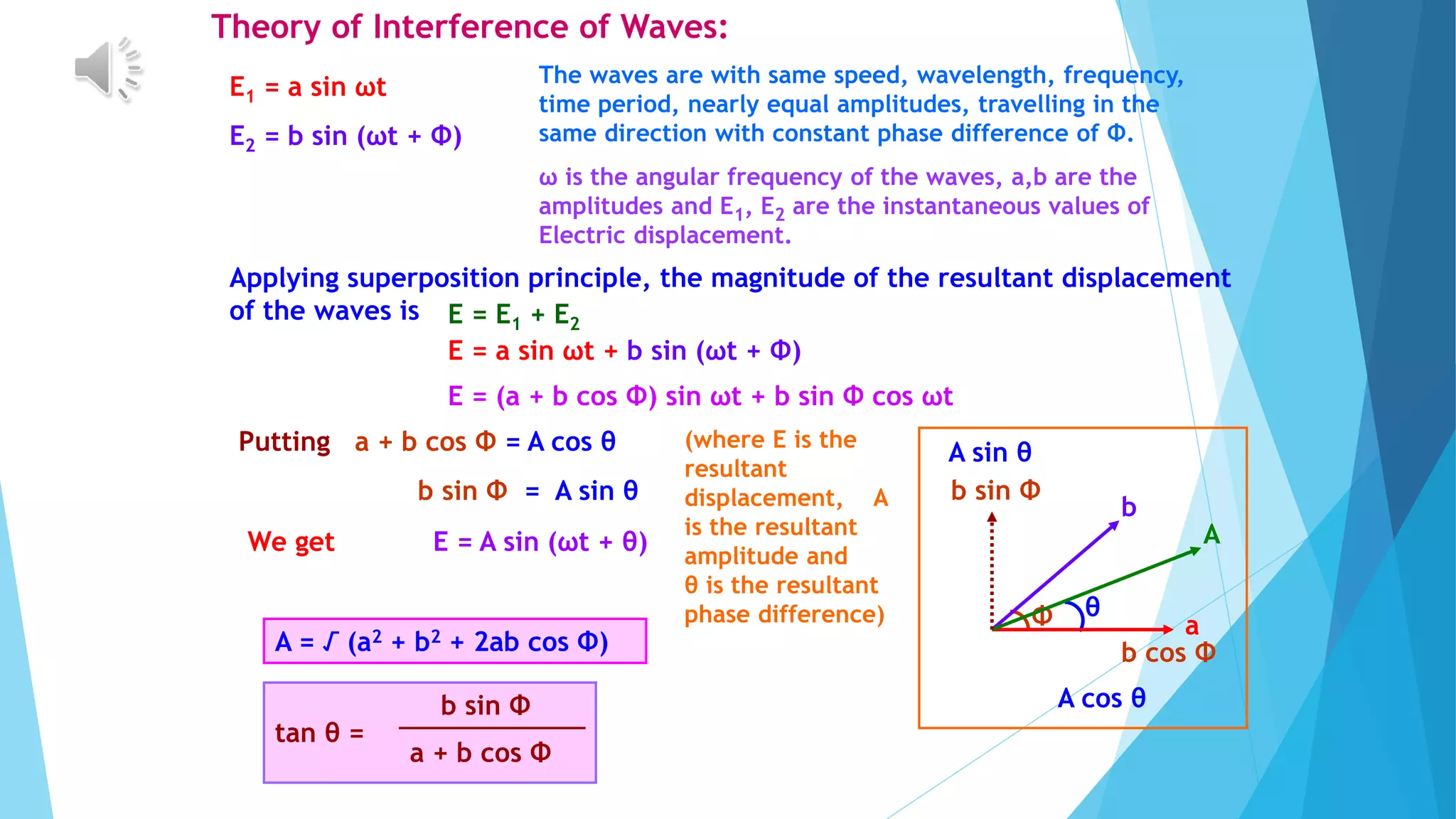
Theory of Interference of Waves:
E1 = a sin ωt
E2 = b sin (ωt + Φ)
The waves are with same speed, wavelength, frequency,
time period, nearly equal amplitudes, travelling in the
same direction with constant phase difference of Φ.
ω is the angular frequency of the waves, a,b are the
amplitudes and E1, E2 are the instantaneous values of
Electric displacement.
Applying superposition principle, the magnitude of the resultant displacement
of the waves is E = E1 + E2
E = a sin ωt + b sin (ωt + Φ)
E = (a + b cos Φ) sin ωt + b sin Φ cos ωt
Putting a + b cos Φ = A cos θ
b sin Φ = A sin θ
θ
Φ a
b
A
b cos Φ
b sin Φ
A cos θ
A sin θ
We get E = A sin (ωt + θ)
(where E is the
resultant
displacement, A
is the resultant
amplitude and
θ is the resultant
phase difference)
A = √ (a2 + b2 + 2ab cos Φ)
tan θ =
b sin Φ
a + b cos Φ
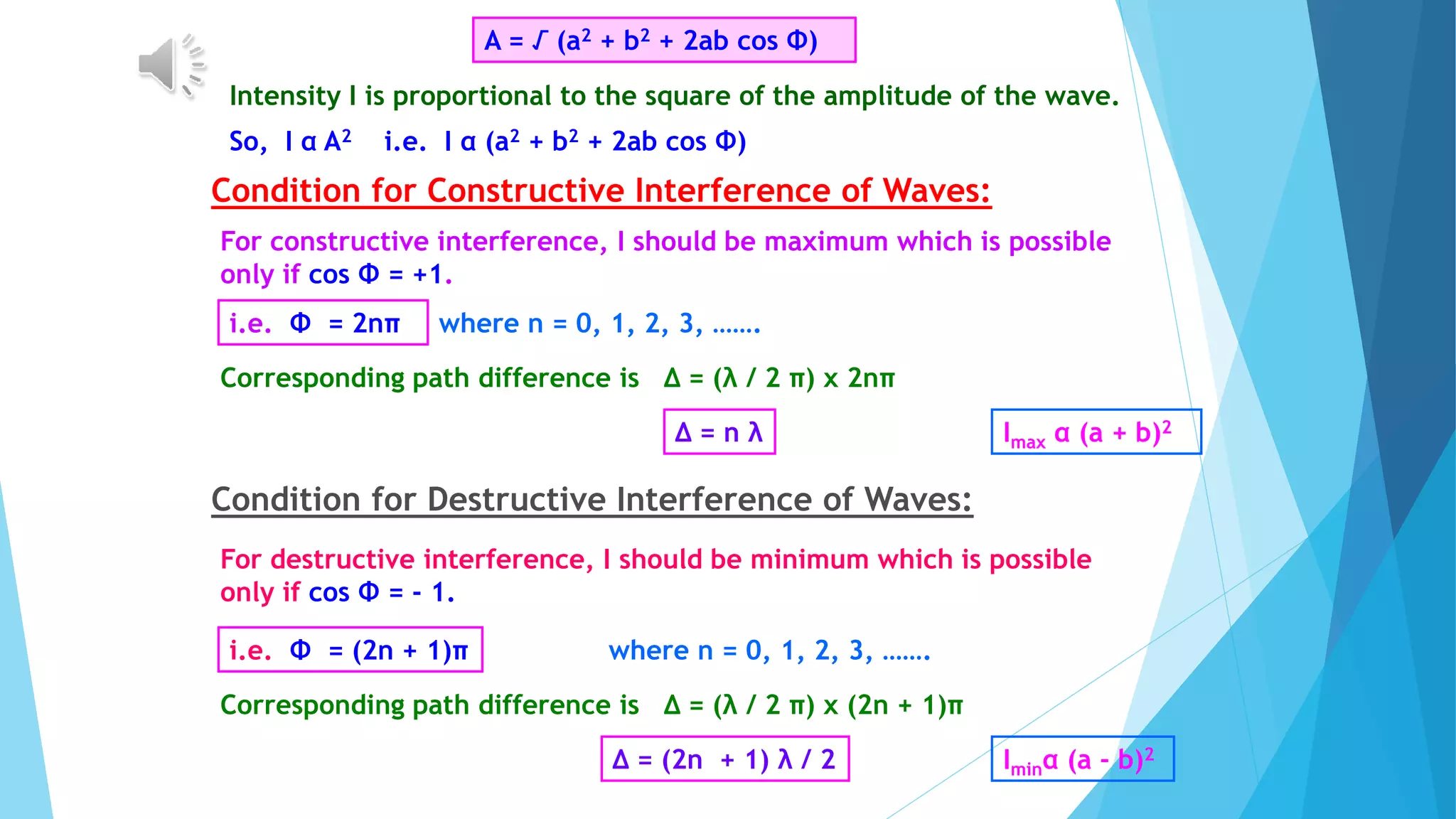
A = √ (a2 + b2 + 2ab cos Φ)
Intensity I is proportional to the square of the amplitude of the wave.
So, I α A2 i.e. I α (a2 + b2 + 2ab cos Φ)
Condition for Constructive Interference of Waves:
For constructive interference, I should be maximum which is possible
only if cos Φ = +1.
i.e. Φ = 2nπ
Corresponding path difference is ∆ = (λ / 2 π) x 2nπ
where n = 0, 1, 2, 3, …….
∆ = n λ
Condition for Destructive Interference of Waves:
For destructive interference, I should be minimum which is possible
only if cos Φ = - 1.
i.e. Φ = (2n + 1)π
Corresponding path difference is ∆ = (λ / 2 π) x (2n + 1)π
where n = 0, 1, 2, 3, …….
∆ = (2n + 1) λ / 2
Imax α (a + b)2
Iminα (a - b)2
Comparison of intensities of maxima and minima:
Imax α (a + b)2
Imin α (a - b)2
Imax
Imin
=
(a + b)2
(a - b)2
(a/b + 1)2
(a/b - 1)2
=
Imax
Imin
=
(r + 1)2
(r - 1)2
where r = a / b (ratio of the
amplitudes)
Relation between Intensity (I), Amplitude (a) of the wave and
Width (w) of the slit:
I α a2
a α √w I1
I2
=
(a1)2
(a2)2
=
w1
w2
Young’s Double Slit Experiment:
•
S
S • O
P
D
S1
S2
d
y
d/2
d/2
Single Slit Double Slit
Screen
The waves from S1 and S2 reach the point P with some
phase difference and hence path difference
∆ = S2P – S1P
S2P2 – S1P2 = [D2 + {y + (d/2)}2] - [D2 + {y - (d/2)}2]
(S2P – S1P) (S2P + S1P) = 2 yd ∆ (2D) = 2 yd ∆ = yd / D
Positions of Bright Fringes:
For a bright fringe at P,
∆ = yd / D = nλ
where n = 0, 1, 2, 3, …
For n = 0, y0 = 0
For n = 1, y1 = D λ / d
For n = 2, y2 = 2 D λ / d ……
For n = n, yn = n D λ / d
y = n D λ / d
Positions of Dark Fringes:
For a dark fringe at P,
∆ = yd / D = (2n+1)λ/2
where n = 0, 1, 2, 3,
…
For n = 0, y0’ = D λ / 2d
For n = 1, y1’ = 3D λ / 2d
For n = 2, y2’ = 5D λ / 2d …..
For n = n, yn’ = (2n+1)D λ / 2d
y = (2n+1) D λ / 2d
Expression for Dark Fringe Width:
βD = yn – yn-1
= n D λ / d – (n – 1) D λ / d
= D λ / d
Expression for Bright Fringe Width:
βB = yn’ – yn-1’
= (2n+1) D λ / 2d – {2(n-1)+1} D λ / 2d
= D λ / d
The expressions for fringe width show that the fringes are equally spaced on
the screen.
Distribution of Intensity:
Intensity
0 y
y
Suppose the two interfering waves
have same amplitude say ‘a’, then
Imax α (a+a)2 i.e. Imax α 4a2
All the bright fringes have this same
intensity.
Imin = 0
All the dark fringes have zero
intensity.
Conditions for sustained interference:
1. The two sources producing interference must be coherent.
2. The two interfering wave trains must have the same plane of
polarisation.
3. The two sources must be very close to each other and the pattern must
be observed at a larger distance to have sufficient width of the fringe.
(D λ / d)
4. The sources must be monochromatic. Otherwise, the fringes of different
colours will overlap.
5. The two waves must be having same amplitude for better contrast
between bright and dark fringes.
Diffraction of light:
The phenomenon of bending of light around the corners and the encroachment
of light within the geometrical shadow of the opaque obstacles is called
diffraction.
S • S •
Diffraction at a slit Diffraction at an obstacle
X
Y
X
Y
X & Y – Region of diffraction
Slit
Obstacle
Screen
Screen
Diffraction of light at a single slit:
1) At an angle of diffraction θ = 0°:
O
0
1
2
3
4
5
6
7
8
9
1
0
1
1
1
2
•
•
•
•
•
•
•
•
•
•
•
•
•
A
B
•
θ = 0°
Slit
Screen
Plane
Wavefront
The wavelets from the single wavefront reach the centre O on
the screen in same phase and hence interfere constructively
to give Central or Primary Maximum (Bright fringe).
Bright
D
d
B
A
Slit
Screen
2) At an angle of diffraction θ = θ1:
The wavelets from the single wavefront diffract at an angle θ1 such
that BN is λ and reach the point P1. The pairs (0,6), (1,7), (2,8),
(3,9), (4,10), (5,11) and (6,12) interfere destructively with path
difference λ/2 and give First Secondary Minimum (Dark fringe).
O
0
1
2
3
4
5
6
7
8
9
1
0
1
1
1
2
P1
N
λ
θ1
θ1
θ1
λ/
2
•
•
•
•
•
•
•
•
•
•
•
•
•
•
•
Plane
Wavefront
Bright
Dark
The slit is imagined to be divided into 2 equal halves.
4) At an angle of diffraction θ = θ1’:
O
0
1
2
3
4
5
6
7
8
9
1
0
1
1
1
2
P1
N
A
B
θ1’
λ/
2
•
•
•
•
•
•
•
•
•
•
•
•
•
P1’
3λ/2
λ
θ1’
θ1’
•
•
•
P2
•
Slit
Screen
Plane
Wavefront
The wavelets from the single wavefront diffract at an angle θ1’ such that
BN is 3λ/2 and reach the point P1’. The pairs (0,8), (1,9), (2,10), (3,11)
and (4,12) interfere constructively with path difference λ and (0,4), (1,5),
(2,6), …… and (8,12) interfere destructively with path difference λ/2.
However due to a few wavelets interfering constructively First Secondary
Maximum (Bright fringe) is formed.
Bright
Dark
Bright
The slit is imagined to be divided into 3 equal parts.
Theory:
The path difference between the 0th wavelet and 12th wavelet is BN.
If ‘θ’ is the angle of diffraction and ‘d’ is the slit width, then BN = d sin θ
To establish the condition for secondary minima, the slit is divided into 2, 4,
6, … equal parts such that corresponding wavelets from successive regions
interfere with path difference of λ/2.
Or for nth secondary minimum, the slit can be divided into 2n equal parts.
For θ1, d sin θ1 = λ
For θ2, d sin θ2 = 2λ
For θn, d sin θn = nλ
Since θn is very small,
d θn = nλ
θn = nλ / d (n = 1, 2, 3, ……)
To establish the condition for secondary maxima, the slit is divided into 3, 5,
7, … equal parts such that corresponding wavelets from alternate regions
interfere with path difference of λ.
Or for nth secondary maxima, the slit can be divided into (2n + 1) equal parts.
For θ1’, d sin θ1’ = 3λ/2
For θ2’, d sin θ2’ = 5λ/2
For θn’, d sin θn’ = (2n + 1)λ/2
Since θn’ is very small,
d θn’ = (2n + 1)λ / 2
θn’ = (2n + 1)λ / 2d (n = 1, 2, 3, ……)
Width of Central Maximum:
O
0
1
2
3
4
5
6
7
8
9
1
0
1
1
1
2
P1
N
A
B λ
θ1
θ1
θ1
λ/
2
•
•
•
•
•
•
•
•
•
•
•
•
•
•
•
Slit
Screen
Plane
Wavefront
Bright
Dark
D
d
y1
tan θ1 = y1 / D
or θ1 = y1 / D (since θ1 is very small)
d sin θ1 = λ
or θ1 = λ / d (since θ1 is very small)
y1 = D λ / d
Since the Central Maximum is
spread on either side of O, the
width is
β0 = 2D λ / d
Fresnel’s Distance:
Fresnel’s distance is that distance from the slit at which the spreading of
light due to diffraction becomes equal to the size of the slit.
y1 = D λ / d
At Fresnel’s distance, y1 = d and D = DF
So, DF λ / d = d or DF = d2 / λ
If the distance D between the slit and the screen is less than Fresnel’s
distance DF, then the diffraction effects may be regarded as absent.
So, ray optics may be regarded as a limiting case of wave optics.
Interference Diffraction
1. Interference is due to the
superposition of two different
wave trains coming from coherent
sources.
2. Fringe width is generally constant.
3. All the maxima have the same
intensity.
4. There is a good contrast between
the maxima and minima.
1. Diffraction is due to the
superposition of secondary
wavelets from the different parts
of the same wavefront.
2. Fringes are of varying width.
3. The maxima are of varying
intensities.
4. There is a poor contrast between
the maxima and minima.
Difference between Interference and Diffraction:

ch-10 ( wave optics).pptx

  • 1.
    WAVE OPTICS 1. ElectromagneticWave 2. Wave front 3. Huygens’ Principle 4. Reflection of Light based on Huygens’ Principle 5. Refraction of Light based on Huygens’ Principle 6. Behaviour of Wave front in a Mirror, Lens and Prism 7. Coherent Sources 8. Interference 9. Young’s Double Slit Experiment 10.Colours in Thin Films 11.Diffraction of light
  • 2.
    0 Electromagnetic Wave: X E0 B0 Y Z Wave ispropagating along X – axis with speed c = 1 / √μ0ε0 For discussion of optical property of EM wave, more significance is given to Electric Field, E. Therefore, Electric Field is called ‘light vector’. 1. Variations in both electric and magnetic fields occur simultaneously. Therefore, they attain their maxima and minima at the same place and at the same time. 2. The direction of electric and magnetic fields are mutually perpendicular to each other and as well as to the direction of propagation of wave. 3. The speed of electromagnetic wave depends entirely on the electric and magnetic properties of the medium, in which the wave travels and not on the amplitudes of their variations.
  • 3.
    Wavefront: A wavelet isthe point of disturbance due to propagation of light. A wavefront is the locus of points (wavelets) having the same phase of oscillations. A line perpendicular to a wavefront is called a ‘ray’. Spherical Wavefront from a point source Cylindrical Wavefront from a linear source Plane Wavefront Pink Dots – Wavelets Blue Envelope– Wavefront Red Line – Ray •
  • 4.
    Huygens’ Construction orHuygens’ Principle of Secondary Wavelets: S New Wavefront (Spherical) New Wave- front (Plane) . . . . . . . . (Wavelets - Red dots on the wavefront) 1. Each point on a wavefront acts as a fresh source of disturbance of light. 2. The new wavefront at any time later is obtained by taking the forward envelope of all the secondary wavelets at that time. Note: Backward wavefront is rejected. Why? . . . . . . . . . Amplitude of secondary wavelet is proportional to ½ (1+cosθ). Obviously, for the backward wavelet θ = 180° and (1+cosθ) is 0. •
  • 5.
    Laws of Reflectionat a Plane Surface (On Huygens’ Principle): i i r r A B C D N N AB – Incident wavefront CD – Reflected wavefront XY – Reflecting surface E F G If c be the speed of light, t be the time taken by light to go from B to C or A to D or E to G through F, then EF t = c + FG c AF sin i t = c + FC sin r c For rays of light from different parts on the incident wavefront, the values of AF are different. But light from different points of the incident wavefront should take the same time to reach the corresponding points on the reflected wavefront. So, t should not depend upon AF. This is possible only if sin i – sin r = 0. i.e. sin i = sin r or i = r X Y AC sin r + AF (sin i – sin r) t = c
  • 6.
    Laws of Refractionat a Plane Surface (On Huygens’ Principle): i i r r A B C D N N AB – Incident wavefront CD – Refracted wavefront XY – Refracting surface E F G X Y c, μ1 v, μ2 Denser Rarer If c be the speed of light, t be the time taken by light to go from B to C or A to D or E to G through F, then EF t = c + FG v AF sin i t = c + FC sin r v For rays of light from different parts on the incident wavefront, the values of AF are different. But light from different points of the incident wavefront should take the same time to reach the corresponding points on the refracted wavefront. So, t should not depend upon AF. This is possible only if AC sin r t = c v sin i + AF ( v sin r - ) c v = 0 sin i sin r - c v sin i sin r = c v sin i sin r = = μ or or
  • 7.
    Behaviour of aPlane Wavefront in a Concave Mirror, Convex Mirror, Convex Lens, Concave Lens and Prism: Concave Mirror A C A B C D B D Convex Lens A B A B C D Concave Lens Convex Mirror C D AB – Incident wavefront CD – Reflected / Refracted wavefront
  • 8.
    AB – Incidentwavefront CD –Refracted wavefront Coherent Sources: Coherent Sources of light are those sources of light which emit light waves of same wavelength, same frequency and in same phase or having constant phase difference. Coherent sources can be produced by two methods: 1. By division of wavefront (Young’s Double Slit Experiment, Fresnel’s Biprism and Lloyd’s Mirror) 2. By division of amplitude (Partial reflection or refraction) Prism Prism A B C D
  • 9.
    Interference of Waves: • • ConstructiveInterference E = E1 + E2 Destructive Interference E = E1 - E2 S1 S2 Bright Band Dark Band Dark Band Bright Band Bright Band Crest Trough Bright Band Dark Band 1st Wave (E1) 2nd Wave (E2) Resultant Wave Reference Line E1 E2 E2 E1 The phenomenon of one wave interfering with another and the resulting redistribution of energy in the space around the two sources of disturbance is called interference of waves. E1 + E2 E1 - E2
  • 10.
    Theory of Interferenceof Waves: E1 = a sin ωt E2 = b sin (ωt + Φ) The waves are with same speed, wavelength, frequency, time period, nearly equal amplitudes, travelling in the same direction with constant phase difference of Φ. ω is the angular frequency of the waves, a,b are the amplitudes and E1, E2 are the instantaneous values of Electric displacement. Applying superposition principle, the magnitude of the resultant displacement of the waves is E = E1 + E2 E = a sin ωt + b sin (ωt + Φ) E = (a + b cos Φ) sin ωt + b sin Φ cos ωt Putting a + b cos Φ = A cos θ b sin Φ = A sin θ θ Φ a b A b cos Φ b sin Φ A cos θ A sin θ We get E = A sin (ωt + θ) (where E is the resultant displacement, A is the resultant amplitude and θ is the resultant phase difference) A = √ (a2 + b2 + 2ab cos Φ) tan θ = b sin Φ a + b cos Φ
  • 11.
    A = √(a2 + b2 + 2ab cos Φ) Intensity I is proportional to the square of the amplitude of the wave. So, I α A2 i.e. I α (a2 + b2 + 2ab cos Φ) Condition for Constructive Interference of Waves: For constructive interference, I should be maximum which is possible only if cos Φ = +1. i.e. Φ = 2nπ Corresponding path difference is ∆ = (λ / 2 π) x 2nπ where n = 0, 1, 2, 3, ……. ∆ = n λ Condition for Destructive Interference of Waves: For destructive interference, I should be minimum which is possible only if cos Φ = - 1. i.e. Φ = (2n + 1)π Corresponding path difference is ∆ = (λ / 2 π) x (2n + 1)π where n = 0, 1, 2, 3, ……. ∆ = (2n + 1) λ / 2 Imax α (a + b)2 Iminα (a - b)2
  • 12.
    Comparison of intensitiesof maxima and minima: Imax α (a + b)2 Imin α (a - b)2 Imax Imin = (a + b)2 (a - b)2 (a/b + 1)2 (a/b - 1)2 = Imax Imin = (r + 1)2 (r - 1)2 where r = a / b (ratio of the amplitudes) Relation between Intensity (I), Amplitude (a) of the wave and Width (w) of the slit: I α a2 a α √w I1 I2 = (a1)2 (a2)2 = w1 w2
  • 13.
    Young’s Double SlitExperiment: • S S • O P D S1 S2 d y d/2 d/2 Single Slit Double Slit Screen The waves from S1 and S2 reach the point P with some phase difference and hence path difference ∆ = S2P – S1P S2P2 – S1P2 = [D2 + {y + (d/2)}2] - [D2 + {y - (d/2)}2] (S2P – S1P) (S2P + S1P) = 2 yd ∆ (2D) = 2 yd ∆ = yd / D
  • 14.
    Positions of BrightFringes: For a bright fringe at P, ∆ = yd / D = nλ where n = 0, 1, 2, 3, … For n = 0, y0 = 0 For n = 1, y1 = D λ / d For n = 2, y2 = 2 D λ / d …… For n = n, yn = n D λ / d y = n D λ / d Positions of Dark Fringes: For a dark fringe at P, ∆ = yd / D = (2n+1)λ/2 where n = 0, 1, 2, 3, … For n = 0, y0’ = D λ / 2d For n = 1, y1’ = 3D λ / 2d For n = 2, y2’ = 5D λ / 2d ….. For n = n, yn’ = (2n+1)D λ / 2d y = (2n+1) D λ / 2d Expression for Dark Fringe Width: βD = yn – yn-1 = n D λ / d – (n – 1) D λ / d = D λ / d Expression for Bright Fringe Width: βB = yn’ – yn-1’ = (2n+1) D λ / 2d – {2(n-1)+1} D λ / 2d = D λ / d The expressions for fringe width show that the fringes are equally spaced on the screen.
  • 15.
    Distribution of Intensity: Intensity 0y y Suppose the two interfering waves have same amplitude say ‘a’, then Imax α (a+a)2 i.e. Imax α 4a2 All the bright fringes have this same intensity. Imin = 0 All the dark fringes have zero intensity. Conditions for sustained interference: 1. The two sources producing interference must be coherent. 2. The two interfering wave trains must have the same plane of polarisation. 3. The two sources must be very close to each other and the pattern must be observed at a larger distance to have sufficient width of the fringe. (D λ / d) 4. The sources must be monochromatic. Otherwise, the fringes of different colours will overlap. 5. The two waves must be having same amplitude for better contrast between bright and dark fringes.
  • 16.
    Diffraction of light: Thephenomenon of bending of light around the corners and the encroachment of light within the geometrical shadow of the opaque obstacles is called diffraction. S • S • Diffraction at a slit Diffraction at an obstacle X Y X Y X & Y – Region of diffraction Slit Obstacle Screen Screen
  • 17.
    Diffraction of lightat a single slit: 1) At an angle of diffraction θ = 0°: O 0 1 2 3 4 5 6 7 8 9 1 0 1 1 1 2 • • • • • • • • • • • • • A B • θ = 0° Slit Screen Plane Wavefront The wavelets from the single wavefront reach the centre O on the screen in same phase and hence interfere constructively to give Central or Primary Maximum (Bright fringe). Bright D d
  • 18.
    B A Slit Screen 2) At anangle of diffraction θ = θ1: The wavelets from the single wavefront diffract at an angle θ1 such that BN is λ and reach the point P1. The pairs (0,6), (1,7), (2,8), (3,9), (4,10), (5,11) and (6,12) interfere destructively with path difference λ/2 and give First Secondary Minimum (Dark fringe). O 0 1 2 3 4 5 6 7 8 9 1 0 1 1 1 2 P1 N λ θ1 θ1 θ1 λ/ 2 • • • • • • • • • • • • • • • Plane Wavefront Bright Dark The slit is imagined to be divided into 2 equal halves.
  • 19.
    4) At anangle of diffraction θ = θ1’: O 0 1 2 3 4 5 6 7 8 9 1 0 1 1 1 2 P1 N A B θ1’ λ/ 2 • • • • • • • • • • • • • P1’ 3λ/2 λ θ1’ θ1’ • • • P2 • Slit Screen Plane Wavefront The wavelets from the single wavefront diffract at an angle θ1’ such that BN is 3λ/2 and reach the point P1’. The pairs (0,8), (1,9), (2,10), (3,11) and (4,12) interfere constructively with path difference λ and (0,4), (1,5), (2,6), …… and (8,12) interfere destructively with path difference λ/2. However due to a few wavelets interfering constructively First Secondary Maximum (Bright fringe) is formed. Bright Dark Bright The slit is imagined to be divided into 3 equal parts.
  • 20.
    Theory: The path differencebetween the 0th wavelet and 12th wavelet is BN. If ‘θ’ is the angle of diffraction and ‘d’ is the slit width, then BN = d sin θ To establish the condition for secondary minima, the slit is divided into 2, 4, 6, … equal parts such that corresponding wavelets from successive regions interfere with path difference of λ/2. Or for nth secondary minimum, the slit can be divided into 2n equal parts. For θ1, d sin θ1 = λ For θ2, d sin θ2 = 2λ For θn, d sin θn = nλ Since θn is very small, d θn = nλ θn = nλ / d (n = 1, 2, 3, ……) To establish the condition for secondary maxima, the slit is divided into 3, 5, 7, … equal parts such that corresponding wavelets from alternate regions interfere with path difference of λ. Or for nth secondary maxima, the slit can be divided into (2n + 1) equal parts. For θ1’, d sin θ1’ = 3λ/2 For θ2’, d sin θ2’ = 5λ/2 For θn’, d sin θn’ = (2n + 1)λ/2 Since θn’ is very small, d θn’ = (2n + 1)λ / 2 θn’ = (2n + 1)λ / 2d (n = 1, 2, 3, ……)
  • 21.
    Width of CentralMaximum: O 0 1 2 3 4 5 6 7 8 9 1 0 1 1 1 2 P1 N A B λ θ1 θ1 θ1 λ/ 2 • • • • • • • • • • • • • • • Slit Screen Plane Wavefront Bright Dark D d y1 tan θ1 = y1 / D or θ1 = y1 / D (since θ1 is very small) d sin θ1 = λ or θ1 = λ / d (since θ1 is very small) y1 = D λ / d Since the Central Maximum is spread on either side of O, the width is β0 = 2D λ / d
  • 22.
    Fresnel’s Distance: Fresnel’s distanceis that distance from the slit at which the spreading of light due to diffraction becomes equal to the size of the slit. y1 = D λ / d At Fresnel’s distance, y1 = d and D = DF So, DF λ / d = d or DF = d2 / λ If the distance D between the slit and the screen is less than Fresnel’s distance DF, then the diffraction effects may be regarded as absent. So, ray optics may be regarded as a limiting case of wave optics. Interference Diffraction 1. Interference is due to the superposition of two different wave trains coming from coherent sources. 2. Fringe width is generally constant. 3. All the maxima have the same intensity. 4. There is a good contrast between the maxima and minima. 1. Diffraction is due to the superposition of secondary wavelets from the different parts of the same wavefront. 2. Fringes are of varying width. 3. The maxima are of varying intensities. 4. There is a poor contrast between the maxima and minima. Difference between Interference and Diffraction: