Experiment 1, page 1                                             Version of March 2, 2006


Experiment 446.1


SURFACE TENSION OF LIQUIDS


Theory
        To create a surface requires work that changes the Gibbs energy of a thermodynamic
system.
                               dG = − SdT + VdP + γdA                                      (1.1)
where γ is the surface tension, the free energy per unit surface area. Since a surface always
involves two phases, the surface tension depends on the nature of the two substances between
which the surface is formed. If surface segregation of material occurs in a solution, then the
surface tension of the solution may depend on concentration in complex ways. Like other
thermodynamic variables, surface tension depends on conditions such as the temperature. Eq.
(1.1), for example, shows that the temperature derivative of γ is given by the following Maxwell
equation:
                                       ⎛ ∂γ ⎞        ⎛ ∂S ⎞
                                       ⎜    ⎟    = −⎜ ⎟                                      (1.2)
                                       ⎝ ∂T ⎠ P      ⎝ ∂A ⎠ T
where the derivative on the right is known as the surface entropy. One can evaluate the surface
entropy by investigating the manner in which the surface tension varies with temperature.
        Reports of surface tension are often given for the situation in which the second phase is
air or the vapor of the material. Thus, for example, at 20°C, the reported surface tension of
benzene against air is 28.85 dyne/cm, whereas the reported surface tension of benzene against its
vapor is reported to be 28.89 dyne/cm. In Table 1.1 are data on the surface tension of water
against air. Surface tensions for liquids against liquids are called interfacial tensions. Such
interfacial tensions can be very different from the surface tensions of liquids against air. For
example, the interfacial tension of water against benzene is 35 dyne/cm at 20°C, whereas its
value against air is 73.05 dyne/cm, and that of benzene against air is 28.85 dyne/cm.
        Surface tension produces several observable phenomena. The rise of a liquid in a
capillary is the result of surface tension. The spreading of a film of oil on water is another
example of the effect of surface tension, something first reported by Benjamin Franklin, although
it probably was known in antiquity.
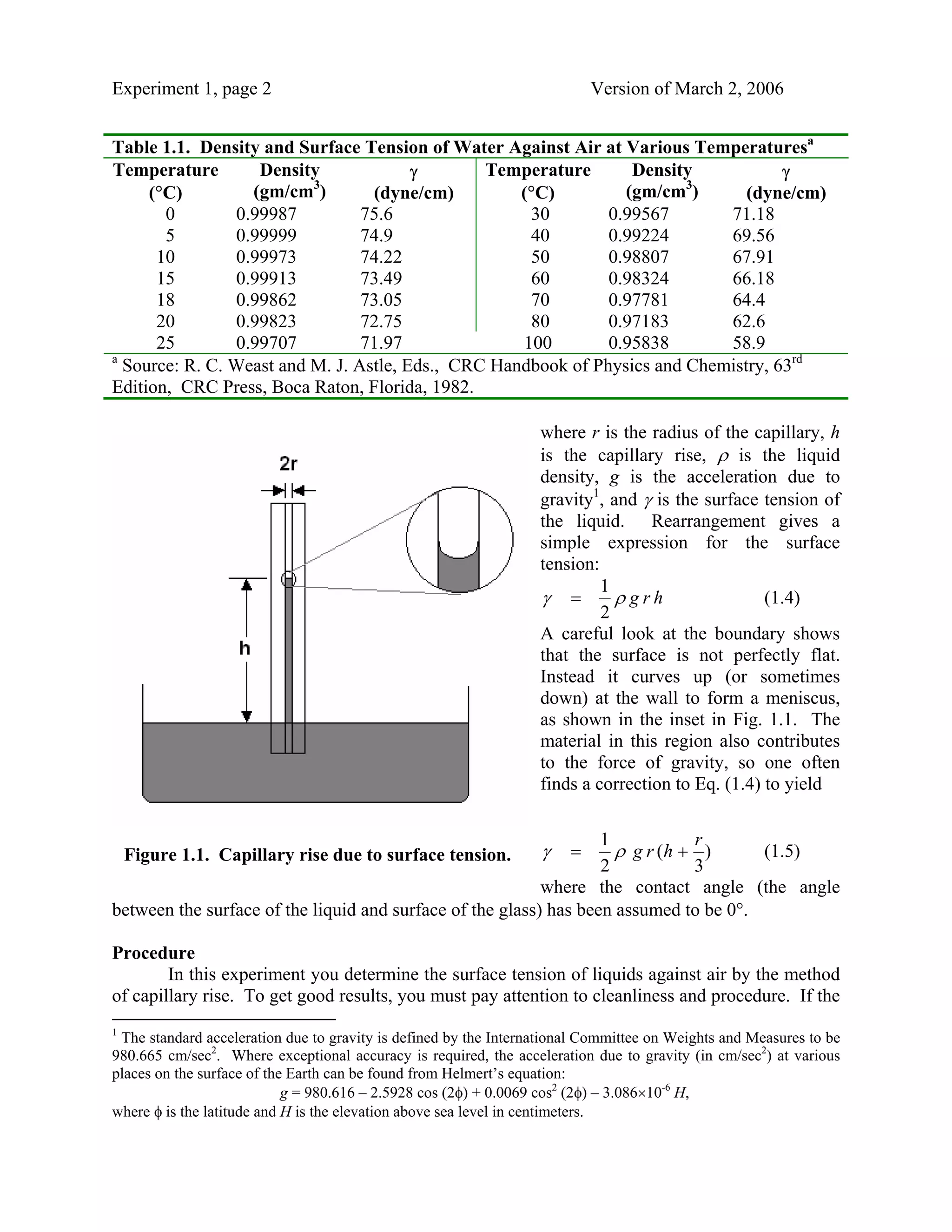
        Consider the simple situation depicted in Fig. 1.1, in which the end of a capillary tube of
radius, r, is immersed in a liquid. For sufficiently small capillaries, one observes a substantial
rise of liquid to height, h, in the capillary, because of the force exerted on the liquid due to
surface tension. Equilibrium occurs when the force of gravity balances this force due to surface
tension. The balance point can be used as a means to measure the surface tension:
                                      γ (2πr ) = ρ h (πr 2 ) g                             (1.3)
Experiment 1, page 2                                                       Version of March 2, 2006


Table 1.1. Density and Surface Tension of Water Against Air at Various Temperaturesa
Temperature        Density              γ       Temperature       Density            γ
     (°C)         (gm/cm3)        (dyne/cm)         (°C)         (gm/cm3)       (dyne/cm)
       0        0.99987          75.6                30        0.99567       71.18
       5        0.99999          74.9                40        0.99224       69.56
      10        0.99973          74.22               50        0.98807       67.91
      15        0.99913          73.49               60        0.98324       66.18
      18        0.99862          73.05               70        0.97781       64.4
      20        0.99823          72.75               80        0.97183       62.6
      25        0.99707          71.97              100        0.95838       58.9
a
  Source: R. C. Weast and M. J. Astle, Eds., CRC Handbook of Physics and Chemistry, 63rd
Edition, CRC Press, Boca Raton, Florida, 1982.

                                                                  where r is the radius of the capillary, h
    Figure 1. 1. Schematic diagram showing                        is the capillary rise, ρ is the liquid
    liquid rise in a capillary of radius r.                       density, g is the acceleration due to
                                                                  gravity1, and γ is the surface tension of
                                                                  the liquid. Rearrangement gives a
                                                                  simple expression for the surface
                                                                  tension:
                                                                           1
                                                                  γ =        ρ grh                (1.4)
                                                                           2
                                                                  A careful look at the boundary shows
                                                                  that the surface is not perfectly flat.
                                                                  Instead it curves up (or sometimes
                                                                  down) at the wall to form a meniscus,
                                                                  as shown in the inset in Fig. 1.1. The
                                                                  material in this region also contributes
                                                                  to the force of gravity, so one often
                                                                  finds a correction to Eq. (1.4) to yield

                                                                   1           r
    Figure 1.1. Capillary rise due to surface tension.            γ  ρ g r (h + )
                                                                       =               (1.5)
                                                                   2           3
                                                           where the contact angle (the angle
between the surface of the liquid and surface of the glass) has been assumed to be 0°.

Procedure
        In this experiment you determine the surface tension of liquids against air by the method
of capillary rise. To get good results, you must pay attention to cleanliness and procedure. If the
1
 The standard acceleration due to gravity is defined by the International Committee on Weights and Measures to be
980.665 cm/sec2. Where exceptional accuracy is required, the acceleration due to gravity (in cm/sec2) at various
places on the surface of the Earth can be found from Helmert’s equation:
                            g = 980.616 – 2.5928 cos (2φ) + 0.0069 cos2 (2φ) – 3.086×10⁻⁶ H,
where φ is the latitude and H is the elevation above sea level in centimeters.
Experiment 1, page 3                                                         Version of March 2, 2006
capillary tube has not been cleaned recently, it should be soaked in hot nitric acid for several
minutes, following by washing with deionized water. The capillary should be stored in the
polyethylene bottle containing deionized water when not in use.
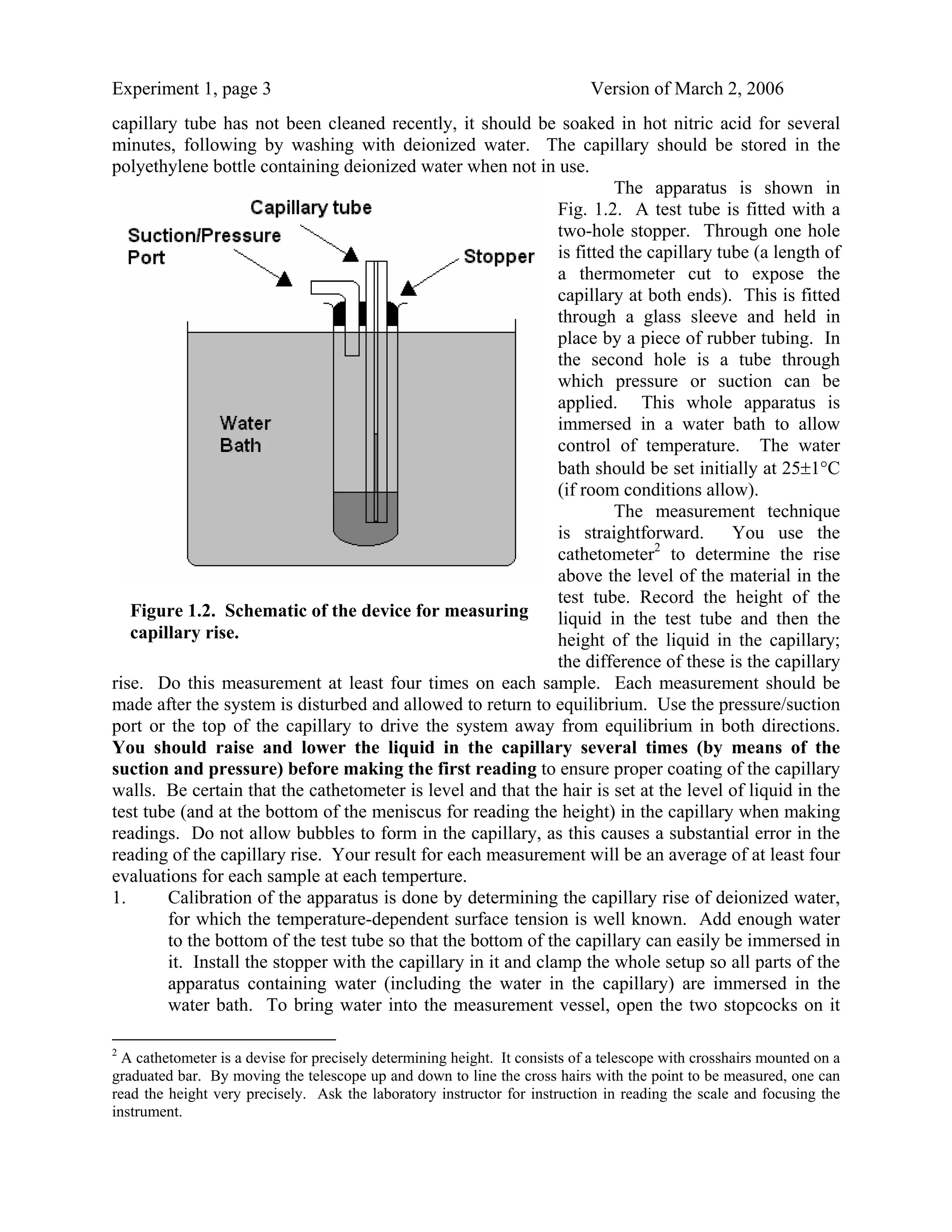
                                                                         The apparatus is shown in
                                                                Fig. 1.2. A test tube is fitted with a
                                                                two-hole stopper. Through one hole
                                                                is fitted the capillary tube (a length of
                                                                a thermometer cut to expose the
                                                                capillary at both ends). This is fitted
                                                                through a glass sleeve and held in
                                                                place by a piece of rubber tubing. In
                                                                the second hole is a tube through
                                                                which pressure or suction can be
                                                                applied. This whole apparatus is
                                                                immersed in a water bath to allow
                                                                control of temperature. The water
                                                                bath should be set initially at 25±1°C
                                                                (if room conditions allow).
                                                                         The measurement technique
                                                                is straightforward. You use the
                                                                cathetometer2 to determine the rise
                                                                above the level of the material in the
                                                                test tube. Record the height of the
   Figure 1.2. Schematic of the device for measuring            liquid in the test tube and then the
   capillary rise.                                              height of the liquid in the capillary;
                                                                the difference of these is the capillary
rise. Do this measurement at least four times on each sample. Each measurement should be
made after the system is disturbed and allowed to return to equilibrium. Use the pressure/suction
port or the top of the capillary to drive the system away from equilibrium in both directions.
You should raise and lower the liquid in the capillary several times (by means of the
suction and pressure) before making the first reading to ensure proper coating of the capillary
walls. Be certain that the cathetometer is level and that the hair is set at the level of liquid in the
test tube (and at the bottom of the meniscus for reading the height) in the capillary when making
readings. Do not allow bubbles to form in the capillary, as this causes a substantial error in the
reading of the capillary rise. Your result for each measurement will be an average of at least four
evaluations for each sample at each temperture.
1.      Calibration of the apparatus is done by determining the capillary rise of deionized water,
        for which the temperature-dependent surface tension is well known. Add enough water
        to the bottom of the test tube so that the bottom of the capillary can easily be immersed in
        it. Install the stopper with the capillary in it and clamp the whole setup so all parts of the
        apparatus containing water (including the water in the capillary) are immersed in the
        water bath. To bring water into the measurement vessel, open the two stopcocks on it

2
  A cathetometer is a devise for precisely determining height. It consists of a telescope with crosshairs mounted on a
graduated bar. By moving the telescope up and down to line the cross hairs with the point to be measured, one can
read the height very precisely. Ask the laboratory instructor for instruction in reading the scale and focusing the
instrument.
Experiment 1, page 4                                                          Version of March 2, 2006
          simultaneously. You may have to adjust the amount of openness of the bottom stopcock
          to make the water level stable, so watch it carefully. Wait a few minutes to allow
          everything to come to a constant temperature. Record the temperature of the bath from
          the thermometer, as well as the levels.

       Be careful with the water flow in the thermostatting bath. If the level rises, it will spill
       over onto the desk, making a mess. Adjust the bottom stopcock to create a steady level.
       You may have to change this as you change the temperature. When starting the flow,
       open BOTH stopcocks simultaneously. When shutting the system down, close BOTH
       stopcocks simultaneously.


2.        Make measurements at a number of temperatures between 25 and 40°C. Change the bath
          temperature slowly between experiments, allowing time for equilibration.3 Always allow
          time for thermal equilibration of the material before making a measurement. Measure the
          capillary rise of water and the alcohol assigned to you at each temperature, doing it first
          at a temperature near 25°C. [Check with the laboratory instructor after you have
          determined the capillary rise of water at that temperature before you continue.] It is
          important that, when adding a new material, you rinse the capillary thoroughly. That
          means you have to add fresh material and pull it into the capillary several times. Repeat
          this with three aliquots of material. After the third rinse, make a set of repeated
          measurements of the capillary rise.
3.        After all measurements are made, rinse the capillary thoroughly with deionized water and
          replace it in the storage tank. The final state of the water bath should be near 25°C.

    Table 1.2. Density of Alcohols at Various Temperatures (gm/cm3)
     Temperature (°C)             Methanol               Ethanol              Propanol
               0                   0.8100                 0.8065                0.8193
              10                   0.8008                 0.7979
              20                   0.7915                 0.7894                0.8035
              30                   0.7825                 0.7810
              40                   0.7740                 0.7722                0.7875
              50                   0.7650                 0.7633
              60                   0.7555                 0.7541                0.7700
              70                   0.7460                 0.7446
              80                   0.7355                 0.7348                0.7520
              90                   0.7250                 0.7251                0.7425
             100                   0.7140                 0.7157                0.7325
    Source: H. Landolt, R. Boernstein and W. Roth, Physikalische-Chemische Tabellen, Springer
    Verlag, Berlin, 1912, 5. Auflage.


3
  I advise you to make all measurements at a particular temperature before changing to another temperature; the
water is used as a calibration. If you are measuring a particular alcohol at several temperatures, measure the water at
each temperature as you go, rather than doing all of the water measurements at different temperatures first. This
saves time because heating the water bath is the rate-limiting step.
Experiment 1, page 5                                             Version of March 2, 2006
Calculations
1. For each measurement on water and the alcohol, calculate the average and standard deviation
   of the capillary rise. It is convenient to report rises along with the associated error as a
   function of temperature for water and the alcohol in a table.
2. Use the results for water and its known surface tension to determine the effective radius of
   the capillary at each temperature with equation (1.4). [You should interpolate to obtain the
   density at the conditions appropriate to your measurements.]
3. Use Eq. (1.5) to estimate the radius of the capillary from the water data. Does this equation
   give a value that is measurably different from that by using equation (1.4)? Explain the
   answer. If it is different, then use Eq. (1.5) in the following calculations. If not, you may use
   equation (1.4) in what follows.
4. Using the known densities of water and the alcohol assigned to you, calculate the surface
   tension of the alcohol at the various temperatures with either Eq. (1.4) or (1.5), whichever is
   appropriate. Assume the known surface tension of water allows a calibration of the
   apparatus at each temperature. Be sure to report uncertainty.
5. From the data on the surface tension of the alcohol as a function of temperature, determine
   the surface entropy.
6. Determine the surface energy of the alcohol at each temperature at which you made a
   measurement.

Discussion Questions
1. Compare your data to literature data for the surface tension of the alcohol. [This means you
   have to spend some time in the library looking through books to find “old” measurements!]
2. Did you notice any effect of hysteresis in this apparatus? Explain your answer.
3. Does the surface entropy of your alcohol depend on temperature? Explain.
4. Describe changes you might make in the design of the experiment to make the measurement
   more precise. Explain your reasoning.
5. Is the surface tension of an alcohol higher or lower than that of water? Give a possible
   physical reason why this is so.
6. What is a contact angle? In this experiment, what contact angle does one have or assume?
   How will this assumption affect the results? Is it important?
7. Briefly describe (in one paragraph) other methods one might use to measure surface tension
   of a liquid against air.

Surface tension of liquids using capilary tube

  • 1.
    Experiment 1, page1 Version of March 2, 2006 Experiment 446.1 SURFACE TENSION OF LIQUIDS Theory To create a surface requires work that changes the Gibbs energy of a thermodynamic system. dG = − SdT + VdP + γdA (1.1) where γ is the surface tension, the free energy per unit surface area. Since a surface always involves two phases, the surface tension depends on the nature of the two substances between which the surface is formed. If surface segregation of material occurs in a solution, then the surface tension of the solution may depend on concentration in complex ways. Like other thermodynamic variables, surface tension depends on conditions such as the temperature. Eq. (1.1), for example, shows that the temperature derivative of γ is given by the following Maxwell equation: ⎛ ∂γ ⎞ ⎛ ∂S ⎞ ⎜ ⎟ = −⎜ ⎟ (1.2) ⎝ ∂T ⎠ P ⎝ ∂A ⎠ T where the derivative on the right is known as the surface entropy. One can evaluate the surface entropy by investigating the manner in which the surface tension varies with temperature. Reports of surface tension are often given for the situation in which the second phase is air or the vapor of the material. Thus, for example, at 20°C, the reported surface tension of benzene against air is 28.85 dyne/cm, whereas the reported surface tension of benzene against its vapor is reported to be 28.89 dyne/cm. In Table 1.1 are data on the surface tension of water against air. Surface tensions for liquids against liquids are called interfacial tensions. Such interfacial tensions can be very different from the surface tensions of liquids against air. For example, the interfacial tension of water against benzene is 35 dyne/cm at 20°C, whereas its value against air is 73.05 dyne/cm, and that of benzene against air is 28.85 dyne/cm. Surface tension produces several observable phenomena. The rise of a liquid in a capillary is the result of surface tension. The spreading of a film of oil on water is another example of the effect of surface tension, something first reported by Benjamin Franklin, although it probably was known in antiquity. Consider the simple situation depicted in Fig. 1.1, in which the end of a capillary tube of radius, r, is immersed in a liquid. For sufficiently small capillaries, one observes a substantial rise of liquid to height, h, in the capillary, because of the force exerted on the liquid due to surface tension. Equilibrium occurs when the force of gravity balances this force due to surface tension. The balance point can be used as a means to measure the surface tension: γ (2πr ) = ρ h (πr 2 ) g (1.3)
  • 2.
    Experiment 1, page2 Version of March 2, 2006 Table 1.1. Density and Surface Tension of Water Against Air at Various Temperaturesa Temperature Density γ Temperature Density γ (°C) (gm/cm3) (dyne/cm) (°C) (gm/cm3) (dyne/cm) 0 0.99987 75.6 30 0.99567 71.18 5 0.99999 74.9 40 0.99224 69.56 10 0.99973 74.22 50 0.98807 67.91 15 0.99913 73.49 60 0.98324 66.18 18 0.99862 73.05 70 0.97781 64.4 20 0.99823 72.75 80 0.97183 62.6 25 0.99707 71.97 100 0.95838 58.9 a Source: R. C. Weast and M. J. Astle, Eds., CRC Handbook of Physics and Chemistry, 63rd Edition, CRC Press, Boca Raton, Florida, 1982. where r is the radius of the capillary, h Figure 1. 1. Schematic diagram showing is the capillary rise, ρ is the liquid liquid rise in a capillary of radius r. density, g is the acceleration due to gravity1, and γ is the surface tension of the liquid. Rearrangement gives a simple expression for the surface tension: 1 γ = ρ grh (1.4) 2 A careful look at the boundary shows that the surface is not perfectly flat. Instead it curves up (or sometimes down) at the wall to form a meniscus, as shown in the inset in Fig. 1.1. The material in this region also contributes to the force of gravity, so one often finds a correction to Eq. (1.4) to yield 1 r Figure 1.1. Capillary rise due to surface tension. γ ρ g r (h + ) = (1.5) 2 3 where the contact angle (the angle between the surface of the liquid and surface of the glass) has been assumed to be 0°. Procedure In this experiment you determine the surface tension of liquids against air by the method of capillary rise. To get good results, you must pay attention to cleanliness and procedure. If the 1 The standard acceleration due to gravity is defined by the International Committee on Weights and Measures to be 980.665 cm/sec2. Where exceptional accuracy is required, the acceleration due to gravity (in cm/sec2) at various places on the surface of the Earth can be found from Helmert’s equation: g = 980.616 – 2.5928 cos (2φ) + 0.0069 cos2 (2φ) – 3.086×10⁻⁶ H, where φ is the latitude and H is the elevation above sea level in centimeters.
  • 3.
    Experiment 1, page3 Version of March 2, 2006 capillary tube has not been cleaned recently, it should be soaked in hot nitric acid for several minutes, following by washing with deionized water. The capillary should be stored in the polyethylene bottle containing deionized water when not in use. The apparatus is shown in Fig. 1.2. A test tube is fitted with a two-hole stopper. Through one hole is fitted the capillary tube (a length of a thermometer cut to expose the capillary at both ends). This is fitted through a glass sleeve and held in place by a piece of rubber tubing. In the second hole is a tube through which pressure or suction can be applied. This whole apparatus is immersed in a water bath to allow control of temperature. The water bath should be set initially at 25±1°C (if room conditions allow). The measurement technique is straightforward. You use the cathetometer2 to determine the rise above the level of the material in the test tube. Record the height of the Figure 1.2. Schematic of the device for measuring liquid in the test tube and then the capillary rise. height of the liquid in the capillary; the difference of these is the capillary rise. Do this measurement at least four times on each sample. Each measurement should be made after the system is disturbed and allowed to return to equilibrium. Use the pressure/suction port or the top of the capillary to drive the system away from equilibrium in both directions. You should raise and lower the liquid in the capillary several times (by means of the suction and pressure) before making the first reading to ensure proper coating of the capillary walls. Be certain that the cathetometer is level and that the hair is set at the level of liquid in the test tube (and at the bottom of the meniscus for reading the height) in the capillary when making readings. Do not allow bubbles to form in the capillary, as this causes a substantial error in the reading of the capillary rise. Your result for each measurement will be an average of at least four evaluations for each sample at each temperture. 1. Calibration of the apparatus is done by determining the capillary rise of deionized water, for which the temperature-dependent surface tension is well known. Add enough water to the bottom of the test tube so that the bottom of the capillary can easily be immersed in it. Install the stopper with the capillary in it and clamp the whole setup so all parts of the apparatus containing water (including the water in the capillary) are immersed in the water bath. To bring water into the measurement vessel, open the two stopcocks on it 2 A cathetometer is a devise for precisely determining height. It consists of a telescope with crosshairs mounted on a graduated bar. By moving the telescope up and down to line the cross hairs with the point to be measured, one can read the height very precisely. Ask the laboratory instructor for instruction in reading the scale and focusing the instrument.
  • 4.
    Experiment 1, page4 Version of March 2, 2006 simultaneously. You may have to adjust the amount of openness of the bottom stopcock to make the water level stable, so watch it carefully. Wait a few minutes to allow everything to come to a constant temperature. Record the temperature of the bath from the thermometer, as well as the levels. Be careful with the water flow in the thermostatting bath. If the level rises, it will spill over onto the desk, making a mess. Adjust the bottom stopcock to create a steady level. You may have to change this as you change the temperature. When starting the flow, open BOTH stopcocks simultaneously. When shutting the system down, close BOTH stopcocks simultaneously. 2. Make measurements at a number of temperatures between 25 and 40°C. Change the bath temperature slowly between experiments, allowing time for equilibration.3 Always allow time for thermal equilibration of the material before making a measurement. Measure the capillary rise of water and the alcohol assigned to you at each temperature, doing it first at a temperature near 25°C. [Check with the laboratory instructor after you have determined the capillary rise of water at that temperature before you continue.] It is important that, when adding a new material, you rinse the capillary thoroughly. That means you have to add fresh material and pull it into the capillary several times. Repeat this with three aliquots of material. After the third rinse, make a set of repeated measurements of the capillary rise. 3. After all measurements are made, rinse the capillary thoroughly with deionized water and replace it in the storage tank. The final state of the water bath should be near 25°C. Table 1.2. Density of Alcohols at Various Temperatures (gm/cm3) Temperature (°C) Methanol Ethanol Propanol 0 0.8100 0.8065 0.8193 10 0.8008 0.7979 20 0.7915 0.7894 0.8035 30 0.7825 0.7810 40 0.7740 0.7722 0.7875 50 0.7650 0.7633 60 0.7555 0.7541 0.7700 70 0.7460 0.7446 80 0.7355 0.7348 0.7520 90 0.7250 0.7251 0.7425 100 0.7140 0.7157 0.7325 Source: H. Landolt, R. Boernstein and W. Roth, Physikalische-Chemische Tabellen, Springer Verlag, Berlin, 1912, 5. Auflage. 3 I advise you to make all measurements at a particular temperature before changing to another temperature; the water is used as a calibration. If you are measuring a particular alcohol at several temperatures, measure the water at each temperature as you go, rather than doing all of the water measurements at different temperatures first. This saves time because heating the water bath is the rate-limiting step.
  • 5.
    Experiment 1, page5 Version of March 2, 2006 Calculations 1. For each measurement on water and the alcohol, calculate the average and standard deviation of the capillary rise. It is convenient to report rises along with the associated error as a function of temperature for water and the alcohol in a table. 2. Use the results for water and its known surface tension to determine the effective radius of the capillary at each temperature with equation (1.4). [You should interpolate to obtain the density at the conditions appropriate to your measurements.] 3. Use Eq. (1.5) to estimate the radius of the capillary from the water data. Does this equation give a value that is measurably different from that by using equation (1.4)? Explain the answer. If it is different, then use Eq. (1.5) in the following calculations. If not, you may use equation (1.4) in what follows. 4. Using the known densities of water and the alcohol assigned to you, calculate the surface tension of the alcohol at the various temperatures with either Eq. (1.4) or (1.5), whichever is appropriate. Assume the known surface tension of water allows a calibration of the apparatus at each temperature. Be sure to report uncertainty. 5. From the data on the surface tension of the alcohol as a function of temperature, determine the surface entropy. 6. Determine the surface energy of the alcohol at each temperature at which you made a measurement. Discussion Questions 1. Compare your data to literature data for the surface tension of the alcohol. [This means you have to spend some time in the library looking through books to find “old” measurements!] 2. Did you notice any effect of hysteresis in this apparatus? Explain your answer. 3. Does the surface entropy of your alcohol depend on temperature? Explain. 4. Describe changes you might make in the design of the experiment to make the measurement more precise. Explain your reasoning. 5. Is the surface tension of an alcohol higher or lower than that of water? Give a possible physical reason why this is so. 6. What is a contact angle? In this experiment, what contact angle does one have or assume? How will this assumption affect the results? Is it important? 7. Briefly describe (in one paragraph) other methods one might use to measure surface tension of a liquid against air.